Category Archives: the language

Laid is a Word You Should Use

In the process of slowly writing blogs about my recent travels, I’m going to just stick a quick post in here on a completely different topic. Most blog writers are interested in being good writers, so I know you won’t be mad at me if I point out a grammatical error that I’ve only started seeing recently. If you make this error, know that you are in good company with Tiina Nunnally, acclaimed translator of Kristin Lavransdatter. I was surprised to see that she was also confused (several times, so I know it wasn’t a typo) on
Lie and Lay.
There are two verbs, to lie and to lay.

Lie is what you do on a bed, or a beach, to rest, or with your lover. Or what anything can do, remaining in a place. (It’s also when you tell an untruth, but that doesn’t get confused, as far as I know, so I’m not dealing with it now.)

The verb has present and past tenses, of course:

Present tense: I lie on the beach, you lie, he lies, they lie. Lie down, Fido! He was lying there asleep for hours.

Past tense: I lay on the bed yesterday, you lay on the bed yesterday, he lay on the bed, etc.

Past perfect: I have lain on the bed every night, etc.

This is called an intransitive verb, which fact might help someone to understand the difference between it and to lay. That means that there is no action transferred to an object. You don’t lie something, you just lie, period.

Lay is a transitive verb, meaning you do it to something. You might lay the napkin on your lap, or the platter on the table.

Present tense: I lay my head on the pillow, The hen lays an egg, Now I lay me down to sleep.

Past tense: I laid my head on the pillow last night, and my mother laid a quilt over me. The hen laid an egg.

Past perfect: I have laid a blanket on the baby every naptime.

The slang about getting laid, etc. is an irregular usage, and I wonder if it may be the reason people avoid the word laid? This is the new error I am noticing, as in Kristin Lavransdatter, when the translator wrote something like, “He lay his trousers on the bed.” Ouch. You can see that there is never a case when that would be correct.

The problem many people have had for ages is saying lay when they should say lie, as in, “Lay down, Fido!” Ouch. That has possibly become more common than the correct usage, I’m afraid. Oddly, it’s the very people who would never make that mistake who are avoiding laid, which can’t be avoided without making me say Ouch.

The only reason I know these things is because as a child I had to memorize verb tenses. Maybe that tradition was fading out soon after, but for any of you who were shortchanged in school, you could revive the tradition to help yourself. Do it like this:

In a sing-song kind of way, if you like, for To Lie, say:
I lie, you lie, he lies, they lie;
I lay, you lay, he lay, they lay;
I have lain, you have lain, he has lain, they have lain.
Or just the short version : “Lie, lay, lain”

And for To Lay, you could just remind yourself: “Lay, laid, laid.”

If you are still confused, you see how others explain it here or here.

Laid is really a fine word. Don’t neglect it!

Streets of the Modern Wild West

In my neighborhood there is a residential street named Filament. When we were first house-hunting here I thought how humiliating, to have to have one’s address be on “Filament Street.” That is not bad at all, I have now discovered.

How would you like to live on Deny Court? I’m not sure if I’d prefer to live there rather than on, say, Pretentious Way. I’d like it better if it were Denial Ct–that is something I can get my mind around, and most people who live in houses have to be personally familiar with the attitude.

In any case, I’d consider it risky to look for a house to buy, in some of the areas of Greater Sacramento where these and other strange names for streets are found. I might fall in love with a house on Elude Ct., and if it were a bargain, I would feel a lot of pressure to sell my literary soul for it. Do good deals tend to come up more often on streets with names like Image, Essence, Adorn and Agree? Perhaps if the quality for which the street is name is positive, like Esteem Ct. or Acclaim Dr., the houses cost more, not less.

Are the houses on Pretentious Way really so? Or are the people who live in them? Perhaps the residents are only illiterate foreigners. Forgive me, but I really can’t imagine. Many questions present themselves, such as, What sort of qualifications does one need to be a street-namer? I suspect that the naming agency nowadays pulls words out of the dictionary by means of a computer database.

As I think about it, many if not most street names that we are used to are concrete nouns, or common or proper names after plants and people, places or events. When you start having words for intangibles, or verbs and modifiers, it is bucking the sensible tradition and causes confusion in the mind every time you turn into your lane.

I didn’t like it when streets in new developments were called “Mountain Ave” or such like, even though there was no elevation even in sight. But at least we know what a mountain is, and it is a simple concrete and neutral thing.

But to live on Proper or Refined or Benevolent: it does sound as though the street, or the houses– or the people?–are being described. I don’t like that. These are all the true names of real residential streets I am listing!

Streets with number or letter names should be considered more, if they are running out of ideas. The picture is of the road on which my childhood home was located, and it had a number for a name. But this is the age when a lot of people make up new names for their children, and perhaps that is the next thing to look for in street names. It will happen in California.

There are also streets named for general categories. The typical School Street or University Ave usually refer to a specific example that is nearby, but one doesn’t usually run across Savant Drive any more than you would see a street named for houses, students, or cars. We might just as well have a street named Avenue, though I didn’t see that one. I did see Component Way, which goes into the same pocket of my mind as Filament Ct.

This aspect of our culture is so vast and jumbled, I am getting more confused and bored as I ramble on. Let me just say that if have to move to Sacramento, the street I will look on is Clarity Court.

In which I am given a prize for my Scribbling…

Deb on the Run gave me the Superior Scribbler Award while I was across the country and couldn’t properly respond. Now I’m home and can say THANKS Deb! Deb’s own blog is one of my favorites, but I guess I can’t just Back-at-her…no problem, as there are several others I’d like to announce.

But first, here are the rules, for those of you I’ll list below:

  1. Each Superior Scribbler must in turn pass The Award on to 5 most-deserving Bloggy Friends.
  2. Each Superior Scribbler must link to the author & the name of the blog from whom he/she has received The Award.
  3. Each Superior Scribbler must display The Award on his/her blog, and link to This Post, which explains The Award.
  4. Each Blogger who wins The Superior Scribbler Award must visit this post and add his/her name to the Mr. Linky List. That way, we’ll be able to keep up-to-date on everyone who receives This Prestigious Honor![anyone can go there and check out the 1343 ! winning blogs that are linked so far. You might find a new one to love.]
  5. Each Superior Scribbler must post these rules on his/her blog.

And now the awards, to a few of the blogs I like to read regularly:

  • My friend Jeannette at Bread on the Water posts thoughtful musings full of hope and beauty.
  • Gigi at Firefly Cottage writes about homemaking, including wonderful pie recipes.
  • The blog name Happy at Home attracted me when I first saw it, and Laurel’s loving descriptions of her family life keep me coming back.
  • Koinonikon is the name of Margaret’s blog, where her careful writing about the working out of her salvation is a joy to read, and always instructive.
  • If you get me mixed up with the blogger at Lifenut, it is only because her name is Gretchen, too. She is witty and wise and I laugh out loud reading about her family-full days.
As to my own writing, the name Superior Scribbler pleases me very much, as the “Scribbler” part matches my self-concept and attempts to join in that Great Conversation we humans are having. Thank you all for being here in It with me.

Categories of First Lines

Many of my favorite books do not have particularly memorable first lines. Some books that I will never read have clever, captivating, even brilliant openers, and among those are quite a few that are well known. If you want to test your knowledge of famous first lines, you can do so here. Thanks to my friend E. for that link.

In 2002 Jay Nordlinger on National Review‘s website mentioned a couple of his favorite first lines–not necessarily from favorite books–which led readers to send in nominations for Great First Lines. Many of those were also Famous, overlapping with a few in the quiz linked above, but often they were obscure. Warning to nit-pickers: Some of these are actually more than one sentence.

What makes a first line “great”?  Does it have to hint at what the whole book is about, or only hook you in? For me, I do like a good sentence (and I liked this article exploring the field), and if the first one in a book is well-crafted, it would make me want to keep reading, for pleasure. If it is curiosity-piquing as well, all the better.

One boring or poor opening sentence would not discourage me from reading on, but if the whole first paragraph or page is confusing or muddy I might lose patience. I am getting too old to fool around with the gazillions of pages by authors who need to practice more.

Whether one can search the archives of NR for Nordlinger’s blog posts I don’t have to know, because back then I saved all of the nominations in a document. Unlike much of my document collection, I am making use of this one, to bring a number of good first lines into this small light. Whether they are Great, I won’t judge; I will just give you a few that I liked. These are from books that aren’t my favorites, so I won’t be tempted to put them into the next List of Five. And I hope I haven’t put too many below and spoiled it for a blogger who wanted to use one of these in her own quiz-list.

Nordlinger includes this fact out front: “We have already decided — we, the great collective ‘we’: my readers and I — that ‘In the beginning . . .’ is the all-time champion. Everything else is competing for second place.” I’m glad they got that straight.

Now, a few of the competitors:

“As I write, highly civilized human beings are flying overhead, trying to kill me.” — Orwell, “England Your England” (an essay)

“‘Where’s Papa going with that ax?’ said Fern to her mother as they were setting the table for breakfast.” — Charlotte’s Web

“For forty years my act consisted of one joke. And then she died.” — George Burns, Gracie: A Love Story

“I am a sick man. . . . I am a spiteful man. I am an unattractive man. I believe my liver is diseased.” — Fyodor Dostoyevsky, Notes from the Underground

“A sky as pure as water bathed the stars and brought them out.” — Antoine de Saint Exupéry, Southern Mail

“She stood on the fox until it died.” — Mitchell Smith, Due North

A good sentence is a thing of beauty. This afternoon Mr. Glad and I started taking books off the shelves, turning pages to the first line, perusing those words we had long neglected, but not wanted to get rid of. (“Get rid of” suddenly sounds so crude and unfitting.) So many good phrases and clauses, and some excellent ones.

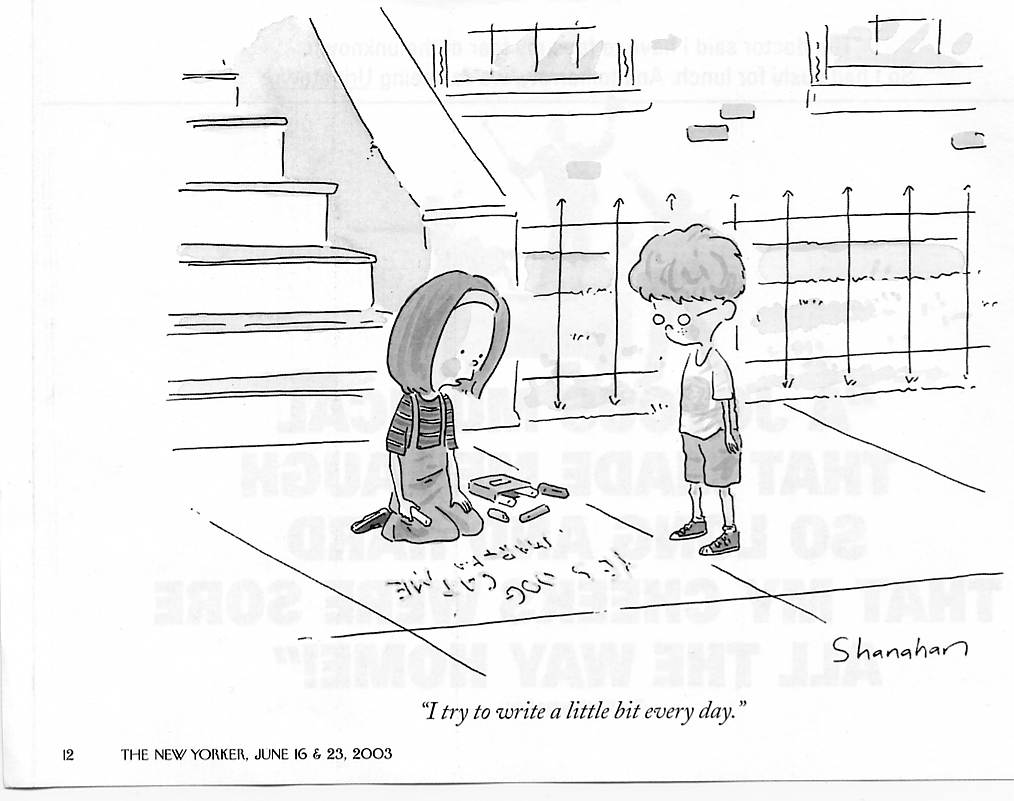
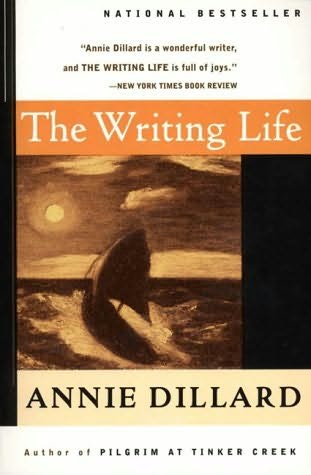
This is not the end of the matter; what is a blog, after all, but words and sentences, and the will to keep spitting them out? Annie Dillard wrote in The Writing Life, “It is no less difficult to write sentences in a recipe than sentences in Moby-Dick. So you might as well write Moby-Dick.

The way I see it, I might as well write sentences in a recipe.