Category Archives: time

It’s taken over everywhere.

When I emerged from my bed after having been under the weather, pushed down by a mean virus, I discovered that one of the (unopened) library books in my stack had been requested and could not be renewed, so I must return it. Well, I had that much strength, but I would put off the errand until I had at least browsed that book, a collection of poems I had read about on Orientikate’s blog. They are by Adam Zagajewski, a Polish poet born in 1945. I did find several poems to love, but it was his voice coming through that somehow soothed me as I scanned poems about time and history, darkness and light. I could hear its timbre in spite of my headache and fogged brain.

I returned the book, Mysticism for Beginners, translated by Clare Cavanagh, c. 1997, but not before I had copied the selection below. I’m glad I have other volumes of his work that I was able to renew, to nourish me in my recuperation. I found this paragraph about him on the Poetry Foundation site:

“His view is a counterpoint to the current fashion of irony, which he decries. ‘I adore irony as a part of our rich rhetorical and mental apparatus, but not when it assumes the position of a spiritual guidance,’ he said. ‘How to cure it? I wish I knew. The danger is that we live in a world where there’s irony on one side and fundamentalism (religious, political) on the other. Between them the space is rather small, but it’s my space.’” 

MOMENT

In the Romanesque church round stones
that ground down so many prayers and generations
kept humble silence and shadows slept in the apse
like bats in winter furs.

We went out. The pale sun shone,
tinny music tinkled softly
from a car, two jays
studied us, humans,
threads of longing dangled in the air.

The present moment is shameless,
taking its foolish liberties
beside the wall
of this tired old shrine,

awaiting the millions of years to come,
future wars, geological eras,
cease-fires, treaties, changes in climate —
this moment — what is it — just

a mosquito, a fly, a speck, a scrap of breath,
and yet it’s taken over everywhere,
entering the timid grass,
inhabiting stems and genes,
the pupils of our eyes.

This moment, mortal as you or I,
was full of boundless, senseless,
silly joy, as if it knew
something we didn’t.

-Adam Zagajewski

He thought there was time.

THE NEW SONG

For some time I thought there was time
and that there would always be time
for what I had a mind to do
and what I could imagine
going back to and finding it
as I had found it the first time
but by this time I do not know
what I thought when I thought back then

there is no time yet it grows less
there is the sound of rain at night
arriving unknown in the leaves
once without before or after
then I hear the thrush waking
at daybreak singing the new song

–W.S. Merwin

In Ephesians 5 we are told to redeem the time: See then that ye walk circumspectly, not as fools, but as wise, Redeeming the time, because the days are evil. Wherefore be ye not unwise, but understanding what the will of the Lord is.”

That admonition comes to mind as I read this poem  in the New Yorker. It’s by W.S. Merwin, whom I mentioned previously here and here in regard to his book The Folding Cliffs, which captivated me and gave me for the first time an interest in visiting Hawaii.

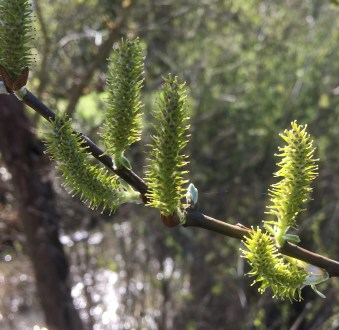
Willow flowers fading, and leaves emerging.

To me it speaks of how we can only make up for lost time by being attentive to the gifts that are coming to us right now, attentive to the presence of God. He is giving Himself in the present moment, and He has given us the lenten season to help us tune into that Reality, to come back to it and to Him.

– – – – – – – – – – – – – – – –

The paragraphs above are from the first time I posted this poem on my blog. As I read Merwin’s meditation now, I find another layer of meaning, which explains the joyful last line. It’s in the words, “there is no time yet it grows less.”

We probably all feel that there is less time in the sense of opportunity to accomplish more things before it “runs out.” But chronologically we don’t get to “no time” until we are long past being able to compose verse about it. Merwin must be referring to the moments of “no time” in the sense of timelessness, such as when he listens to the rain, or hears the thrush, and experiences that fullness of heart that comes with the awareness of the gift of being. “Here I am, alive, and it’s raining!”

It’s still a good poem for Lent. This is when we try to make some space in our busy schedules for that time out of time, and listening for the new song.

(Re-post from 2012)


More time, more time.

YEAR’S END

Now winter downs the dying of the year,
And night is all a settlement of snow;
From the soft street the rooms of houses show
A gathered light, a shapen atmosphere,
Like frozen-over lakes whose ice is thin
And still allows some stirring down within.

I’ve known the wind by water banks to shake
The late leaves down, which frozen where they fell
And held in ice as dancers in a spell
Fluttered all winter long into a lake;
Graved on the dark in gestures of descent,
They seemed their own most perfect monument.

There was perfection in the death of ferns
Which laid their fragile cheeks against the stone
A million years. Great mammoths overthrown
Composedly have made their long sojourns,
Like palaces of patience, in the gray
And changeless lands of ice. And at Pompeii

The little dog lay curled and did not rise
But slept the deeper as the ashes rose
And found the people incomplete, and froze
The random hands, the loose unready eyes
Of men expecting yet another sun
To do the shapely thing they had not done.

These sudden ends of time must give us pause.
We fray into the future, rarely wrought
Save in the tapestries of afterthought.
More time, more time. Barrages of applause
Come muffled from a buried radio.
The New-year bells are wrangling with the snow.

-Richard Wilbur

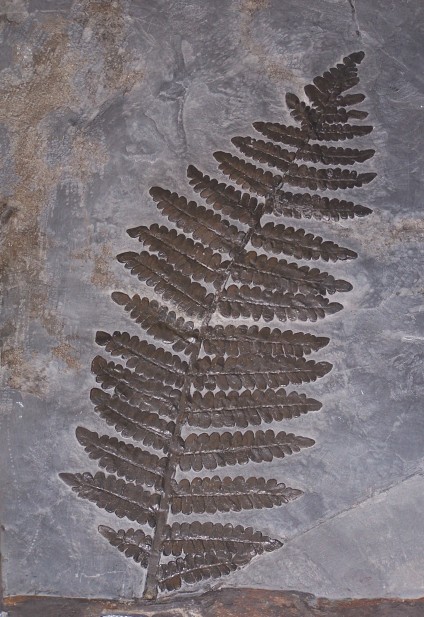
fern fossil

The moment when Before turned into After.

When I began blogging I read Maria’s blog which featured a poem a day taken from a book in her local public library. She always included a painting to go with the poem. After only two years the project ended abruptly, and even the queries from faithful readers in the comments stopped five years ago. I had saved many, many poems from her offerings, and here I am sharing/copying one as an echo of her post for December 25, 2010, painting still attached. Thank you, Maria, wherever you are! I know you are with God.

BC: AD

This was the moment when Before
Turned into After, and the future’s
Uninvented timekeepers presented arms.

This was the moment when nothing
Happened. Only dull peace
Sprawled boringly over the earth.

This was the moment when even energetic Romans
Could find nothing better to do
Than counting heads in remote provinces.

And this was the moment
When a few farm workers and three
Members of an obscure Persian sect

Walked haphazard by starlight straight
Into the kingdom of heaven.

~ U. A. Fanthorpe (1929-2009), English poet

The Holy Family with Angels by Rembrandt van Rijn, 1606-1669