
What a strange day… starting with a strange night, during which I was awake for four hours. What? At first I tried to pray and go back to sleep at the same time, but after an hour or so of that I switched on the light and sat in bed writing in my journal. I didn’t turn on my phone – yay for me! But if I had I might have been able to talk with my dear cousin who was wishing from the East Coast that she could talk to me, as she wrote, “I wish you were not still asleep.” Little did she guess that I was not.

Eventually I slept a little more, and got up late. Today is sunnier than in a long time, and I noticed out the window the hopbushes that line the fences, also looking brighter than ever decked in their flowers. I took my lunch outside to eat under the umbrella, with my back out of the shady area and baking, but as in a very slow oven, so I remained in place.
I conversed with friends blog-style about moments and fleeting time and what happens to those moments: Are they like the picture Annie Dillard paints in words for us, “…a freely given canvas… constantly being ripped apart and washed downstream….” ? The violence of her image doesn’t set well with me now, but just a few months ago its tone would have matched what I was feeling, not about a moment but about the entire lifetime of my husband.
Now here I am, in a lovely moment, a warm and springy afternoon with birds and insects crossing paths in the air around me. The bird bath has water in it and the towhees are taking advantage of that — or is it just one towhee who has a daily bath, and a long one at that? He splashes around for about five minutes while I watch and wait from the kitchen window, because I know that when he’s satisfied I will need to refill the bowl.
Near the birdbath is one of my two remaining Mexican Bush Sage plants. The old one at which I used to watch hummingbirds out my window for several months of the year was dug up and divided into six plants. The one we transplanted into the new garden died, and the others spent the winter in pots, three of which I gave away on Freecycle this week. I always forget until I get up close, how furry the flowers of this plant are.
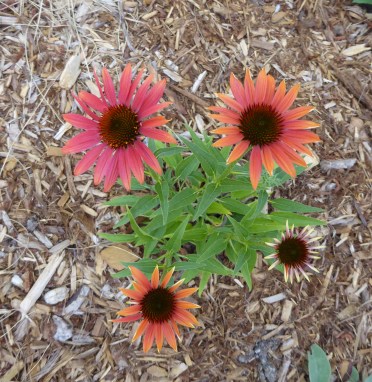
And the echinacea are already blooming. At this time I have six of this variety, but no traditional purple ones. I was planning to buy a purple one to replace one that was eaten by snails, but didn’t find one anywhere.
As I bask in this moment of an hour or more I am writing, yes, because that is what I do with many of my moments and minutes and hours. It isn’t often that I am enjoying a space other than my computer corner while I write, but today I’ve written in two other places. Because I took the trouble to move myself out here to the spot in my garden where I have the wide view of everything from Margarita Manzanita to the bird feeders to the greenhouse, my moment seems to expand into deliciousness. And this isn’t the time to wonder where it has gone, poof!
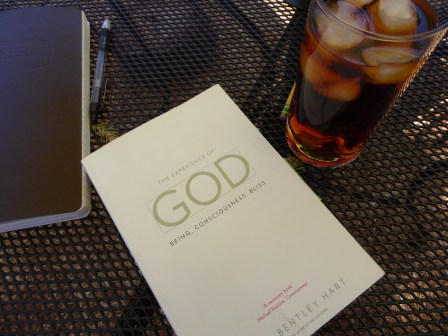
I was planning to sit out here and read this book that I haven’t given up on by any means, but have been neglecting. Then I looked aside and saw the first calendula flower, and this is what happened. But now I will get down to business.


 established hospitals, and wrote books before joining a monastery later in life. A little later still she founded Holy Transfiguration Monastery in Pennsylvania. This year marks 25 years since her repose, and Frederica Mathewes-Green shared this quote from one of Mother Alexandra’s handwritten notebooks:
 Early on in our 21 years of homeschooling I found that my style of learning and teaching was suited to doing unit studies. Someone has explained the concept like this: “
 r, as long as we lived in that house, while we ate our meals we could watch the house finches enjoying theirs at the same time.
 of what there is to study and know. All the rest has no substance.
 Gladsome Lights