Category Archives: time

The Kairos in my week.

While it is still this week in chronos, I must tell about the several ways kairos has made its impression on my heart and mind.

Last Sunday when I was zooming with my friends up the Nevada highway to church, we passed a car whose license plate read “Kairos.” We knew that Greek word from its use at the beginning of Orthodox Divine Liturgy, when the Deacon proclaims, “It is time (kairos) for the Lord to act,” so it seemed to us a fundamentally theological word, and with the aid of my phone we researched and discussed the concept as we rolled along, and wondered if the vehicle belonged to someone we would be worshiping with in a few minutes.
gl iconostas crp P1110337

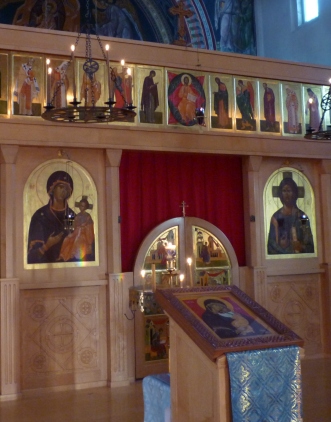
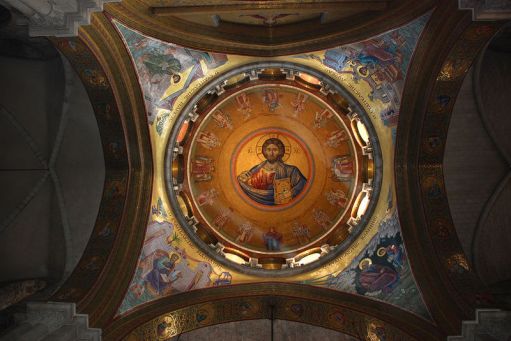
It was the Sunday of the Last Judgment, and in the homily our attention was directed to the icons on either side of the doors to the altar. On one side is the icon of The Incarnation, and on the other, of The Pantocrator, or Judge. Everything in between happens right here, Fr. Stephen said, in the Church, from the altar and in the Holy Mysteries, bringing heaven to earth and joining all who partake or have died in Christ. We had just an hour earlier read on Wikipedia that kairos refers to “a moment of indeterminate time in which everything happens.”

The meaning and reality of Time is a deep well into which I love to dip, with my mind, but it is a heady beverage and makes me dizzy. I didn’t do any further reading this week, as I plodded on through chronos — chronological time — and tried not to get behinder in it and in my housework and tax preparation and garden planning….

I plodded, because after my joyous interlude of a kind of kairos, about which I wrote in my last post, I returned to my house that still seems empty without my husband, to my responsibilities that continue to overwhelm me, to a future whose unknowns appear daunting, now that I have to meet them without my life’s companion. And in less than two weeks we will come to the one-year mark, of his death. Is there another kind of time that reflects what I feel, that it was only last month? Or that it is a perverse, somehow false, fact? I guess that would be called grief.Minarets Wild. 81
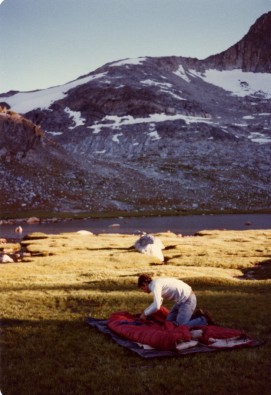
Yesterday I spent most of the day updating my screensaver, which right now is scrolling through a folder of photos named “Mr. Glad.” I had decided it didn’t have enough files in it, so I combed through all the other folders to find more images of him, and I was very nurtured by reviewing his life, and my life with him, in this visual way. We had over the last years scanned hundreds of pre-digital photos into the computer, so there he was as a little boy laughing on his father’s lap, bursting with the energy and zeal of youth at our wedding, cradling our newborn babies or reading to our little children; singing with his strong and beautiful voice in church, backpacking with his kids, giving me a kiss on the cheek while I was standing over the stove.

My housemate Kit had never met my husband, and she was glad to look through many of the pictures with me and hear some stories. It made me happy to collect my pictures, and even happier to have her to share them with. I went contentedly to bed and sleep last night.

Bill and Gretchen at lake, on dome

I hadn’t planned to attend Liturgy this morning, for the Commemoration of the Holy Monastic Saints. But I woke at 4:30, and after an hour passed and I couldn’t go back to sleep, I turned on the light and got up, and it seemed at the time that God had awakened me so that it would be easy and sensible to go to church. And there is nothing that makes me feel so needy for the Holy Mysteries as missing sleep!

(Which reminds me of how we moderns are so far removed from the sacredness of even chronos that we have to try to control it with our silly clock changes.)clock antique look
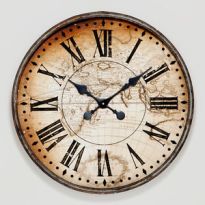
I went back to my rest and dreams after all, not before a good session of musing on how this month is likely to be harder than I expected. I woke at last in time to get to church, where I was surprised that in addition to the Holy Ascetics, we were remembering a beloved priest from San Francisco, who reposed ten years ago this day.

In his homily and other remarks, our rector brought up the reality of kairos, speaking of how in the church, in the Liturgy, we are joined together with everyone who has ever died in Christ. He said, “It is common to hear, ‘I have Christ in my heart,’ but we also can have a little of each other in our hearts, because we are brought into the Kingdom, in that moment of kairos.” It was what I needed to be reminded of this morning: not my loss, but the enduring nearness of my dear husband.

Now I want also to read more about this truth, this kairos that I experience. I imagine that Fr. Alexander Schmemann’s book The Eucharist will speak a good deal to the subject, and just this afternoon I ran across a pertinent article, on The Chalice of Eternity. It will be a good place for me to start. Here is a quote from what appears to be a thorough treatment of time in all its facets and forms:

In Christ, as the Lord of Time, is realized the ingathering of all moments in one moment of what we might call an ‘eternal temporality’ and which Schmemann calls temps immobile, that is, the co-inherence or co-presence of each part of time to each other in the present in Jesus Christ. Christ is Himself the Lord of Chronos or time proper because He is the Kyrios Kairou, Lord of the appointed time of our salvation. In Him, our broken mode of temporality, chronos, is renewed and sanctified, ascending with Him to the Father and becoming a spiritual mode of time through its marriage with creaturely eternity (aeon). But when He returns to us in His Body and Blood in the liturgy, which is both our ascent to God and His descent to us, we see that our new mode of time, eternal temporality, is something radically new to creation, sensible and spiritual at once, as it has partaken of the very mode of God Himself as everlasting Trinity (aidiotes), God before the ages.    -Dr. Brandon Gallaher

Tomorrow is the Sunday of Forgiveness, and The Casting out of Adam and Eve from Paradise. And then (for us Orthodox) Lent begins! May the everlasting Trinity use this blessed season to reveal to us Himself and all of His Truth, including the reality and fullness of kairos. Amen.
pantocrator dome in church


Rambling from roots to rest.

On the tail of my recent mention of trees and their strength, I was impressed by the tree roots in this collection of photos in The Guardian, “Root Force.” My wandering mind led me from there down this bloggy path to make the kind of word-thing that is too long because I didn’t have time to make it shorter.

Italian cypresses and giant oaks, pine trees with thick trunks arching over lawns — the neighborhood in which I’ve been walking the last few days is a good one for a tree-lover, but it’s fairly new (not 50 years old yet) and manicured, not the kind of place where one is likely to see trees who have managed to exert their wills in the way of this example from the article.

FullSizeRender

This photo is compelling, and led me to search and find online many more cases of invasive tree roots, and I also know one firsthand. At my husband’s childhood home a steel post had been stuck in the earth to stake a young tree that, presumably while everyone was watching (whether out of the corners of their eyes, or faster than they could blink their eyes, I can’t say), grew up and around to swallow its supporting rod. But not completely; the top of the stake appeared to grow ungracefully out of the huge trunk.

Does it seem off topic, my telling you about  the tree trunk, not the root? We must remember that all the parts are connected.

What occurs to me is that to live on a piece of land, to have a house or gate or sidewalk which you essentially give over to a living plant, is to show a deference to nature or at least a willingness to co-exist even in the likelihood that you, the human, will be the one to relinquish something. Or does it show that everyone was too busy or lazy to care? Many times I have let smaller plants in my garden have their way, but I somewhat regret that I haven’t had enough trees in my life, or lived ages in one place, for this to happen with great woody specimens.

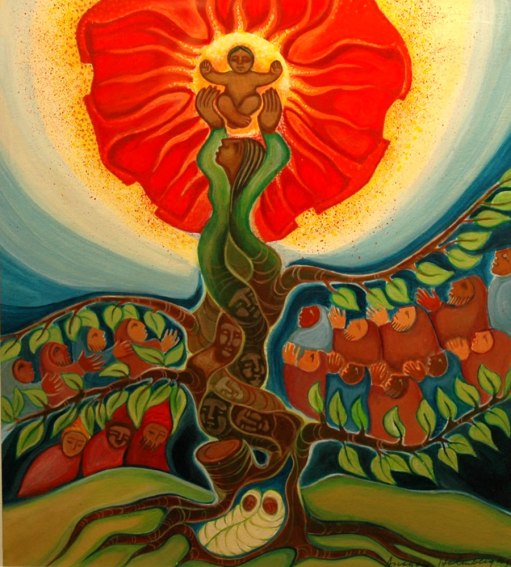
All the roots and trees passing by my eyes and through my mind this week bring me around to the Incarnation, the birth of Christ which we are celebrating. That’s because the most persistent and enduring life system, if you will, is the Root of Jesse, and the Branch that sprouted, mentioned in Isaiah 11. Iconographers have painted this flowing of our salvation history, and it is the inspiration for many other types of illustrations, like this dramatic interpretation by Ansgar Holmberg:

  Jesse tree rj- ansgar

Some excerpts from the passage in Isaiah:

A shoot will come up from the stump of Jesse; from his roots a Branch will bear fruit.

The wolf will live with the lamb, the leopard will lie down with the goat, the calf and the lion and the yearling together; and a little child will lead them.

They shall not hurt nor destroy in all my holy mountain: for the earth shall be full of the knowledge of the Lord, as the waters cover the sea.

And in that day there shall be a root of Jesse, which shall stand for an ensign of the people; to it shall the Gentiles seek: and his rest shall be glorious.

I am pleased to have arrived at a Christmastime theme, a history and reality that leads many of my friends to put up a Jesse Tree decoration during Advent. Christ is somehow the Root and the Branch and the whole Tree of Life. It’s just one of the ways that the metaphor of trees and roots and branches is used in the Bible to reveal God’s plans and ways to us. No wonder I love trees: I admire them for their strength and grace, but I am myself alive with the same sap that is the Source of all root and tree life.

My own preference for letting trees take over is a romantic and privileged one; I don’t live where hardwood forests perennially compete with farmers for every plot of soil, or where such things as Weed Trees can be talked about knowingly. We were told via Adam and Eve to have dominion over nature, which at the least means conserving it and managing it. A gate that can’t function as a gate because some roots have essentially ruined it is not a sign of good husbandry after all, though it makes a pretty picture. Other clashes that come to mind involve roots doing bad things to pipes; the play of humankind with  trees is not always artistic, because the design elements are always in flux.

Time is a factor you don’t want to ignore in this sort of interplay. So many people disregard it, not imagining what a nursery sapling might become in 20 years, roots and branches reaching out and down and to the sky. Living in the  moment doesn’t excuse us from the responsibility to plan for the future, taking into account the nature of living things to change and grow.

Even God plans, and caused His good will to be planted especially in the family of Jesse, the father of King David, from whose tribe our Savior blossomed forth. He had a very long-range perspective and intention, and we haven’t seen the end of it.

The imagery in The Guardian, and the language that connotes for me destruction and relinquishment, seem to contrast with the words of Isaiah quoted above. Nature will be at peace in the day of which the prophet speaks, and a great order will prevail because of the knowledge of the Lord. It will be a large space where all of God’s creation can function as intended, with plenty of room for partnership and concord between mankind and the rest of creation. What struck me most was that last line above: “His rest shall be glorious.”

I’ve been wanting to post again a link to the carol Jesus Christ the Apple Tree, in which we are appropriately encouraged in Christ to “sit and rest awhile.” I think it’s what I’ve been longing to say — and for that we don’t have to wait until Christmas.

The only answer that makes sense!

My last post was mostly a quote from Metropolitan Anthony Bloom, and in my transcription I somehow left out a whole sentence and turned the meaning of the main point on its head! Ugh. So I am going to post it here again, and put in boldface the critical passage that I have corrected, so you don’t have to read the whole thing through if you don’t want to. It should make more sense now.

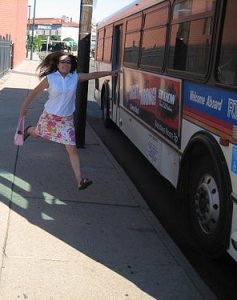
…the aim and content of our life…is to be where we are now, whereas ordinarily, catch bus runningand nearly all the time, we live as if we were trying to catch a bus.
We have an erroneous notion of time. The amazing thing in life, said a seventeenth century Russian philosopher, is that all the necessary things are simple and all the complicated things are useless. In fact, if we could only remember that time does not run away, that at a slow pace or at a gallop it rushes towards us, we should be much less fearful of losing it. Do you think that by going towards the hour of your death as fast as possible you can prevent it from coming, or catch it? Do you think that if you go on placidly, tranquilly listening to me, the hour of your deliverance will not come? In both cases it is time which is coming towards you, you have no need to run after it.

It is coming…and you will not escape it any more than it will escape you. Therefore we can establish ourselves quite peacefully where we are, knowing that if the time ahead has a meaning that is necessary for us, it is inevitably coming towards us at a sure and regular pace, sometimes more quickly than we could run to meet it.

On the other hand, if we establish ourselves peacefully in the present, we are living in a world of realities, whereas if we hurry towards the future, we are moving towards a world of unreality…. eternity and time are incommensurable with one another. Eternity is not an indefinite length of time; eternity is not the presence of time without end. The difference between time and eternity is that time is a category of the created: it appears at the moment when something which did not exist before begins to be and to become, and it exists as long as the becoming continues.

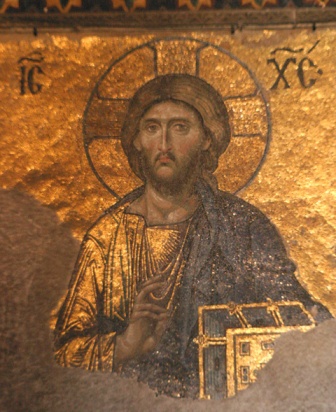
Eternity does not answer thePantocrator OW Hagia Sophia question ‘What?’ It answers the question ‘Who?’ Eternity is God, God who is always contemporaneous with each moment of time; He is always there, completely stable, unchanged and unchangeable because He already  has in Himself, before the first thing was, all the richness necessary to meet all things and all situations. He does not need to change in order to be contemporaneous.

It is useless to look for God within a time. He is in the time in which we are….

–Metropolitan Anthony Bloom, from “Holiness and Prayer” in God and Man.

“The future is something which everyone reaches at the rate of sixty minutes an hour, whatever he does, whoever he is.” CS Lewis

The question eternity answers.

I find nearly everything I’ve read from Metropolitan Anthony Bloom to be very encouraging, in the sense of giving me courage to do the things that I somewhat fear, but that I know are necessary for life. Time is a very practical subject to talk about, this most real quality of our created lives. And as he shows here, eternity is as well.

…the aim and content of our life…is to be where we are now, whereas ordinarily, catch bus runningand nearly all the time, we live as if we were trying to catch a bus.

We have an erroneous notion of time. The amazing thing in life, said a seventeenth century Russian philosopher, is that all the necessary things are simple and all the complicated things are useless. In fact, if we could only remember that time does not run away, that at a slow pace or at a gallop it rushes towards us, we should be much less fearful of losing it. Do you think that by going towards the hour of your death as fast as possible you can prevent it from coming, or catch it? Do you think that if you go on placidly, tranquilly listening to me, the hour of your deliverance will not come? In both cases it is time which is coming towards you, you have no need to run after it.

It is coming…and you will not escape it any more than it will escape you. Therefore we can establish ourselves quite peacefully where we are, knowing that if the time ahead has a meaning that is necessary for us, it is inevitably coming towards us at a sure and regular pace, sometimes more quickly than we could run to meet it.

On the other hand, if we establish ourselves peacefully in the present, we are living in a world of realities, whereas if we hurry towards the future, we are moving towards a world of unreality…. eternity and time are incommensurable with one another. Eternity is not an indefinite length of time; eternity is not the presence of time without end. The difference between time and eternity is that time is a category of the created: it appears at the moment when something which did not exist before begins to be and to become, and it exists as long as the becoming continues.

Eternity does not answer thePantocrator OW Hagia Sophia question ‘What?’ It answers the question ‘Who?’ Eternity is God, God who is always contemporaneous with each moment of time; He is always there, completely stable, unchanged and unchangeable because He already  has in Himself, before the first thing was, all the richness necessary to meet all things and all situations. He does not need to change in order to be contemporaneous.

It is useless to look for God within a time. He is in the time in which we are….

–Metropolitan Anthony Bloom, from “Holiness and Prayer” in God and Man.


“The future is something which everyone reaches at the rate of sixty minutes an hour,
whatever he does, whoever he is.”
-C.S. Lewis