Category Archives: travel

Mountain Air – I notice some things.

After reading of John Ruskin last summer, how he recommended that everyone learn to draw as a way of learning to attend to God’s creation, I felt it almost my Christian duty to at least make an effort. Normally I don’t want to take the time for a new challenge like that, so I had put it off until I knew I would have these uninterrupted hours at the cabin.

An ant visited my sketch pad.

Betty Edwards, in her book Drawing on the Right Side of the Brain, was my instructor. I enjoyed some of the exercises one day on the cabin deck, and the next I walked over to Gumdrop Dome and attempted to draw a very complicated scene.

It was a surprising pleasure, concentrating on all the lines and angles in front of me as I perched on a boulder, soaking up one of my favorite venues in a brand new way, noticing with my hand transferring what my eyes processed through my mind — for about an hour. Then suddenly I was done for, too brain weary/bored to finish my impossible drawing.
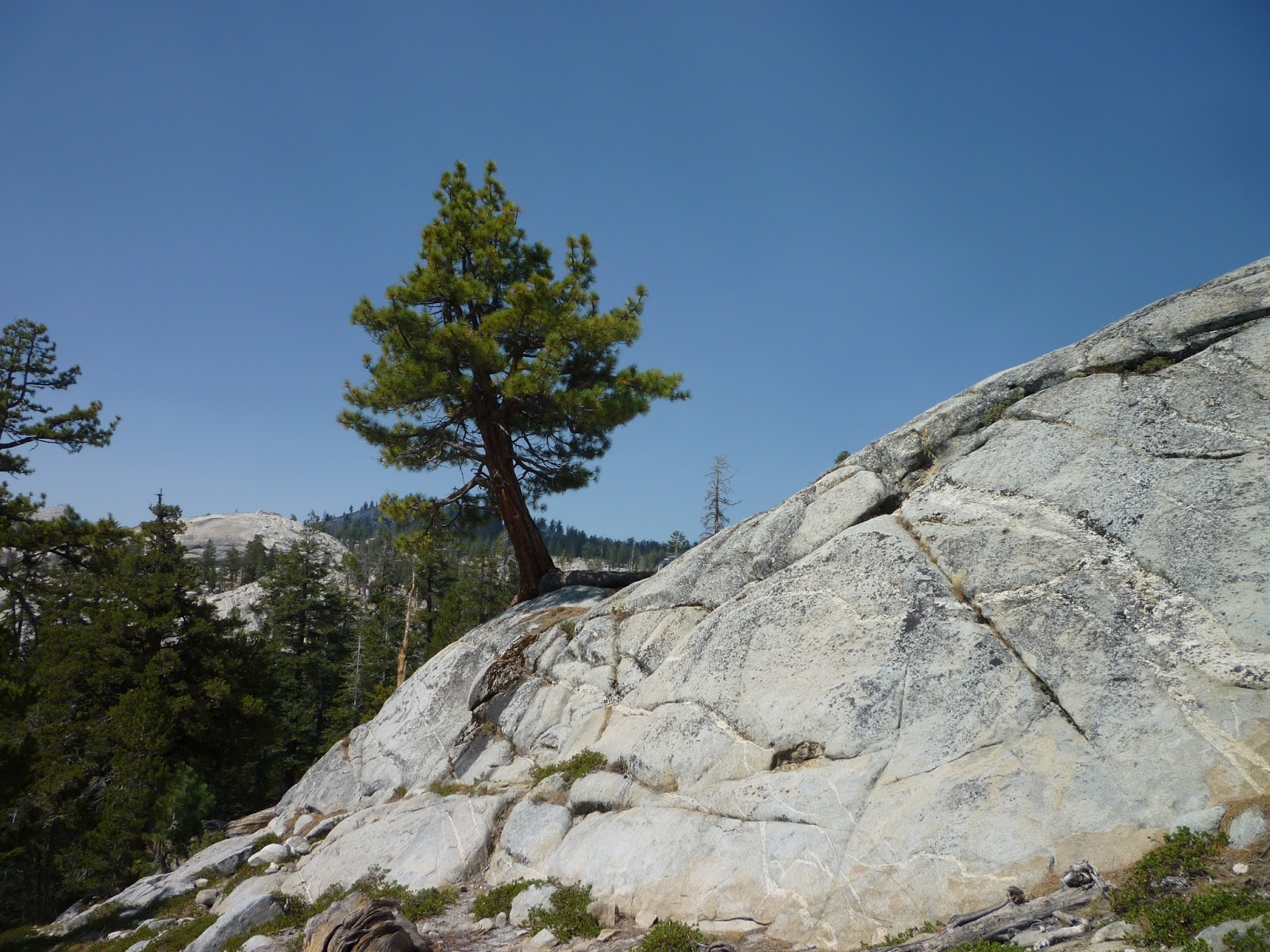
I picked up my tools and hiked a little farther around the dome where there was a simpler picture in view. This will be easier, I thought. So I sat on another rock and started in on this slope of the dome with a tree growing out of it, photo at right.

But no, granite domes and trees are just way too intricate for this beginner, and I gave that sketch up within a few minutes. It was soothing after my exertions to take out my camera and do instead some more familiar kind of focusing on these natural wonders.
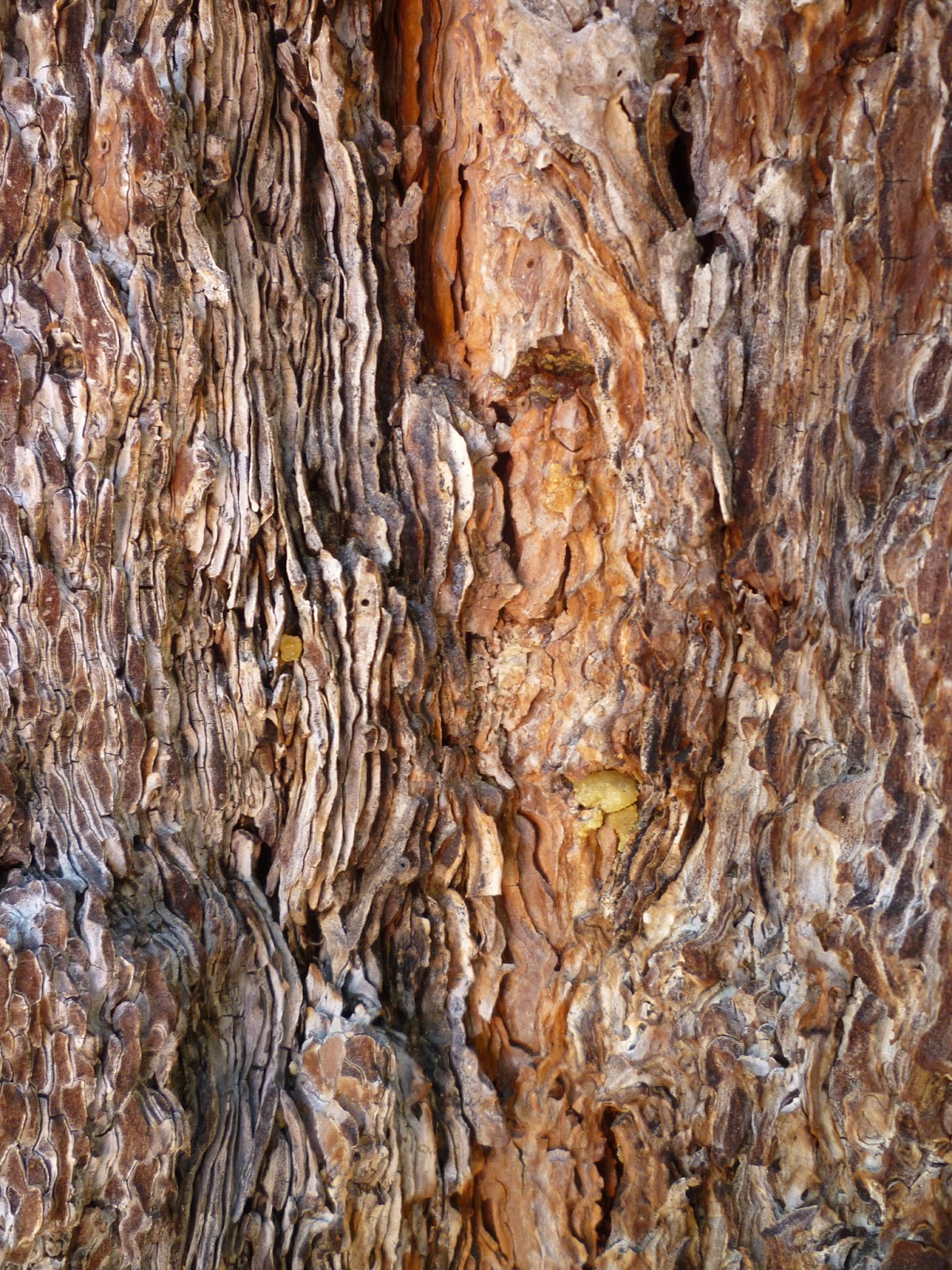
tree bark

My primary goal in taking this little walk was unrelated to my drawing exercises anyway. When we’d hiked here with our friends earlier in the summer, while the other three were on top of the dome with the camera, I’d walked around the side and noticed the dearest little tree growing out of the rock and seeming to lay its “head” down on the stone, in a manner reminiscent of the way we children in First Grade used to lay our head on our desks every day after lunch for Rest Time.

This is how it had looked to me then:

I had tried very hard to concentrate my mental forces and memorize the way that tree looked, so that when I arrived back at the cabin I’d be able to sketch it. The results weren’t satisfying, though, and I’d contented myself with the thought that Next Time I would go locate it again, camera in hand. Here was my next time, a mere two months later.

As I walked around the tree I saw that it’s not resting on the rock at all. But the poor thing must have had its bones permanently bent by snow as a child. It will always be a hunchback, but with the honorable position of pointing to a beautiful granite dome, showing the climbers, “This way to the top!”

Here is another complex arrangement of nature that I didn’t even consider taking pencil and paper to, rock, trees, sky and clouds. This one seems to demand colored pencils:

At last, the picture I know you all have been dying to see, the result of my feeble exploration of the mountainside with the Right Side of My Brain:

Mountain Air – smoke and writing


I returned this week from a solitary trip to the mountains, where I stayed in a cabin off the grid for four nights. I could easily write a book about my five days of journeying and lodging, probably a philosophical novel. Or would it be a how-to treatise with packing lists and suggested activities and prayers?

I’m always saying, “I could write a book about ____.” And it just occurred to me that I am always writing, as I endlessly analyze events as to their significance, and organize my thoughts, composing and reworking the lines in my mind. If I have a pencil or keyboard handy and hands free I might scribble down some of it, often in a notebook or in the margin of the book I’m reading. But the process has begun long before that.

It wouldn’t be a lie exactly, when people ask me what I do, to say, “I write.” Because I’m a process-oriented type, I can’t see a book ever resulting from my work, but no pressure — no one is clamoring for a discussion of the things in my pocket or the interrelatedness of the last ten books I read.

I thought I might do some sort of scribbling during my getaway, but I didn’t make much visible progress on my “books.” Many things that are fascinating to my self-centered self consumed my hours and my thoughts, and I do want to reflect on some of that here, hopefully without rambling on and on.


Today I just want to mention one sad thing about my experience: Smoke. The brown cinders from that horrid Rim Fire, the largest wildfire on record in the Sierra Nevada, had drifted south and made the air murky around Our Lake. One day was so bad that my eyes and throat and head hurt from the pollution. But I didn’t have to come home early, because it cleared up a little by the next morning.


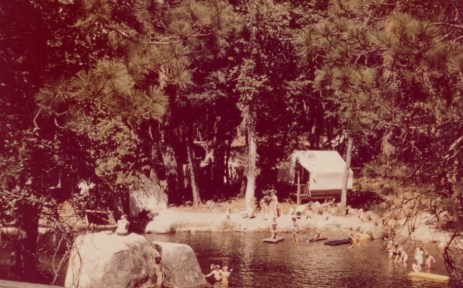
I can’t imagine what the landscape will look like, the next time we visit our beloved Yosemite and drive through the scorched forests. One thing I know: On August 25th the fire destroyed the Berkeley City Camp Tuolumne where my sisters and I as children vacationed with our grandparents.

It has been many decades since I did water ballet in that swimming hole in the Tuolumne River, or even visited the camp, and it won’t change my life that it is wiped out. But what a heartache for the people who spent dozens of formative summers in the context of that special place, and those for whom the rustic cabin life in an idyllic setting was a very recent tradition and expectation. I’m very thankful it was only smoke that invaded our family’s lake and village.

I communicate vintage style in small bits.

This week the discussion of Hidden Art of Homemaking is on chapter 9 – Writing Prose and Poetry. I haven’t kept up with the conversation at Ordo Amoris for a week or more, and for this chapter I’m just re-posting this from August 2009. Don’t be misled by the now-obsolete references to postage rates!

Old-Fashioned Correspondence


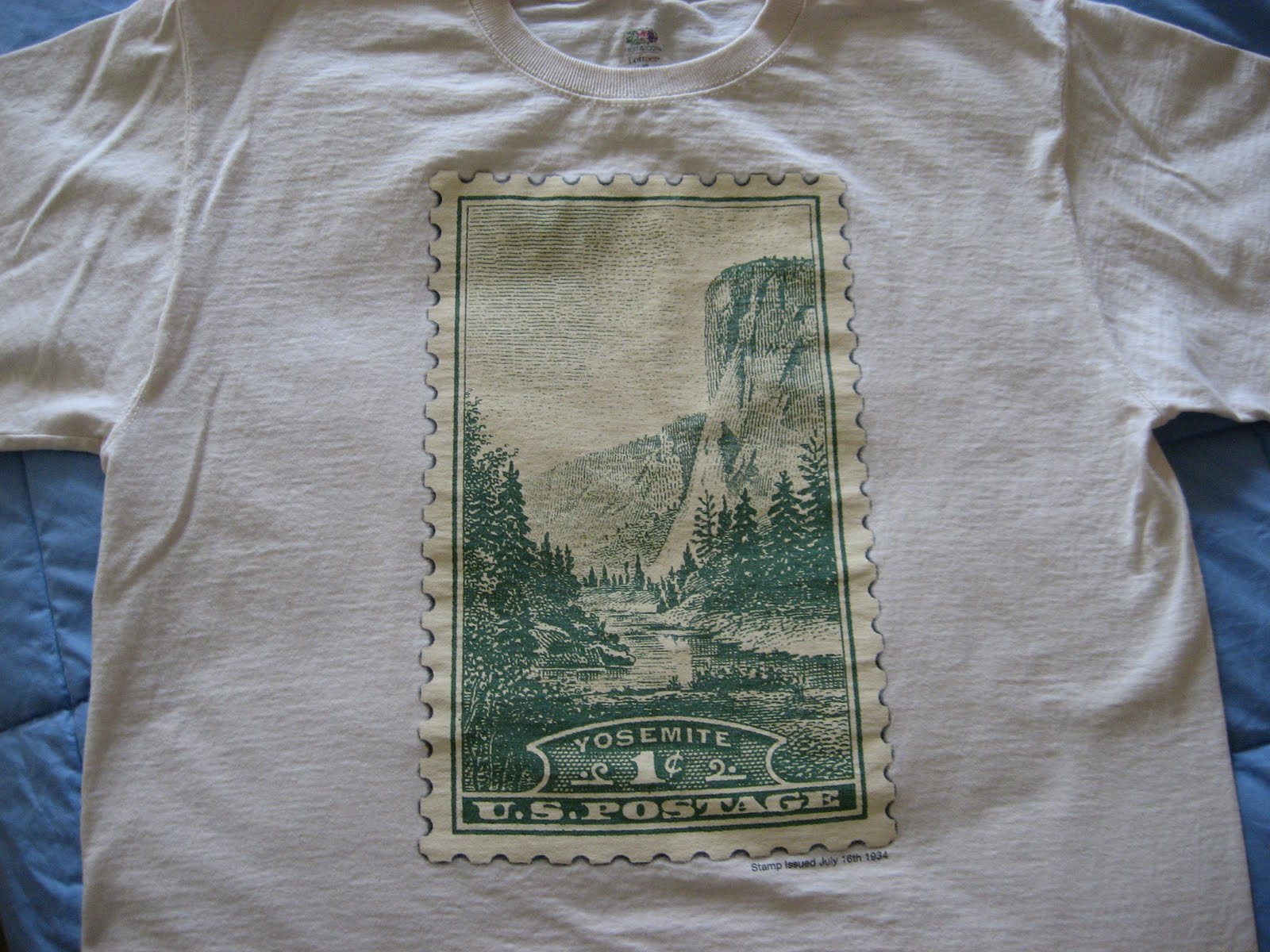
To introduce the postal theme– and for a few moments just forget about the concept of mail that can’t be carried in from the mail box in one’s real hands–I show you this T-shirt we bought in Yosemite last month, at the post office. It was the best clothing deal in the park, and an unusual and historic design: a reproduction of a stamp that was issued in 1936, showing–Yes! my beloved El Capitan! If you have ever beheld that rock I trust you won’t find its frequent appearance here tiresome.

I mostly wanted to tell about postcard-writing, and the shirt isn’t very pertinent to that…though it just occurred to me that one might buy the shirt at the Yosemite post office and then write a postcard sort of message on the fabric before mailing it in its more personalized form. I don’t think I’ll run right back there and pick up a few more, though.


When I was a child, my maternal grandmother would send postcards to me and my siblings from wherever she was traveling. I recall receiving word from Turkey, Norway, Mexico, and Hawaii. She also wrote very entertaining letters from home. As she has been a major role model for me, it’s no wonder that I feel it a natural activity as a human being to share my life in this way with those I love.

It’s easy when on a journey, away from the usual housekeeping duties, to remember friends and family and take the opportunity to let them know I do think of them. A trip just doesn’t satisfy if I haven’t dropped a dozen cards in the letter-box.

This picture was taken at the Grand Canyon. When others in our party were hiking down into the gorge one morning, I walked all over the place looking for a picnic table with a view, from which I might write my cards. That was not to be found, but in a sheltered courtyard I did find a good spot, away from wind and next to a big stone with rain water pooled in a depression on the top. I didn’t notice this rock until I was startled by a raven who swooped down to drink.

Postage “just” went up again. It now costs 28 cents to mail a postcard. On those first envelopes carrying my grandmother’s address in the corner, the stamps on the other corner said “4 cents.” I can’t imagine that a postcard was more than a penny.

One thing I inherited from my father recently was the stamps from his desk drawer. There are some pretty old ones, from when a letter was 25 cents. If they still have stickum on them I use that, and if not, I apply a little Elmer’s glue and save my pennies by using these old stamps.

I also “inherit” stamps from my father-in-law, who gets them (less and less, now that he responds infrequently) from charitable organizations that want him to send donations. They come to him already sticking to envelopes, but I cut them off and glue them on to our own bill payments. Some of my collection are in the photograph above. If you want to see the stamps up close, just click on the picture and you can see an enlarged version.

In California it seems that every town is a tourist town. At least, I find postcards in all the stores. But in some locales, the market has yet to be discovered, and I have to make my own postcards, which I learned to do from Martha Stewart, who gives us this handy template and instructions for using it. I’ve made these one-of-a-kind cards with photos of someone’s backyard, or a lake that is small and unknown, or a town that is seemingly too plain for the professional postcard people.

But why restrict this fun habit to traveling days? I started sending postcards to the grandchildren and friends any old time. A postcard is small enough that I can find time to write a few words while the iron or computer is warming up or perhaps even in the middle of the night when sleep won’t come. I don’t think old-fashioned correspondence of this sort will ever become obsolete or unwelcome.

Oregon – long good-bye

On our last day in Oregon we woke up in a little old room in a lodge by a lake. Lake O’Dell, where Mr. Glad had come a couple of times as a child and where we thought we might row or paddle around on the glassy water in the morning. But I was impatient, knowing we had a long day of driving ahead of us, to just get on with it and get to Pippin’s.

The night before, we had sat on the deck and continued our reading of The Hobbit. Then we retired to our rustic room, likely designed for a fisherman type who doesn’t read in bed or need a nightstand for anything. The fisherman doesn’t have any bottles or jars or pillboxes in the bathroom, either, so it’s o.k. for him that the floor is the only horizontal surface other than a narrow windowsill.

It was kind of sweet, actually. The room smelled just normal, not like disinfectant or stale cigarette smoke or fake deodorizer. Maybe partly because the windows were letting in the fresh air from the forest, into a room that mostly houses just plain folk. We could see the lake through the trees, and hear the birds.

A well-dressed tree trunk by Lake O’Dell

Nothing and nobody woke us out of our good sleep, not even a motorboat of fishermen going out on the lake in the wee hours of the morning, as Mr. Glad had predicted. But we did wake and get on our way, south toward our home state. It would take the better part of the day, by way of long straight roads in the high and dry eastern side of Oregon.

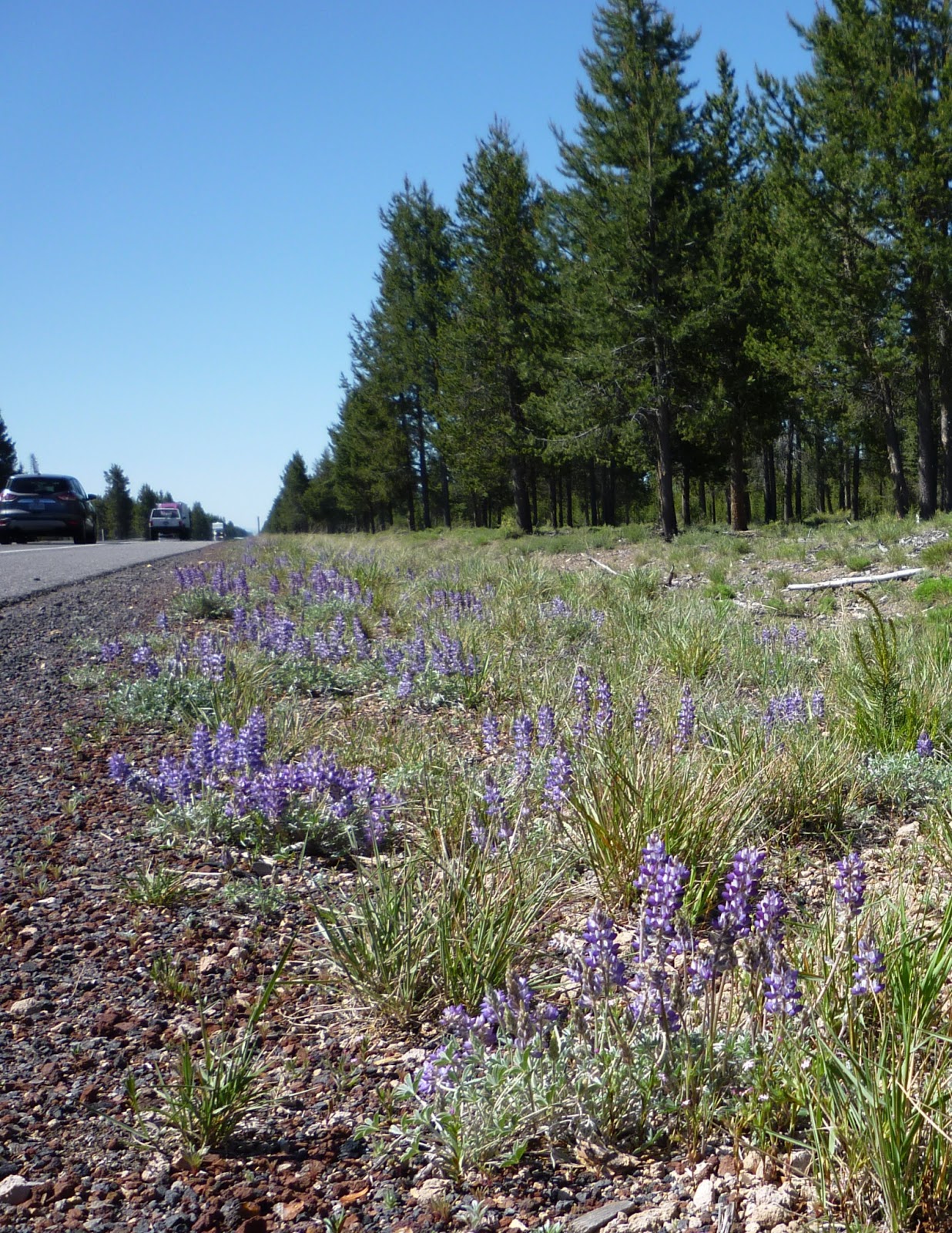
Forest, forest and more forest, with “fields” of short lupines in bloom along both sides of the highway, thickest out in the open between the road and the trees.

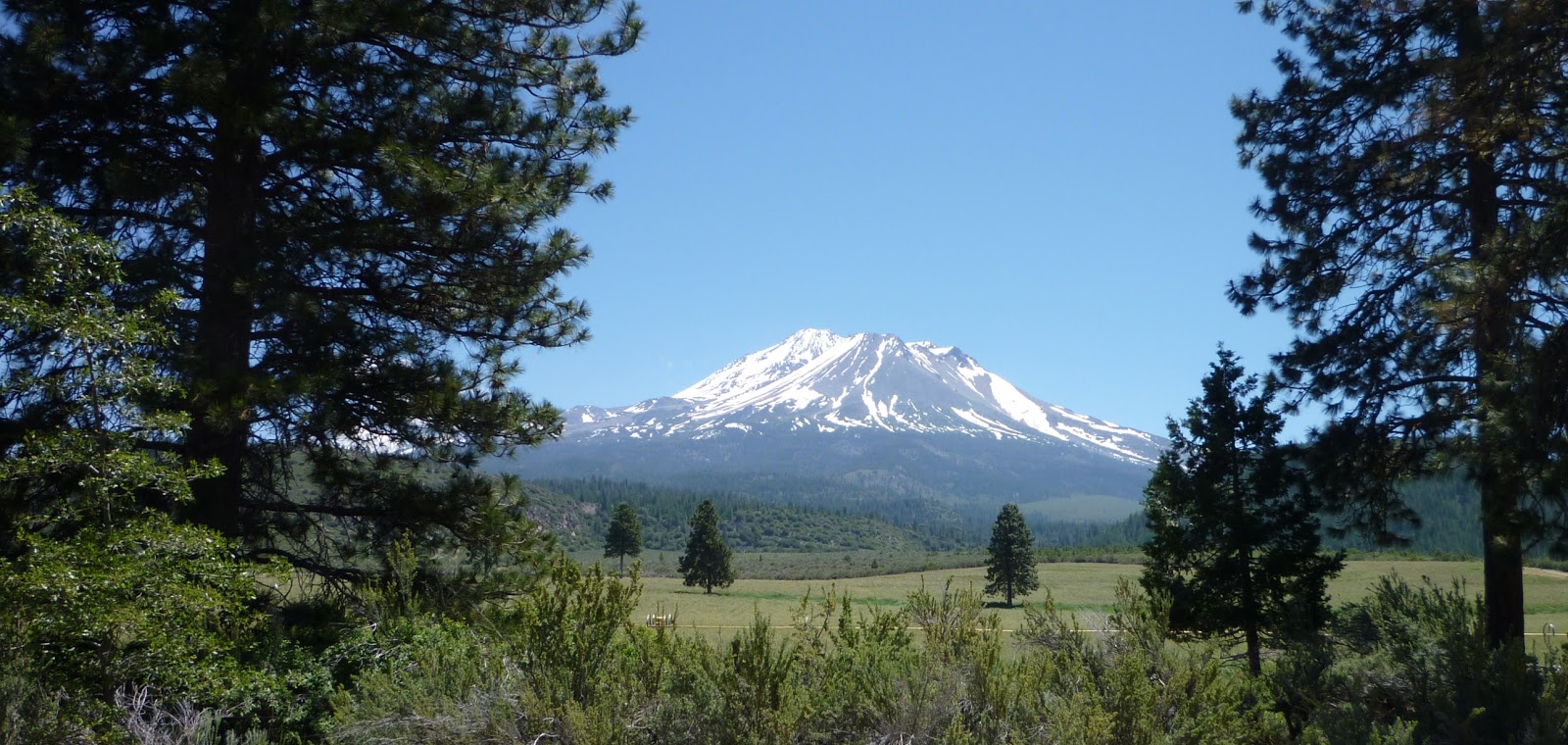
When we were still at least 200 miles away, I got my first glimpse of the top of Mt. Shasta, that volcano that stands by itself over 14, 000 feet high as a dramatic landmark an hour’s drive south of the Oregon-California line. And then I really got excited, like a horse on its way back to the barn, and it struck me how much I love that mountain for telling me “Welcome to California!” and “Welcome home!” while I was yet a long way off.

It’s summer, and summer in the West means the highway department is repairing the roads, so this trip was marked by many many extended stops waiting for the flagman to let us go on.

The last of these roadwork episodes was near Weed, California, and I was driving, and could roll down my window and snap this picture of the mountain from a normally impossible spot. “It’s my lucky day!” I said, as once again we were sitting motionless on the blacktop.

But only a few minutes later we were playing with the grandchildren and eating strawberries with our dear ones. The Oregon loop was lovely, but not more so than the feeling of home.