Category Archives: travel

Oregon – Astoria, and what The Corps of Discovery ate

In 1805 Lewis & Clark came to Astoria, or more precisely, to the mouth of the Columbia River where the city would be founded a few years afterward. In the next century, during World War II, my in-laws came at the orders of the U.S. Navy. Last week my husband and I made our first visit to Astoria.
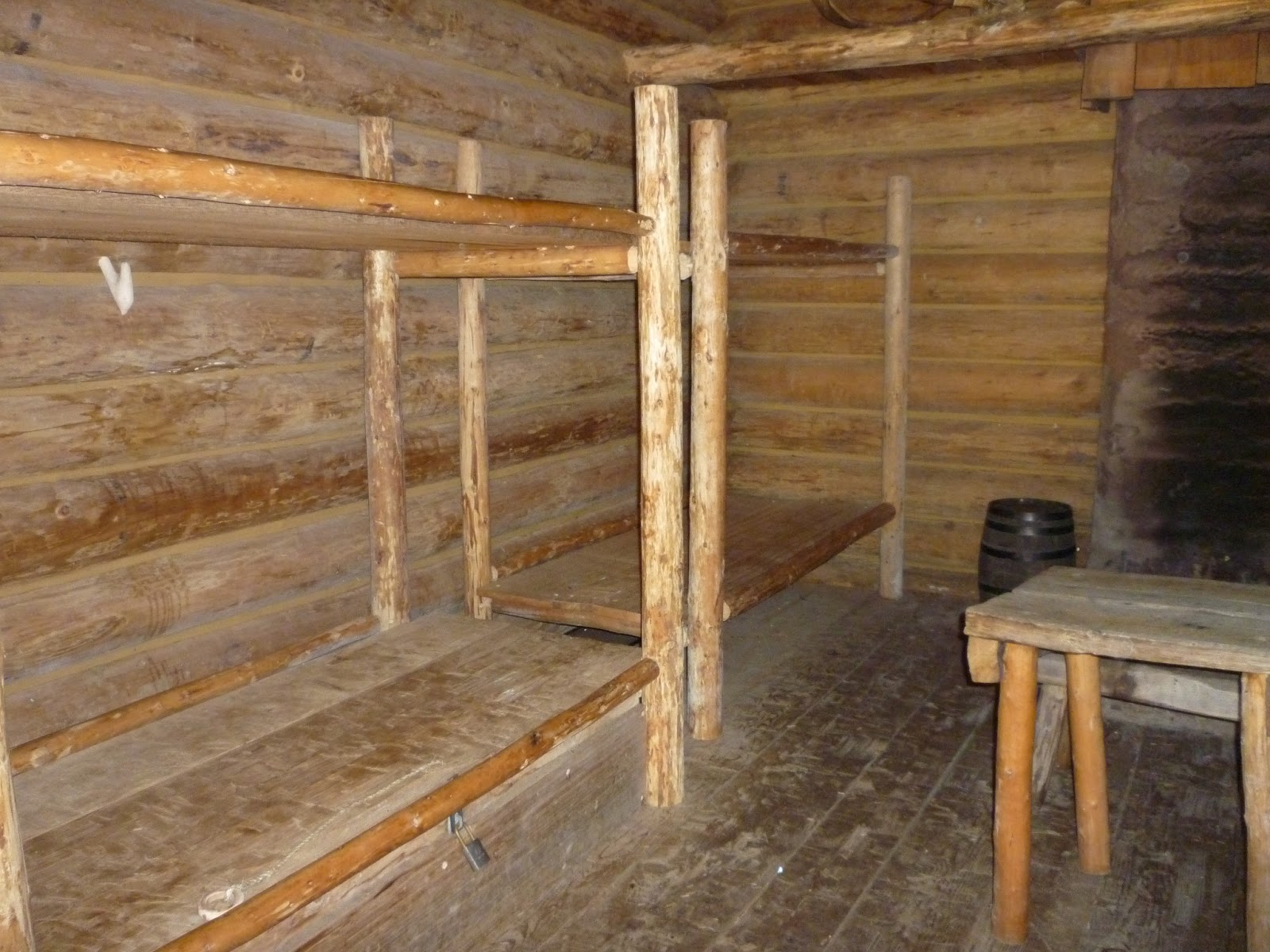
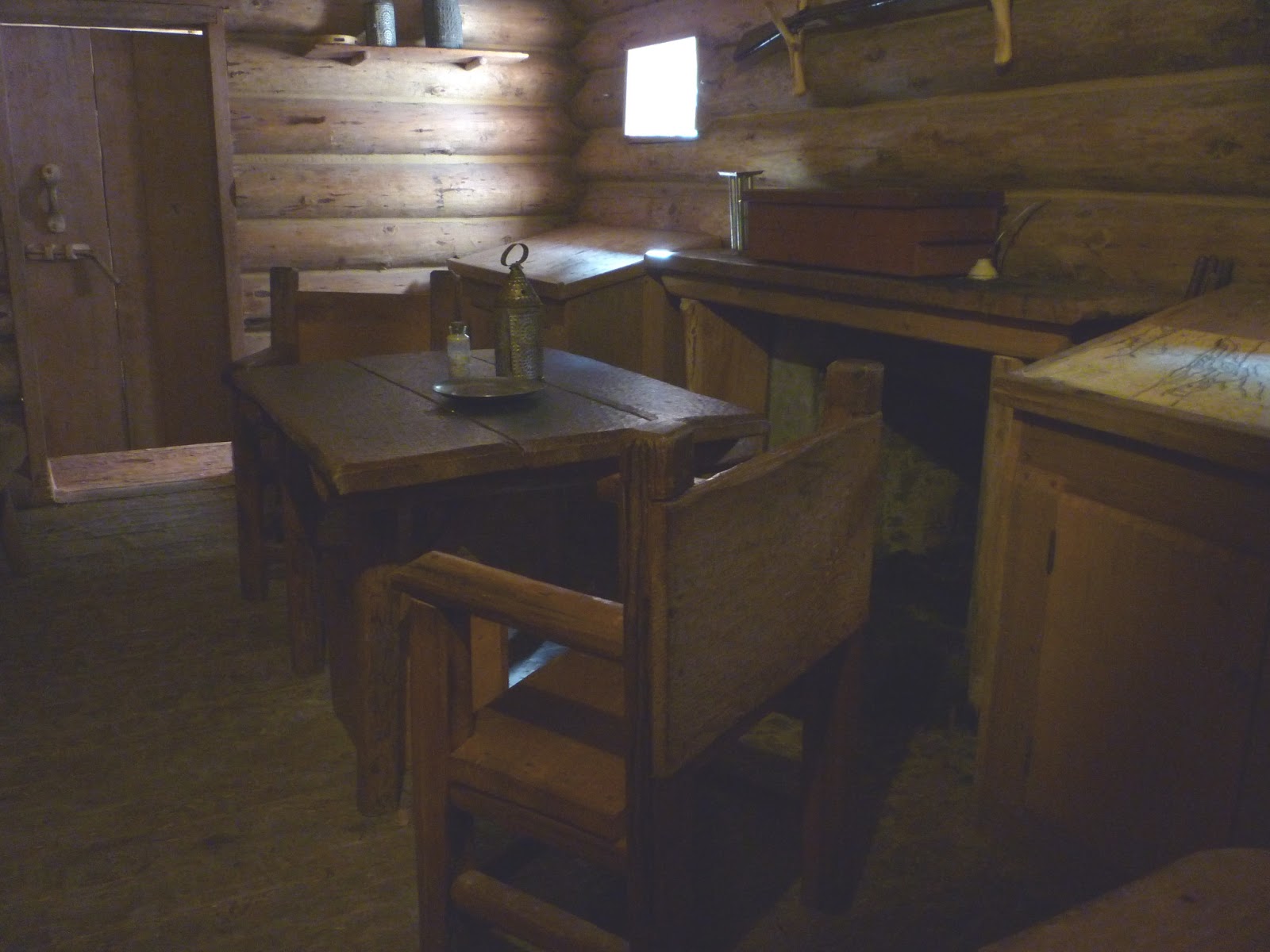
Bunkhouse for the soldiers


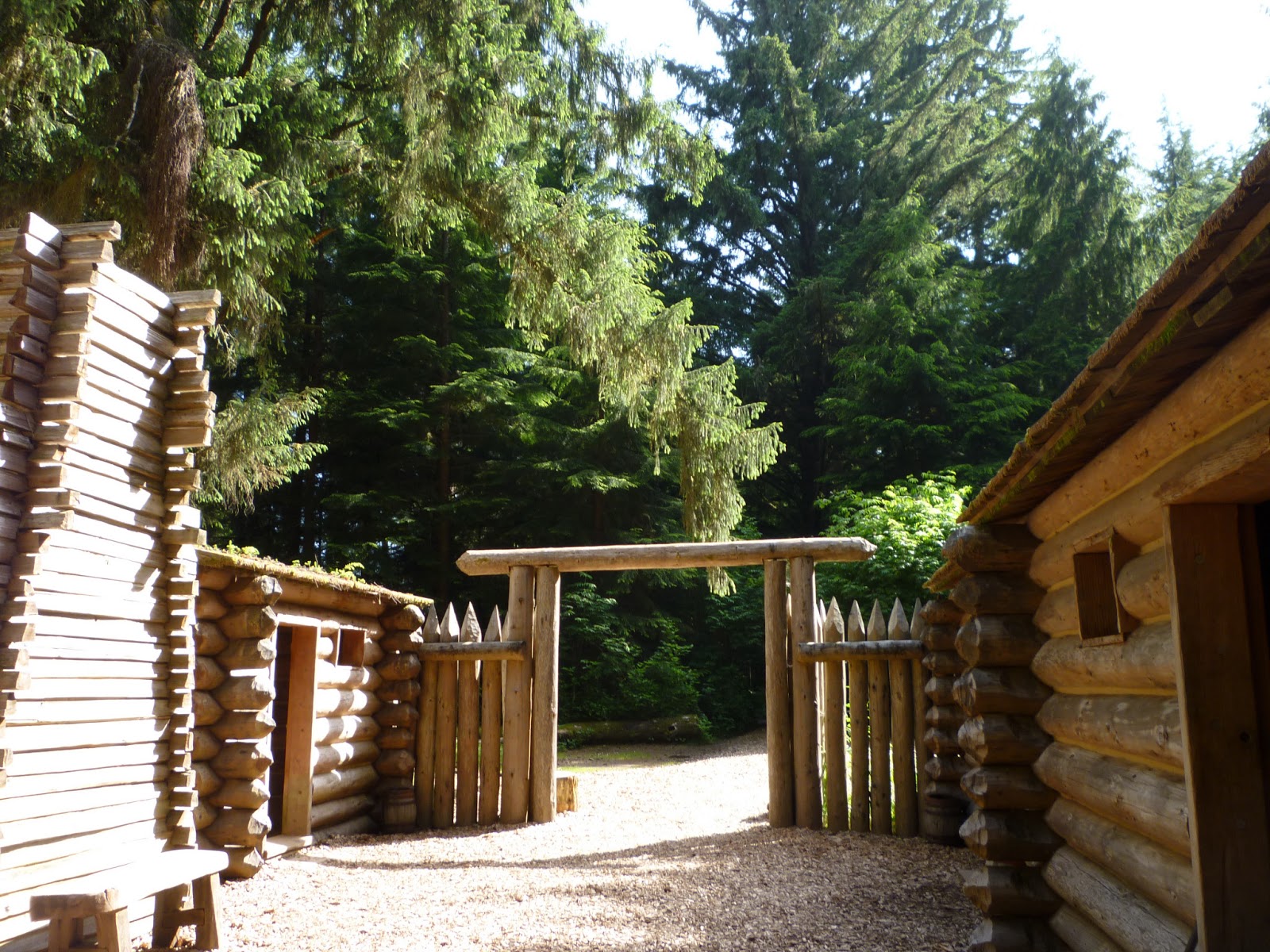
We didn’t stick around nearly long enough to satisfy my traveling style, which is marked by a desire to make a home for at least a week or two in every place I visit. But only a minute is required to introduce a thought or fact and pique my interest; that’s what happened at the Fort Clatsop park where replica log cabins have been built showing how the Corps of Discovery sent out by Thomas Jefferson lived for their 106 very wet days there.

Astoria front yard with salal

I told the docent that one thing I’d remembered from reading about Lewis & Clark with the children more than ten years ago was that when the party arrived at the Pacific Ocean (it was November) they turned up their noses at the salmon, being meat-loving guys. Well, it wasn’t so simple, she replied. Back in September when they were famished because game was scarce, they had traded with the Nez Perce Indians for camas root (camassia quamash) and dried salmon, which made them sick, so they associated that unpleasant experience with the fish….and besides, there wasn’t a lot of salmon to be had at that time of year at the mouth of the Columbia.

The woman was focused on taking down the flag and didn’t even notice that I was asking questions: What was it about the camas root that was bad, why did the Indians give it to the explorers, and what was it doing with the salmon? She had made it sound like they were eaten together. So I had to do my own research when I got home, and of course more questions are raised the more knowledge one gets.
I haven’t found anything leading me to believe that the men of the Corps of Discovery despised salmon. They didn’t write a lot while they were at Fort Clatsop; it was a relatively boring life after the excitement of getting there, and the social life was lacking compared to the previous winter, as the coastal Indians were into commerce, not partying. But in the journal accounts before and after the uncomfortable camas episode there are many passages that mention the eating of salmon with no negative comments.

One thing they did record about the food at the coast was that they had obtained salal berry bread — probably a “cake” of dried berries —  from the Clatsop Indians. That got my attention, because we had seen thousands of salal bushes on and near the Oregon Coast. The leaves may look familiar to anyone who has enjoyed bouquets of flowers from florists, because they are used extensively in flower arrangements.
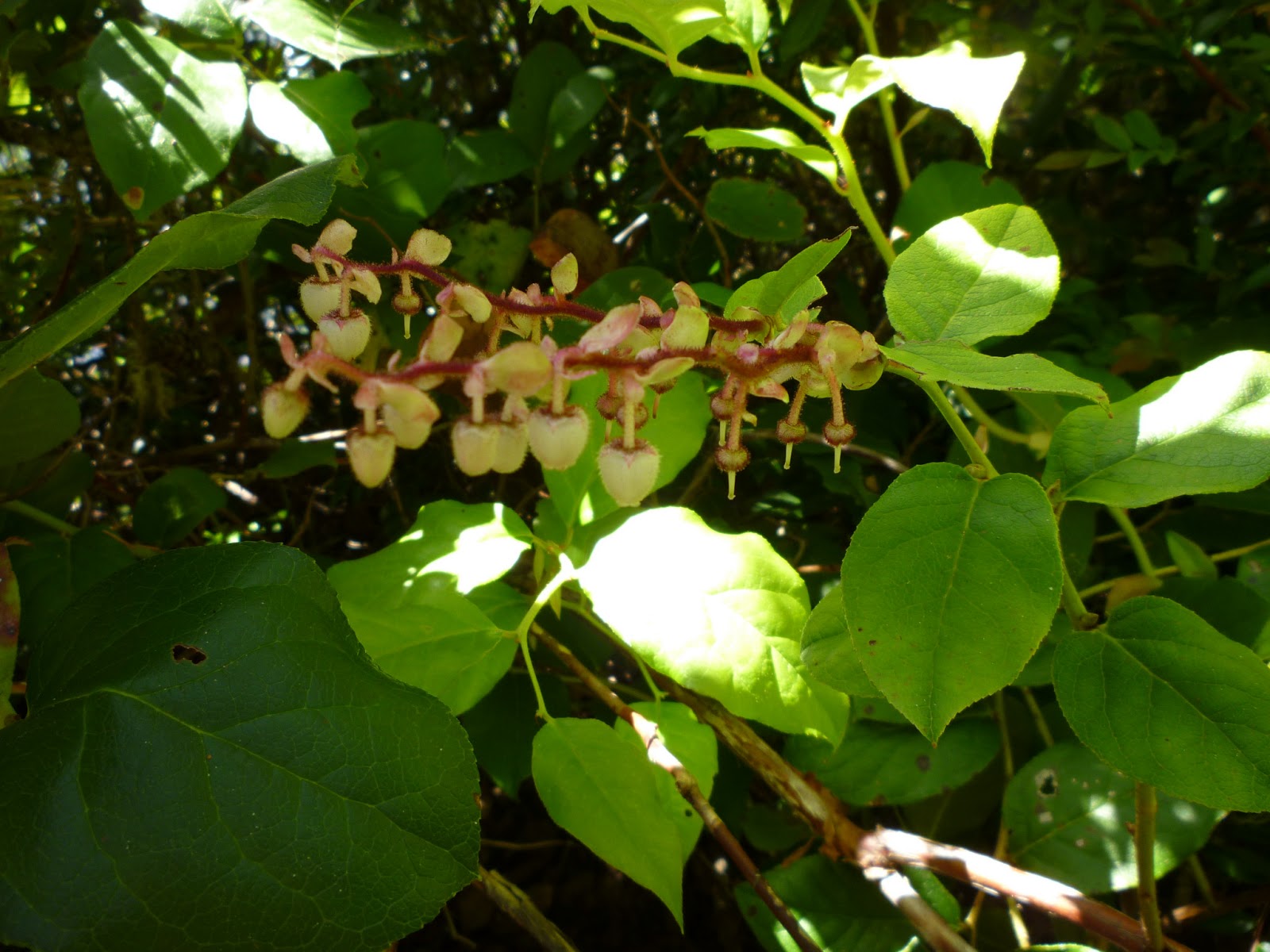
Salal in flower –
Gaultheria shallon

Over the last few days Mr. Glad and I both have become engrossed in the journals of Meriwether Lewis and George Clark and others of the company, because of questions raised during our brief stop at the fort. I read on the blog of Frances Hunter, who has written at least one book on the expedition, that the reason the easterners had debilitating digestive ailments for a week after eating camas was that they were “unaccustomed to eating much fiber.” But in the paragraph before, she wrote that because the hardtack supplies had been depleted, the men had for some time been eating more corn, beans, and squash than was usual.
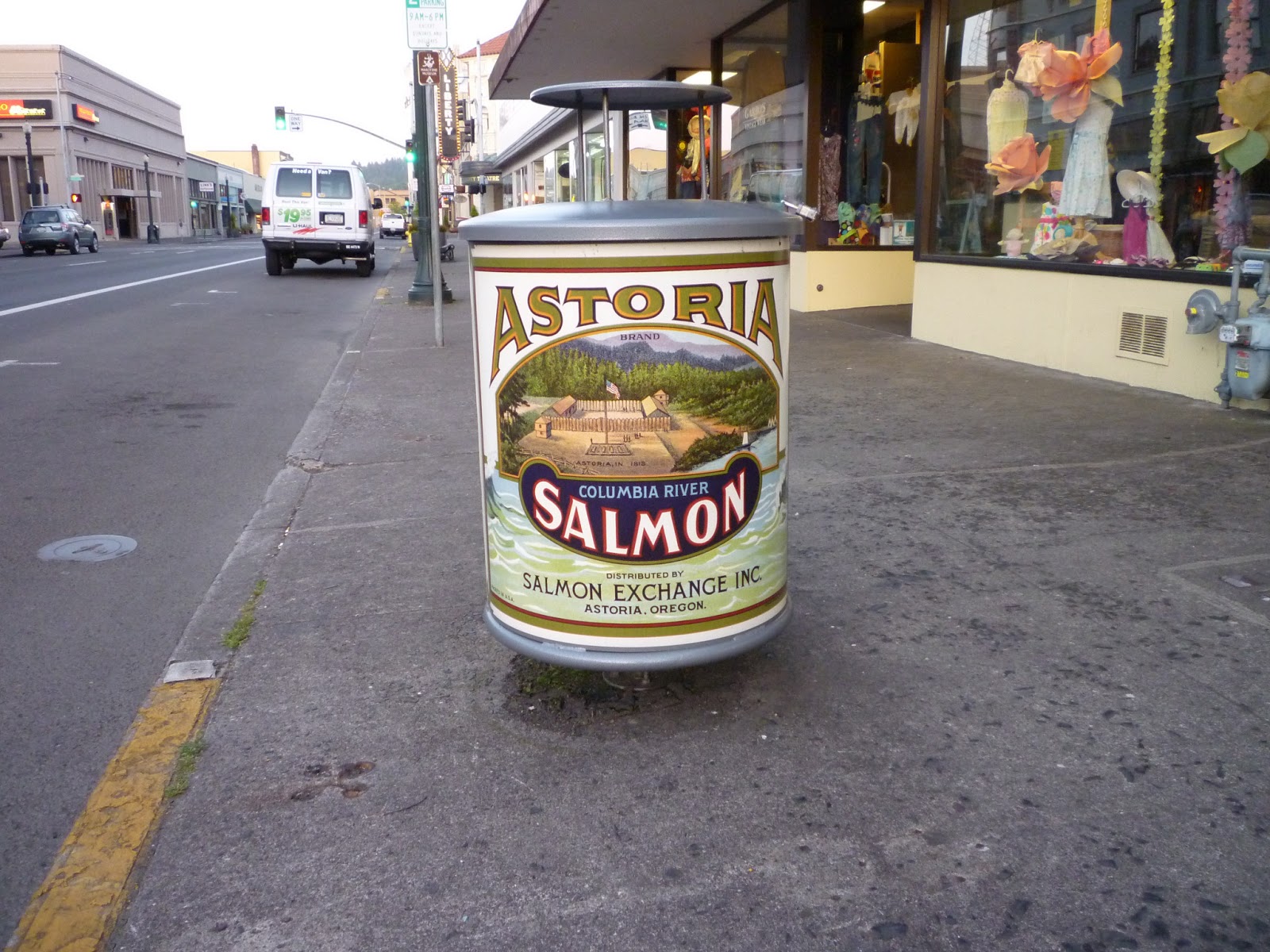
An Astorian garbage can poses as a giant can of salmon.

Many people aren’t aware of which foods have fiber and which don’t, and maybe Hunter is among the ignorant. The “three sisters” of Indian staple vegetables have plenty of fiber, as do the berries that the soldiers had been eating all along. And while an excess of fiber might cause bloating and cramping, it wouldn’t normally cause vomiting and diarrhea. But the explorers themselves did attribute their illness to the salmon and camas.

Lucky for me I ran into The Natural World of Lewis and Clark by David A. Dalton, which treats the aspects of Lewis & Clark’s journeys that I’m currently wanting to know about. I learned that the main starch in camas roots is inulin, and the book explains how humans lack the enzyme to digest inulin in our stomachs. It goes straight to the intestines where fermenting bacteria digest it and produce gases, a process similar to what happens when someone who doesn’t usually, eats beans.
The Indians had a way of cooking the camas root that has been shown to break down the inulin and make the resulting food more digestible: they cooked the roots in a pit for several days until they turned into a mush reportedly as sweet as molasses. The Nez Perce had digestive systems that were accustomed to this food, and they probably knew to eat it in moderation, while the Corps ate lots, being quite hungry at the time.

Later after they had success at hunting and ate some meat, they felt better, until they boiled some camas root — note, they didn’t deep-pit it — and their bloating reoccurred. Eventually they figured out how to eat the stuff, which they came to consider a comforting part of their diet.
Dalton informs us about salmon in his book, as well, that in large quantities it has a laxative effect. So now I feel that I have a much better understanding of one little point of history, not about dates or kings or wars, but — food!

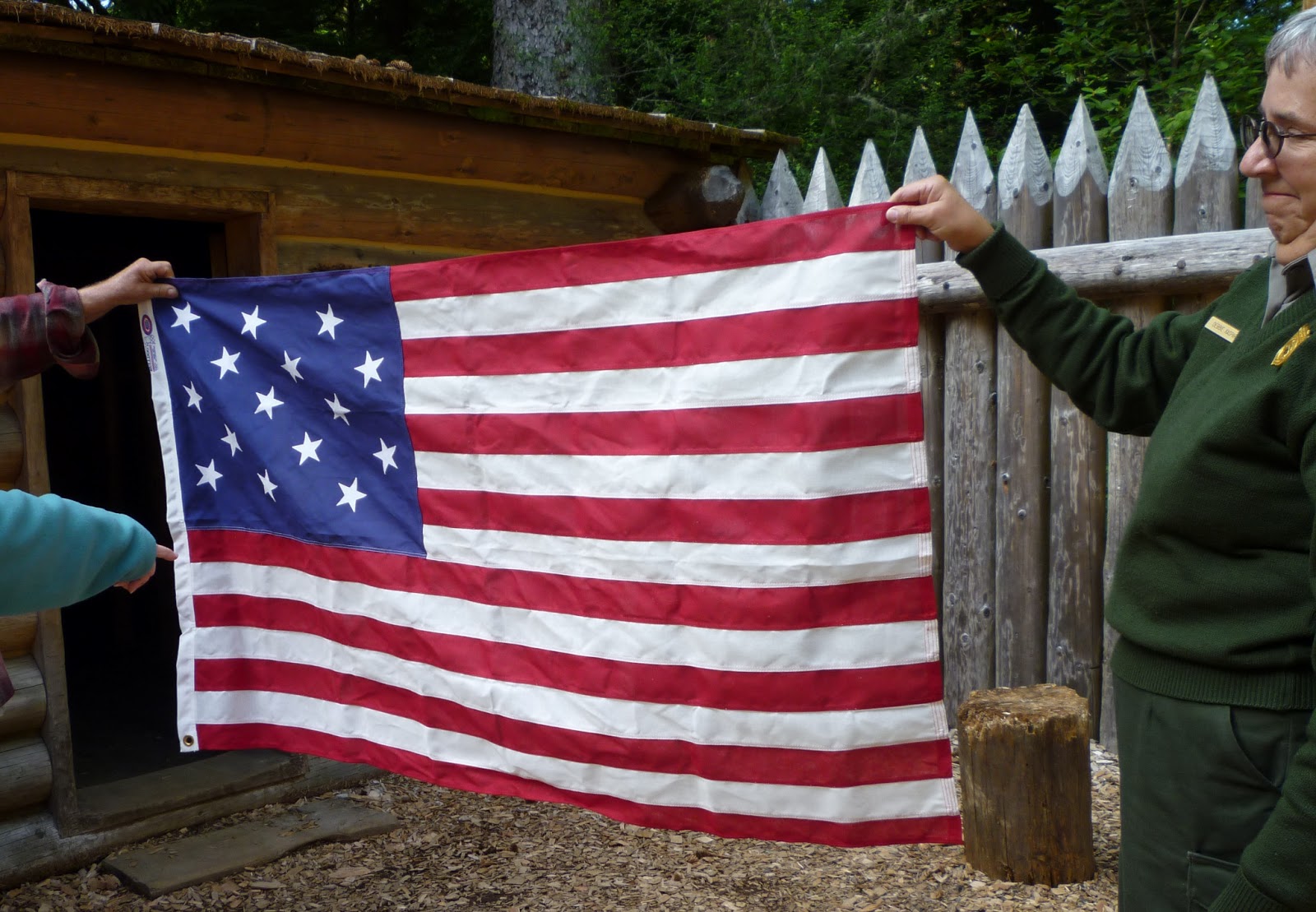
If you are a stickler for historic detail, you might have noticed that the replica flag the docents now fly over the fort does not match the original in its proportions. This page shows all the flags in our nation’s history. Most of them don’t have proper names, but this one is called The Star Spangled Banner.

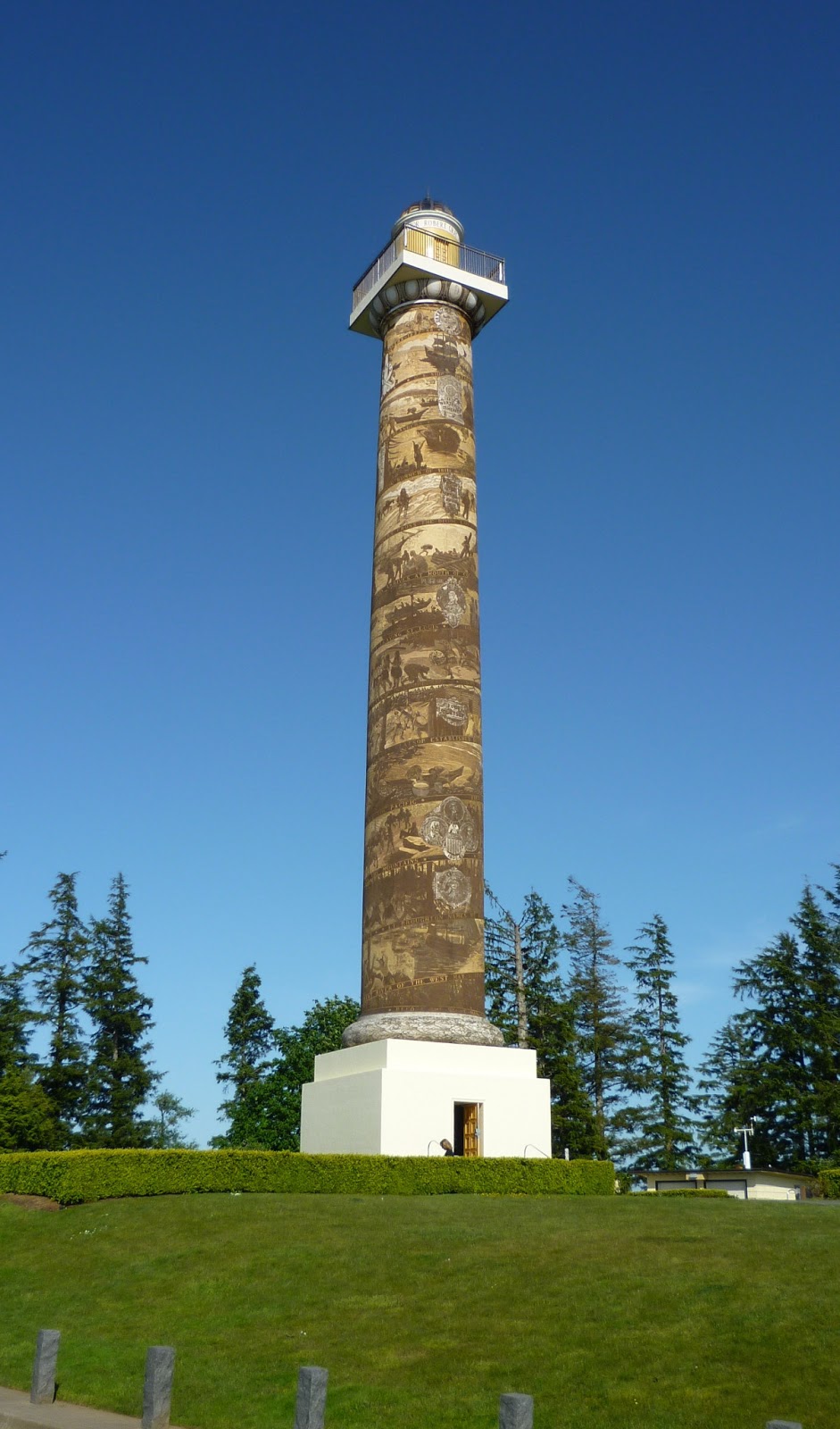
While in Astoria we climbed the 164 steps to the top of the Astoria Column, which gives a broad view of the rivers and town. A spiral of painted relief murals on its surface shows scenes from Oregon history, including this enlarged one below that I found online and that shows a Lewis and Clark event.

I did love looking due south from the column at the large Youngs River, and at the smaller Lewis and Clark River to the right of it, flowing from the southwest. Even before they join the Columbia at its mouth, they make this beautiful scene.

The Lewis and Clark expedition has always captivated me. Because several of the party kept detailed journals, we who didn’t accompany them can vicariously enjoy the fun of discovering rivers and flowers and people groups, while escaping the scary and miserable experiences. By this short and comfortable, warm and well-fed expedition of my own, I have by my plant-identification efforts and by spending a while in the land where they reached their goal felt a new kindredness with these brave men.

I’d like to read more of their journals, but I’d like even better to spend more days in this corner of Oregon next time. I would hope to discover a pretty blue camas flower.
Oregon – Sand, Waves, and the Carrot Family

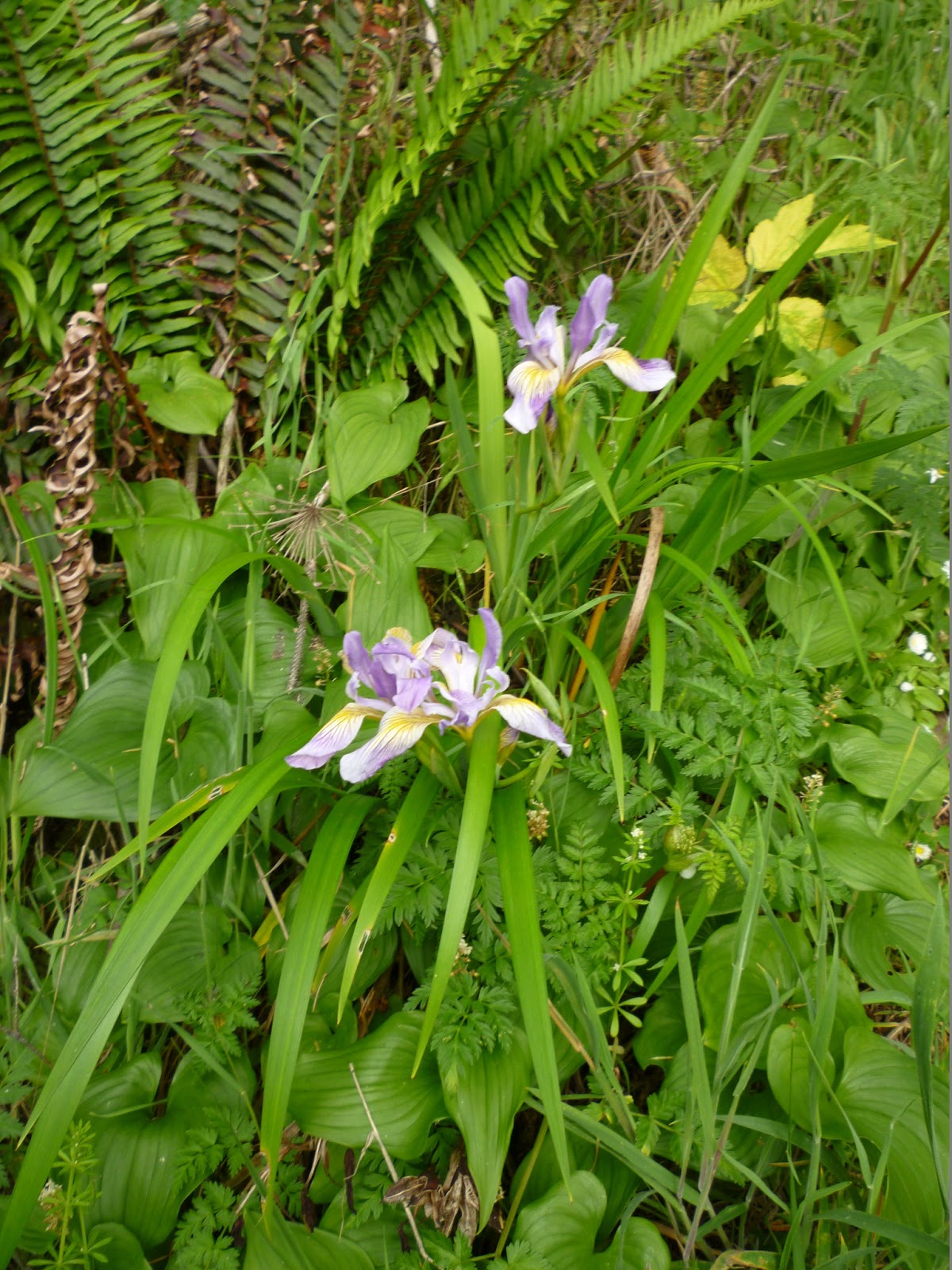
wild iris

From southern Oregon we headed northwest to the coast. This trip involved lots of driving, of which I did a fair amount, and that kept my nose out of a book and my eyes on the scenery. I tried to memorize the components of the lush countryside, forests thick with every kind of tree, bordered by wide bands of blackberry hedges in bloom. The Deer Brush (mentioned in my last post) in white and blue made big pastel splashes, and I’m sorry to say that a species of noxious weed, Scotch Broom, was rampant here, making gaudy yellow blotches on the hillsides in quantities I’d never seen before. I now do believe what they say: Broom is taking over.

Cow parsnip bloomed everywhere, too. It wasn’t until we got to the coast and walked down to the shore that I noticed what seemed to be two types of cow parsnip. I had to wait until we got to Pippin’s house a few days later to read in her wildflower books and get the two cousins straight. They are both in the Apiaceae family, also known as the carrot or parsley family. The one on the left below is the more familiar-to-me Cow Parsnip, Heracleum maximum (named after the god Hercules) and on the right is Angelica lucida, known as Sea Watch or Seacoast Angelica. That one doesn’t grow so much inland.

Cow Parsnip and Seacoast Angelica


Wish I could identify the viney blue flower that grew nearby, in the middle of the photo at right, but I’ve already spent a fruitless hour trying. Anyone?

enlargement of the unknown flower above

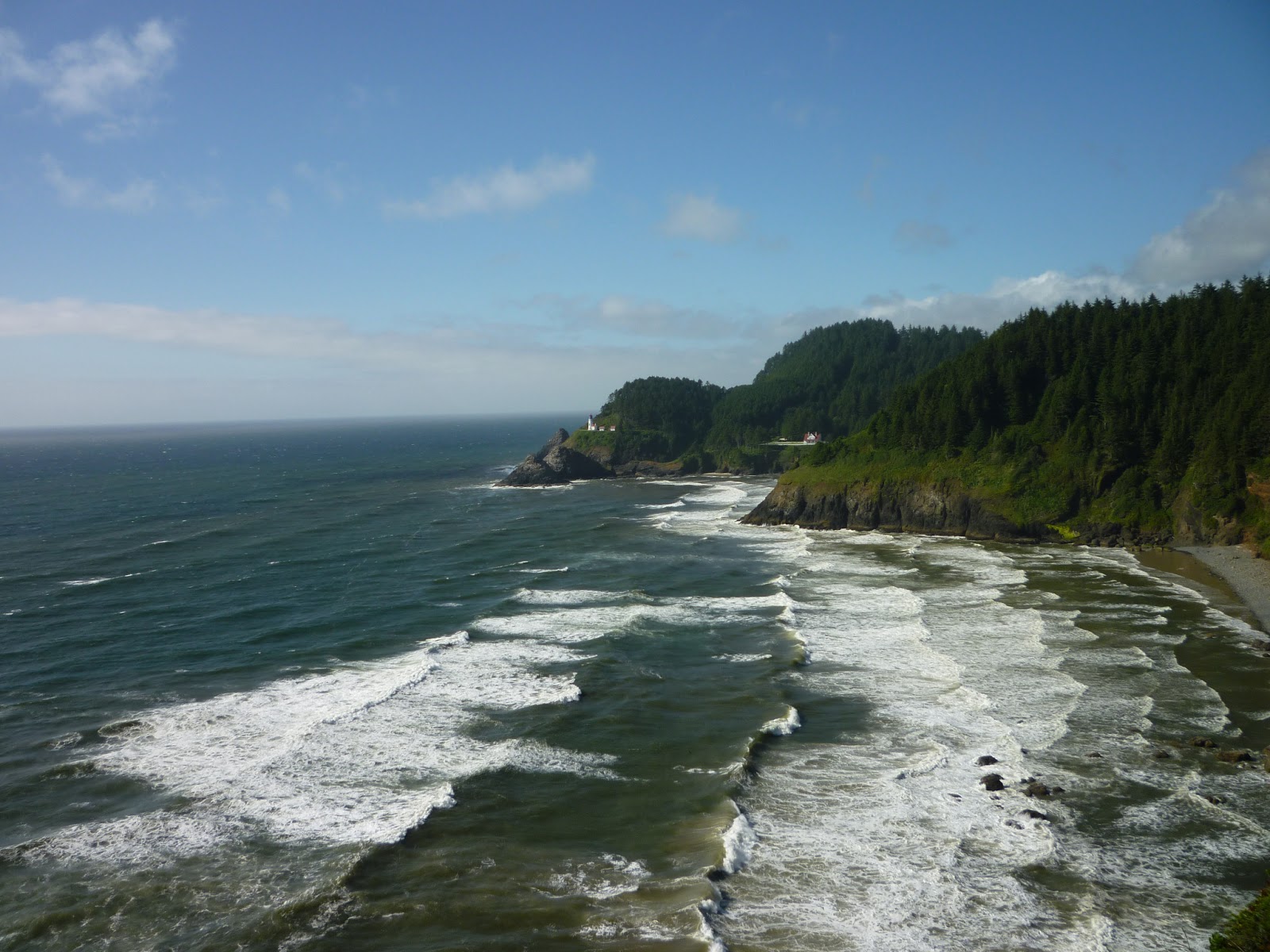
Heceta Head Lighthouse in the distance

Our first night on the coast was spent in Yachats, where our room looked out on this scene. That made the long drive worth every mile – nothing like going to sleep to the sound of ocean breakers.

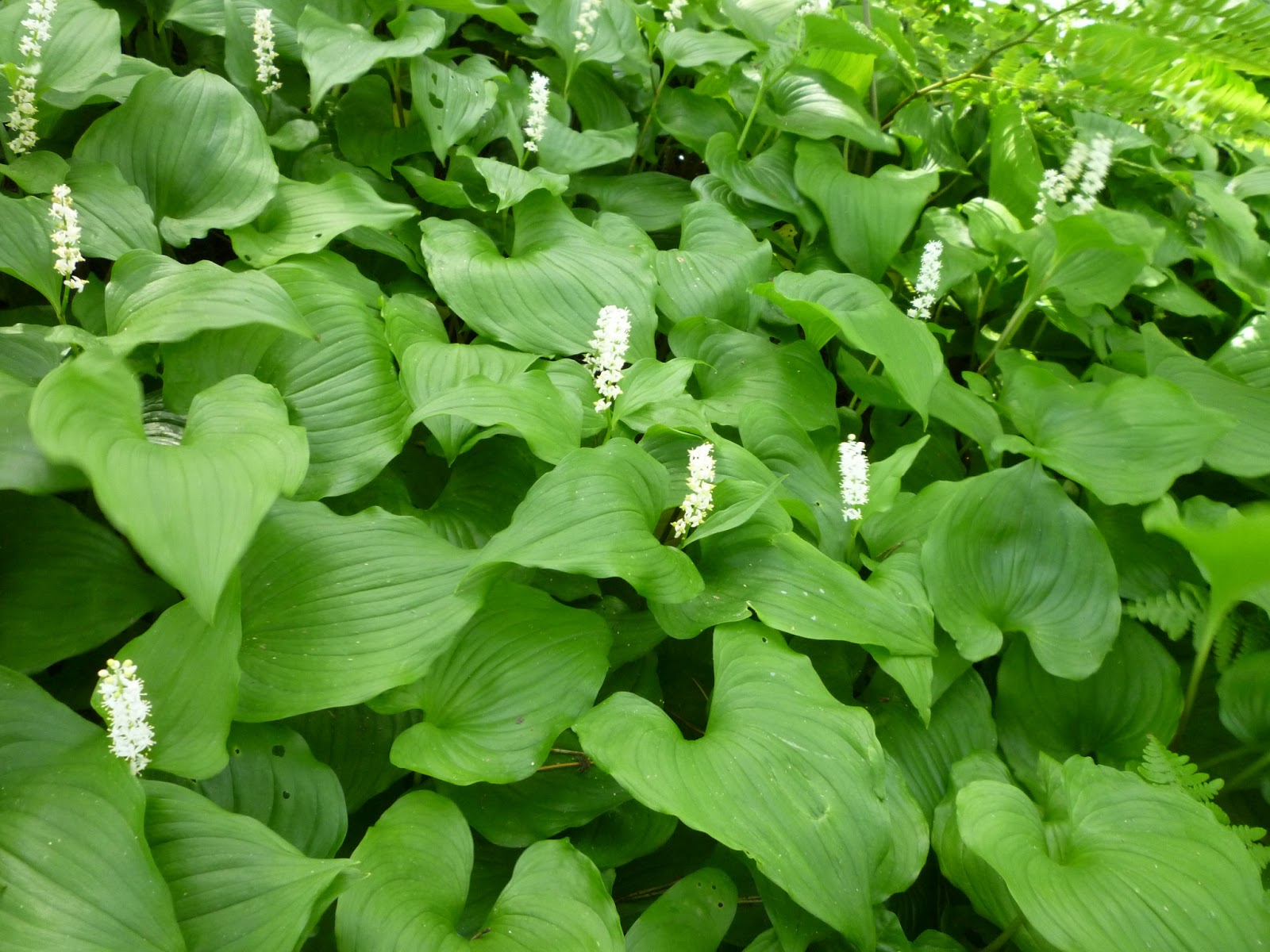
One more plant was new to me, and I eventually found it in an Oregon wildflower guide: Maianthemum dilatum, common name False Lily of the Valley or May Lily or Two-leaved Solomon’s Seal (below).

Maianthemum dilatum

Wherever we drove or walked, big rhododendrons met us around every corner, covered with big pink or red or white blooms. Purple vetch and foxgloves, long-stemmed white daisies blowing at the roadsides, and even giant blue lupines added to the visual feast.

We did stop at the famous Oregon dunes on our way up the coast, miles of broad and high sand dunes you can get lost in. I left my shoes in the car and trudged up a tall sand hill, the wind blowing my pink flowered skirt all over. Deep sand is the most cushiony thing you could desire to hold you up, so after pausing a minute at the top to look all around, I galloped down again, feeling young and strong.

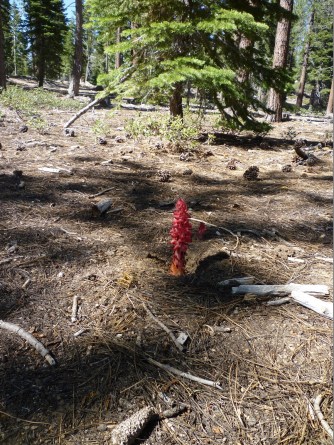
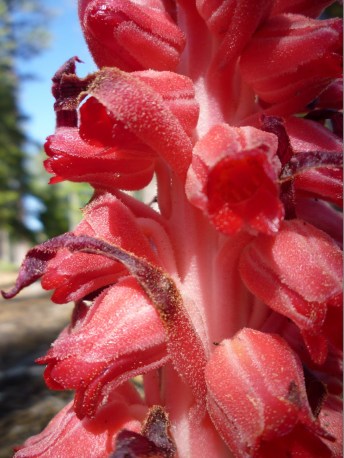
The parasitic snow plants are blazing at Tahoe.

Mr. and Mrs. C. invited us to their cabin again on the south end of Lake Tahoe. At 6,000 ft. elevation it’s still pretty brisk in May, but the sky was SO blue, the lake was SO blue, and the air was dry, full of the smells of pine trees and cedars with some wood smoke thrown in. I breathed deeply.

Here is a map if you need to get your bearings. The lake itself lies on the Nevada-California state line. We usually approach from the southwest and drive through the state capital of Sacramento to get there.

I had escaped the world down below where picture storage was one of the many time-consuming computer problems that had recently worn me out, and I arrived with a reluctance to use my camera. Of course that didn’t last long, especially when wildflowers are out. May in the Sierras brings flowers you can’t see in the summertime, so I had to seize my opportunity, didn’t I? My other blog posts about the Tahoe area have different photos from what I came away with this time.

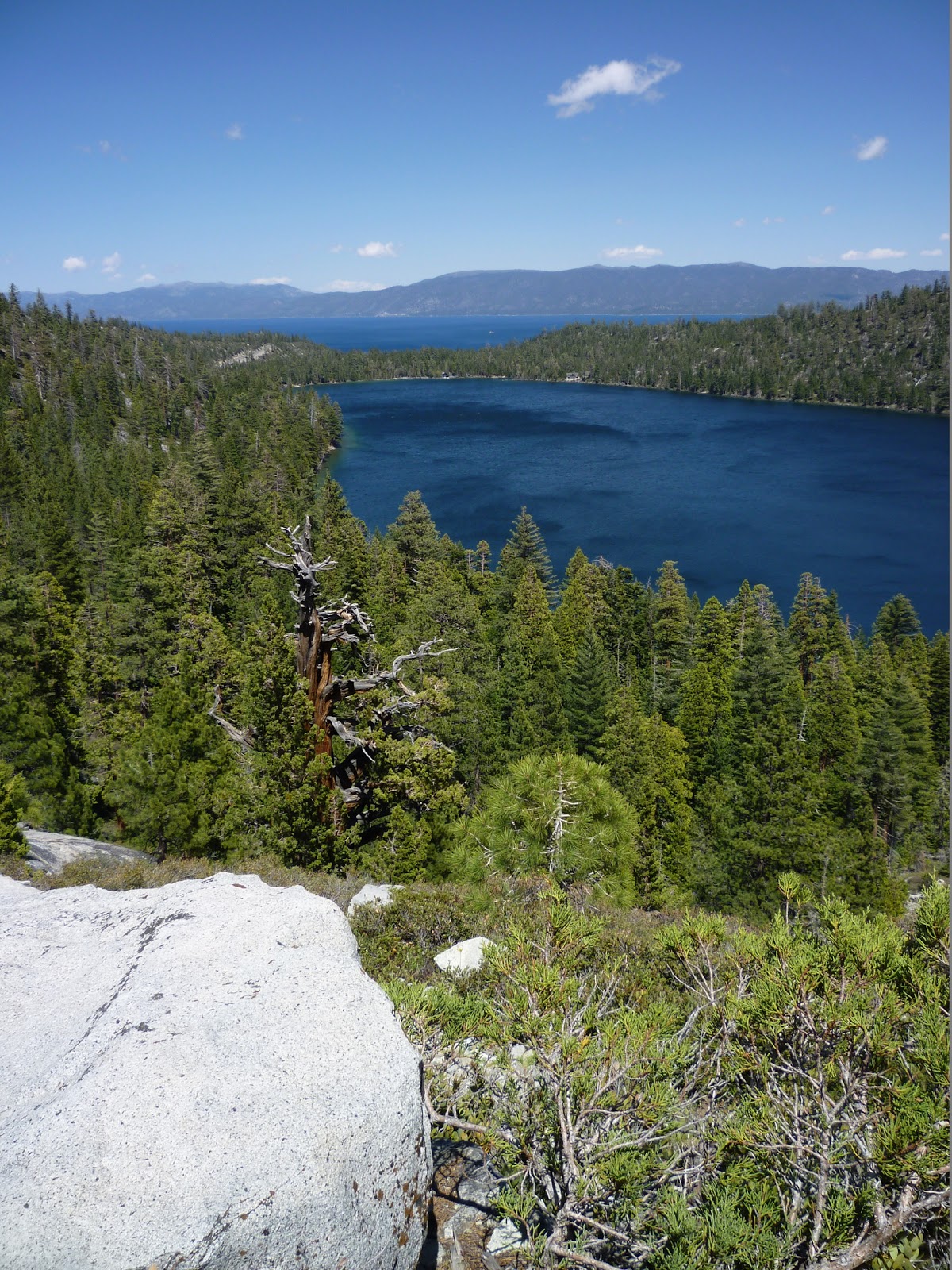
Cascade Lake in foreground, Tahoe in distance.

We hiked to the top of Cascade Falls one day. It drops and flows into Cascade Lake which lies just south of Emerald Bay, a little higher in elevation. This picture was taken from a granite shelf looking as straight-down as I could manage to the bottom of the falls.

Sticky Cinqefoil
                      This looks to me like some kind of buttercup but I haven’t found it in a book yet. (Update: I added the caption after one of my readers enlightened me.)

The Snow Plants have popped up all over, here and there on the floor of the conifer forest, with no leaves. Mrs. C. was coveting one, wondering how she might get a specimen to grow near the cabin, but what I found out on Wikipedia when I came home makes me think that would be near impossible to make happen.

The snow plant is sarcodes sanguinea, the only species in the genus sarcodes, in the heath family. It is unable to photosynthesize its own food, “…a parasitic plant that derives sustenance and nutrients from mycorrhizal fungi that attach to roots of trees.” Now I can imagine the roots of these bright plants extending deeply into the world of tree roots. If we are lucky, perhaps the right conditions will in the future concur and surprise Mrs. C. with a burst of red.

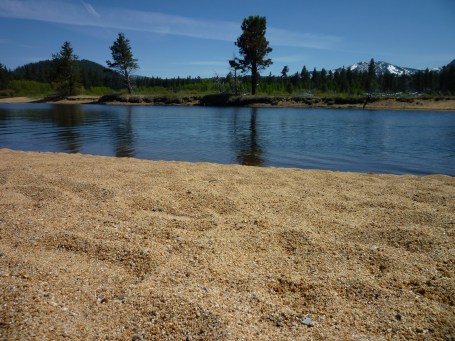
A lagoon by Kiva Beach

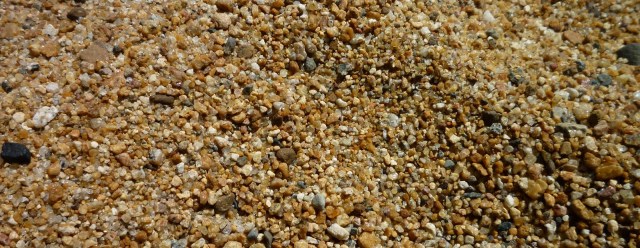
Another color that got my attention was the sand around Lake Tahoe. We took the yellow lab to swim and fetch and I sat on the shore and considered how all the grains of sand were warm golden tones, not like any ocean beach I’ve seen.


Wooly Mule’s Ears, also known as mountain mule’s ears, were in bloom, and I got a photo of them as in a perennial bed planted by Mother Nature, with a border of Squaw Carpet in front.

Wyethia mollis and Ceanothus prostratus
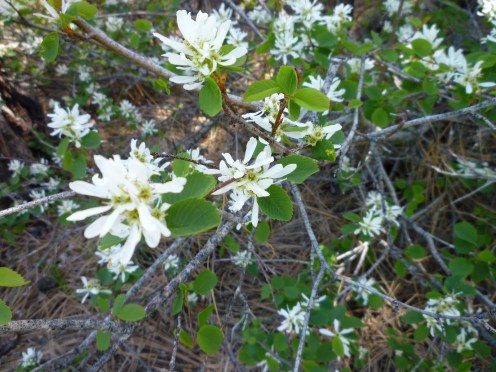
Here’s a nice flowering bush that I don’t know. Maybe someone reading this knows this plant? It grows in the forests on public land and in private yards. (Update: the same reader in a comment below is kind enough to tell us that this is Western Serviceberry.)


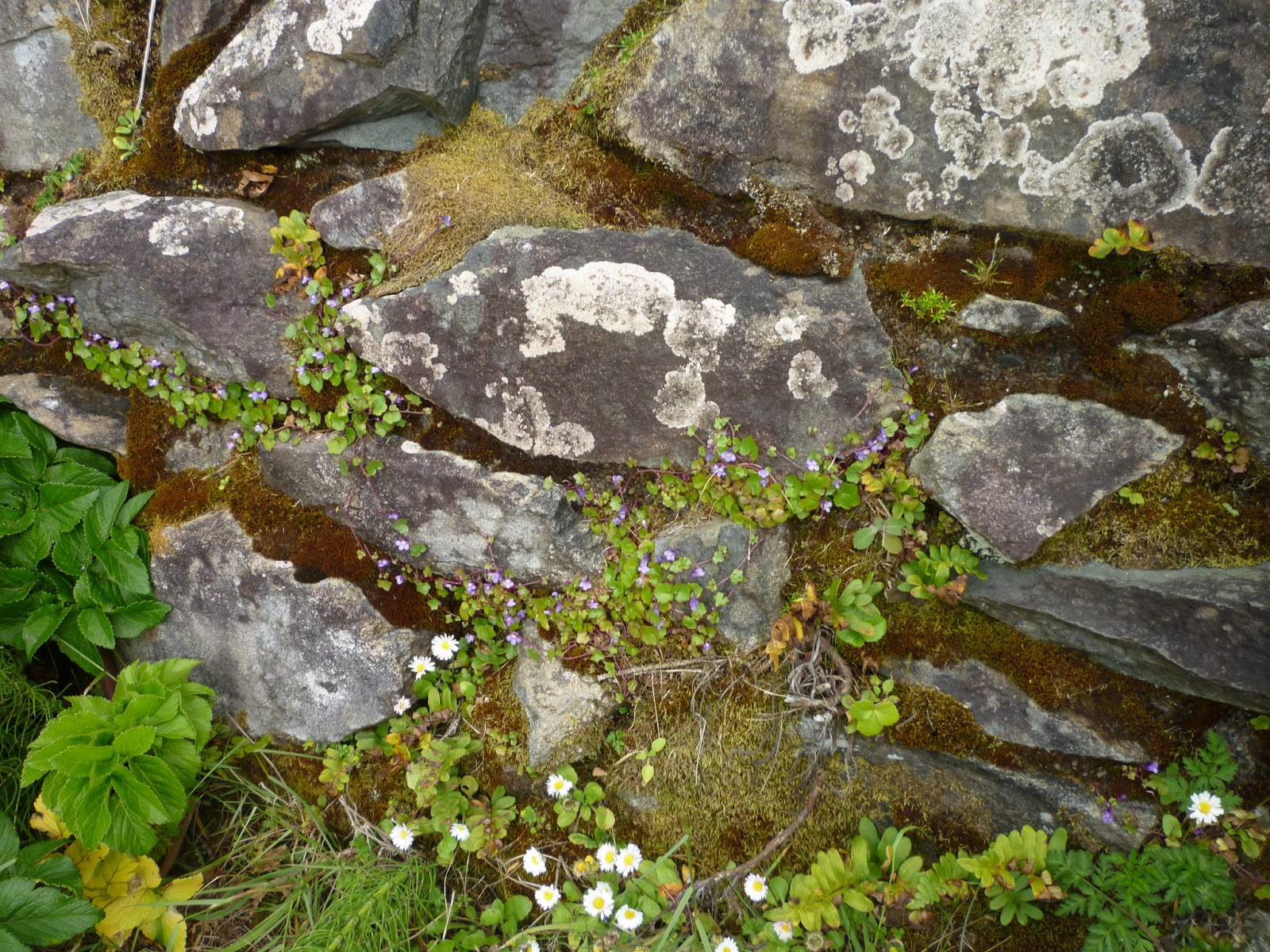
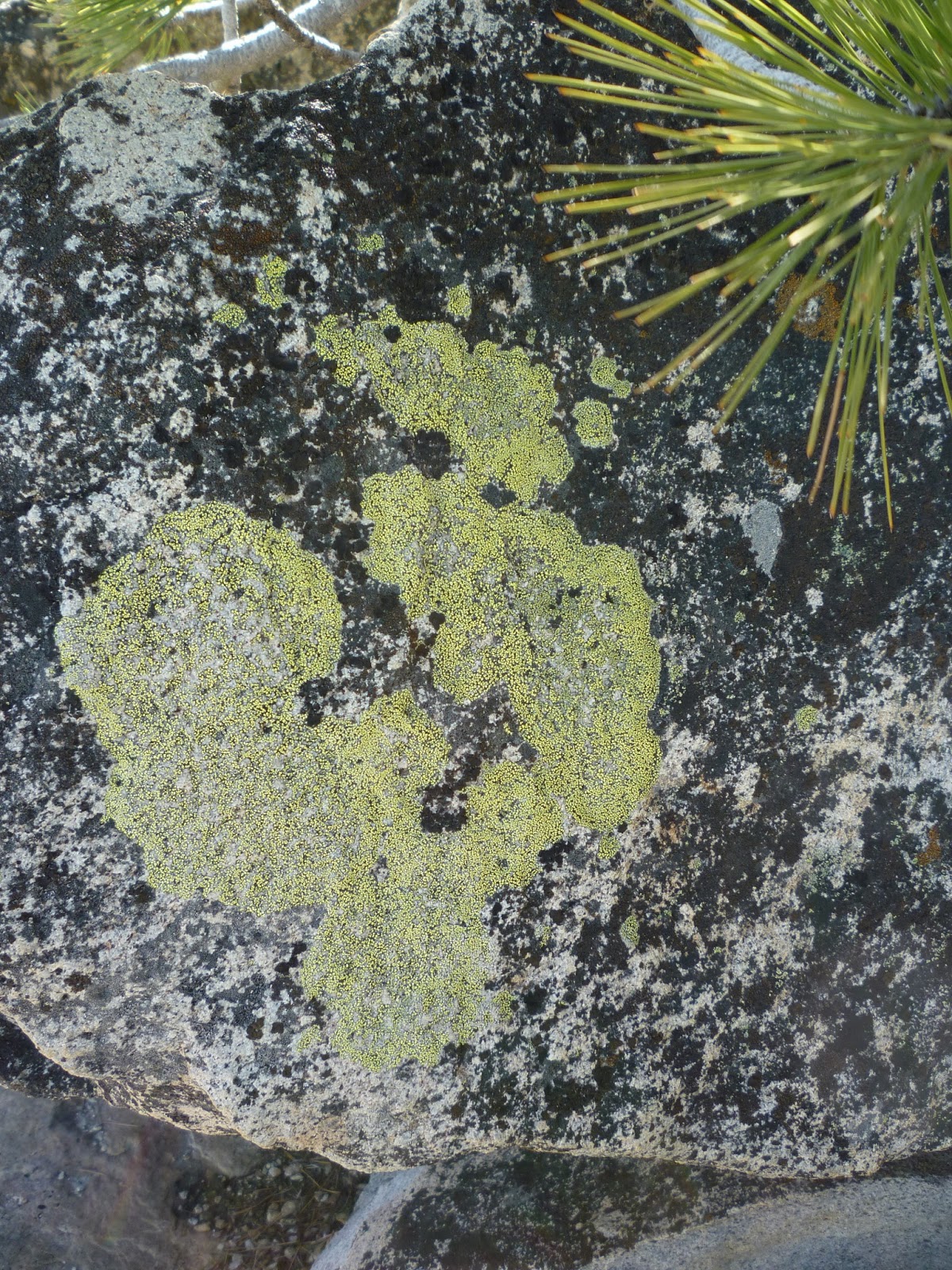
Did you ever do a Google image search of “lichen”? Amazing, amazing plants. Here is one of the more subtle designs, which we saw on a rock at the top of Cascade Falls, a lovely arrangement of vegetable and mineral and just one example of how God’s artwork is splashed all around the world for our pleasure and His glory. Thank You, Lord, for the refreshment.

Snow falls but I am warmed.

On the plane to Philadelphia I got halfway through Metropolitan Anthony Bloom’s God and Man. It helped to calm my jitters that had developed since the initial excitement and decision to go to my last remaining aunt’s memorial service. I was about to arrive at an event and to enter a house and family where every person was a stranger.

Eeek! What was I getting into? Metropolitan Anthony encouraged me with words about love and life, and before I knew it a first cousin once-removed was hugging me at the airport and driving me to a houseful of other huggers and gracious people. I stayed up with them later and later every night sharing stories of our grandparents and parents, digging up memories and laughing with happiness over all the many connections we have by way of genetics and family traditions.

The realities of The Kingdom I had been reading about are certainly pertinent to the activity in my heart last weekend, but I’m still debriefing myself about what happened. I may never figure it out enough to put it down in words, but it was exciting and glorious.

What I am able to do is share some photographic images of the little bit of Philadelphia I experienced. Cousin #1 put me in The Nursery at her house, which is decorated in the most comforting and cozy way, with pictures of the Teddy Bears having their picnic, and Babar, and more pictures and items that probably helped me feel that I was falling asleep with the Sandman’s help as when I was a child. Stuffed animals sat around on the stuffed chair and on the extra bed, and green leaves were painted on the creamy yellow wood floor.

In the kitchen Revere Ware pots had been hung on the wall – hey! just the way Grandfather used to do! – and science “experiments” I won’t describe sat on a shelf all ready for the grandchildren, my first cousins twice-removed. Flowers filled the air with sweetness – We would soon load them in the back of the car to drive to the memorial service and reception.

See that orange towel on the kitchen counter above? I brought it with its citrus-y design as a gift to remind my cousin of the boxes of oranges my father sent across the country to their family every Christmas in bygone days.

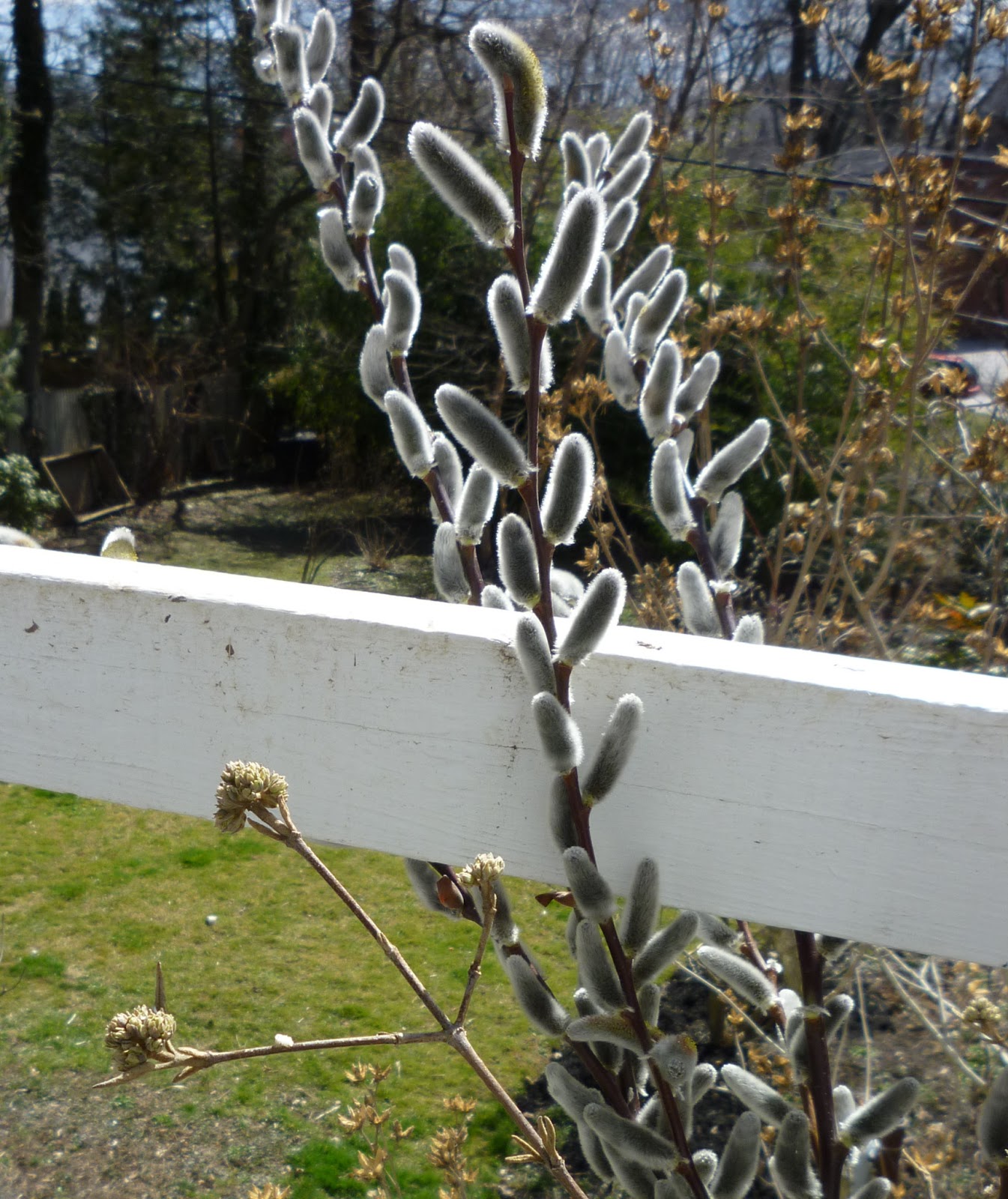
Out back, raised beds were awaiting spring planting, and pussy willows budded right off the kitchen porch. I sat on the steps going down to the garden to talk on the phone to Mr. Glad who was still back in California missing me.

The morning of the memorial service we walked a block to the train station to meet daughter Kate who had come from D.C. to be with me. She had never even met her great-aunt whose life we were honoring that day, but she was happy to get acquainted with the cousins, and she slept in The Nursery in the bed next to me.

One night Cousin #3 cooked dinner for the two of us at her place, a very “vertical” row house in South Philly, narrow and rising five levels. She honored the first owners with a photo on the wall showing a very sober and Italian wedding party featuring the bride-and-groom owners. It’s a pretty old house of the sort that has (newly refurbished) rosettes on the ceiling in some rooms.

All the long weekend, all the folk I met were amazed at how much I resemble my late aunt; the cousins in our branch of the family haven’t been together in a long time, and for most of their lives they had been daily surrounded by people related to my aunt’s former husband. I was happy to provide a facial link to her instead. We pored over all the old photos we had assembled, staring at the faces as though trying to penetrate the souls of our ancestors to understand who we are.

I woke up the morning of my departure to see the ground all white, and snow falling. The birds arrived at the feeders, and I even saw a female Cardinal for the first time. I’ve never lived where this classic red bird does.

After I was dropped at the airport, I wandered around waiting for a flight that was delayed for weather, and wondered at how fast I had made a fast friend of my cousin. Someone told me before I set off on my adventure that a cousin is sort of like a sister, but better in that you don’t have the tension that can happen between siblings.

So it seems at this point, and I’m grateful for the gifts of God. He is everywhere, of course, even in the middle of a bunch of strangers. We don’t have any love that doesn’t come from Him. But that provides plenty.