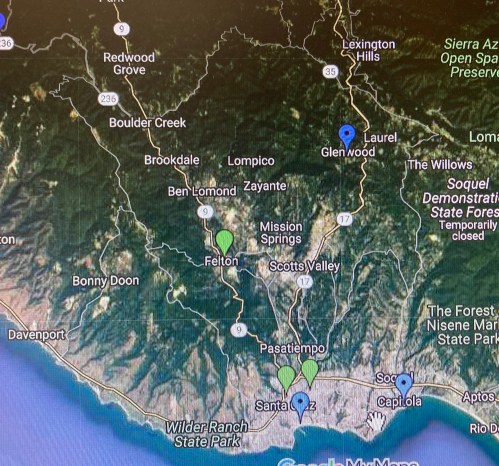
Soon after returning from Pippin’s forest dwelling in the northern reaches of California, I drove southward to the Santa Cruz mountains, where I hadn’t visited for six years. My Airbnb was quite close to Henry Cowell Redwoods State Park, and also to the cousins whom I was visiting.
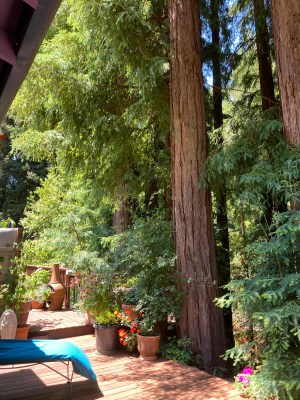
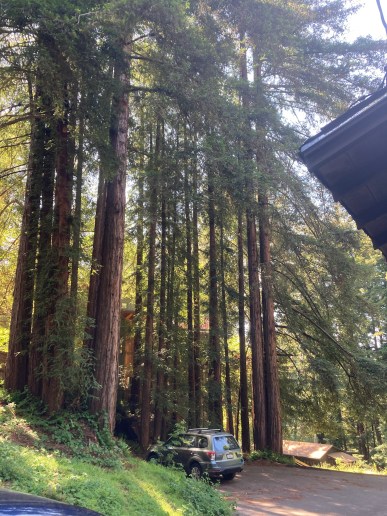
This area is where our extended family used to have a cabin, at Mount Hermon, just up the hill from Santa Cruz, under the redwoods. Under the redwoods is the theme of this whole area, which I had apparently forgotten, because when I came into town and found my lodging, and found again my cousins’ place, I was astounded by the height of the forest and its unique scents. I know, I was just remarking similarly about Pippin’s trees, but of course these are a unique experience, in a different climate zone. The forest here is mainly redwoods, madrones, and oaks. Fog is abundant, and redwoods thrive in it.
The cousins’ driveway.
My first encounter with dogwoods was in the understory of these towering trees, many decades ago. Little towns have nestled on the slopes and along the creeks since the 19th century, and humans have planted their own shrubs and flowers that thrive, and add to the good smells that rise up when the morning fog dissipates and the sun draws out their essences.
The climate this far south and close to the ocean is very mild. Sometimes the winter passes without a frost; this June is cooler than usual here as it has been farther north.
But summer has officially arrived! My cousins and I ate seafood on the wharf at Santa Cruz, with views of the boardwalk and the beach. We drove as far south as Capitola, and north to Boulder Creek; the sun came out every day, eventually, and flowers bloomed everywhere. We were nourished by all the beauty (and great food), but primarily by our memories, and our affection for one another.
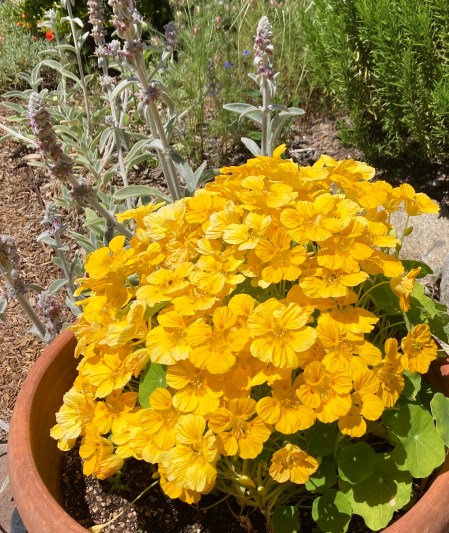
Now I have returned home, and see that my garden has filled out a lot just from the beginning of the week to the end. The layers of blooms and textures are different, now that the ixia has faded and the succulents and lavender are coming into prominence. In the last few years it seemed that the yarrow was dying out, but now I think maybe it just needed extra water, because after the wet winter it is doing great.
Everything looks pretty when the sun shines through in the evening. The acanthus is so tall, and the heuchera, whose flowers change tone week by week as they dry up; they started as greenish white, and now are ever darkening orangey brown…
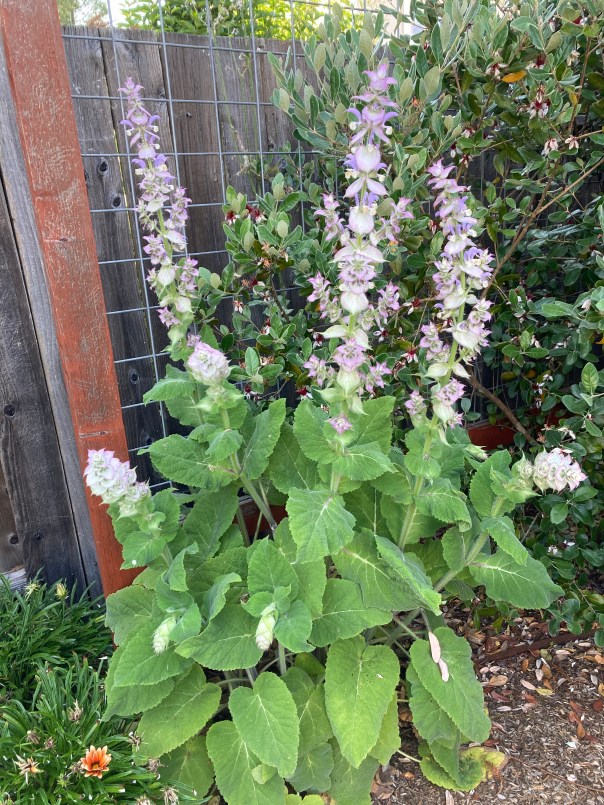
Clary Sage
I’ll be traveling again in just two weeks, to visit Kate and her family in D.C. In the meantime I plan to take advantage of the energizing warmth of summer, and enjoy every moment, in the garden and all over the place. Summer is the best!
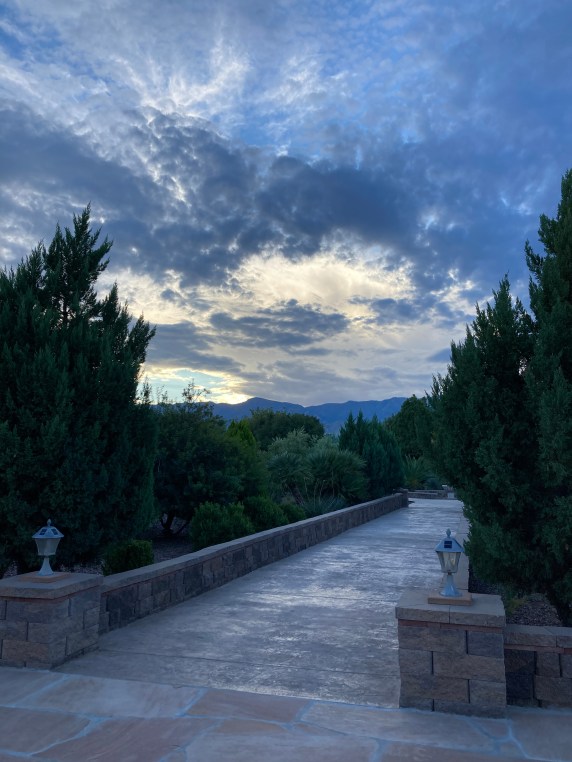
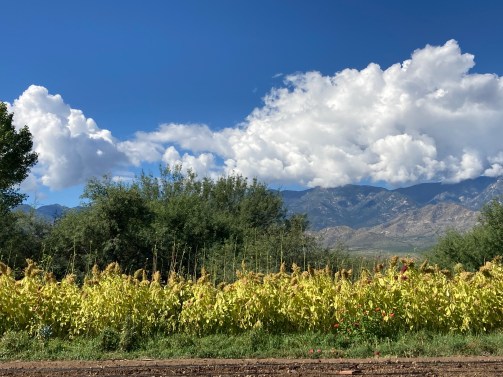
The monsoon season officially ended in Arizona on September 30, but at least one rainstorm was not keeping to that calendar. The evening that we arrived at the high-desert monastery we enjoyed a loud thunderstorm and showers that continued through the morning.
Velvet Ash
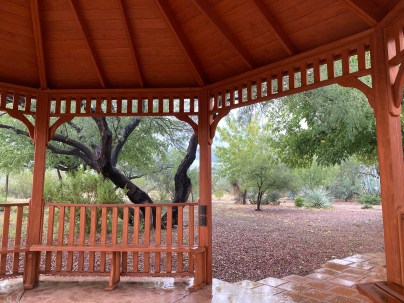
When I got caught in a shower while taking a walk I discovered this gazebo near at hand, where I waited a few minutes until the rain lessened.
Now that I have returned to northern California (where we are still waiting for our own wet season to begin in force) I feel that the spiritual watering I received is liable to evaporate to nothing if I don’t take more time than I have so far, to process what seems like a deluge of impressions and experiences.
I’ve been thinking about an article from Father Stephen Freeman, about Living in the Real World. Here is an excerpt:
A monk lives in a monastery. He rises early in the morning and prays. He concentrates his mind in his heart and dwells in the presence of God. He will offer prayers for those who have requested it. He will eat and tend to the work assigned for him to do. And so he lives his day. He works. He prays.
And someone will say, “But what does he know about the real world?” But what can they possibly mean? He walks on the earth. He breathes the same air as we do. He eats as we do and sleeps as we do. How is his world any less real than that of anyone else on the planet?
A man lives in a city. He wakes in the morning, turns on the TV as he gets ready for the day. He dashes out the door (he’s running late). He gets to his car, listens to the news on the radio, takes a couple of calls on his cell phone. He gets to work and for every minute he does something that he thinks of as “work,” he spends at least another checking his email, looking quickly at Facebook, and maybe checking the news. He gets into an argument at lunch about what should be done somewhere else in the world and who should do it. Angry and distracted, he is frustrated with himself because he swore he was not going to have that same argument today. He goes back to work with the same routine. After work he drops by a bar, has a couple of drinks and decides to stay and watch some of the game. He gets home late and heads to bed.
Who is living in the real world? The man-in-the-city’s life is “real,” it actually happens. But he is distracted all day from everything at hand. He never notices himself breathing unless he’s out of breath. He swallows his food as quickly as possible. Even the beers he has at the bar are as much for the buzz as for the taste.
If the man refrained from these things his friends might taunt him, “What are you? Some kind of monk?”
What is the “real” that we should live in?
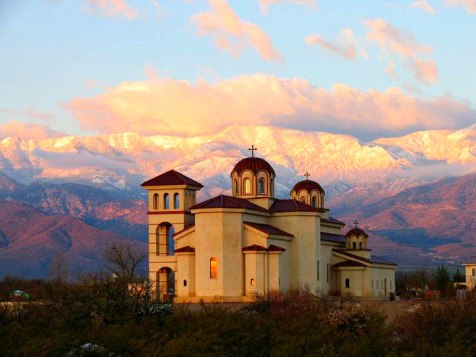
The sisters at the monastery demonstrate a quality of life that is closely grounded in the earthly, incarnated existence that God has given us, with all its limitations and glories. Their orderly life, hard work and continual prayer create an oasis of beauty and holiness.
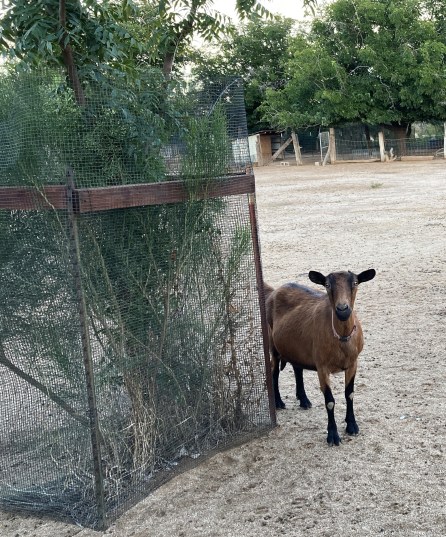
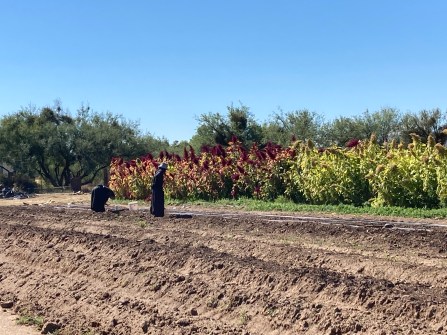
From their chickens, ducks and guinea fowl they collect eggs. From a little herd of goats they get plenty of milk for their own use and to sell to soap-makers. Pomegranate and apple orchards and vineyards supply more fruit; and they take the fruit of 850 olive trees to press into oil and cure into olives for eating. Over the years they’ve learned to drive tractors and do construction of their buildings, among dozens of other skills.
Guest quarters and bookstore are in this building.Goat milk feta was available to guests for breakfast.
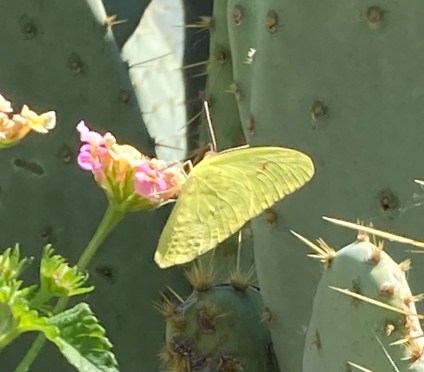
I took many pictures of plants and butterflies! Lantana is interspersed with prickly pear cactus in the landscape, and we saw several species of swallowtail butterflies, skippers, this Cloudless Sulphur, and Queen Butterflies feasting on those flowers.
While at the monastery our group of women woke in time for Matins at 5:30. Vespers was at 3:50 and Compline after dinner. One morning of our visit Divine Liturgy was served soon after Matins. (The sisters have more services in the night, just for them.) Standing and praying in church (and sitting when we couldn’t stand any longer) was a huge shower of blessing, of course.
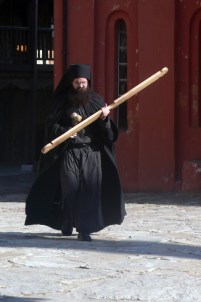
One of the sisters walks around the property beating the hand-held talanton (semantron) to announce both services and meals. This picture of the talanton is from Mt. Athos; St. Paisius Monastery tries to keep the monastic rule and tradition of Athonite monasteries.
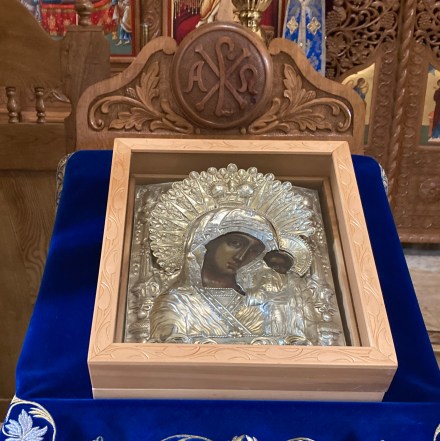
When we arrived they were coming to the end of the Feast of the Cross, with the accompanying red altar cloths. Soon the cloths had been changed to blue, which is the default color, in honor of Christ’s mother, the Theotokos.
One image that comes to mind regarding the idea of pilgrimage is from the novel Kristin Lavransdatter, set in medieval Norway. Kristin sets off on foot with only her infant child for company, and walks to a holy site far enough away that she has to sleep outdoors on the way, I don’t remember how many nights. Her food is whatever she has brought in her bag.
Such a pilgrimage that takes serious commitment and protracted journeying would no doubt lend a different flavor to the experience, compared to our group’s monastery visit that was so easy and comfortable, and quick. Do I even qualify to be called a pilgrim?
One afternoon I sat on a bench next to this quiet moth, about an inch across, and I felt some camaraderie with his dull color. (He was much more “boring” in his actual size.) Maybe I, too, could just cling to the monastery for a time, blending in as much as possible with its unique color, the way the moth clung to the bench, and soak up the grace by clinging.
My friend Lorica comes into my story at this point. She was in our group, and had compiled a booklet of songs for us, titled “Spiritual Songs for a Pilgrim Journey.” We sang from it in the van on our drive from the Tucson airport.
Whither goest thou, oh pilgrim, with thy staff in hand? Though the wondrous mercy of the Lord go I to a better land.
The lines above remind me that my whole life’s journey might be called a pilgrimage, and this too-brief trip was a reminder of what my Real Life consists of. I want one day to return to St. Paisius or to visit another monastery to help me further on my way — if I do I hope it is for a much longer visit! — but in any case, it is through God’s wondrous mercy that I travel in the right direction moment by moment, wherever I find myself.
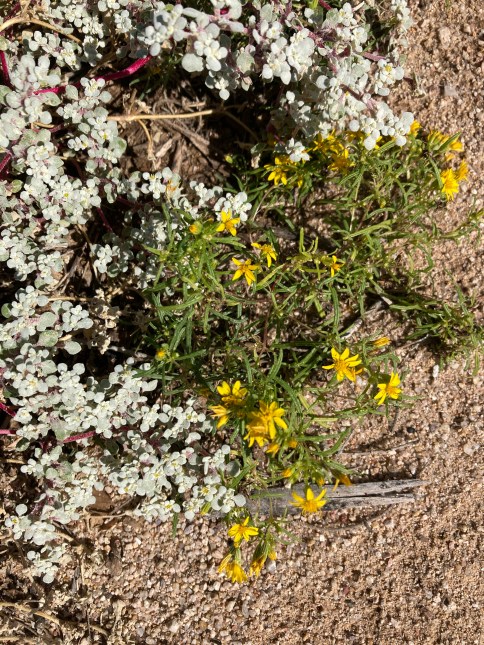
Lorica helped me in another way, on our first full day of our visit. As we were having a tour around the property, she said, “Something that we are walking on is very aromatic.” I hadn’t noticed, but I looked down and saw these little yellow daisies growing like weeds along and in the path. I broke off a stem and we knew that that was the aromatic plant. It was delicious to my own senses, and new.
I learned that it is the Southwestern native pectis papposa, or chinchweed, and they say it can sometimes be found in Mexican markets sold as limoncillo.
On the day of our departure, I was standing by the van waiting for the others and watching the butterflies again, when I noticed a big clump of chinchweed right there. A stem of it just fit into a pocket of my backpack, so I brought it home as a memento of the visit. It is sitting near me now on the sideboard, dried up and having lost not quite all of its spiciness.
The intangible things that I brought home from the monastery — I pray those stay with me longer, whatever they are. Because the aroma is sweet, and powerful. I think it’s the scent of holiness.
This week I am one of several women from my parish who are flying together to Arizona, on pilgrimage to The Holy Monastery of Saint Paisius. I don’t expect to be posting to my blog for a few days, but I thought I would share this quote from their patron St. Paisius Velichkovsky that the sisters have on their website; he offers plenty to meditate on while I am away:
I IMPLORE and exhort you, my beloved fathers, brethren, and children, in the following: Love the Lord with all thy soul and all thy heart. Be righteous and just, submissive, with bowed head and your mind turned towards heaven. Have contrition towards God and men. Be a consoler of the sorrowful, patient in trials, and not given to irritation, bountiful, merciful, a feeder of the poor, receiver of strangers, sorrowful for the sake of sins, joyful in God, hungry and thirsty, meek, patient, not a lover of glory, not a lover of gold, a lover of your neighbor, not hypocritical, not proud, a lover of labor for the sake of God, silent, pleasant in replies, fervent in fasting, in frequent prayers, vigils, and psalm-singing, sensible. Do not judge any man, but condemn yourself. And for this you will be the child of the Gospel, the son of the Resurrection, the inheritor of life in Christ Jesus our Lord. To Him may there be honor and power and worship, with the Father and the Most Holy Spirit, both now and ever and unto the ages of ages. Amen.
Please pray for us. ❤
Holy Monastery of Saint Paisius in Safford, Arizona
As I was making my last sweep through the house to make sure I hadn’t forgotten anything, my attention was caught by movement outside the kitchen windows, and I delayed my departure five minutes because of birds: doves, finches, a dozen juncos, a titmouse, a chickadee, a pair of Nutall’s woodpeckers — many hanging off the suet feeders to fortify them against the freezing weather coming through.
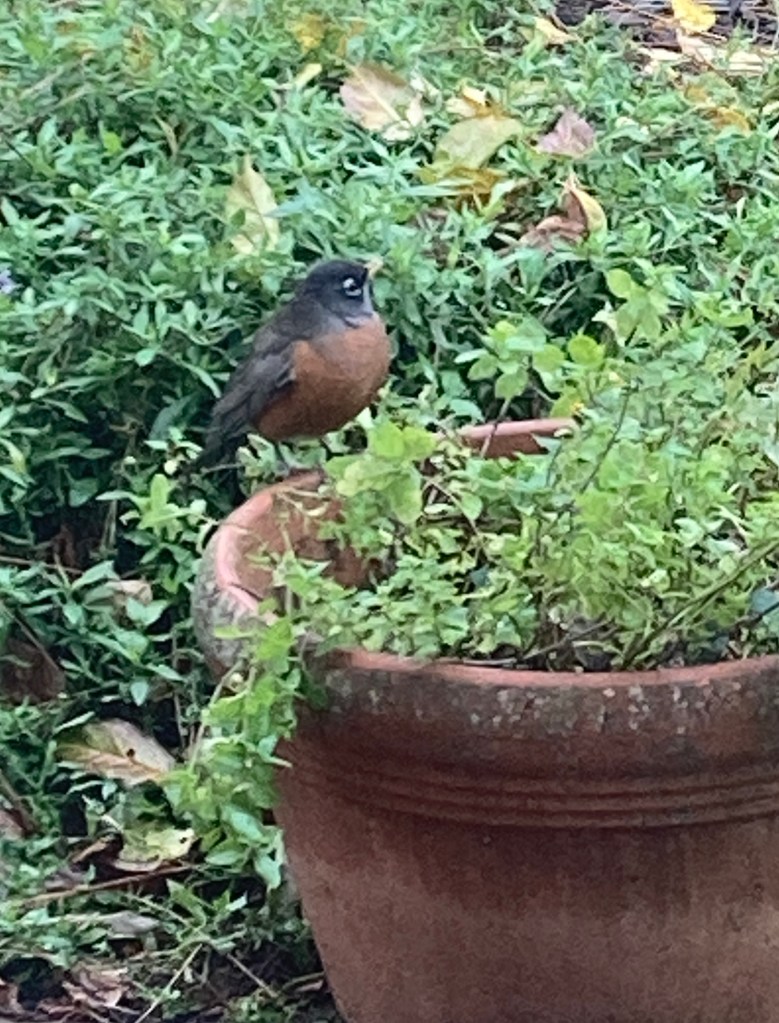
And this guy, whom I stared at for as long as he perched there, not recognizing him, as he was the biggest, fattest robin I have ever seen.
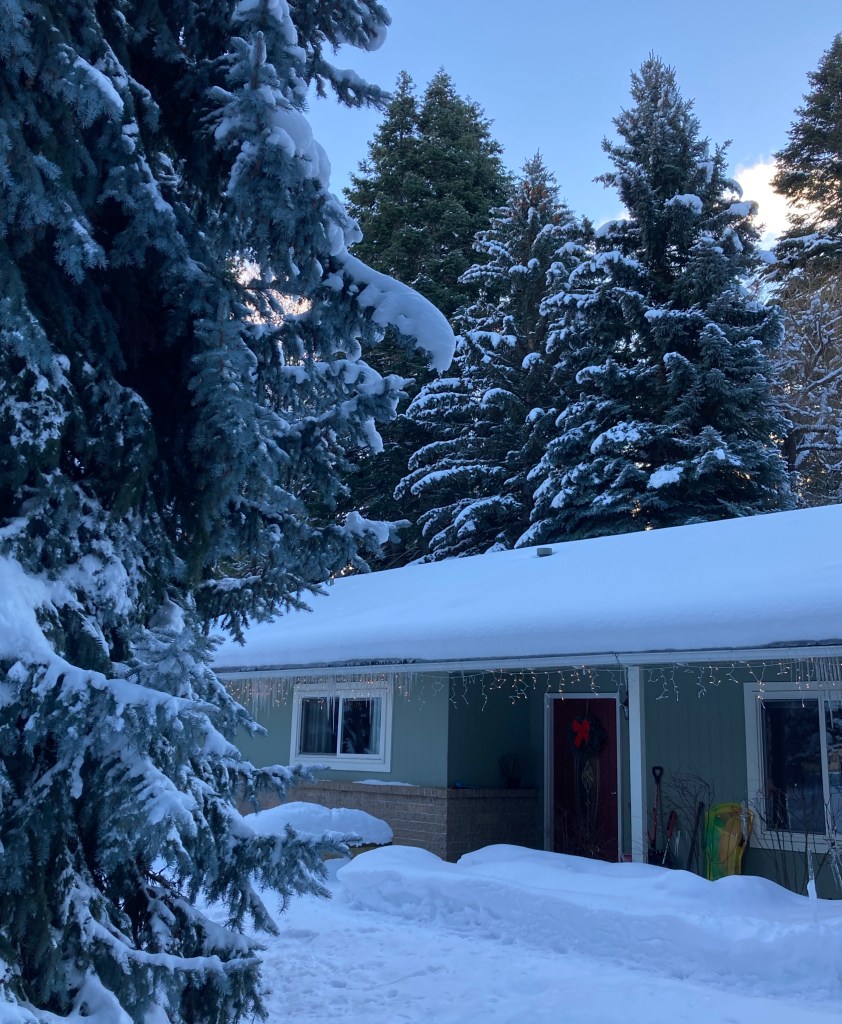
Then, I loaded myself in the car and off I drove, north to daughter “Pippin’s.’ The first hours were through winter-greened and gentled landscapes.
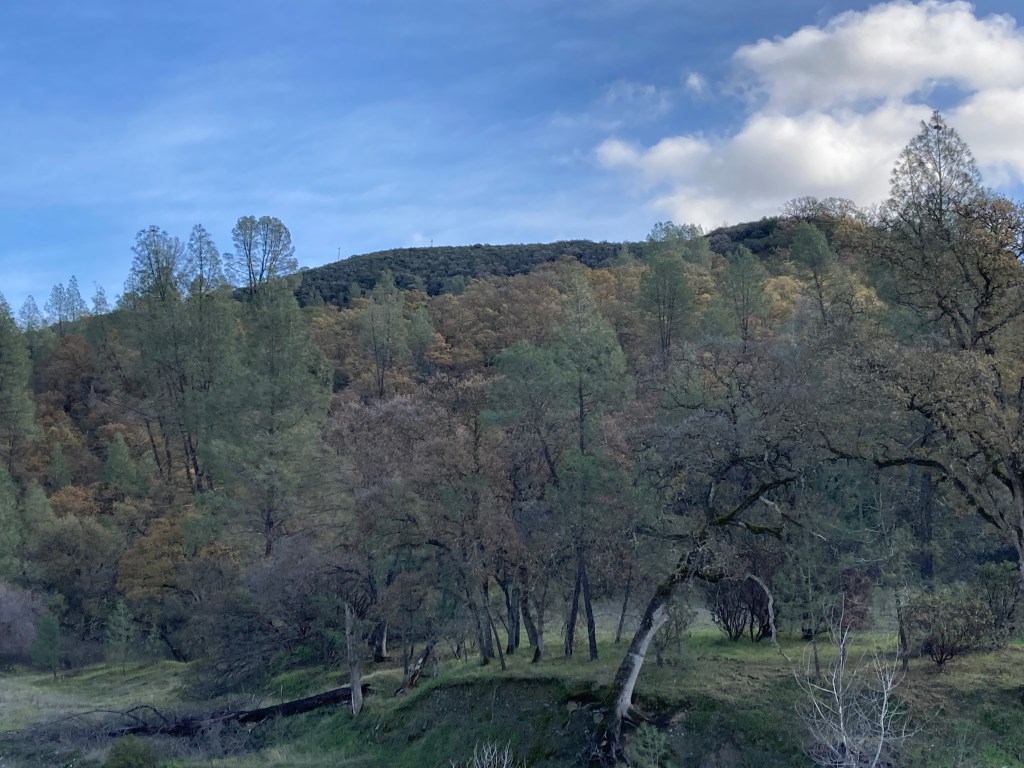
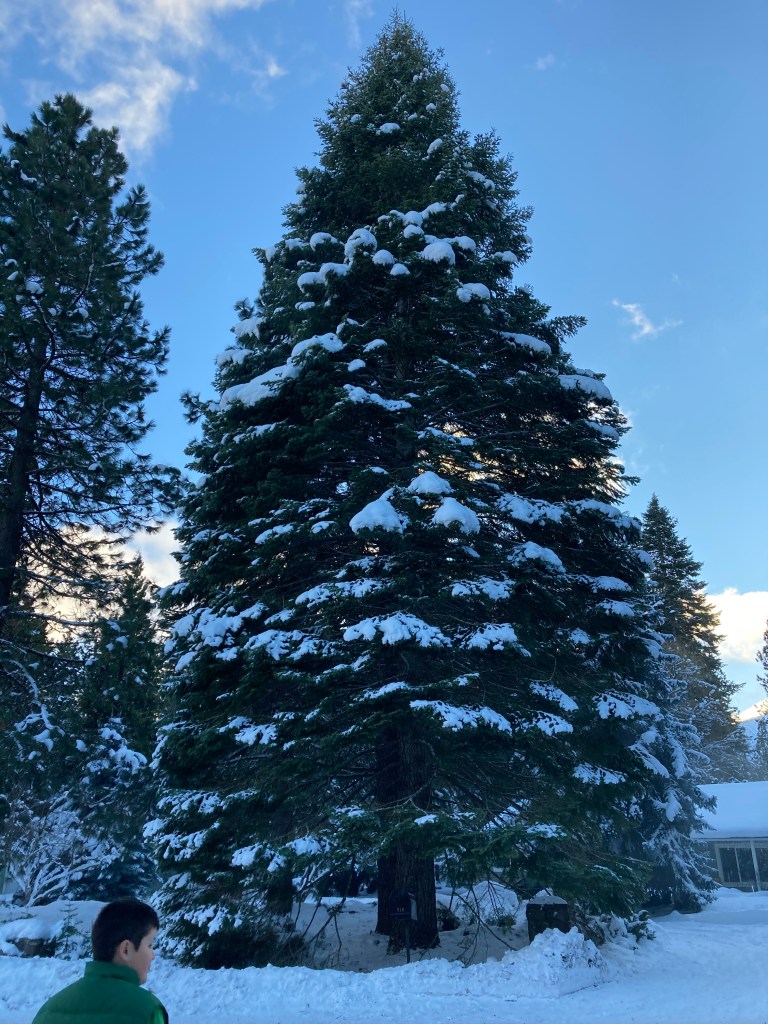
But now I am in the mountain forest.
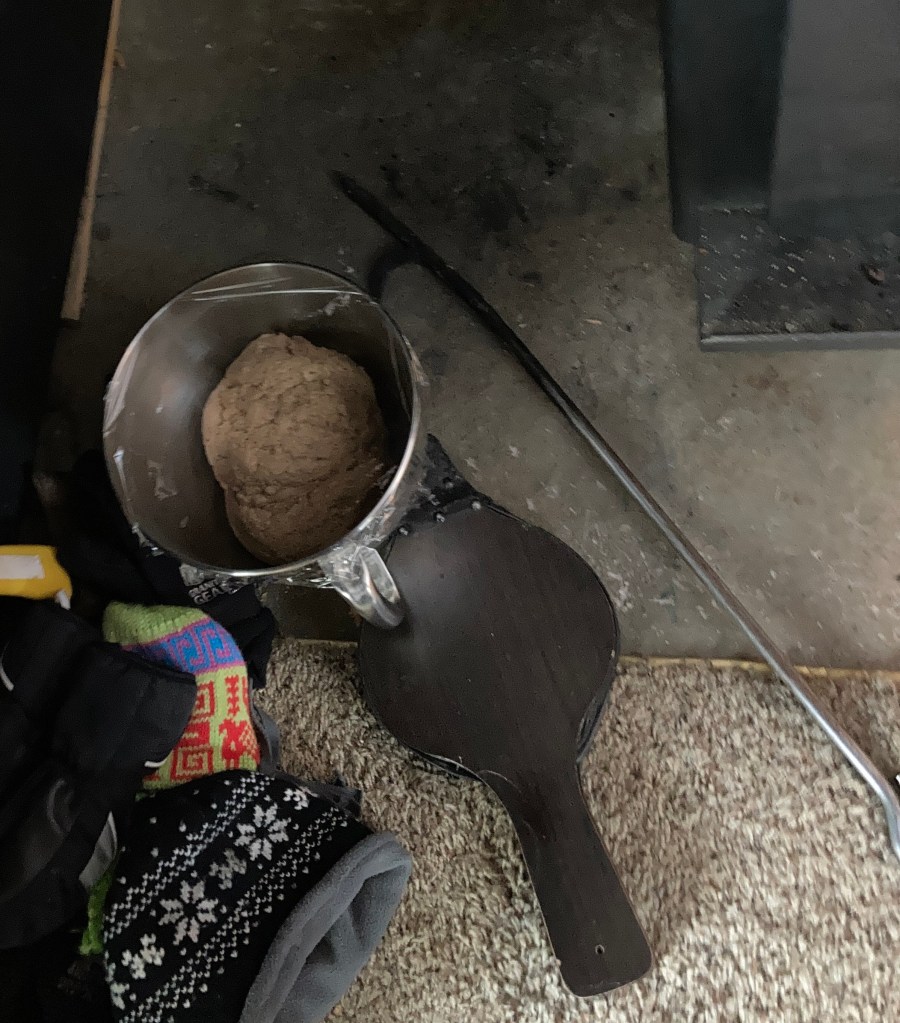
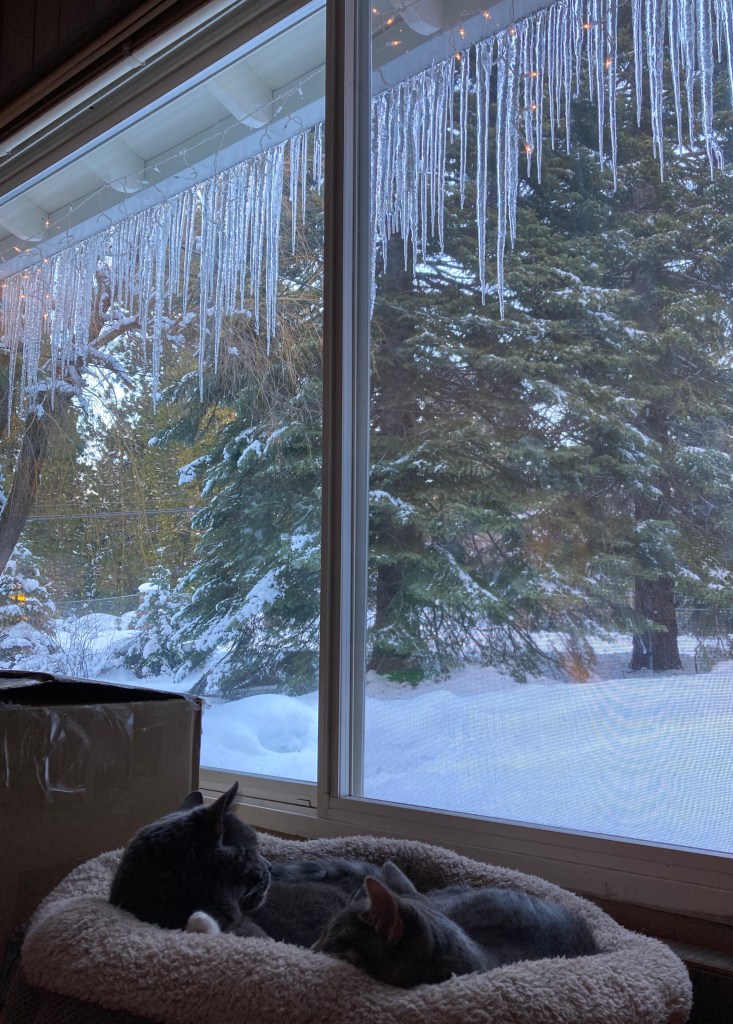
I forgot to pack my laptop, so this post may come out a bit strange. When I arrived Pippin was just putting bread dough to rise next to the woodstove, and cats Fred and Duncan were not feeling the winter at all.
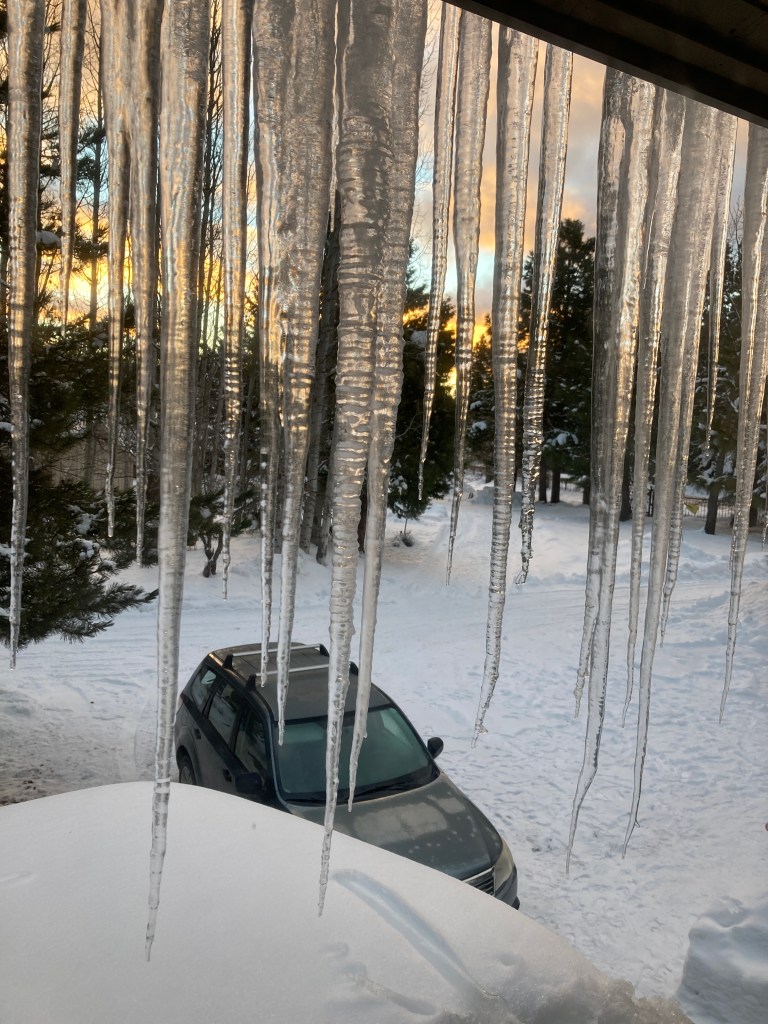
Scout helped me unload my car, and we admired icicles together.
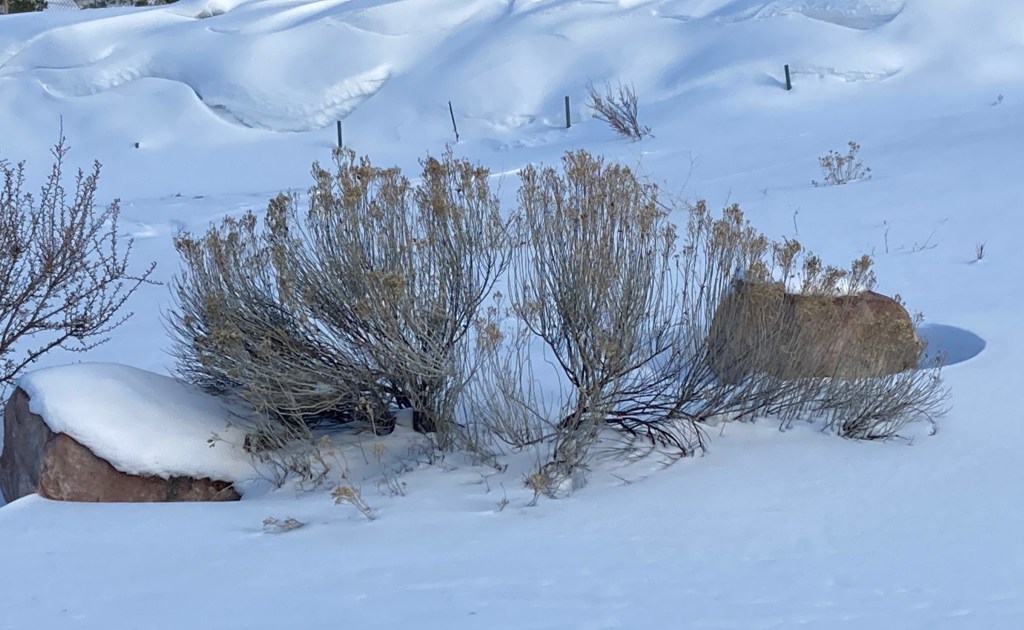
This morning I woke in a cozy room with this view out my window:
Dear Readers who have kept me company here during the past year, or who only recently stopped by, I hope that in 2022 you also find comfort and peace. My advice: Try not to stand under large melting icicles.














 Such a pilgrimage that takes serious commitment and protracted journeying would no doubt lend a different flavor to the experience, compared to our group’s monastery visit that was so easy and comfortable, and quick. Do I even qualify to be called a pilgrim?
 I learned that it is the Southwestern native pectis papposa, or chinchweed, and they say it can sometimes be found in Mexican markets sold as limoncillo.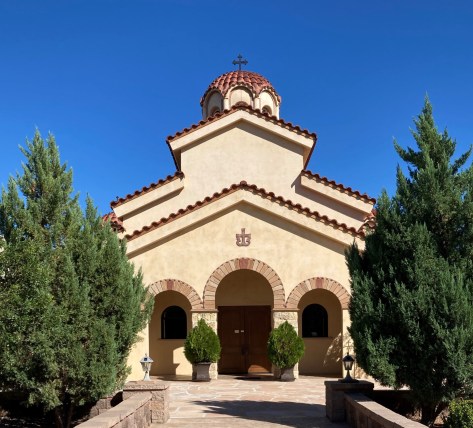




 Gladsome Lights