Category Archives: weather

You and I, we do not shrink.

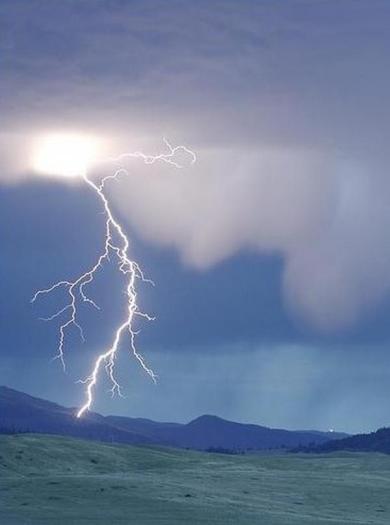
When I was in the Midwest recently I enjoyed watching through big windows the rainstorms with lightning and thunder. I don’t understand this poem’s title — can anyone explain it to me?  I did find the whole thing fun to read. But then, I’ve never experienced a hurricane.

A WATCHED EXAMPLE NEVER BOILS

The weather is so very mild
That some would call it warm.
Good gracious, aren’t we lucky, child?
Here comes a thunderstorm.

The sky is now indelible ink,
The branches reft asunder;
But you and I, we do not shrink;
We love the lovely thunder.

The garden is a raging sea,
The hurricane is snarling;
Oh happy you and happy me!
Isn’t the lightning darling?

Fear not the thunder, little one.
It’s weather, simply weather;
It’s friendly giants full of fun
Clapping their hands together.

I hope of lightning our supply
Will never be exhausted;
You know it’s lanterns in the sky
For angels who are losted.

We love the kindly wind and hail,
The jolly thunderbolt,
We watch in glee the fairy trail
Of ampere, watt, and volt.

Oh, than to enjoy a storm like this
There’s nothing I would rather.
Don’t dive beneath the blankets, Miss!
Or else leave room for Father.

-Ogden Nash
The earth’s heart and mine.

This week I discovered Longfellow’s poem, “The Poet’s Calendar,” and I liked it so much I decided to memorize it, starting with the April section. Just before dusk today, as I was ambling along the creek path, I worked on those several lines, which are so musical, within a few minutes the words had flowed right into my heart. Two sorts of hearts are featured in the poem.
April in these parts started out pretty cold, but is beginning to warm up. We had several surprise showers after it seemed that rain had gone for good — of course not forever, though our dry California summers sometimes feel like “forever,” while we wait and hope for precipitation again in the fall. One of those showers was half-frozen slush that splatted on my car’s windshield for a few minutes.

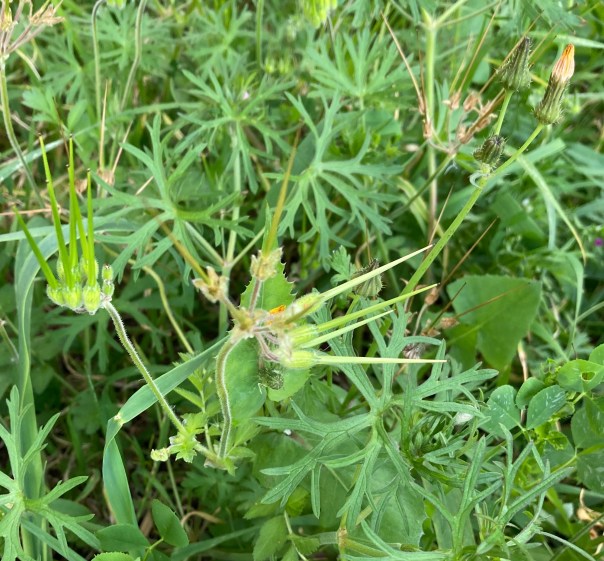
Storksbill or Cranesbill – don’t remember which…

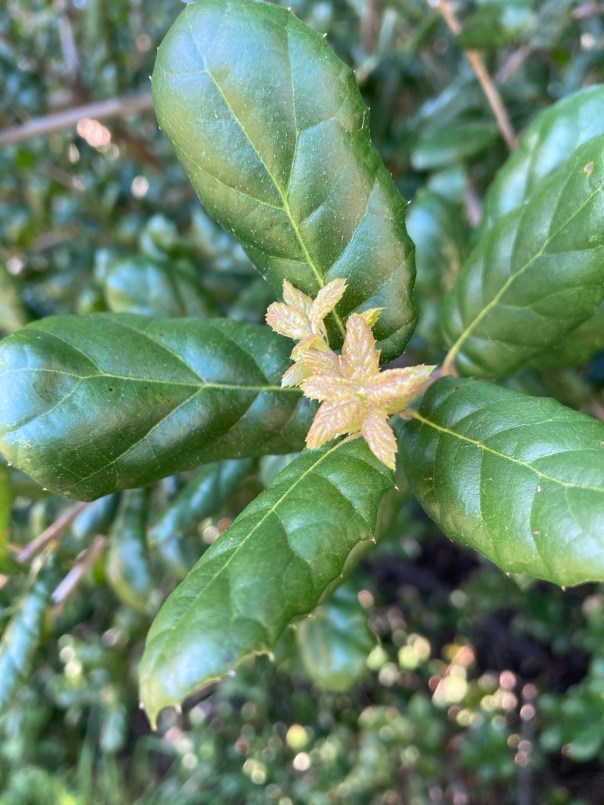
It’s easier to fit in a good walk, now that the clocks have been changed and there is more evening to work with. The live oaks along my path are sprouting new growth, and climbing roses that escaped their back yards bloom again on the chain link fence.

APRIL

I open wide the portals of the Spring
…..To welcome the procession of the flowers,
With their gay banners, and the birds that sing
…..Their song of songs from their aerial towers.
I soften with my sunshine and my rain
…..The heart of earth; with thoughts of love I glide
Into the hearts of men, and with the Hours
…..Upon the Bull with wreathed horns I ride.

-Henry Wadsworth Longfellow, from “The Poet’s Calendar”

Excitement at dusk.

The rain stopped this evening, just in time for me to walk on the bike path to the bridge. This wooden bridge spans two little creeks where they join and flow on westward through my patch of suburbia. I figured out that when I have a few more minutes available than it takes to walk around the block, I can go on this more woodsy walk to the middle of the bridge and still be back in less than 15 minutes.

What got me excited was just the utter freshness of the air after days of steady rain, and getting to see the creeks fuller than usual. It’s interesting how one is so much muddier than the other. Many wonderful plant scents were in the cool and damp air, underneath the bolder smell of wood smoke.

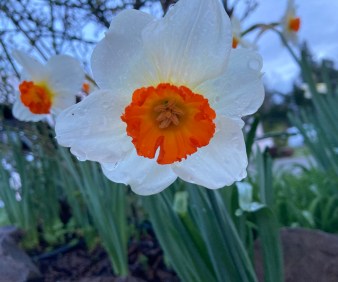
Between my house and that bike path, one of my neighbors has my favorite color of daffodils blooming right now. Their faces were heavy with rain, so I had to stoop down to get a good view of their happiness.

Let yourself get soaked.

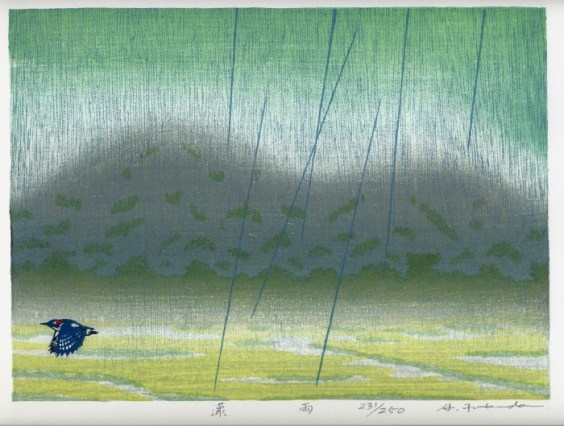
“Rain Bird” woodblock by Hirokazu Fukuda

The poem below is part of a collection of “Himalaya Poems” on the “Asymptote” website, where that magazine’s name is explained like this:

“Asymptote is the premier site for world literature in translation. We take our name from the dotted line on a graph that a mathematical function may tend toward, but never reach. Similarly, a translated text may never fully replicate the effect of the original; it is its own creative act.”

I originally read the poem on a blog that didn’t tell what century the poet was writing in, so I had to hunt around to find out that he is a contemporary Korean. On his own website he writes something that I can relate to: “I long not to finish my life as a poet. In other words, I wish I could be a poem at the end of the poet.” 
If Ko Un does manage to set off and “walk on and on until the sun sets,” and not just write about that kind of activity, then I think he stands a good chance of turning into a poem. Especially if he gets drenched! Lately I have done a lot of walking in the rain myself, and I have begun to look forward to those wet outings. I keep wondering why that is…

One friend said something about “the ions,” and online I found numerous articles about the “health benefits” of walking in the rain. Every article counted a different number of benefits, ranging from four to nine, one number per article, and that coordinated numbering was the most interesting thing about them.
I try not to take an umbrella on my walks, because of the way an umbrella usually takes my attention from the wind and water assaulting me, and forces me to give my all to one more instance of wrestling with technology, especially if it’s the pop-up type. (However, umbrellas seem to add cheer to dark and rainy paintings.) If the day is very wet, I do merely a loop around a block or two, and change into dry clothes afterward. That’s not a pilgrimage, but it makes me feel that I am walking in a (short) poem.

YOUR PILGRIMAGE

A slower pace, a somewhat slower pace will do.
Of a sudden, should it start to rain,
let yourself get soaked.
An old friend, the rain.

One thing alone is beautiful: setting off.
The world’s too vast
to live in a single place,
or three or four.

Walk on and on
until the sun sets,
with your old accomplice,
shadow, late as ever.
If the day clouds over,
go on anyway
regardless.

-Ko Un

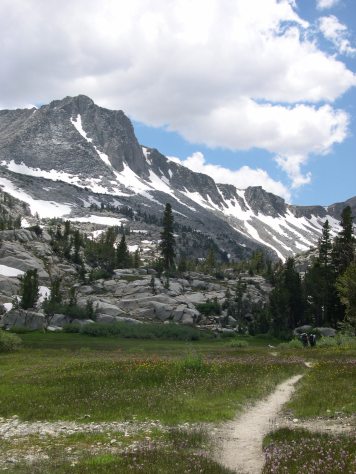
McGee Creek Trail in the Sierras