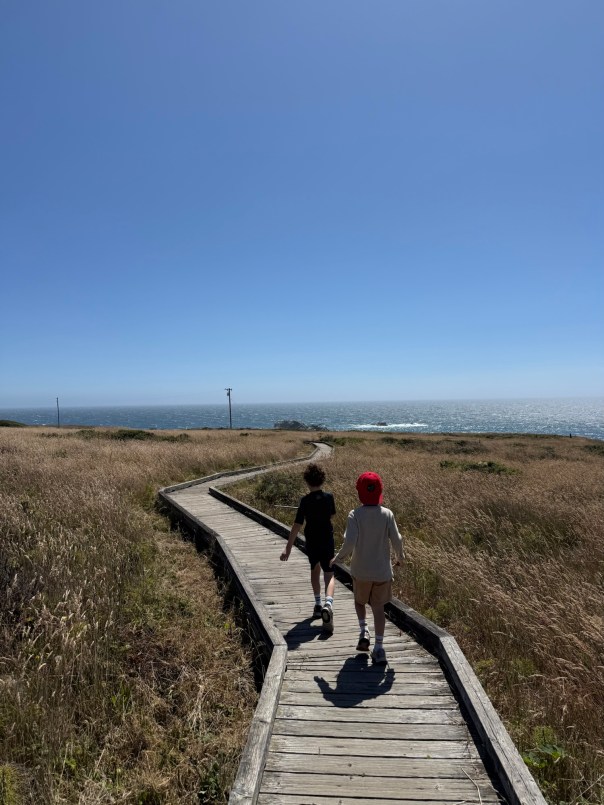
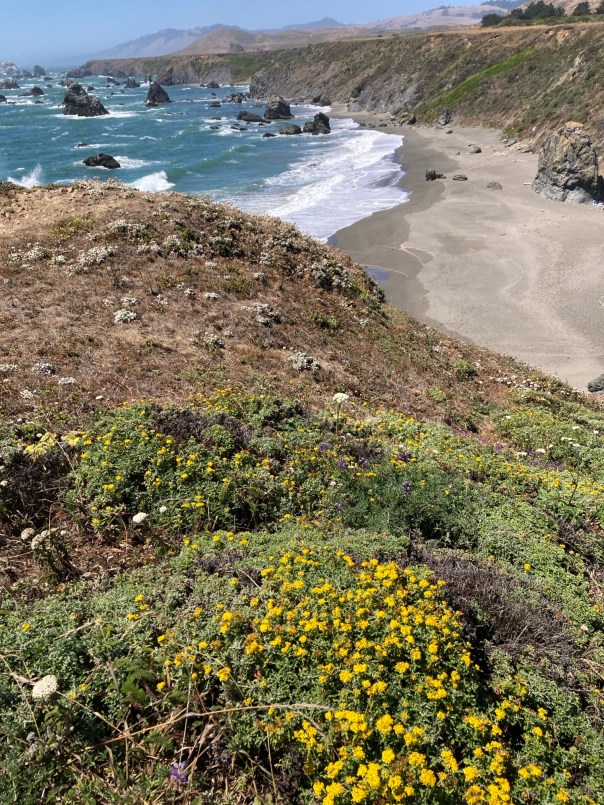
Son “Pathfinder” came from Oregon to see his sister Kate’s family, and we six packed into his truck to drive out to the coast for the day, to hike along a ridge trail and also picnic on the beach. As usual, I lagged behind half the time, making discoveries every few feet of interesting grasses and flowers, and trying to learn or remember their names.
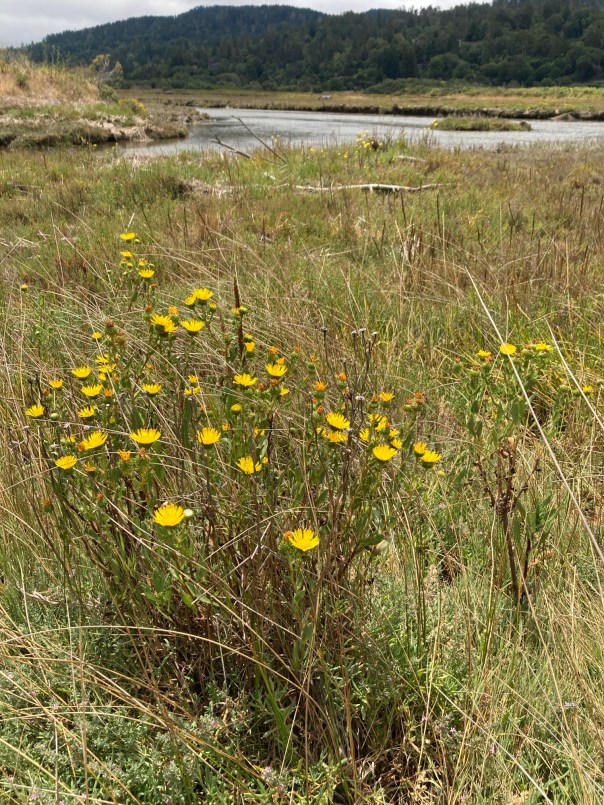
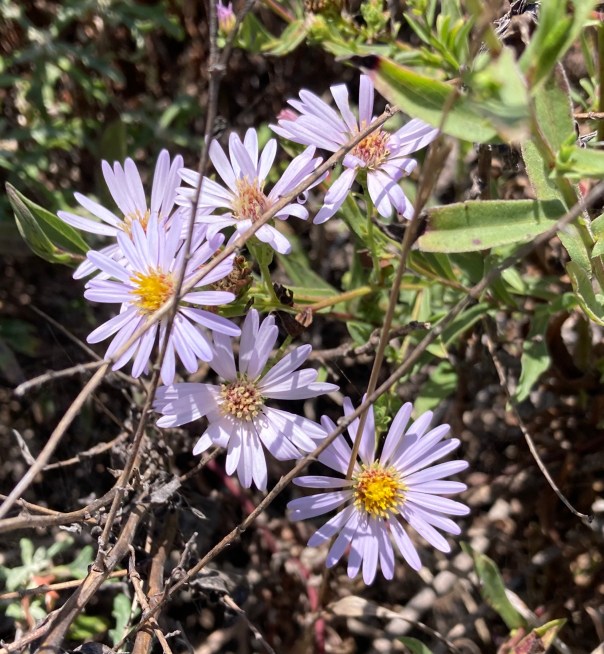
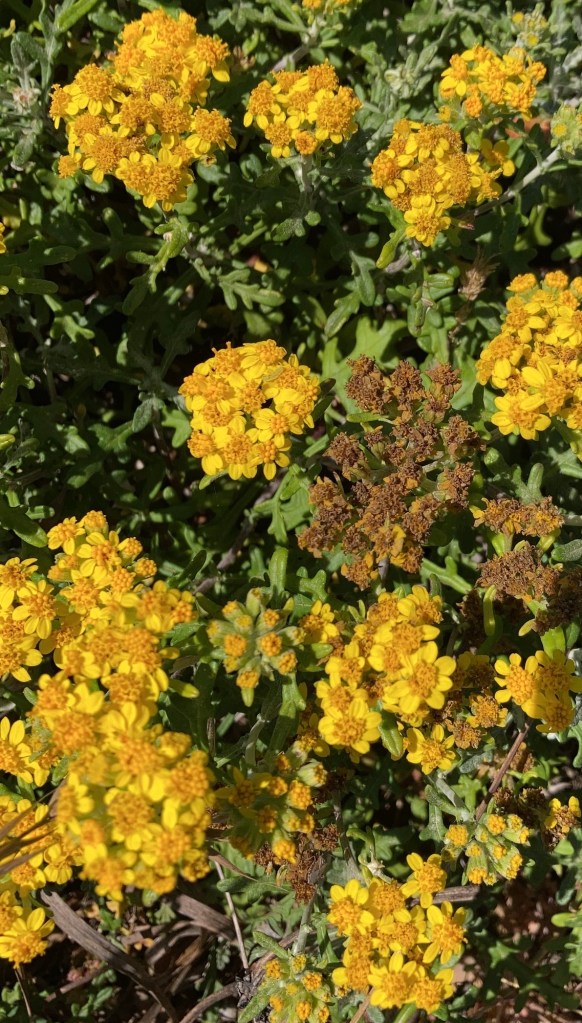
California Aster a.k.a. Pacific Coast Aster
The wind was blowing up on the bluffs, but on the beach the air was still, and Kate was able to slice cheese in her lap and pass it around to the rest of us with nary a grain of sand involved.
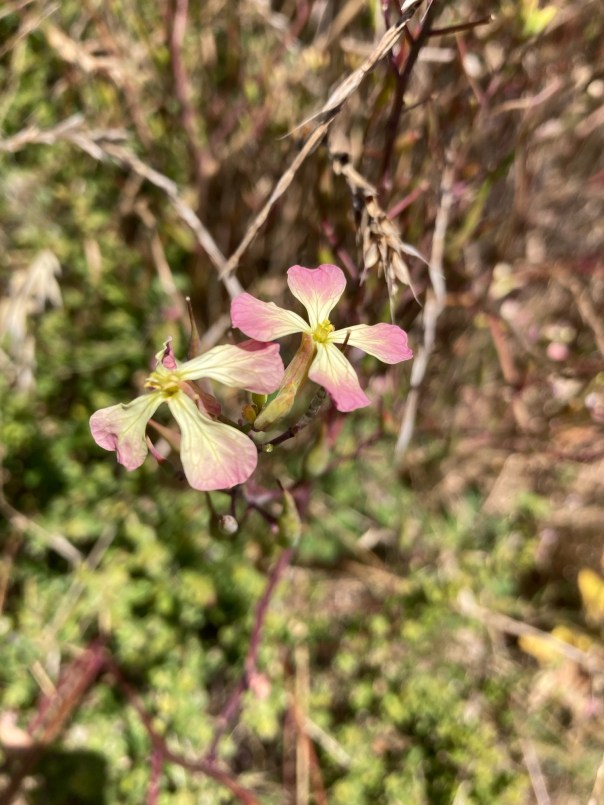
Black Mustard
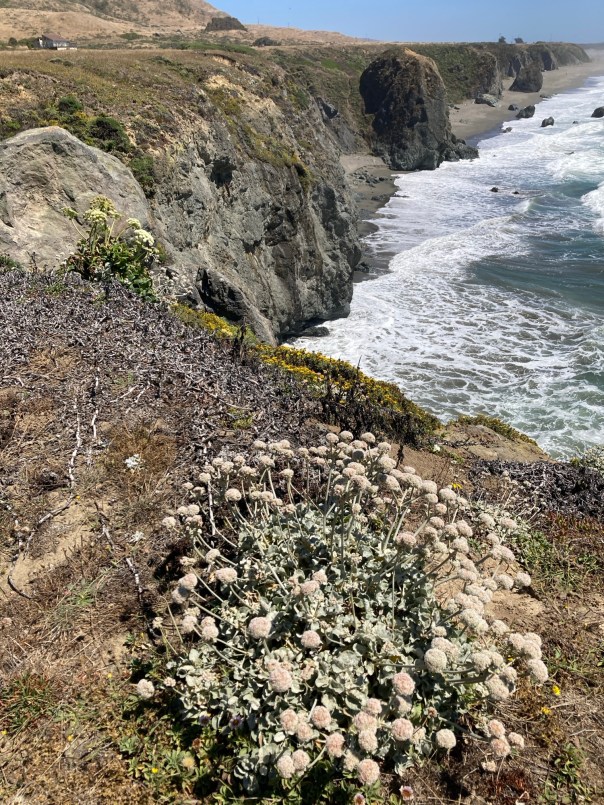
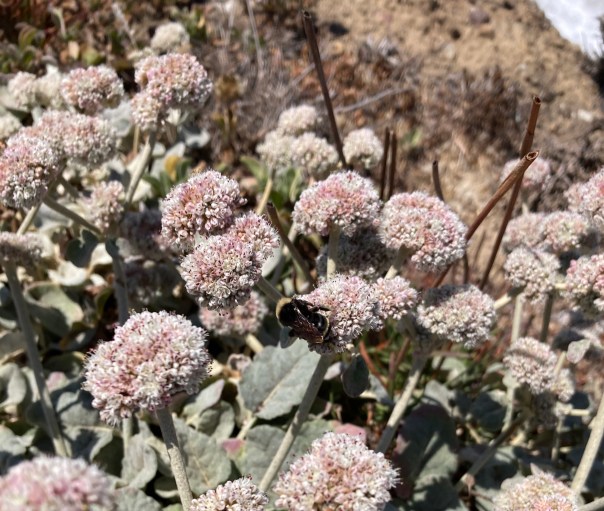
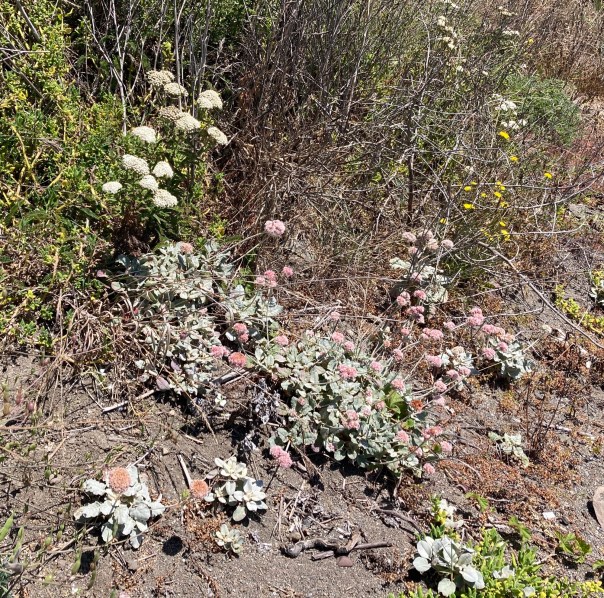
I’m showing several instances of Coastal Buckwheat, one of my favorite plants, with blooms more or less faded from the original pastel pink. It just now occurs to me that one reason I love it may be that those gray and pink colors were also featured in my grandma’s bathroom when I was a child. The bees appreciate it for their own reasons.
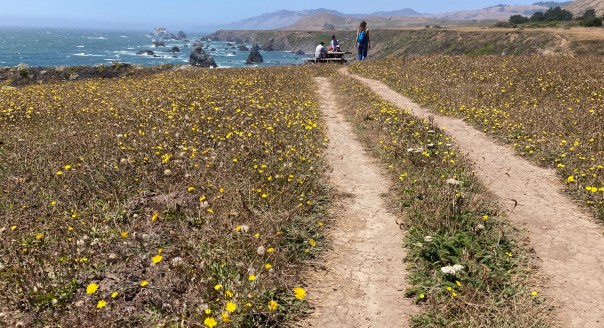
Below, a mixture of catsear and lotus combined to create a carpet of yellow:
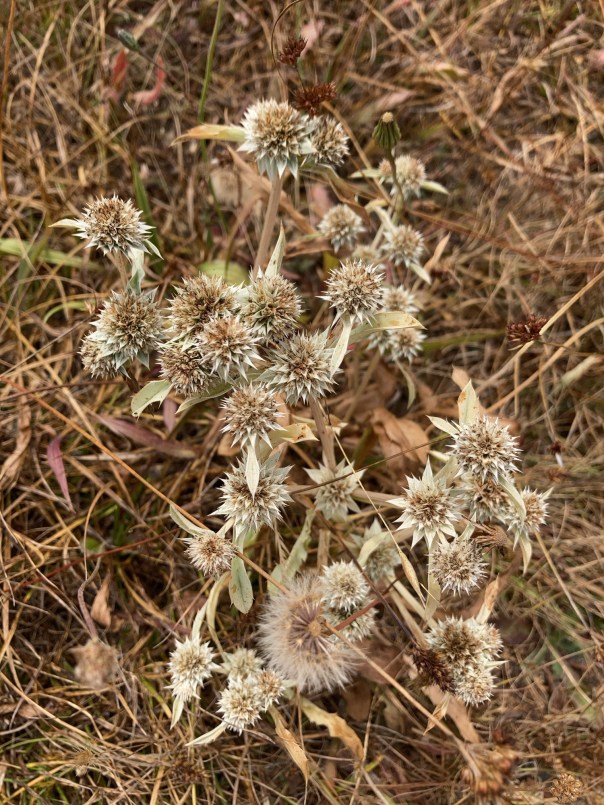
Another contributor to the sunny tone was the Seaside Woolly Sunflower:
Seaside Woolly Sunflower
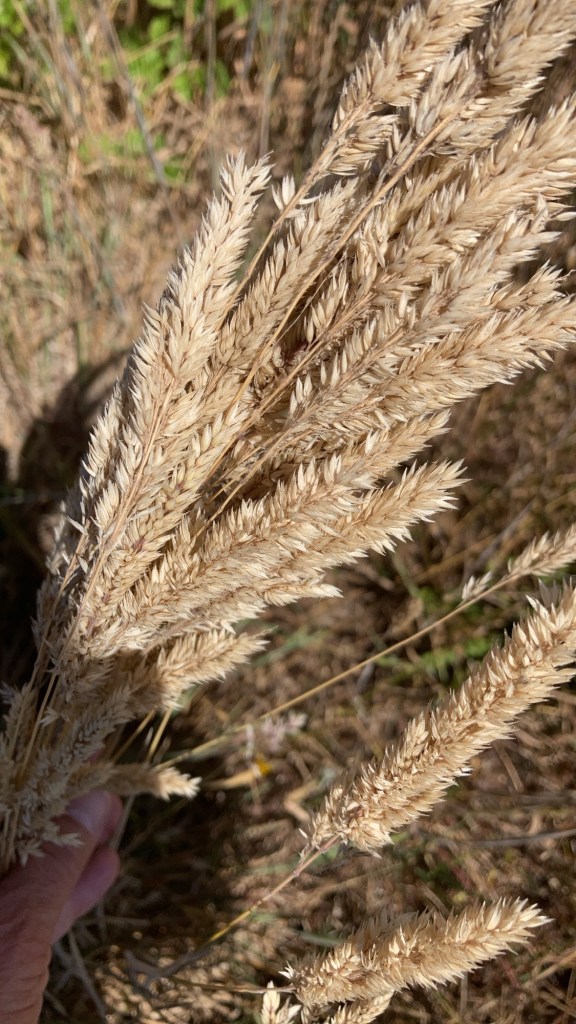
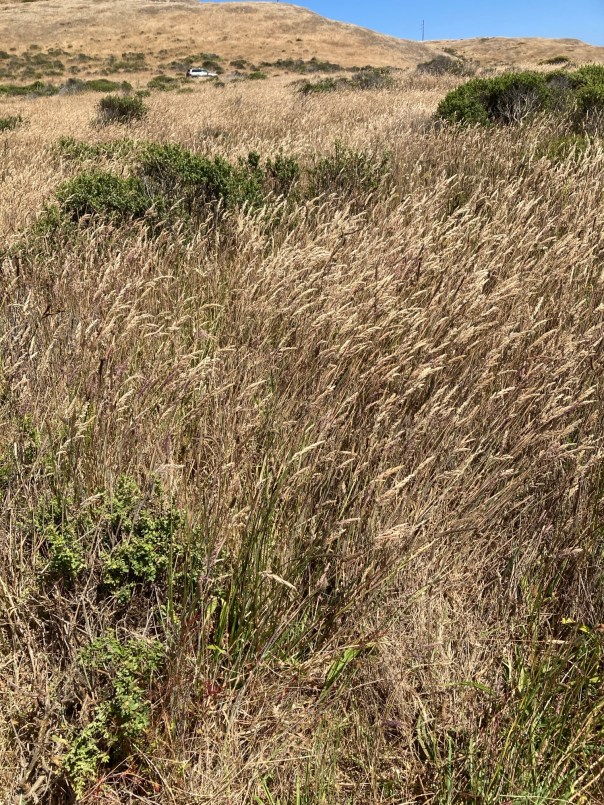
The grasses were swaying back and forth in the wind — European Marram Grass, my Seek app told me — and my favorite Rattlesnake Grass was abundant.
European Marram GrassRattlesnake Grass
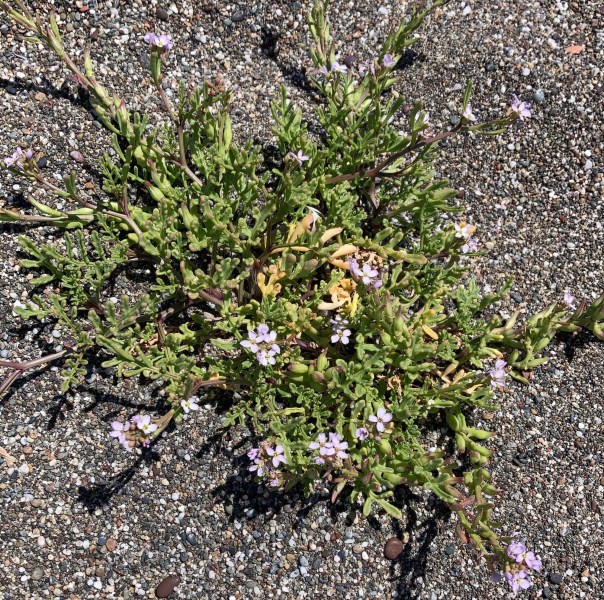
European Searocket
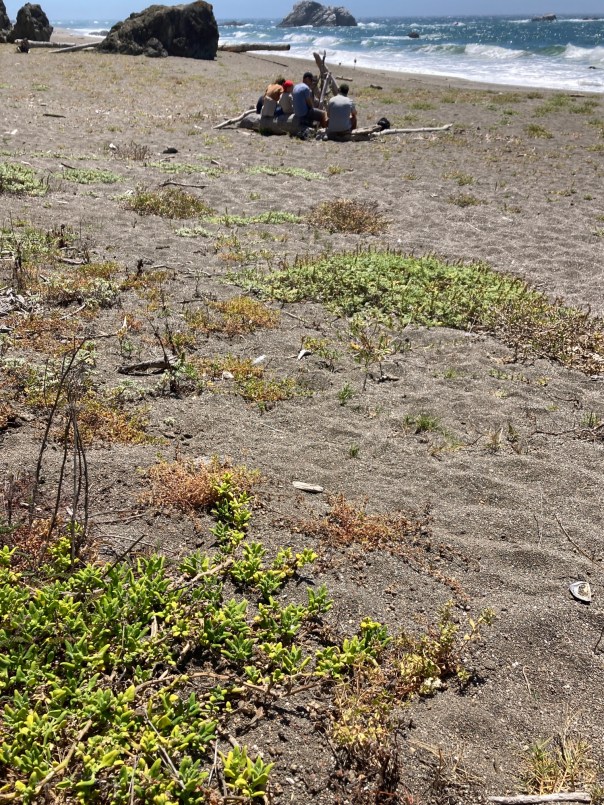
To eat our snacky lunch, we gathered around a minimalist and rickety teepee someone else had built, because there was a nice log beside it that seated five nicely. In the foreground here is Tetragonia tetragonioides, which I’ve always known as New Zealand Spinach, but the actual New Zealanders usually call it warrigal. There’s a better-watered specimen of this plant that keeps volunteering in my backyard garden:
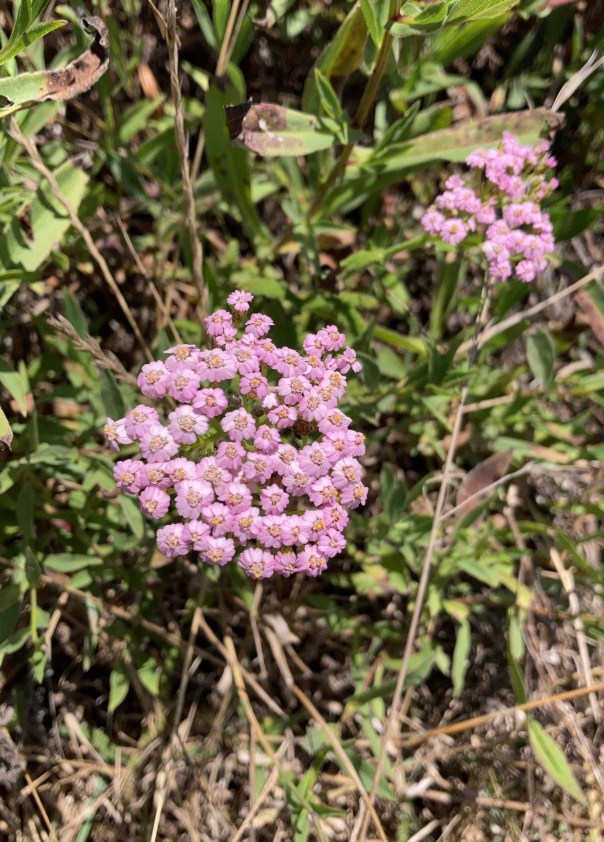
A pink sport from the usual white native yarrow.
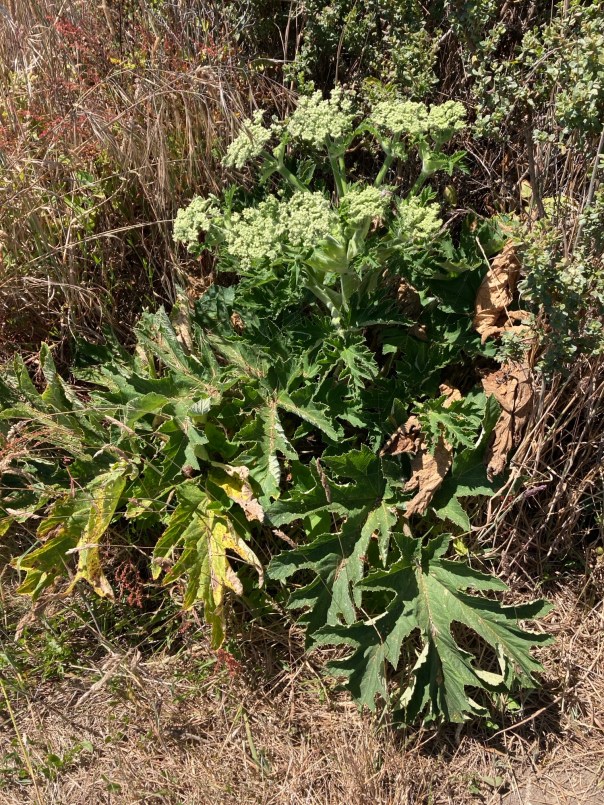
Pathfinder patiently discussed with me ways to tell two members of the Carrot Family apart, plants that grow in a similar habitat and that I’ve repeatedly mixed up over the decades. He noticed the different leaf shape and type: Cow Parsnip has large, deeply toothed leaves:
Cow Parsnip
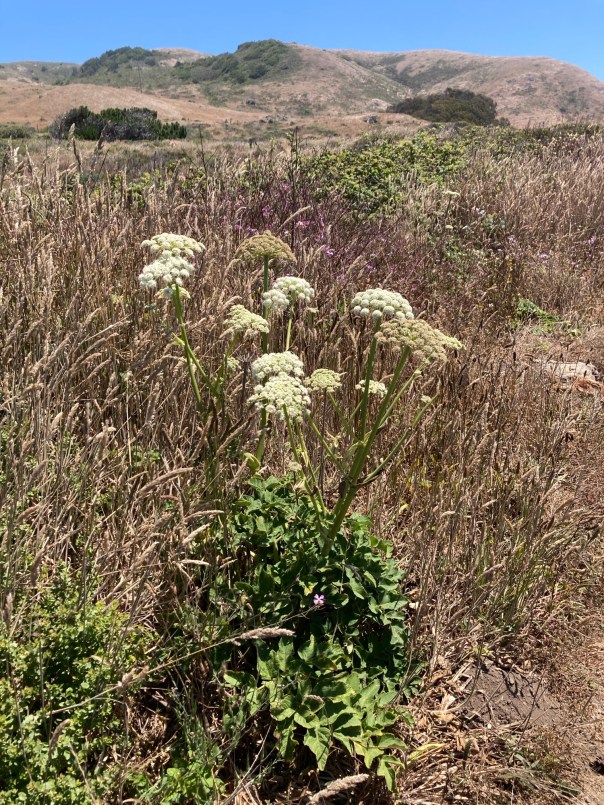
…while Angelica — in this case Henderson’s Angelica — has pinnately compound leaves.
Henderson’s Angelica
Their flowers aren’t exactly the same, either, and there are other differences. Once I saw the two plants growing right next to each other; that helped, for a time. Unfortunately the Seek app that I use a lot does not have a search feature; but if it did, I would probably be even more distracted from enjoying the plants themselves. So I guess it’s just as well.
Coastal Buckwheat with yarrow and more.
It was a very satisfying outing, even if several of us did get sunburned. That was opportunity to take advantage of a backyard botanical: my Aloe Vera plant, the leaves of which we peeled on one side, revealing the gelatinous interior, which we applied to red arms and neck. Oh, so soothing.
I’ve been home from my travels more than two weeks already, and before any more trips loom on the horizon, I have eight more weeks of homebody bliss remaining. It’s still high summer, when the days –or at least, the afternoons — are of the warm sort that energize and call me to the garden. This is the greatest good fortune. Glory to God, that I have a garden. Glory to God!
Stinking Chamomile
Other things besides the garden have helped to fill my days, and are filling my calendar into the near future. When I am home, I can be a host, and have guests! My house is happy when extra people are enjoying its spaces, and feeling the breezes blow through. That’s happened twice already in the last two weeks, and I’m expecting it to happen more.
When guests come in the summertime, they can stroll about the garden and pick a plum, and younger guests can play in the playhouse. The last one who did that made a soup entirely of tarragon and fountain water, and then dumped it into the fountain. Speaking of the fountain, when I am home I can keep it running, and keep it clean. It’s not very cheery to have a fountain turned off.
Lesser Goldfinch – internet photo
The birds are enjoying the summer. I hadn’t noticed the goldfinches much in the last couple of years, but this week they have been frolicking around the fountain; they seem to have plenty of time to play, probably because they’re not burning so many calories to keep warm. Today the house finches came along to drink and bathe as well. And one goldfinch made a side trip to the arbor, to perch on a long wisteria runner that was reaching out horizontally. He made short and quick jumps down toward the tip, which dropped a couple of inches in elevation with each jump, pecking at the buds, or maybe at insects, until he was at some critical point, after which I suppose he’d have found himself upside down if he’d held on — so he flew away.
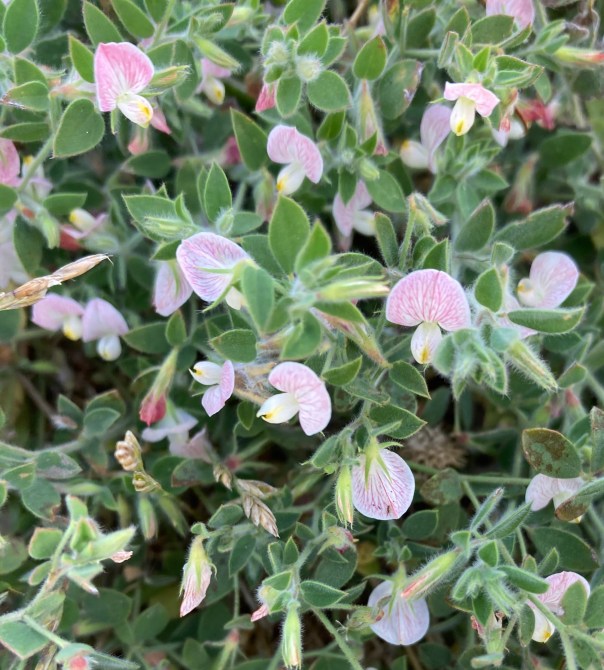
Spanish Clover
It was a wet spring here, and the early summer was cool, but now everything not in watered gardens is crisping up. I took my friend to one of my favorite parks for an easy hike, but it was so dry that the trail in many places had deep and wide cracks that made walking difficult, even in my boots. I guess I’d never been there at this time of year before? It did smell good out there, I must admit, and amid the crackling grasses we saw lots of wildflowers — first, masses of Yellow Star-Thistle, Centaurea solstitialis, an invasive plant that is in bloom now.
Yellow Star-Thistle
Star-Thistle is one of the many invasives that one can learn about on the website of the California Invasive Plants Council website, which I only just discovered. I think I’ll like to return there. The website of Yosemite National Park also features articles about such plants locally, and one of them tells about the great lengths different agencies go to, to control what is in California considered a weed. A Wikipedia article is unclear about whether the star-thistle is considered noxious in six or in 23 of the U.S. states where it is present. Are you my U.S. readers familiar with it? Evidently the purple star thistle is essentially the same thing, except for the color.
Star Thistle
The pennyroyal that amazed me at Tomales Bay also grew along the path in less spectacular displays; and Spanish Clover, and Stinking Chamomile (Anthemis cotula), photo above. That chamomile was new to me; Gwen sniffed it and said that indeed it did not smell good.
Domesticated and not-stinky chamomile is growing in my planter box, just one specimen that sprouted from the old seeds I threw in there before I went to Greece. I should plant it every year, it is so cheery.
Last week we celebrated the Procession of the Cross, and the festal cross stayed in the middle of the temple until the Forefeast of Transfiguration. Now we will celebrate Transfiguration for about a week until the Leavetaking of Transfiguration which is the day before we celebrate Dormition (Assumption) of the Theotokos in the middle of the month. I love the way the calendar anchors me to the church, and reveals the abundance of saints and events who fill the year with the glory of God.
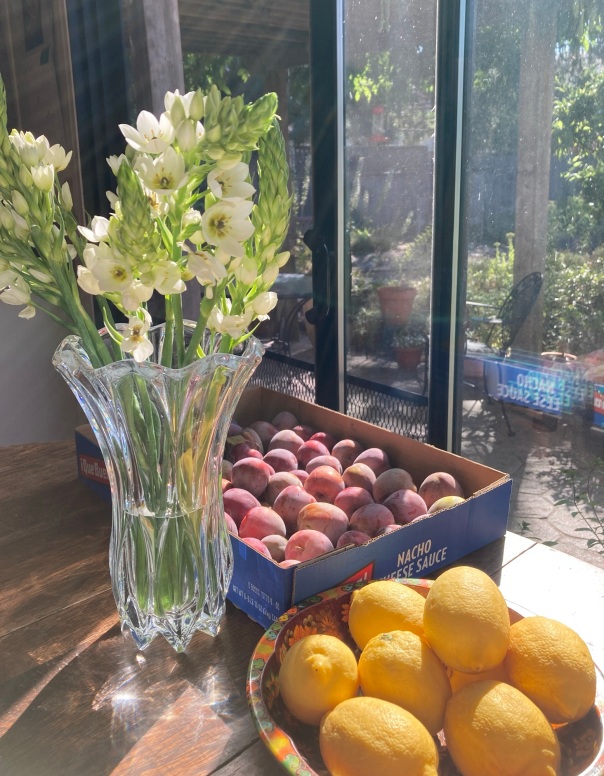
Before the service, before all the fruit had arrived.
As usual we brought baskets of fruit, and after Liturgy processed through the vineyard singing. It wasn’t as prickly as the trail I walked on last week, but it required careful stepping around grape prunings and blackberry brambles.
I pruned the lavender this week, and set it aside to take to a friend so she can add it to the straw in her chicken coop, to sweeten up the atmosphere:
A different friend came for lunch, and we were able to eat outside on the patio, after a leisurely tour of the garden. It was just warm enough to thoroughly relax, but not to wilt. I added snips of my parsley and tarragon to the salad we made together. I could have put a few calendula petals in as well, but I didn’t think of that.
This has been a pretty unfocused ramble, I’m afraid, so rambling that I don’t know how to sign off. So, let’s just pretend we were talking together next to my planter boxes, and looking at the zinnias, and then I went into the house and didn’t come back.
Our last day together at the cabin, Kate’s family and I took a walk to “Gumdrop Dome” in the morning. This is the walk I do every time I visit, not trying to climb to the top anymore, but picking my way around on its “shoulders” and feeling exhilarated from a combination of the exercise, sun, pine-scented air, and expansive views.
I very much wanted to introduce my grandsons to my favorite tree. When I mentioned my tree “friend” to them beforehand they asked what its name was — of course a friend would have a name, right? But I hadn’t thought to name it. So I said they could help me choose a name after they were introduced.
Prickly Hawkweed
It took longer than expected for the whole expedition, because as we walked through an empty campground on the way, we met the campground host who loved to talk, and then his two “surprise rescue,” exuberant pups. That was fun, but eventually we started our ascent, which was slow and deliberate going as we adults cautioned the children about the gravel and the steep slopes. I avoided the trickiest gravel-strewn expanses of granite, and led our group into the manzanita ground cover higher up on the back of that hunk of rock, where we admired the lichens and flowers as we headed for the small dome to the side, which is easy to climb.
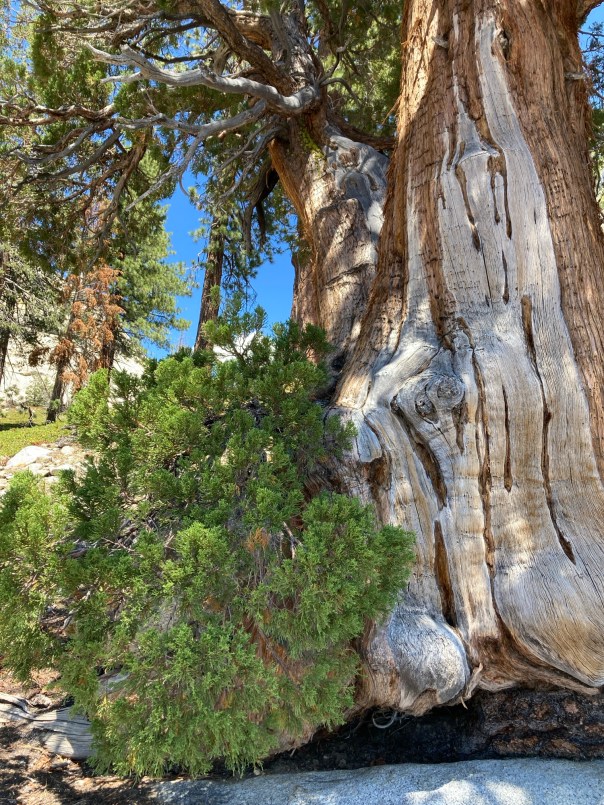
Then I found my friend, which is actually two trees intertwined, a Sierra Juniper and a pine. It/they were christened “Double Hug,” seeing as the two are in a forever embrace by means of large roots lying next to each other, and even their branches tangled together. We hugged the trees, and posed on the bench formed by those hugging arms.
Below, I am exclaiming over a little tree that, having been bent down by snow as a sapling, is growing sideways along the rock.
I don’t remember the last time I was with other humans on The Dome — it was a nice change, to have them along to “ooh” and “aah” with me. Tom also had never been up at the lake at all, and Kate not since she was a teen, so they were truly thrilled to be there.
In the afternoon we went to the lake for a canoe outing. The previous day, a neighbor had helped Tom and Kate get the very heavy boat out from under the cabin deck and on to his truck, to haul it down for the season. This day I rode down with the four of their family in their car to help them clean out the canoe, and I took pictures as they pushed off and paddled away.
Then I began walking up the hill back to the cabin, a hike that can be done in ten minutes, but this time it took me one and a half hours, because I meandered and wandered and explored the woods and ditches along the way looking at the many beautiful plants, and also watching a mated pair of birds hopping back and forth on the road in front of me. They were Pine Grosbeaks. This is what the male looks like, from an internet photo, because mine were from too far away. That was definitely a new sighting for me, and combined with the junco nest, very encouraging, because other than Steller’s Jays, I rarely see birds up there. Maybe in my usual visiting month of September the birds are already gone to lower elevations.
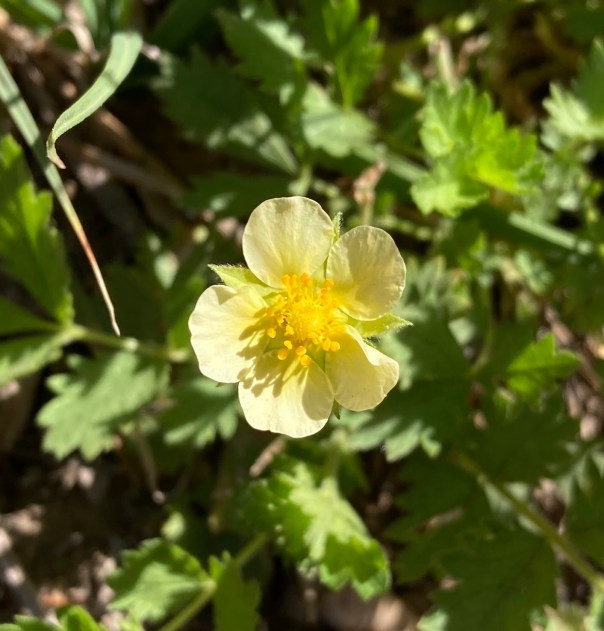
Some of the (mostly yellow) plants and insects I admired and/or identified by the roadside are below:
Pretty Face or Golden BrodiaeaYellow Velvet Beetle on Ranger’s ButtonsWoodbeauty
I met on the road a mother and daughter whose cabin is not far from ours, and the daughter told me that one of our hugging trees on the dome is a Sierra Juniper, Juniperus occidentalis. I had thought it was some kind of cedar tree, but when I researched it later I realized that it is indeed a Sierra Juniper. True cedars are not native to the Sierra Nevada, though one conifer typically called “cedar” does grow there, the Incense Cedar (Calocedrus decurrens).
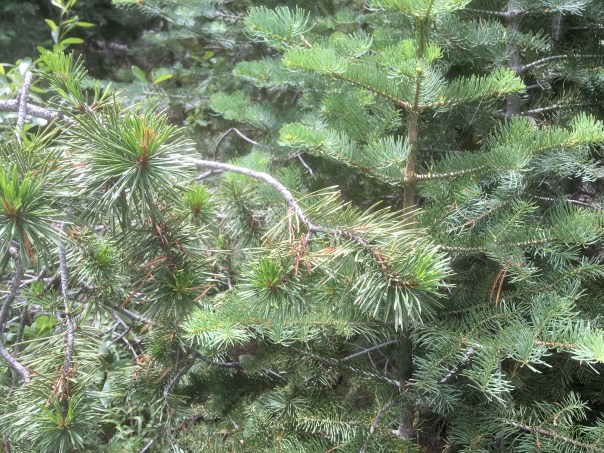
Lodgepole and Red Fir
The sad, sad day arrived, when we must pack up, clean up, and load up our cars, to caravan down to the valley and back to my house — but our vacation had not ended, only changed locations…
Soon Uncle “Pathfinder” had arrived to spend a day and a night, and we all headed out to the coast, to Tomales Bay, for a short walk through the entirely different biome. The sky was mostly cloudy and overcast, which is common in the summer.
In many places the paths were narrow tunnels through thickets of live oak and coyote brush, tall grass, fennel — and the dreaded poison oak reaching out threateningly. The boys’ uncle was a wise counselor who gently reminded them again and again to keep an eye out for those clusters of three leaves, often red and often shiny, so that they could squeeze by without their bare arms touching.
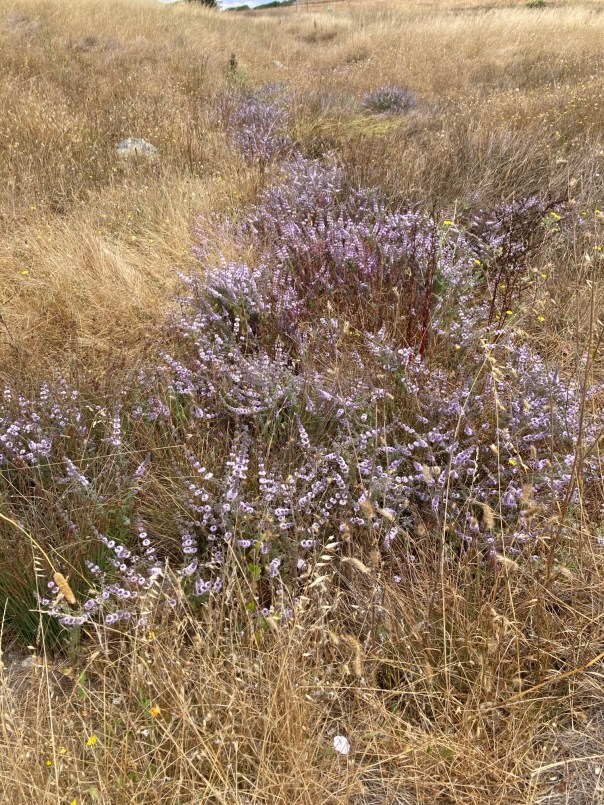
Pennyroyal marks where winter streams ran.
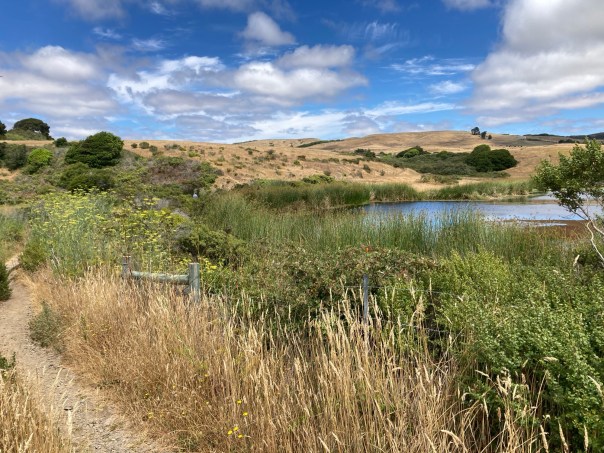
But mostly we walked through more open places with dry grass spreading away from the trail and far into the distance. I am actually on a path in this picture below. Kate had read a tick warning and no one wanted to venture into the foliage very much.
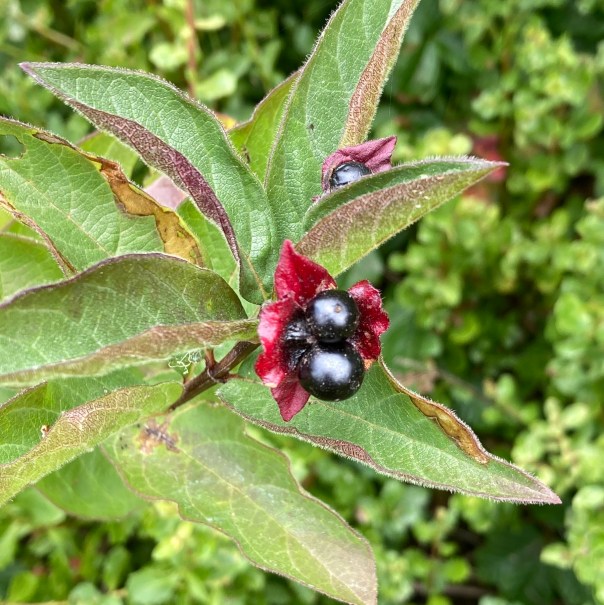
Pathfinder joined me in noticing various plants and talking about what they might be. He demonstrated to the nephews how the fennel fronds are pretty tasty for munching on, and he knew this flower that I didn’t, the Twinberry Honeysuckle:
Twinberry Honeysuckle
Raj and Rigo were hopeful of reaching the shore of Tomales Bay and getting their hands at least into the water, but every time we drew near, the ground turned out to be too boggy, and no one, including them, wanted them to sink into the mud, and who knew how far one might sink and stick into it.
So we continued looping around on the paths, going on faith that they would eventually lead us back to the parking lot…
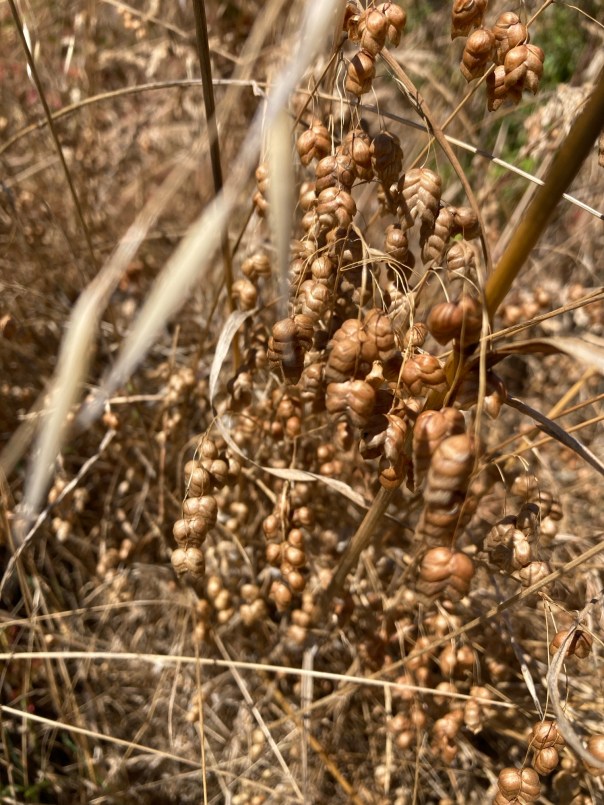
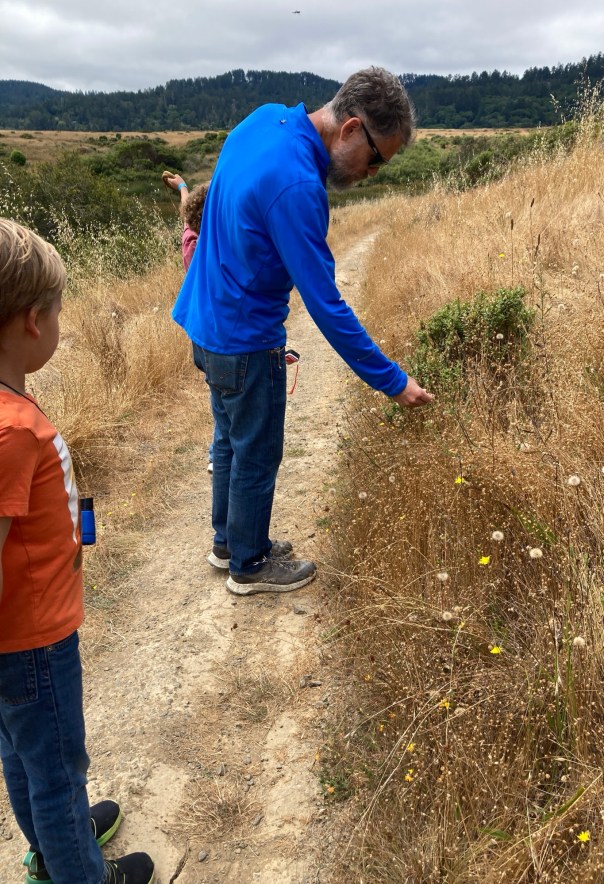
At left Pathfinder is looking at the Rattlesnake Grass, Briza maxima, which is not native here but has certainly naturalized and grows “everywhere.” It is native to areas of Africa, Asia and Europe. Do you have it where you live? I didn’t get a good picture this time, partly because it was not a good stand of the stuff, and most of the “rattles” were very short. You can click on the link to see the Wikipedia photo.
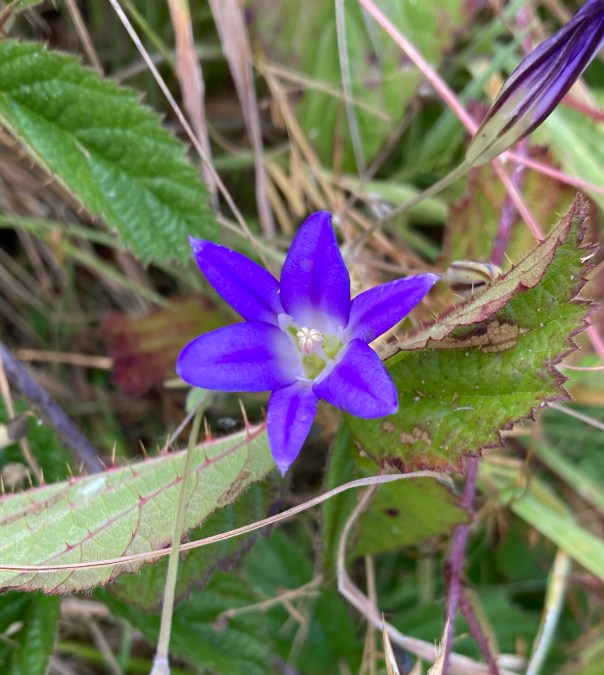
Related to the Golden Brodiaea I had seen at the lake, is the Elegant Brodiaea in its much drier habitat near the sea:
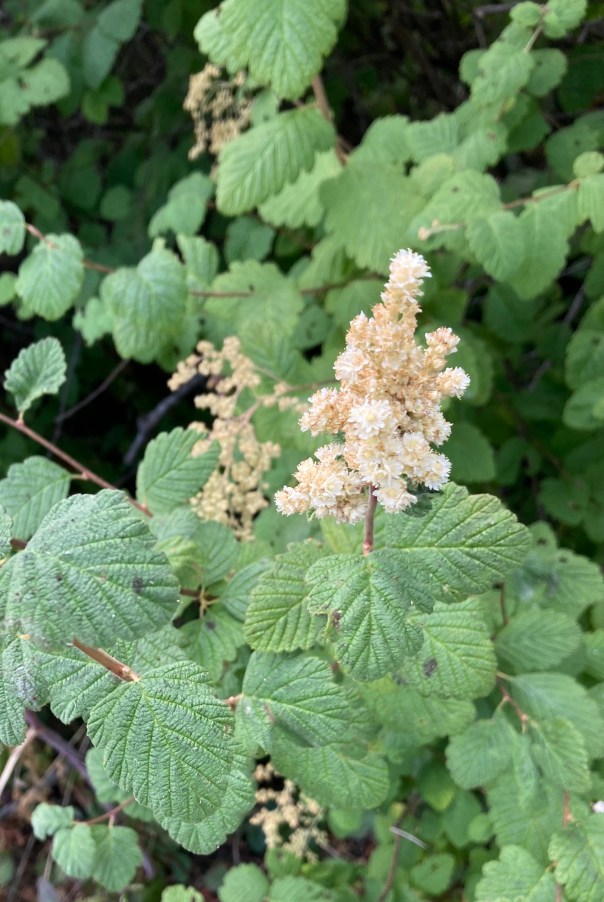
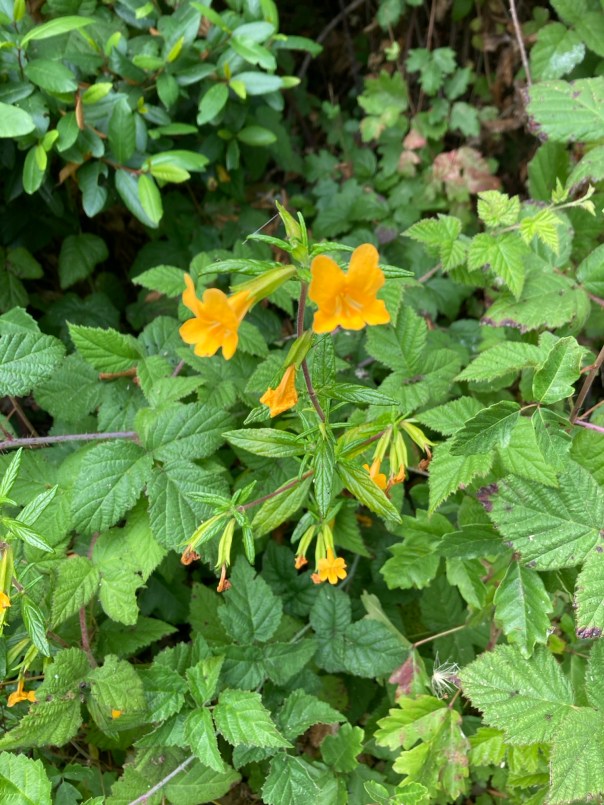
Ocean SprayOrange Bush Monkeyflower
This forbidding plant has the agreeable name of Coastal Button Celery:
Coastal Onion
Oregon GumplantThe pennyroyal was extravagant.
Oh, it smelled so good out there, among all that dry grass with the fennel and pennyroyal and other species continuing to dry up under our noses, where their essential oil droplets could be breathed into our lungs. I wished there were a bench to sit on… but there wasn’t, and anyway, we had places to go, things to do.
When we got back in the car we drove up the Coast Highway, Highway 1, and found the oysters Tom was longing for at Nick’s Cove. We didn’t order any of their special fries, but we noted on the menu that they came with a sprinkling of — chopped wild fennel!
It had been a most wonderful outing, and the final one of this visit with my dear children. This morning they will all have departed to their homes, and we’ll continue our adventures separately. It has been a very special couple of weeks, filling my gladness cup to overflowing. Thank you, Lord.
My journey to the mountains took me more than eight hours, owing to the search for a fruit stand on the way. I followed several Google leads to popular stores where I might pick up peaches and a watermelon and other items close to the farm, just before leaving California’s gloriously productive Central Valley. This project led me out of my way and brought me to destinations along county highways with nary a turnout where I could imagine a fruit stand ever having existed.
In frustration and great disappointment I resigned myself to having to buy the produce at the last good grocery store further along my way in the lower mountains. But I prayed as I headed back toward the correct route, “Maybe, Lord, you could lead me to a fruit stand that Google doesn’t know about.”
And there, “in the middle of nowhere,” south of Madera in an area called Trigo on the map, I saw the sign that read, “PEACHES APRICOTS CORN” — It was a real place, not a mirage, a tiny outpost with a nice lady who helped me load my box of treasures into the car. I’m certain that as my happiness turned into enthusiasm and then extravagance, I bought way too much for Kate’s family and me to eat — I will probably need to make a pie or soup up here to use it all.
Then, as drove off and headed up through the sandy blond, hay colored foothills, baking under the midday sun, I calmed down and fully entered the experience of the rising elevation and of leaving that everyday world behind. No need for a map, because I know the way.
After the expanse of golden hills comes the area where orchards of date palms grow, and then the miles of oak forests, after which the climb gets steeper, and the foliage denser. There are the elderberries in bloom, waving their flowers in the breeze, and huge bushes of lupines growing on the banks and reaching out with loaded purple stems.
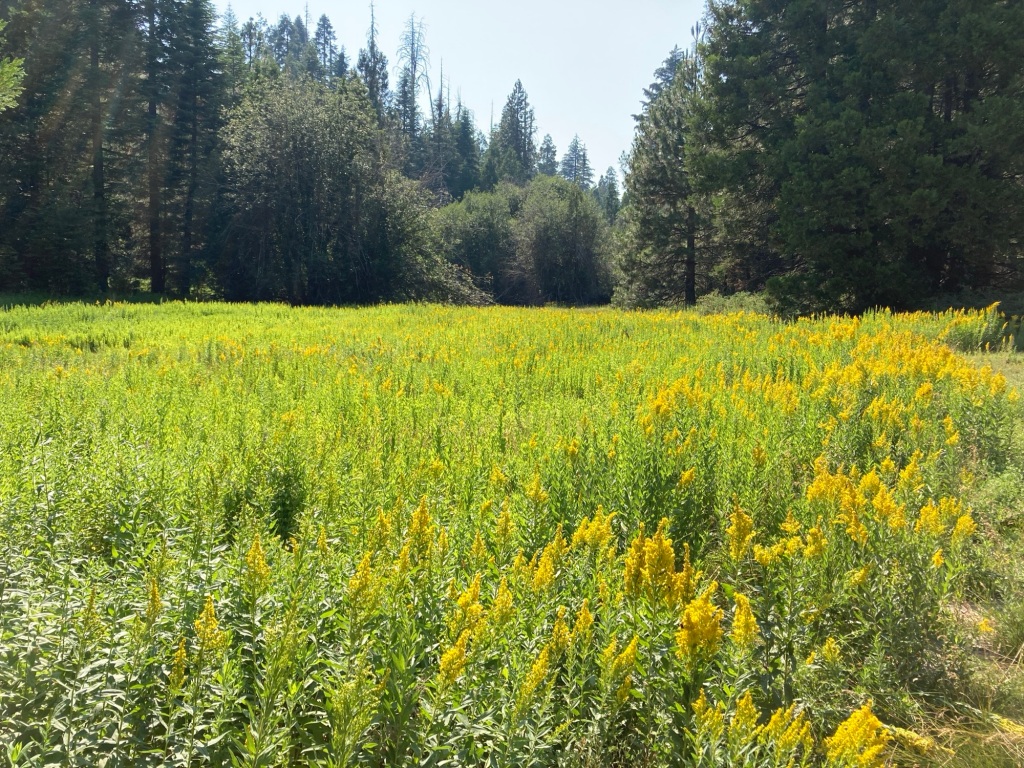
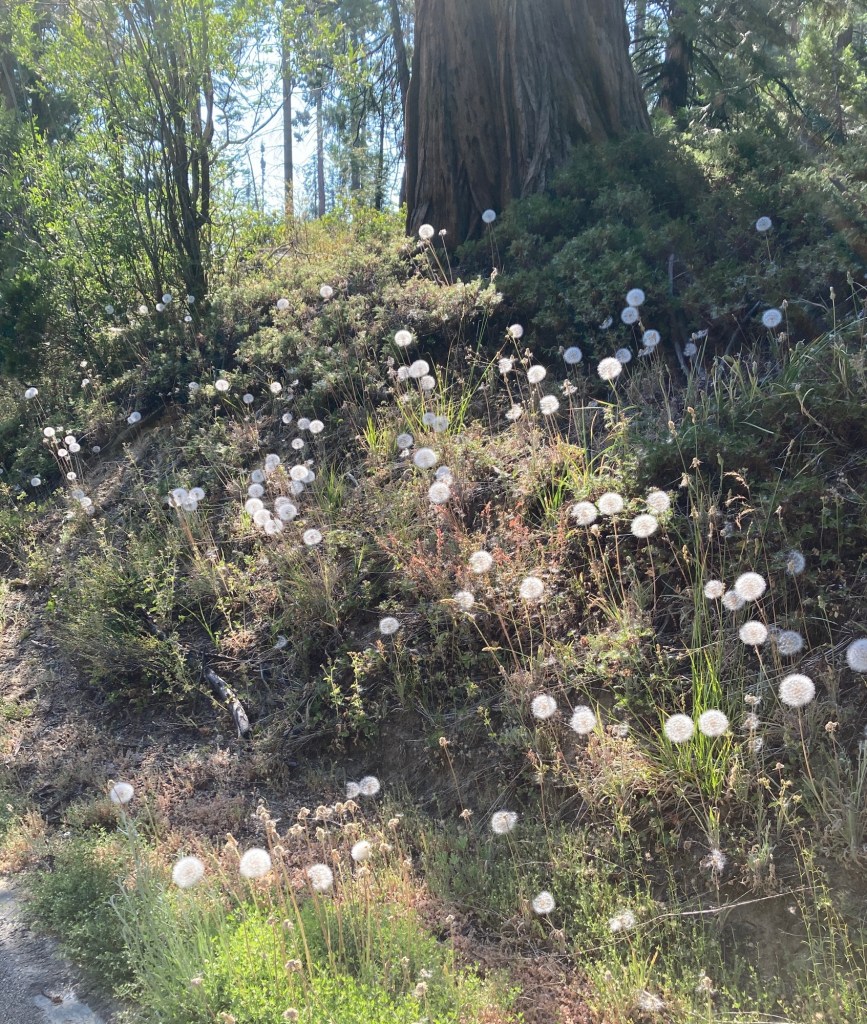
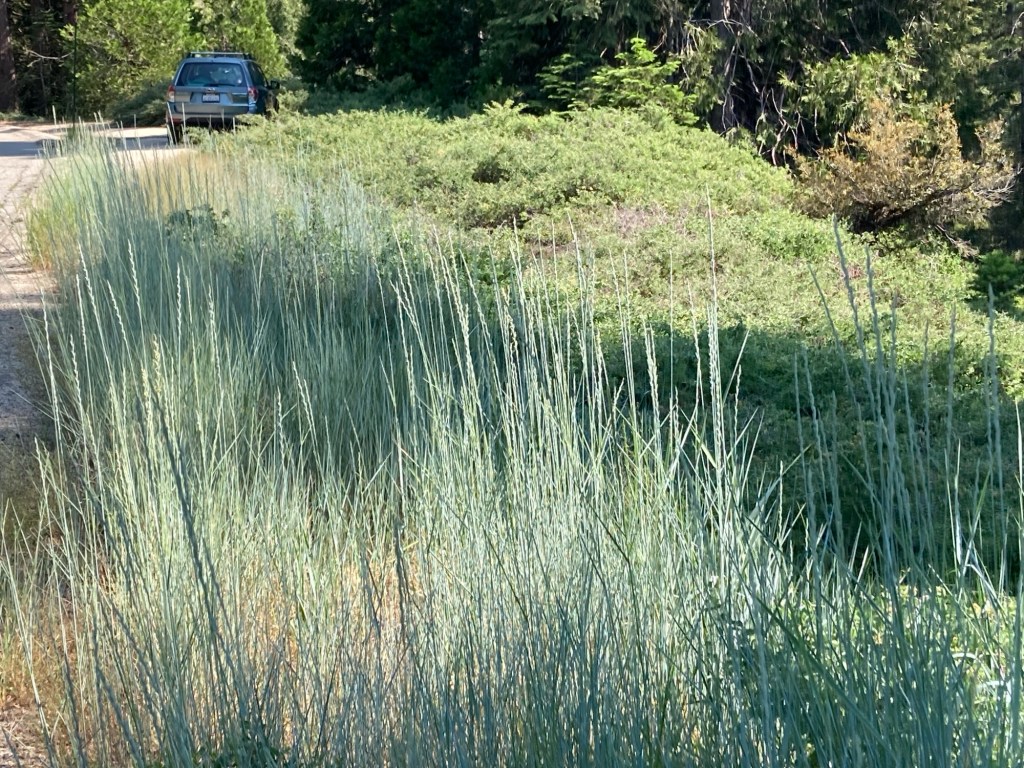
The goldenrod is spreading its gold across the meadows, and a certain elegant grass grows alongside. The Grand Mountain Dandelion is at its puffiest, and smaller puffs on the wild buckwheats refuse to pose for a photo but prefer dancing in the wind.
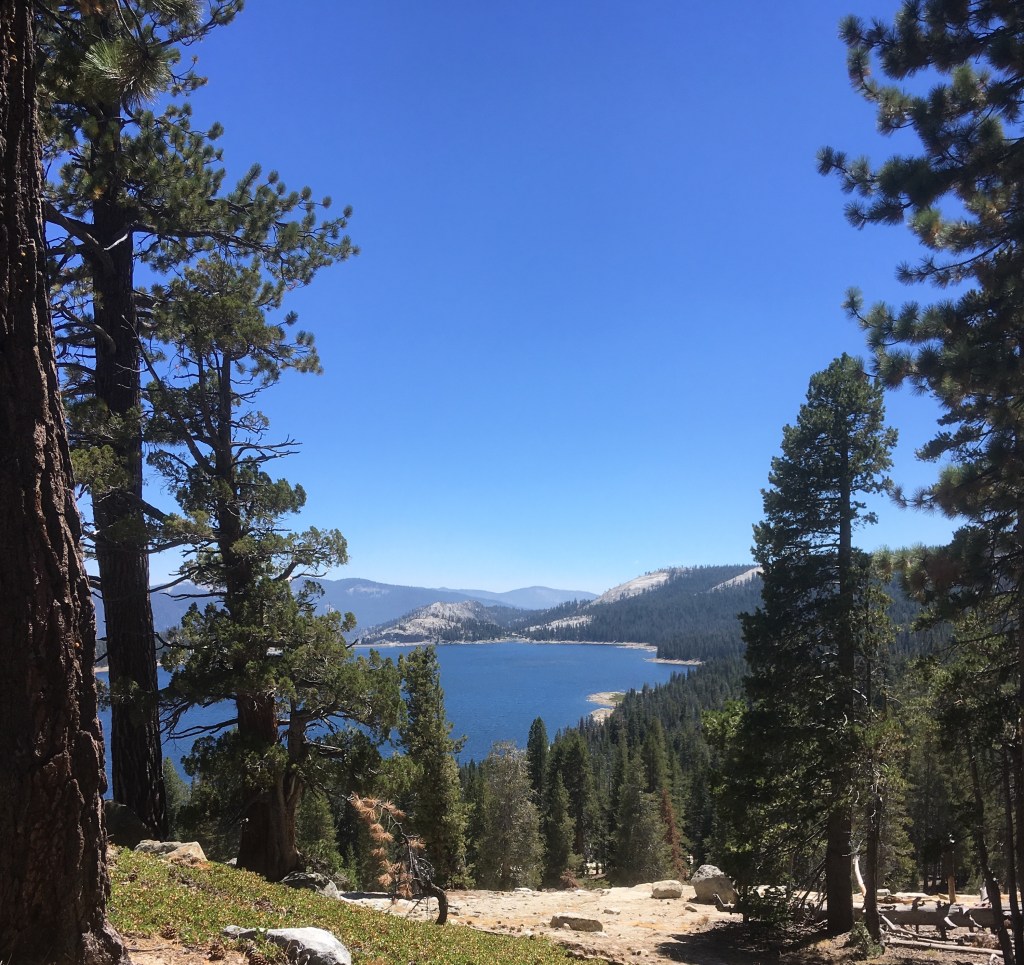
In spite of my dawdling along the way to say hello to these old friends, I made it to the lake and the cabin well before dark and was welcomed by my sister and her husband.
I slept very well, they went home this afternoon, and tomorrow the rest of my group will arrive. I’m in the High Sierra and feel on top of the world.




 I added snips of my parsley and tarragon to the salad we made together. I could have put a few calendula petals in as well, but I didn’t think of that.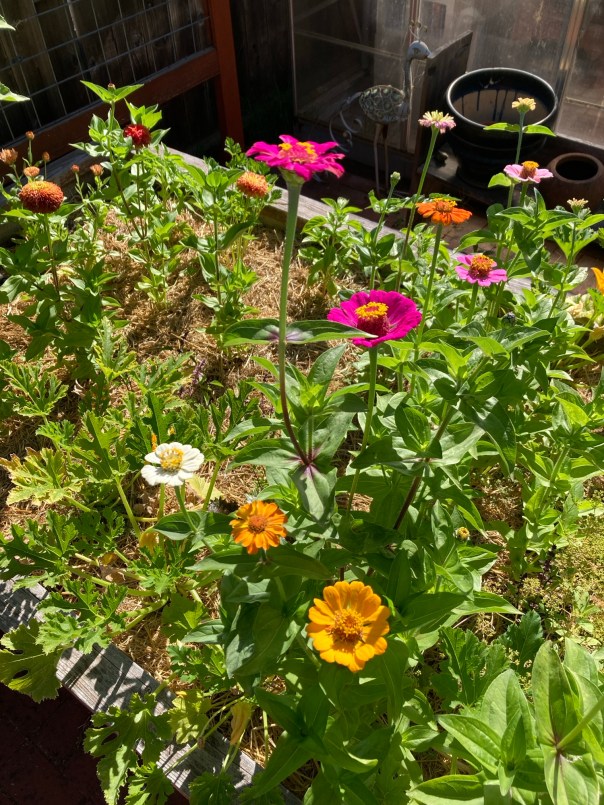



 Then I began walking up the hill back to the cabin, a hike that can be done in ten minutes, but this time it took me one and a half hours, because I meandered and wandered and explored the woods and ditches along the way looking at the many beautiful plants, and also watching a mated pair of birds hopping back and forth on the road in front of me. They were Pine Grosbeaks. This is what the male looks like, from an internet photo, because mine were from too far away. That was definitely a new sighting for me, and combined with the junco nest, very encouraging, because other than Steller’s Jays, I rarely see birds up there. Maybe in my usual visiting month of September the birds are already gone to lower elevations.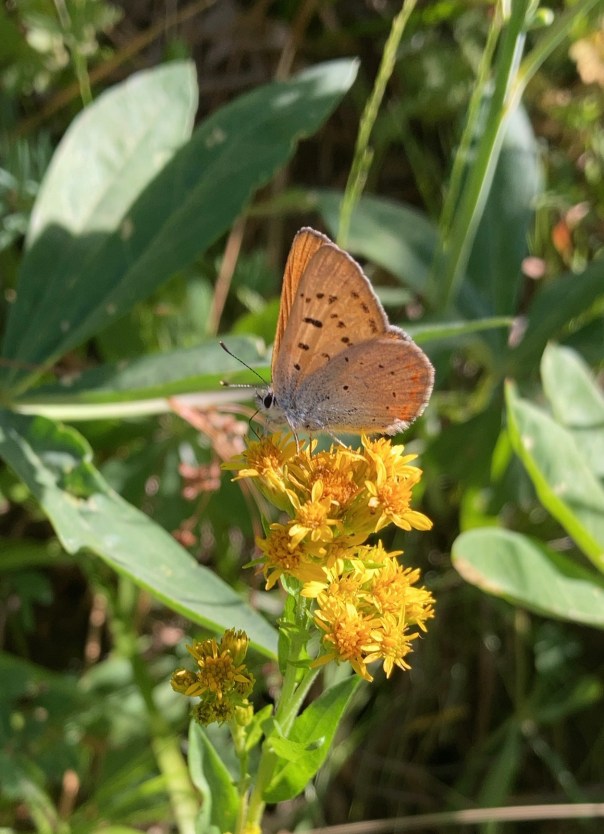





 Raj and Rigo were hopeful of reaching the shore of Tomales Bay and getting their hands at least into the water, but every time we drew near, the ground turned out to be too boggy, and no one, including them, wanted them to sink into the mud, and who knew how far one might sink and stick into it.