What is night will soon be day.

Ogden Nash makes me rejoice in the English language as it presents itself to his peculiar, playful mind. I liked this galloping poem, and won’t argue with it, because that’s not what humor is for. But I will say that the line I chose for the title of my post led me from laughing to silent theologizing…

TIME MARCHES ON

You ask me, brothers, why I flinch.
Well, I will tell you, inch by inch.
Is it not proper cause for fright
That what is day will soon be night?
Evenings I flinch the selfsame way,
For what is night will soon be day.
At five o’clock it chills my gore
Simply to know it isn’t four.
How Sunday into Monday melts!
And every month is something else.
If Summer on the ladder lingers,
Autumn tramples upon her fingers,
Fleeing before the jostling train
Of Winter, and Spring, and Summer again.
Year swallows year and licks its lips,
Then down the gullet of next year slips.
We chip at time with clocks and watches;
We flee him in love and double scotches;
Even as we scatter in alarm
He marches with us, arm in arm;
Though while we sleep, he forward rides,
Yet when we wake, he’s at our sides.
Let men walk straight or let them err,
He never leaves them as they were.
While ladies draw their stockings on
The ladies they were are up and gone.
I pen my lines, I finish, I scan them,
I’m not the poet who began them.
Each moment Time, the lord of changers,
Stuffs our skins with ephemeral strangers.
Good heavens, how remote from me
The billion people I used to be!
Flinch with me, brothers, why not flinch,
Shirts caught in the eternal winch?
Come, let us flinch till Time stands still;
Although I do not think he will.
Hark, brothers, to the dismal proof:
The seconds spattering on the roof!

-Ogden Nash

Hope is not a program for reform.

What is the difference between optimism and hope? One difference is that the word “optimism” is not in the Bible, and the word “hope” is. They are two distinct words and at least one of them is worth contemplating. I like to quote Fr. Alexander Schmemann on this topic:

“If there are two heretical words in the Christian vocabulary, they would be ‘optimism’ and ‘pessimism.’ These two things are utterly anti-biblical and anti-Christian…. Our faith is not based on anything except on these two fundamental revelations: God so loved the world, and: The fallen world has been secretly, mysteriously redeemed.”

Hope is one of the three foundational virtues of the Christian life, as this article, “Hope,” explains. Its description of the absence of hope tells us:

“The opposite of hope is despondency and despair. According to the spiritual tradition of the Church, the state of despondency and despair is the most grievous and horrible condition that a person can be in. It is the worst and most harmful of the sinful states possible for the soul.”

That’s why the title of an article in the current issue of The New Atlantis got my attention: “How Tech Despair Can Set You Free” by Samuel Matlack.

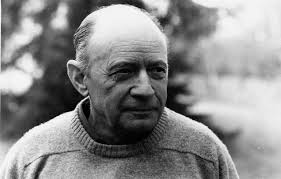
The author of this article discusses the philosophy of Jacques Ellul, and quotes him as saying, in Hope in Time of Abandonment, “You cannot talk about hope. The question is how to live it.”

Jacques Ellul, 1912-1994

Matlack comments, “The reason you cannot talk about hope — or rather, cannot describe the action it takes — is this: Hope is not a program for reform, a solution to implement, or a prescription to follow. To borrow from the farmer and writer Wendell Berry, hope means ‘work for the present,’ whereas optimism means ‘making up a version of the future.'”

“What we do know is that Ellul’s own life bears ample testimony to hope. Here is one episode of many. Having lost his university position during the Nazi occupation of France, Ellul and his wife Yvette settled on a farm in a small village near the demarcation line, opening their door to Resistance fighters and Russians escaping German prison camps. With the help of neighbors — since Ellul knew nothing about farming — he grew potatoes and corn, with his wife raising chickens. As he once told the story, “I spent most of my time helping people get across into the free French zone. I was in cahoots with an organization that dealt in forged papers. So I was able to provide a whole series of people with forged identity cards.’”

About their own aims the editors of the journal from which I quote write: “Dystopian dread is the shadow of utopian dreams. The hope of The New Atlantis is to help steer away from both — and instead toward a culture in which science and technology work for, not on, human beings.”

In another article on this general subject, of how to live in a technological age, Alan Jacobs wrote in last winter’s issue; he also mentions Jacques Ellul as one of the early critics of the technological society in “From Tech Critique to Ways of Living.” It is accessible to read right now. And Samuel Matlack has written previously about Ellul, in 2014: “Confronting the Technological Society.”

There he writes, after Ellul: “What is needed is a true revolution, which Christianity by its essence is uniquely equipped to effect — being in the world but not of it, living the hope of a kingdom already here but not yet.”

True revolution is not a change in the political order, but has to be something far beyond that realm, and deeper; may the Lord show us the basis for our true Hope, and teach us how to live it.

Our soul waits for the Lord; He is our help and shield.
Yea, our hearts are glad in Him, because we trust in His holy name.
Let Thy steadfast love, O Lord, be upon us, even as we hope in Thee.

-Psalm 33

One balmy day was all I needed.

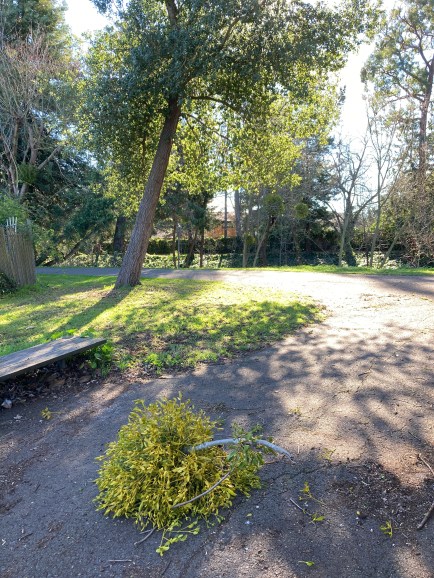
We came out of church last Friday evening and the wind was blowing warm. It was the softest… Blow and blow it did through the night, knocking down leaves and branches and clumps of mistletoe, banging my garden gate.

Saturday morning I walked on the bike path and it was the happiest, friendliest neighborhood walk I’ve experienced in two years. Many many people and no masks, so you could take in their smiles and their open faces turning this way and that to say “Good morning!” to everyone… Whole families on bicycles and dozens of dogs on leashes. I’m sure that in all my decades of walking that route people have never before been that happy in an outward direction.

mistletoe
oxalis
manzanita

When I got home from my walk, and was not driven indoors by any sort of chill, I wandered the back yard and saw that the manzanita buds are out. My row of Stir-Fry Mix greens needed thinning, and because of the sun shining and all, I did it then and there. I took the thinnings in and washed them immediately in the sink. Springtime energy in January!

Recently I had the only tree on my property trimmed to please the neighbors, over whose back yard most of the tree’s mass hangs threateningly. It is a tall Canary Island Pine and my late husband and I have resisted several times outside pressure to just cut it down. I tried to take a flattering picture but there is no way to do that, because it is a gangly thing.

Our book group chose Silas Marner to read over the next four weeks. I could not find my old paperback that I last read probably 15-20 years ago, but tucked behind the trim of the bookcase I found this smallish volume:

It was my grandmother’s school book! She was probably reading it in about 1910 in Winona Lake, Indiana where she grew up. I did not remember seeing it before, though I am sure I was the one who put it on the shelf, who knows when. There are quite a few pages with her notes like this:

I had been reluctant to commit to reading with the group this month, but now that I have found this copy of Silas I can’t resist reading along with my grandmother.

I have eaten half of the greens, chopped into a pot of tomato soup this afternoon. The balmy weather lasted one day, and now we are back to January. But that blessed day snapped me out of the endurance mode into expectation.  I have a nice fire going in the stove and wonderful books to read as I sit by it.

I haven’t been accomplishing very much this month if one looks at my to-do lists. But maybe the important things are not listed there. I’ve been trying not to get caught up in things that I don’t really care about… so here is a good quote, to help me end my post:

“Doing nothing is better than being busy doing nothing.”

– Lao Tzu

The dullest person you can talk to.

 “It is a serious thing to live in a society of possible gods and goddesses, to remember that the dullest, most uninteresting person you can talk to may one day be a creature which, if you saw it now, you would be strongly tempted to worship, or else a horror and a corruption such as you now meet, if at all, only in a nightmare. All day long we are, in some degree helping each other to one or the other of these destinations.

“It is in the light of these overwhelming possibilities, it is with the awe and the circumspection proper to them, that we should conduct all of our dealings with one another, all friendships, all loves, all play, all politics. There are no ordinary people. You have never talked to a mere mortal. Nations, cultures, arts, civilizations – these are mortal, and their life is to ours as the life of a gnat. But it is immortals whom we joke with, work with, marry, snub, and exploit – immortal horrors or everlasting splendors.”

-C.S. Lewis