Nancy was glowing.

Cousin Rosamund is a more difficult read than the first two books in the Aubrey Trilogy (also known as The Saga of the Century), in ways I might tell about later. But this passage in which the Aubreys’ friend Nancy shares her expectant-mother thoughts sweetened the mood:

“You see, the thing isn’t a bit reasonable,” Nancy went on. “Oswald keeps on telling me how it happens, ovulation and all that, but it doesn’t explain anything. It’s not logical that two little things without any sense can get together and make a third thing, that suddenly gets sense and thinks and feels for itself and gets born and has a will of its own, and is a person. How can there be a person, suddenly, when there wasn’t before?”

“It’s a mystery,” agreed Aunt Milly.

“Yes, put it like that, it’s against nature,” said Aunt Lily.

“And think of it happening all the time,” Nancy went on. “And all these people that come into the world in this extraordinary way clinging on the earth, which is just a star like any other, and nobody knows how the stars come to exist. It’s all so odd that anything should be here.”

“I never thought of it before, but it would be more natural if there wasn’t anything at all,” said Aunt Milly.

“Yes, it’s all so unnatural that there must be a meaning to it,” said Nancy, glowing. “They always say so in church but you only half-believe it, but having a baby, it’s more extraordinary than anything they tell you in church. I don’t know what it all means,” she proclaimed, “but I feel that I might know any minute now.”

-Rebecca West in Cousin Rosamund

How knitting is like dying.

This month our parish women’s book club is reading Tolstoy’s “The Death of Ivan Ilyich.” I finished it this morning, in an old anthology from 1947 that I had kept from our homeschooling years, when twice my late husband and I taught a short story course to our children. That collection is A Treasury of Short Stories edited by Bernardine Kielty. When I closed that volume I opened The Norton Reader, Seventh Edition, to see if it included any Tolstoy stories, but when I saw the title “From Journal of a Solitude,” I continued reading the first few excerpts taken from the book by May Sarton.

Her musings in the first paragraphs were on topics that were also among those so powerfully treated in the story of Ivan Ilyich: depression, dying; the perceived absence or presence of God, both “too frightening.” I don’t have any comments on those themes, but I would very much recommend Tolstoy’s story to your own reading. I thought I had read it before, but maybe I only started once. It is powerful.

I don’t know anything about May Sarton except what I read just this morning, but I appreciated the thoughts below; these came just down the page, after she’d moved on from writing about her dying friend. They are not so obviously linked to the Tolstoy story, except perhaps by their highlighting the need for patience in every stage and situation in life, not least at its end. “By your patient endurance you will gain your souls.” (Luke 21:19)

“In the mail a letter from a twelve-year-old child, enclosing poems, her mother having pushed her to ask my opinion. The child does really look at things, and I can write something helpful, I think. But it is troubling how many people expect applause, recognition, when they have not even begun to learn an art or a craft. Instant success is the order of the day; ‘I want it now!’ I wonder whether this is not part of our corruption by machines. Machines do things very quickly and outside the natural rhythm of life, and we are indignant if a car doesn’t start on the first try. So the few things that we still do, such as cooking (though there are TV dinners!), knitting, gardening, anything at all that cannot be hurried, have a very particular value.”

-May Sarton, Journal of a Solitude

Sleeping must be won without pride.

How to Sleep

Child in the womb,
Or saint on a tomb –
Which way shall I lie
To fall asleep?
The keen moon stares
From the back of the sky,
The clouds are all home
Like driven sheep.

Bright drops of time,
One and two chime,
I turn and lie straight
With folded hands;
Convent-child, Pope,
They chose this state,
And their minds are wiped calm
As sea-levelled sands.

So my thoughts are:
But sleep stays as far,
Till I crouch on one side
Like a foetus again –
For sleeping, like death,
Must be won without pride,
With a nod from nature,
With a lack of strain,
And a loss of stature.

-Philip Larkin


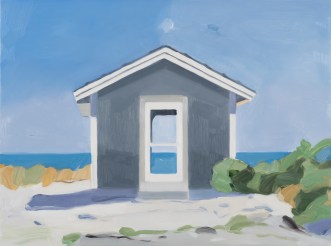
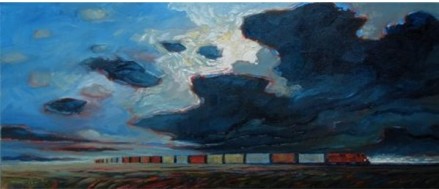
Painting by César Gemayel

Warned by their music.

By the end of the second novel in Rebecca West’s Aubrey Trilogy, This Real Night, the children are grown up, and our narrator Rose is often discussing with herself the meaning of world events and human behavior. The narrator’s inner dialogue is just one of the ways that I think the author expresses her own wonderings and certainties; the reader also learns from discussions between the characters, often in emphatic statements that one or another makes out loud or privately in silence, on any number of topics, from fashion to politics and philosophy, from the motives of others to the failings of herself.

The constant revelation of what goes on in her highly analytical mind, her wanting to understand the meaning of things, and her sureness that there is something numinous behind the visible world, all draw me to the stories. (She makes me love just being with the characters — I never want to leave them — which is probably a greater reason, but it deserves its own post.)

I don’t know how to describe the elements of her prose style that makes every other sentence seem worth reading a second or third time — so I keep posting samples. I can say that each page is rich in metaphors that somehow are more than metaphorical: they convey an understanding that there is something more than meets the eye; much of the truth of things is underneath, and beyond.

She is quoted as having said, “Writing has nothing to do with communication between person and person, only with communication between different parts of a person’s mind.” She didn’t complete This Real Night until almost 30 years after The Fountain Overflows, and it was published in 1984, the year after her death. Here are a couple of passages from the last chapters:

“We were not surprised when the war came, for we had heard our father prophesying it all through our childhood… We had also been warned by our music. Great music is in a sense serene; it is certain of the values it asserts. But it is also in terror, because those values are threatened, and it is not certain whether they will triumph in this world, and of course music is a missionary effort to colonise earth for imperialistic heaven. So we were not so sorely stricken by August, 1914, as many other people. Indeed we had our consolations. It was proved to us that music was not making a fuss about nothing, and that the faces of our parents had been distorted out of common placidity not by madness but by the genuine spirit of prophecy.”

Soon, however, their only brother Richard Quin enlists, and after a few months of training in England, during which his family sees him often, he ships off to the Continent, and they accompany him to Victoria Station in London.

“The space around the station had become one of those areas which, like cemeteries and the corridors of hospitals, are swinging on a turntable between the worlds… myriads of men in uniform, deformed by the weight of the kitbags on their backs, of women and children scurrying by their sides, those also deformed, by the weight of grief and stoicism… Above, a great dimly lit illuminated clock said that this was the hour. The occasion was the annulment of life, for what is life but being able to move according to the will?

“But the people who got out of the taxis and cars, all the men bent under their kitbags, were doing what their will would never want them to do, which it could never let them do, were it not in the custody of something outside them not certified to be wise or loyal. The clock said that there was not time to start that argument….”