Today is the beginning of our salvation; the revelation of the eternal Mystery! The Son of God becomes the Son of the Virgin as Gabriel announces the coming of Grace. Together with him let us cry to the Theotokos: “Rejoice, O Full of Grace, the Lord is with you!”
I had wanted to continue my ruminations on The Lily of the Field and the Bird of the Air by further considering The Moment that Søren Kierkegaard refers to when, after waiting in silence, “…the silent lily understands that now is the moment, and makes use of it.”
I don’t know what that moment consists of for you, for me, for us as a world community, or in our cities or church communities or families. No doubt there are overlapping times and seasons containing infinite instants, and only by quiet listening can we make any sense of them. But this passage in particular I wanted to pass on, in which the writer discusses what is missed when we fail to make the proper, standing-before-God kind of preparation:
“Even though it is pregnant with rich significance, the moment does not send forth any herald in advance to announce its arrival; it comes too swiftly for that; indeed, there is not a moment’s time beforehand…. But of course everything depends upon ‘the moment.’ And this is surely the misfortune in the lives of many, of far the greater part of humanity: that they never perceived ‘the moment,’ that in their lives the eternal and the temporal were exclusively separated.”
So many thoughts swirl in my own noisy mind and heart that I could not imagine how I might find a way to share even these few gleanings with you. Then, in God’s providence and the church calendar, appeared someone who is the supreme example for us of being ready for the moment, that time in history and that time in her life, in a particular moment of a day, when the Angel Gabriel appeared to her. Today we remember that event, when Mary listened, and responded, “Behold, I am the handmaid of the Lord; let it be to me according to your word.”
The Word became flesh and came to live with us, taking on all our human experience, its weakness and suffering and death. He defeated death, and opened the gates of Paradise. The Incarnation, the beginning of our salvation, is The Moment of history; our own “Yes” to God, echoing Mary’s willingness, can be the essence of our every prayer as well, as we wait on Him.
Kierkegaard exhorts us, in words that seem especially fitting for this time of uncertainty and change: “Would that in the silence you might forget yourself, forget what you yourself are called, your own name, the famous name, the lowly name, the insignificant name, in order in silence to pray to God, ‘Hallowed be your name!’ Would that in silence you might forget yourself, your plans, the great, all-encompassing plans, or the limited plans concerning your life and its future, in order in silence to pray to God, ‘Your kingdom come!’ Would that you might in silence forget your will, your willfulness, in order in silence to pray to God, ‘Your will be done.'”
We know that God’s will for us is good, now as ever. Our inability to see or understand that is due to our weakness or sin, or His hiding of His works. May He give us grace to wait and to pray, and eventually we will see the full salvation of the LORD.
Oh, the depth of the riches and wisdom and knowledge of God! How unsearchable are his judgments and how inscrutable his ways! For who has known the mind of the Lord, or who has been his counselor? Or who has given a gift to him that he might be repaid? For from him and through him and to him are all things. To him be glory forever. Amen.
“Let us now look more closely at the lily and the bird from whom we are to learn. The bird keeps silent and waits: it knows, or rather it fully andfirmly believes, that everything takes place at its appointed time. Therefore the bird waits, but it knows that it is not granted to it to know the hour or the day; therefore it keeps silent. ‘It will surely take place at the appointed time,’ the bird says. Oh no, the bird does not say this, but keeps silent. But its silence speaks, and its silence says that it believes it, and because it believes it, it keeps silent and waits.” -Søren Kierkegaard
I worked very hard last week to compose a second post on Kierkegaard’s The Lily of the Field and the Bird of the Air, which I am reading along with Mags. No good fruit seemed to come from my effort, though I wrote many words in a draft and searched for appropriately themed photos. When earlier this week I heard from Simone Weil through her anthologist Laurie Gagne, who was interviewed on Mars Hill Audio, that a writer must often wait patiently for the right word, it made me think more hopefully about the outcome.
I had begun at least two weeks ago, writing about the new bird community just on the other side of my fence, a few feet away from me when I garden. They are tropical birds in several large cages, temporary residents while their owners are between houses, and they are noisily chirping and even screeching from dawn to dusk. That long time ago, as it seems now, I was focused on their being jungle birds, surely not the sort that inspired Kierkegaard’s contemplations. I cleverly speculated that if Kierkegaard had lived in the jungle he wouldn’t have been likely to write the book he did.
But more pertinent to my present situation, only days later, is the fact that they are caged birds. And right now, many of us the world over feel like caged birds, in our efforts to slow the spread of a quickly spreading virus. Some are less restricted than others because they are in a type of helping role, but they also are at more risk. I, who am healthy and feeling in some ways younger than ever, have been grouped with The Elderly; I am trying to submit meekly, in my mind as well as my body, to my classification and assigned task: to stay home. In this regard, what Kierkegaard writes about seeking God’s kingdom first is something to take to heart:
“But then, in a certain sense is there in fact nothing I shall do? Yes, quite true, in a certain sense there is nothing. You shall in the deepest sense make yourself nothing, become nothing before God, learn to keep silent. In this silence is the beginning, which is first to seek God’s kingdom.”
He does talk about how humans often enter into this silence when they are praying: “…as he became more and more fervent in prayer, he had less and less to say, and finally he became entirely silent…. indeed, he became what is, if possible, even more the opposite of talking than silence: he became a listener.”
Currently, the whole world is waiting. The necessity of waiting is a gift given to us, an opportunity, but if I only wait on the decisions of authorities and on the latest statistics, my waiting is of little value.
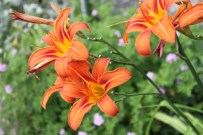
“This is also how it is with the lily, it keeps silence and waits. It does not ask impatiently, ‘When is the spring coming?’ [see Pippin’s daffodils at right] because it knows that it will come at the appointed time; it knows that it would not benefit in any way whatever if it were permitted to determine the seasons of the year. It does not say, ‘When will we get rain?’ or ‘When will we havesunshine?’ or ‘Now we have had too much rain,’ or ‘Now it is too hot.’ …. Then the moment comes, and when the moment comes, the silent lily understands that now is the moment, and makes use of it.”
Obviously I myself know little of this subject experientially, but Søren Kierkegaard and the birds and flowers and all of nature have a lot to share, which I love to pass on! Glory to God, that He somehow arranged for me to find this particular book, chosen for its brevity. Ha! Every paragraph seems to have a world of meaning that one could meditate on for a year. The author must have known how to wait for the right word, as Simone Weil talks about.
Suffering. Are we not all suffering right now? Suffering at the most superficial level by our own movements being curtailed, or because we can’t find our favorite food in the stores, all the way to those who are suffering in a holy and productive way, deeply in their souls, expressing coinherence with the healthcare workers of Italy or with the helplessly panic-stricken of any place. When I think of all the monastics and even my priest, who are accustomed to self-containment and waiting on God, who are praying for all the rest of us who pray little, I feel both grateful and ashamed. When I pray with them at all, via their live-streamed services, it strengthens my ability to wait.
Simone Weil
Charles Williams coined that word coinherence that I used above, but I don’t think he invented the truth that each of us is mysteriously and mystically united to the other. Simone Weil knew about this, too, and not in a theoretical way, but in the compassion and solidarity that emanated from her heart. When she was only five, she heard that soldiers (in the first World War) had no ration of sugar, so she refused to eat sugar. And much later, when she was at the Sorbonne, we learn more from fellow student Simone de Beauvoir’s writings. When Weil heard about a famine in China, she burst into tears; de Beauvoir envied her for having a “heart that could beat across the world.”
Christ suffered on the Cross in taking on Himself all the death and suffering of mankind, and He calls us to do it for each other, to be little Christs, by the power of the Holy Spirit. It’s a mystery to me, for sure, but I hope that praying with my fellow creatures everywhere will help me to acquire more of this grace.
Regarding our own personal pain and death, Kierkegaard says that when we are silent, it makes our suffering less. This runs counter to modern culture in which we all want to talk in an effort to relieve suffering.
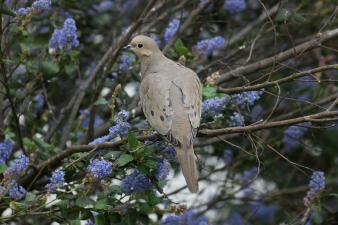
“The bird keeps silent and suffers. However much heartache it has, it keeps silent. Even the melancholic mourning dove of the desert or of solitude keeps silent. It sighs three times and then keeps silent, sighs again three times, but is essentially silent. For what it is it does not say; it does not complain; it accuses no one; it sighs only to fall silent again.Indeed, it is as if the silence would cause it to burst; therefore it must sigh in order to keep silent.”
And by that silence under suffering, Kierkegaard lists several ways suffering is eased; the bird – and potentially we humans! – are freed (I put these points into list form):
“1) From what makes the suffering more burdensome: from the misunderstood sympathy of others; 2) From what makes the suffering last longer: from all the talk of suffering; 3) From what makes the suffering into something worse than suffering: from the sin of impatience and sadness.”
Oh my, I’m afraid I have tempted you to the sin of impatience by my long post, so I am going to stop for now, though I still haven’t come to the end of my meditations on Kierkegaard’s First Discourse. Let me say, in closing, that I am praying with and for people everywhere who are distressed, joining my sighings with yours. I pray that our afflictions may be turned into the sighings of the mourning dove, who after all may be understandably melancholic about the true and sorry state of mankind. Her heartache and sighings become silence, and that is her prayer.
My birthday hasn’t yet arrived, but since I’m unlikely to see any of my children on the proper day, the family I was with just a few days ago gave me a celebration. (Soldier had planned to come here from Colorado with Liam one day, but he wisely cancelled that trip.) Presumably we’ll all be holed up apart from one another when I cross over to a new age.
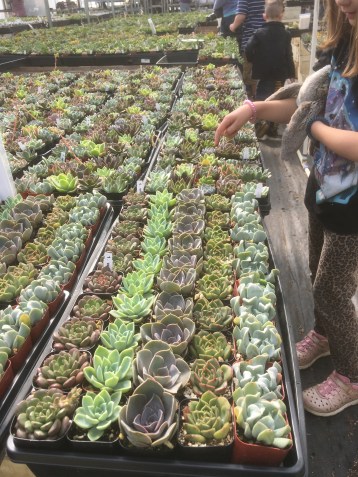
The first special thing Pippin did was to drive me and the children to a succulent farm she’d been wanting to visit. We took a picnic and ate on the way; it took us a while, as it’s in Fort Jones, sort of in the middle of “nowhere,” and not a place that succulents would grow naturally, but the whole operation is in greenhouses. Maybe some of you have ordered from Mountain Crest Gardens. If you like succulents, you would have feasted your eyes on the long rows of charming species and collections.
One of them I did not find charming, only strange:
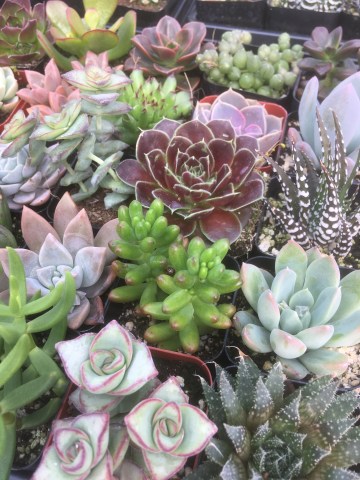
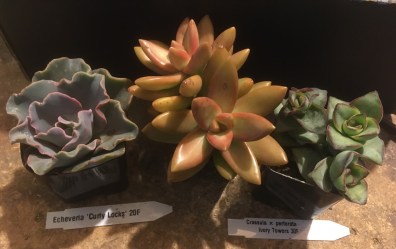
Pippin wanted to get me a few for my birthday and I chose these that are different from anything I already have:
I put them in my car to keep them safe, and I checked on them one day to see that they weren’t getting too cold. I didn’t notice then that the one on the right had evidently gotten too cold, and no wonder. My car looked like this one of those mornings.
I knew I wouldn’t be keeping that plant outdoors in the winter here, and I don’t know why I didn’t have more sense about how cold it would get in my car. At least, it is only damaged, not killed. Scout also came home with a little succulent, and Ivy collected various leaves and stems off the greenhouse floor which I told her were likely to grow into plants if they were in dirt, so she put them all together in one pot when she came home.
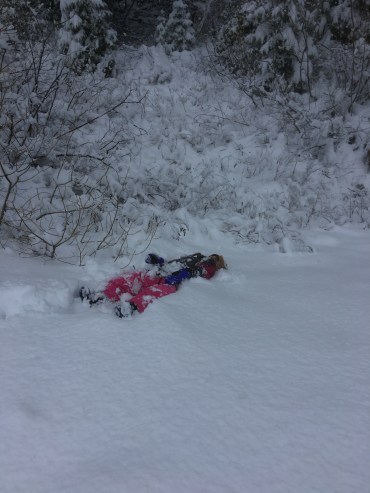
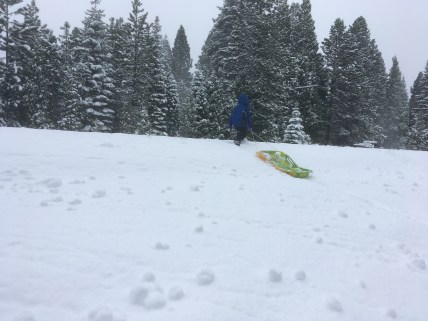
The second birthday surprise was nothing anyone could have planned: a big snowfall of the powderiest sort, followed by a morning when we could easily walk down the road a few paces to a good spot for sledding. That day Jamie had looked out the window and beamed, “It feels like Christmas!” and when I asked why, he said because of the snow.
I realized then how special a treat it was, after their relatively dry winter, that this dumping of perfectly fun snow should happen while I was there, and actually, on the perfect day. I had tried to make my visit other weeks that should have been more wintry. Now, in the middle of March, came my birthday gift from God.
If not for the children, I’d have been happy to look at the snow through the window, but being able to accompany them and watch them literally throw themselves into it was the joy and the gift.
They were thankful for this late snow because when it was Christmas on the calendar their family had just returned from my house and collapsed sick. They couldn’t even eat their Christmas cookies that had been laid by.
As we were pulling on our snow boots and rummaging around for the bibs and gloves, Scout said, “When we come back we can have tea with leftover Christmas cookies!”
Jamie broke trail heading for the little hill alongside the railroad track, and soon the children had smoothed out a sledding run. But after a while they all seemed to like as well merely rolling down the railroad embankment, or in the case of Ivy, just diving and splashing around in the snow, eating it.
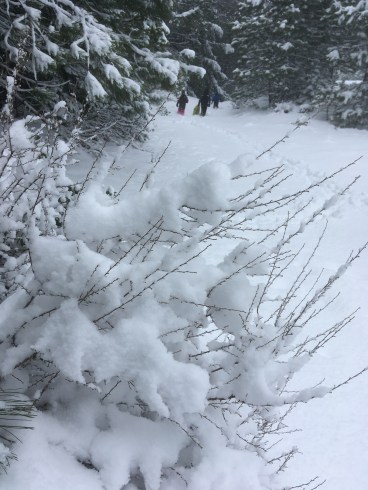
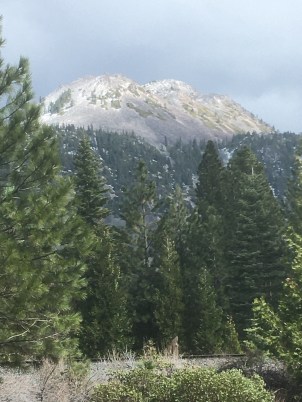
Two days before, I had walked through the forest with the children, trying to identify species of lichens, and noticing stages of manzanita growth or death. This day the manzanita blooms were set in fluffy white.
On the embankment next to where freight trains run many times a day, snowballs form on their own, maybe from the wind of the train rushing past?
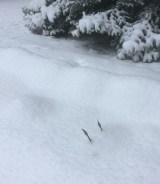
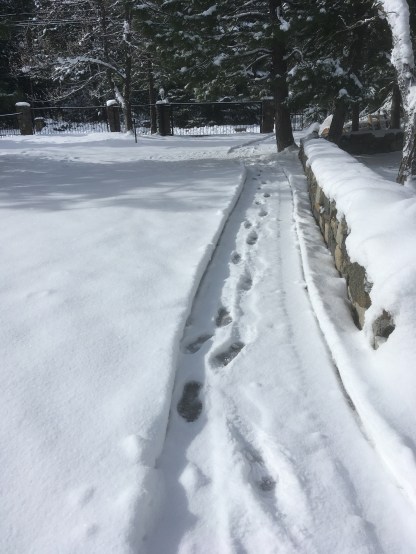
We did go home and eat those Christmas cookies and drink our tea. The Professor blew a path through the snow for me to walk on back to where I was sleeping, in a sort of guest cottage across the street. The next morning the scene showed my tracks with no new snow.
Too many of my children have moved to where the winters are cold and snow is common, and the older I get, the more I try to avoid visiting them during the winter. I should try to remember that every visit I have had in snowy weather has been fun; remember the last time when I taught Liam and Laddie to make snowballs? This week’s snow made good snowballs, too! It was another blessed birthday to remember. ❤
I didn’t know the name for it at the time, but one morning last week I experienced an acute and painful case of Cognitive Overload. It was the day I had been looking forward to for two months, when I would drive up to Pippin’s; the day before that I’d started packing my car with the books and food and even a 50-ft garden hose I was going to take to the family there in far-Northern California.
The morning of, I read an article about the coronavirus before I got dressed, and for the next two hours I debated whether I should change my plans. What if I were asymptomatically infected already? I could be the one responsible for bringing the pathogen to a relatively remote area. That was my main concern, and I worked myself into tears not being able to decide what to do.
Eventually all of my daughters weighed in, and the Professor, too. They didn’t just say, “Go ahead,” or “Come!” but they gave their reasons, which helped me choose among my own jangling thoughts and pick a course of action. I went.
I took along a dozen Mars Hill Audio Journal CD’s for the ride because I thought I might catch up on some of the interviews. One of the first ones I listened to was of Alan Jacobs talking about his book How to Think: A Survival Guide for a World at Odds. Toward the end of the interview when he and Ken Myers were talking about how thinking takes time and effort, and how “practical discernment must be cultivated and developed over time,” he mentioned a discussion he had with Jonathan Rauch about an aspect of thinking that Rauch told him he hadn’t emphasized enough; here are some snippets I transcribed:
“Jonathan Rauch reminded him of the inability of any one human being to bear the cognitive load of decision making that we are called upon to do every day… there is a necessity to offload some of this responsibility to a reliable and healthy community. Each of us individually can’t know what we need to know about every issue; that means we have to trust other people to help guide us and inform us. We just don’t have the cognitive energy to be able to do this…. that triage is impossible for any of us to do on our own. Don’t listen to the people who tell you to think for yourself. It’s not possible to think for yourself… we are always embedded both socially and temporally… That can work for us, if we see to it that we are properly and helpfully embedded.”
There I was, driving up Highway 5, peacefully following through on a decision that I had made by offloading some of my cognitive load. 🙂 When I had a husband to confer with, that would have been enough community. Various articles on the Internet aren’t helpful because they aren’t humans in my community, but thank God I am embedded in a family.
In the days since then, I’ve been grateful for other communities that I am part of, for better or worse, and the way they have taken some of the load. We pray that by God’s providence, whether the decisions of our civic authorities are always the best or not, they will turn out for the best in the end. The governor of my state said that everyone in my age group should stay home, period. Soon afterward, the more immediate area I live in came under “shelter in place” orders.
I remember the many years during which I would defer to my husband about many, many decisions that I didn’t always think he made with the most wisdom — even then I was often glad not to have to think through every last decision on my own; it was enough that I had the good judgment to defer. Maybe my tears last week were partly the cumulative outflow of five years of pent-up frustrations, the weight of a widow’s decision fatigue.
Before I learned of the governor’s edict, I had planned to attend church as soon as I returned, though everyone was debating about the prudence of that, even those of us who know that it’s not through the Holy Mysteries in the chalice that we could share pathogens. It’s all of us breathing parishioners and the surfaces we touch…. Here also I have been relieved of the exhausting effort to have perfect wisdom. My rector, with these words, has passed on to us the decision of our bishop to close the church for at least two weeks:
“Let us realize that we simply cannot know the burdens that our Bishops carry as pastors. We all heard the incredible words of the Savior on Sunday about the “Good Shepherd” in John 10 in honor of St Gregory Palamas, how a true bishop cares for the flock…. let’s remember that the bishop has the ‘mind of the Church’ and so we receive his words, actions and requests with joy, and yes, obedience.”
And Monk Seraphim of Mull Monastery, as he was embarking on a trip through five airports on his return to Scotland, wrote to us:
“This is not our time to ‘shine’ by showing empty courage and adolescent bravado. A Christian shines through humility and sacrifice of one’s self, sacrifice of one’s ‘courageous’ image in the world.
“We are human beings, made of flesh and bones. Flesh and bones can become Chalices of God’s presence in the world, but they can alsobecome ill. As a Christian, my duty is to comfort and to love, to keep myself and my neighbour from harm.”
“Pray for the weak and those most exposed, and try to help any way you can. Forget about ‘playing it cool’ – no one rejoices in our pride except the evil one. Be human. Be a human being, surrounded by human beings, loving them, helping them, protecting them. In this simple, living, non ‘heroic’ attitude is the Cross that will lead to the Resurrection.”
I did try to protect my fellow humans as I traveled down the state. I used so many homemade alcohol wipes at gas stations and rest stops that my hands were in great need of TLC last night. Today I’m resting from the trip, and feeling comforted and joyful because of God’s care for me.
I want to tell you, too, more about my visit and fun with the grandkids, but for now I’ll just mention that I saw a thousand ? or so Western Redbud trees and bushes on my travels. The grass on the California hills is still mostly brown, changing to gray-green in some places, and these bright pink splashes all over the place are also speaking JOY!

 So many thoughts swirl in my own noisy mind and heart that I could not imagine how I might find a way to share even these few gleanings with you. Then, in God’s providence and the church calendar, appeared someone who is the supreme example for us of being ready for the moment, that time in history and that time in her life, in a particular moment of a day, when the Angel Gabriel appeared to her. Today we remember that event, when Mary listened, and responded, “Behold, I am the handmaid of the Lord; let it be to me according to your word.”
 “Let us now look more closely at the lily and the bird from whom we are to learn. The bird keeps silent and waits: it knows, or rather it fully and firmly believes, that everything takes place at its appointed time. Therefore the bird waits, but it knows that it is not granted to it to know the hour or the day; therefore it keeps silent. ‘It will surely take place at the appointed time,’ the bird says. Oh no, the bird does not say this, but keeps silent. But its silence speaks, and its silence says that it believes it, and because it believes it, it keeps silent and waits.” -Søren Kierkegaard
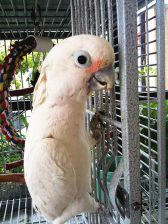 I had begun at least two weeks ago, writing about the new bird community just on the other side of my fence, a few feet away from me when I garden. They are tropical birds in several large cages, temporary residents while their owners are between houses, and they are noisily chirping and even screeching from dawn to dusk. That long time ago, as it seems now, I was focused on their being jungle birds, surely not the sort that inspired Kierkegaard’s contemplations. I cleverly speculated that if Kierkegaard had lived in the jungle he wouldn’t have been likely to write the book he did.


 My birthday hasn’t yet arrived, but since I’m unlikely to see any of my children on the proper day, the family I was with just a few days ago gave me a celebration. (Soldier had planned to come here from Colorado with Liam one day, but he wisely cancelled that trip.) Presumably we’ll all be holed up apart from one another when I cross over to a new age.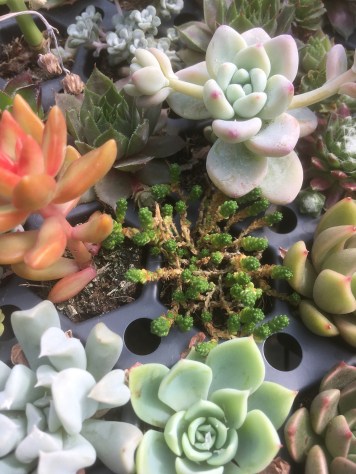



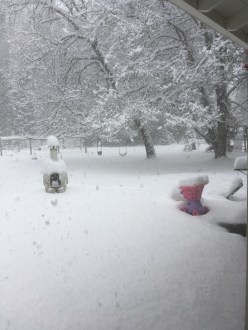 The second birthday surprise was nothing anyone could have planned: a big snowfall of the powderiest sort, followed by a morning when we could easily walk down the road a few paces to a good spot for sledding. That day Jamie had looked out the window and beamed, “It feels like Christmas!” and when I asked why, he said because of the snow.
 If not for the children, I’d have been happy to look at the snow through the window, but being able to accompany them and watch them literally throw themselves into it was the joy and the gift.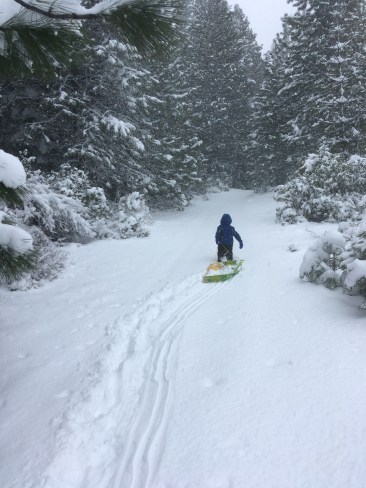



 I didn’t know the name for it at the time, but one morning last week I experienced an acute and painful case of Cognitive Overload. It was the day I had been looking forward to for two months, when I would drive up to Pippin’s; the day before that I’d started packing my car with the books and food and even a 50-ft garden hose I was going to take to the family there in far-Northern California.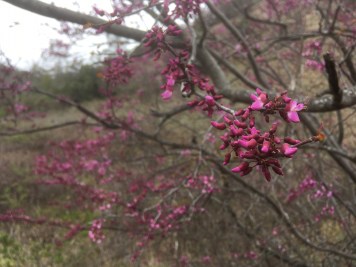
 “Jonathan Rauch reminded him of the inability of any one human being to bear the cognitive load of decision making that we are called upon to do every day… there is a necessity to offload some of this responsibility to a reliable and healthy community. Each of us individually can’t know what we need to know about every issue; that means we have to trust other people to help guide us and inform us. We just don’t have the cognitive energy to be able to do this…. that triage is impossible for any of us to do on our own. Don’t listen to the people who tell you to think for yourself. It’s not possible to think for yourself… we are always embedded both socially and temporally… That can work for us, if we see to it that we are properly and helpfully embedded.”
 “We are human beings, made of flesh and bones. Flesh and bones can become Chalices of God’s presence in the world, but they can also become ill. As a Christian, my duty is to comfort and to love, to keep myself and my neighbour from harm.”

