It was tangled up all through her, too.

In this article “Science fiction, and what Jesus said to the woman at the well,” Fr. Jonathan Tobias discusses the possibility of extra-terrestrial life, what human nature is like, and the meaning of worship.

My favorite line is, “Wherever there is beauty, Christ the Word is speaking to your heart of the Love the Holy Trinity has for you.”

Many portions of the article are to me extra-rich soul food, but I will share just a little here. I hope you will like to read more on Fr. Jonathan’s site.

It is interesting that everyone “worships.” You can’t help worshiping some god or another one. If it isn’t the true God, then a human being will construct his own version. He may not call it “god” and will probably even deny that his invention is a “god,” but it occupies the place of “god” in his thoughts and emotions. The very people that claim that God does not exist, but that there is only stuff that you can scientifically observe are the people who have ended up making this “stuff” their god.

Human beings cannot get away from their human nature. Worshiping “god” is a necessary part of what makes us human (and I suggest here that “worship” is the highest act of being human). You and I are going to worship something: “You’re gonna have to serve somebody,” as Dylan once sang. You can deny the true God, but you cannot deny worship. Worship is tangled up all through your psychology: seeking god is not part of your consciousness … it is your consciousness.

Let me say that again.

Seeking God IS your consciousness. It is the essence of your rationality. Seeking God is your life. Seeking God is the air that you breathe.

Let’s just hope that the “god” you seek is the true God, the Holy Trinity, of Which Jesus is the only Word.

-Father Jonathan Tobias

The Samaritan woman at the well. Mosaic, 6th century, Ravenna

Fava beans, and moving on.

It’s convenient that my next-door neighbor has gone camping this weekend, because I need his yard waste can. I forgot to ask him but I am pretty sure he will be okay with me using it to load up with all of the garden clippings I’ve collected in just two days. He has his dragster parked long-term and rent-free on a few inches of my driveway so he likes to feel that he is doing things for me, too.

The fava beans were a big job! Yesterday I cut all the pods off the 30-something plants that grew from two packets of seeds I’d bought online. I might have started the harvest earlier if it hadn’t been so rainy. As it was, I got caught in a surprise shower in the  middle of the process. Before the last week of rain the beans were overflowing their planter, thus:

But by the time I got to picking them, they had grown a few more inches and were  getting infested with insects and maybe disease, and were just a mess generally. Here are a few shots showing how the project developed over the day. By the evening I was sitting under the wisteria shelling the creamy green beans out of their pods, which I dropped on to the patio at my feet. Just the plants and the pods of these Vicia faba — also known as broad beans or horse beans — filled most of my own large green waste bin.

It was slow going, but I shelled a couple of quarts of beans. That didn’t make much of a dent in the tubful, and I needed to do some other kinds of work still before bed; the thought occurred to me that I could offer them on a county freesharing Facebook group I belong to, so I took pictures and posted them, and this morning  a woman came and took half of the remainder. Tomorrow another member is coming and maybe she will clean me out. I could eat all the beans myself eventually, but I have so many things needing doing right now besides shelling favas… like cooking the ones I did shell!

While I was waiting for the lady I thought I’d do a little deadheading – ha! I ended up spending hours on the front garden, yanking out the poppies that want to cover every other plant, shearing one wallflower bush, cleaning up the irises, weeding. Oh, yes, and taking pictures of pretty flower pairings, or trios, and the asparagus in its ferny state with Johnny Jump-ups. I dragged the neighbor’s can over to my driveway and started piling in the green and flowery trimmings.

A Painted Lady butterfly was drinking at the chive flowers, and making me think that she was showing off for the camera. Unlike most butterflies, she did not flutter away as I drew near, but did pirouettes, and flew from bloom to bloom striking different poses. Perhaps the strong drink was making her lose all inhibitions. All the while I slowly came closer…  and then she came closer to me, spread her wings on the flower right in front of me and let me watch and admire her at her work.

Her wings are a bit tattered, I can see now in the closeups. I wonder if a bird tried to make lunch out of her… Speaking of birds, I think I may have made friends with a certain chickadee. I will tell you about him later; right now I have to head to rest and sleep so that I can tackle more garden tasks tomorrow.


Sometimes both useful and easy.

When I posted about borage two months ago, half of the commenters said they also hadn’t had luck growing it. For some it didn’t reseed itself; for others, the summers were too hot. Kim said, “I have always thought it to be easy,” though she doesn’t have any growing right now.

bee drinking from oregano

The uses of borage was the subject of several comments; a couple of people said they didn’t know what they would do with it if it did thrive. But Cathy wrote, “It is such a captivating plant which attracts bees and creates curiosity from human garden visitors.”

And it is primarily for the bees that I thought to grow it in my Pollinator Garden, and so that I could behold that pretty sight of borage with bees buzzing happily around it. I let the insects make use of the plants, such as the oregano I always grow, but rarely use myself. The bees drink their fill of its nectar and last year I got good pictures of them doing it. So I guess I would use borage as material for my photo art. 🙂

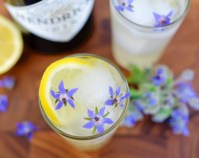
I want the borage for its pretty, often gorgeously blue, flowers. I would like to have a few of those flowers to put in salads or in cold drinks in the summertime. Martha asked if I would be making tea with it — perhaps I would! They say that tea made from the leaves tastes like cucumber. Here is a picture from the Internet of one way I can imagine enjoying those blue accents, come August.

A young friend dug four borage plants from her garden and brought them to me at church just this month. Then the weeks of rain began, so they are still sitting in their pots, but looking very healthy.

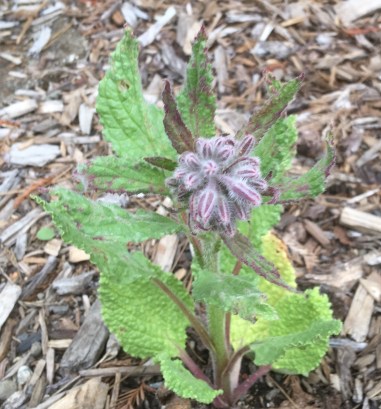
I have come to suspect that borage is a bit thirstier than most of the plants in my garden, and that previously it has died from drought. The one I bought and planted this spring is looking good after the recent season of bounty, during which its little roots were surrounded by as much water as they could drink, day after day, no matter where they reached. Once the rains stop — as of this evening, there is no rain at all on the forecast — I may just have to squirt a little extra from my garden hose on the borage, beyond what it gets from the drip irrigation.


It won’t be long before this flower cluster opens, and the bees arrive!
To do their work, to get their sweet drinks, they will find to be the easiest thing.

Favorites and friends in the garden.

The Mexican daisy “showered down the drystone walls” of Penelope Lively’s grandmother’s garden, and was “a Gertrude Jekyll favorite.” She mentions this plant, Erigeron karvinskianus, four times in her book Life in the Garden, finding its other common name “fleabane” to be disagreeable (as do I).

June 2016

“And, as for me, it has become a kind of signature plant; in London, it has obligingly seeded itself all round the railings at the front of my house, and down the iron steps to the basement. And it has spread along this side of the square, colonizing other frontages, where others have clearly welcomed it — only one insensitive neighbor has torched it with weed-killer.”

I’ve been surprised at how much I have in common with this London gardener. I also have Erigeron, which my landscape designer four years ago knew would fit nicely into my vision for the back garden. At the time I didn’t foresee how I would love it.

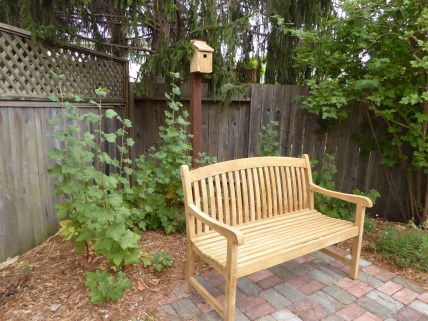
Today it is a bit bedraggled by all the drenching it’s received, just when it was beginning to put on a show after being sheared a month ago. When I went looking for a photo showing it in its glory, I found scenes from the past that show how far things have developed.

September 2016

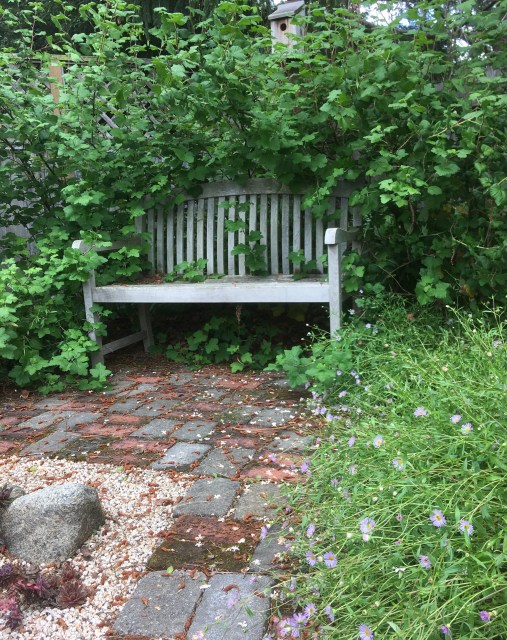
Compare that to this morning, and we can see that clearly, one of the first things I must do when the rain finally stops, is to trim back the native currant that has evolved from being simply a pleasant a background to the bench.

Because very soon, I’m hoping one of you will come and sit there with me, while we drink tea and gaze out on the Mexican daisies and other beauties, talking gardens or whatever you like. ❤