One of the readings for Holy Monday is from Ezekiel, a description of what the prophet saw in his vision of creatures and wheels:
…a whirlwind was coming out of the north, a great cloud with raging fire engulfing itself; and brightness was all around it and radiating out of its midst like the color of amber, out of the midst of the fire. Also from within it came the likeness of four living creatures. And this was their appearance: they had the likeness of a man. Each one had four faces, and each one had four wings. Their legs were straight, and the soles of their feet were like the soles of calves’ feet. They sparkled like the color of burnished bronze. The hands of a man were under their wings on their four sides; and each of the four had faces and wings. Their wings touched one another.
The creatures did not turn when they went, but each one went straight forward. As for the likeness of their faces, each had the face of a man; each of the four had the face of a lion on the right side, each of the four had the face of an ox on the left side, and each of the four had the face of an eagle. Thus were their faces. Their wings stretched upward; two wings of each one touched one another, and two covered their bodies.
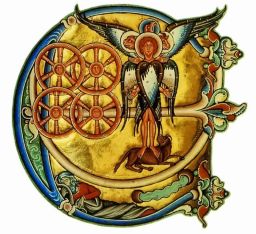
And each one went straight forward; they went wherever the spirit wanted to go, and they did not turn when they went. As for the likeness of the living creatures, their appearance was like burning coals of fire, like the appearance of torches going back and forth among the living creatures. The fire was bright, and out of the fire went lightning. And the living creatures ran back and forth, in appearance like a flash of lightning.
Now as I looked at the living creatures, behold, a wheel was on the earth beside each living creature with its four faces. The appearance of the wheels and their workings was like the color of beryl, and all four had the same likeness. The appearance of their workings was, as it were, a wheel in the middle of a wheel. When they moved, they went toward any one of four directions; they did not turn aside when they went.
As for their rims, they were so high they were awesome; and their rims were full of eyes, all around the four of them. When the living creatures went, the wheels went beside them; and when the living creatures were lifted up from the earth, the wheels were lifted up. Wherever the spirit wanted to go, they went, because there the spirit went; and the wheels were lifted together with them, for the spirit of the living creatures was in the wheels.
I was interested to see how artists might have rendered these images. Many of the pictures I saw were quite psychedelic, and just as mind-boggling as the descriptions Ezekiel gave. My favorite was this quiet sculpture, detail of an Amiens Cathedral facade which shows only two wheels, and a prophet who might be seen as receiving his vision, or perhaps meditating on the whole of it — which would be impossible to render in stone. The complexity and drama are only hinted at by the way the wheels are interwoven or interweaving.

The church fathers have written that the four living creatures are the cherubim, the guardians of the throne of God. The burning coals are holy men, the lamps signify the light of the gospel, and the wheels signify Holy Scripture; St. Gregory the Great tells us that “the New Testament lay hidden by allegory in the letter of the Old Testament.”

Ezekiel closes his description (beyond this day’s reading) with the words, “This was the vision of the likeness of the Lord’s glory. I saw it, and I fell down on my face….” and God spoke to him, gave him an assignment, and gave him a scroll, saying:
“Son of man, eat this scroll, and go and speak to the children of Israel.” So I opened my mouth, and he fed me the scroll. Then he said to me, “Son of man, your mouth shall eat and your stomach will be filled with this scroll that is given you.” So I ate it, and it was in my mouth as sweet as honey.
My Bible footnotes remind me that the faithful can also know that sweetness that Ezekiel tasted, as the Psalmist sings:
How sweet to my taste are Your teachings.
More than honey and the honeycomb in my mouth.
This probably works best when we love and obey those teachings… Lord, have mercy!
Heal me, O LORD, and I shall be healed;
save me, and I shall be saved:
for thou art my praise.
Jeremiah 17:14
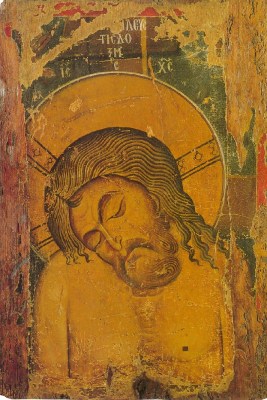
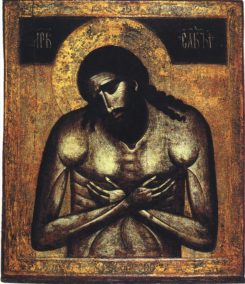 adds, ‘even death on a Cross.’ The point of the ‘even’ is not that the Cross is painful above all pain, but that the Cross is shameful above all shame.”