Don’t confuse the mane with the magpie.

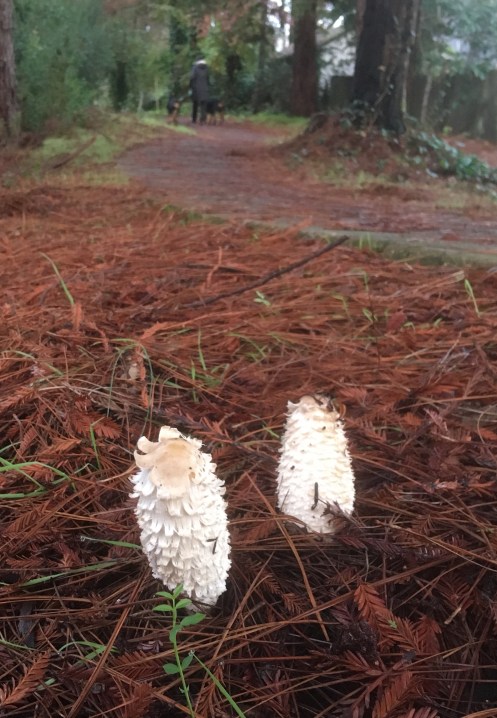
I saw this strange fungus on the walking path last week, and wondered if it were a puffball type. My nephew saw the photo on Instagram and told me it looked like Shaggy Mane Fungus. I thought he might be joking, but Wikipedia gave me the straight scoop: It is indeed Shaggy Mane, a.k.a. Coprinus comatus. “This mushroom is unusual because it will turn black and dissolve itself in a matter of hours after being picked or depositing spores…” It grows “in places which are often unexpected, such as green areas in towns.” The ones I saw were just up the bank from the creek. You can cook and eat the Shaggy Mane — I guess if you do so before it “dissolves itself.”

We are warned not to confuse it with the magpie fungus, Coprinopsis picacea, which is poisonous, and looks like this one, at right.

Or with the common inkcap fungus, Coprinopsis atramentaria, whose botanical name also starts with Coprin-, but whose form is nothing similar.

I’ll be interested to see what condition my specimens are in next time I meet them.
Gardening in sunshine and breezes.

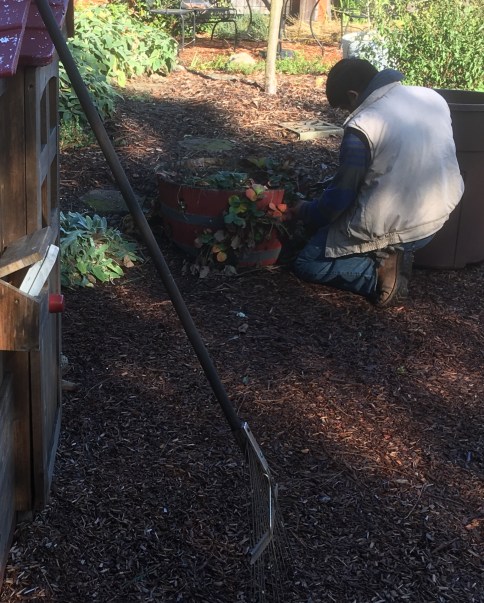
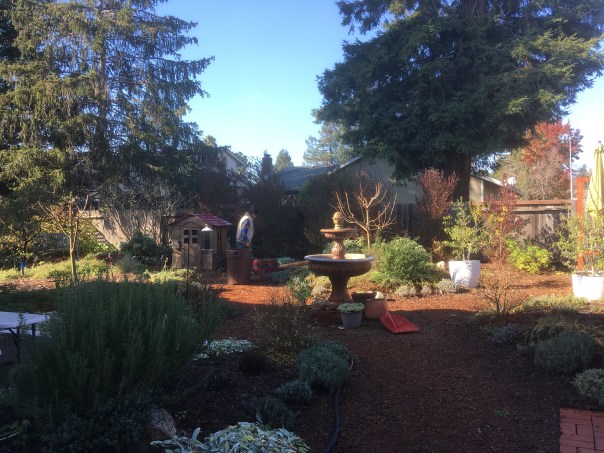
The picture below shows clearly how I’ve kept one of my Elephant Heart plum trees (far left) to about half the size of the other, by my prunings over the last few seasons. I don’t know why that is, but I seem to have continued the trend today. I pulled on my jeans and was out with the loppers before breakfast, because my gardener-helper was coming and would be able to clean up after me.

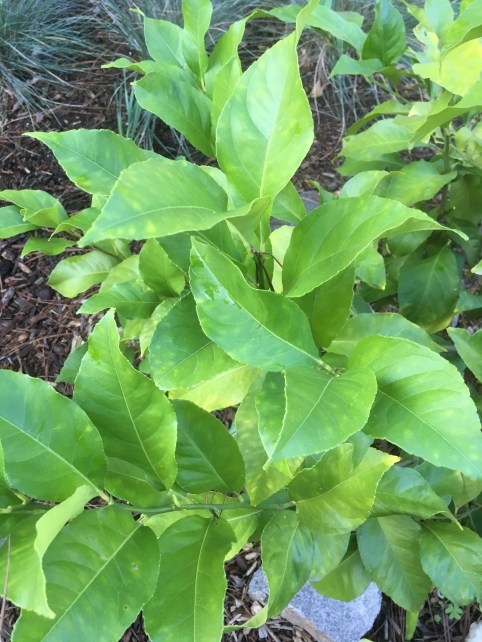
The north side of my garden is especially shady on this winter day, but it is a sunny and drying-out kind of day in any case, in the midst of a series of also welcome waterings. Everything is damp, and the sunshine drew out the scents of all the plants that we were trimming and cleaning up: a little bay tree in a pot, rose geranium, lemon. Alejandro said that even the fig branches gave off a pleasant smell where we sliced off a few branches in our team effort to shape that tree.

I found a flower on the fava beans, and buds on the azealea. The strawberry runners that I staked into the soil have taken firm root under the rice straw that is now so sodden that we threw it out. I hope it’s true, what those “old-timers” predicted when they saw the lizards last summer, that we will have a mild winter.

But the midwinter of 2018 was mild, prompting the fruit trees to bud early enough that they got frosted later on, ruining at least the plum crop — at least, that’s what Mr. Greenjeans, my youngest old-timer friend, told me.

I hated to stop my gardening this noon; I never get my fill of seeing the new buds, and pine boughs waving in the breeze – but A. and I both had tasks elsewhere to tend to. As the days grow longer there will be plenty more work to provide us with happy times in the dirt and leaves and fresh air. Every day in the garden reveals change and new beauty.

Blessed is the kingdom…

Pantocrator OW Hagia SophiaIn The Eucharist, Fr. Alexander Schmemann lays before us the glories of the faith, which “manifests and grants that to which it is directed: the presence among us of the approaching kingdom of God and its unfailing light.” The very Kingdom of God seems to shine directly from the pages of Fr. Alexander’s book into my heart; it feels that way because he brings to mind what I have experienced in our services.

Jesus himself referred to the kingdom as something present on earth when He was among his disciples; as something within us; as something for whose coming we ought to pray in The Lord’s Prayer. Truly the Divine Liturgy is where we both experience heaven and anticipate the fullness of the kingdom to come.

The Orthodox Divine Liturgy, the Eucharist, begins with the announcement, “Blessed is the kingdom of the Father, and of the Son, and of the Holy Spirit, now and ever, and unto ages of ages.”

What does it mean to bless the kingdom? It means that we acknowledge and confess it to be our highest and ultimate value, the object of our desire, our love and our hope. It means that we proclaim it to be the goal of the sacrament — of pilgrimage, ascension, entrance — that now begins. It means that we must focus our attention, our mind, heart and soul, i.e., our whole life, upon that which is the “one thing needful.” Finally, it means that now, already in “this world,” we confirm the possibility of communion with the kingdom, of entrance into its radiance, truth and joy. Each time that Christians “assemble as the Church” they witness before the whole world that Christ is King and Lord, that his kingdom has already been revealed and given to man and that a new and immortal life has begun. This is why the liturgy begins with this solemn confession and doxology of the King who comes now but abides forever and shall reign unto ages of ages.

– Father Alexander Schmemann

What to say about a cookie?

This one is certainly the Cookie of the Year, though I don’t know which year, because I started the dough in 2018 and finished them in 2019. A new recipe, from the current Bon Appétit, which means you can find it on epicurious.com:  Double-Pecan Thumbprints.

The layer of flavor-rich frangipane tops off (even though it’s in the middle) the oh-so-toasty-pecan everything of this thumbprint. It instantly became my favorite cookie of all time. I spent hours over several days browsing recipes and planning this year’s cookies; that brainstorming was the easy part. Shopping, baking, then giving and eating took any remaining energies, leaving little for describing or promoting. But I wish you might try baking these so you can taste for yourself. Now that you’ve seen the picture, take a look at that recipe, and if it calls to you…

(I’m sorry if you recently resolved to eat no more cookies. 😦 )

pecan thumbprints 2018 cookies