He lived daily with the Lord.

St. Nicholas is one of the “favoritest” saints in the Orthodox Church. I have read about him many times and don’t usually remember much. I didn’t grow up hearing about him as the real historical not-Santa-Claus person that he is, or knowing that there was such a thing as St. Nicholas Day, and since I became Orthodox I haven’t succeeded in implanting him in my heart in any satisfying way.
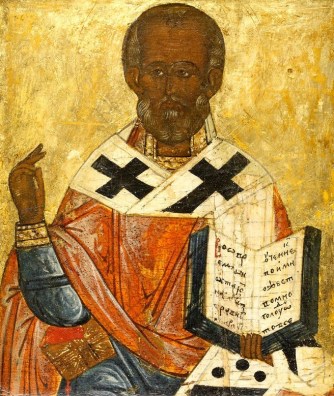
But we both live by and in the love of Christ, so he must be in my heart in spite of my neglect. I will pass on to you (again) what blessed me some years ago, from The Winter Pascha:

The extraordinary thing about the image of St. Nicholas in the Church is that he is not known for anything extraordinary. He was not a theologian and never wrote a word, yet he is famous in the memory of believers as a zealot for orthodoxy, allegedly accosting the heretic Arius at the first ecumenical council in Nicaea for denying the divinity of God’s son.

He was not an ascetic and did no outstanding feats of fasting and vigils, yet he is praised for his possession of the “fruit of the Holy Spirit…love, joy, peace, patience, kindness, goodness, faithfulness, gentleness, self-control” (Gal. 5:22-23). He was not a mystic in our present meaning of the term but he lived daily with the Lord and was godly in all his words and deeds. He was not a prophet in the technical sense, yet he proclaimed the Word of God, exposed the sins of the wicked, defended the rights of the oppressed and afflicted, and battled against every form of injustice with supernatural compassion and mercy.

In a word, he was a good pastor, father, and bishop to his flock, known especially for his love and care for the poor. Most simply put, he was a divinely good person.

-Fr. Thomas Hopko
Red for the Word made flesh.

When the doorbell rang one evening after dark, dark coming so early this season, Susan and I were both on our guard, because we are two vulnerable women and we weren’t expecting anyone.

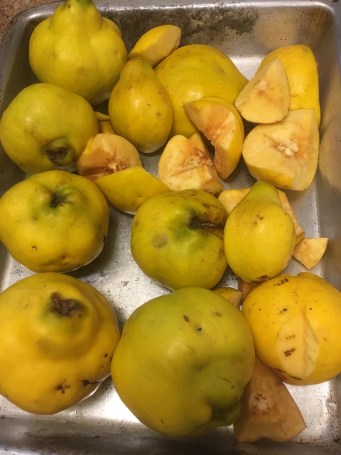
I have a peephole in my door, and I peeped, and saw that it was a human shape and not a package on the step, but I had to turn on the porch light to see if it was someone I recognized. It was Linda! Linda is  my friend who took me to the Heirloom Festival recently. She has been gifting me with garden things for four decades, and she’d mentioned last month that her neighbor — they live fifteen miles from here! — had some quinces she would try to bring me. Here she stood at my door with a dozen in the bottom of a shopping bag. I kissed her.

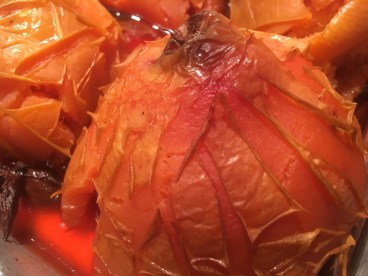
She’d heard about the puny and rock-hard fruits I’d gathered and tried to use, but this will be my last mention of that batch, because these were perfect. For a couple of days I let the good quinces perfume the kitchen, and then I faced the challenge of making use of them for food, when I didn’t have time to peel them. I took time instead to find a recipe for oven-poaching whole quinces with star anise, lemon, honey and cinnamon. As they baked, the whole house filled with an even complex and delicious aroma.

It is worth cooking quinces just to see how the fruit changes to this beautiful orange-pink color. I found it festive in Christmasy way, partly because I had that morning heard a talk that our rector gave the children after Liturgy, about the sequence and meaning of the layers of vestments that he puts on for the services, and he started out telling what the different colors symbolize.

Liturgical churches do not all use the same colors for various seasons or feasts on the calendar, and there are numerous options and meanings. But during Advent in our tradition, the vestments and altar cloths are red, as we are anticipating the birth of the Savior born to a human mother, who gave him human flesh and blood. Red for blood. To remind us of that tenet of our Christology.

In the beginning was the Word, and the Word was with God, and the Word was God.  He was with God in the beginning.  Through him all things were made; without him nothing was made that has been made.  In him was life, and that life was the light of all mankind. The light shines in the darkness, and the darkness has not overcome it.

The Word became flesh and made his dwelling among us. We have seen his glory, the glory of the one and only Son, who came from the Father, full of grace and truth.

-The Gospel of John

Firelight and that happy grace.

The phrase I took for the title of this post describes what my housemate and I soaked up this evening as we sat by the stove, where she had been tending a wood fire since she got home from work. When I came downstairs from a nap, it was already brightening up the whole house, and our dispositions as well. The modern world doesn’t let us feel comfortable about the slowing-down and love of staying home that are natural during these cold and short days, but Kenneth Grahame does:

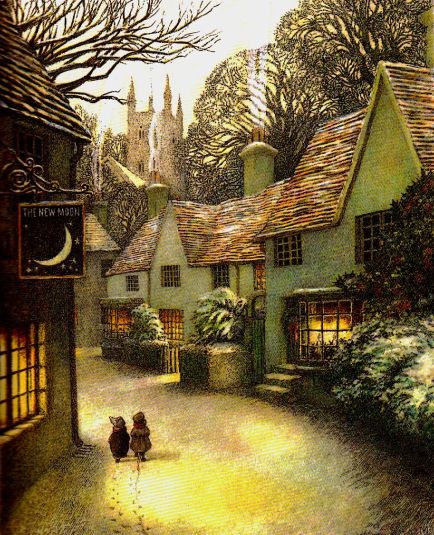
“The rapid nightfall of mid-December had quite beset the little village as they approached it on soft feet over a first thin fall of powdery snow. Little was visible but squares of a dusky orange-red on either side of the street, where the firelight or lamplight of each cottage overflowed through the casements into the dark world without. Most of the low latticed windows were innocent of blinds, and to the lookers-in from outside, the inmates, gathered round the tea-table, absorbed in handiwork, or talking with laughter and gesture, had each that happy grace which is the last thing the skilled actor shall capture–the natural grace which goes with perfect unconsciousness of observation.

“Moving at will from one theatre to another, the two spectators, so far from home themselves, had something of wistfulness in their eyes as they watched a cat being stroked, a sleepy child picked up and huddled off to bed, or a tired man stretch and knock out his pipe on the end of a smouldering log.”

― Kenneth Grahame, The Wind in the Willows

His mirror, sister, Bride.

Malcolm Guite has given us a rich treasury in the poetry anthology he assembled, Waiting on the Word: A Poem a Day for Advent, Christmas, and Epiphany. For each poem he writes what he calls a “reflective essay,” and they are wonderfully enlightening for someone like me whose education in poetry is minimal.

I was browsing the paperback last night just before falling asleep, and when I read this poem by Christina Rossetti I got the idea to post it here on its eponymous day — but I lost that thought altogether with consciousness. Guite has put it on his blog on the proper day, where you can hear him read it if you like. But to read his thoughts you’ll have to get the book itself.

For the Orthodox, what we call the Nativity Fast does not begin on a certain day of the week approximately four weeks before the Feast of the Nativity of Christ, but always on November 15, making it 40 days long. It’s consistent, but wouldn’t make a tidy title for a poem!

ADVENT SUNDAY

BEHOLD, the Bridegroom cometh: go ye out
With lighted lamps and garlands round about
To meet Him in a rapture with a shout.

It may be at the midnight, black as pitch,
Earth shall cast up her poor, cast up her rich.

It may be at the crowing of the cock
Earth shall upheave her depth, uproot her rock.

For lo, the Bridegroom fetcheth home the Bride:
His Hands are Hands she knows, she knows His Side.

Like pure Rebekah at the appointed place,
Veiled, she unveils her face to meet His Face.

Like great Queen Esther in her triumphing,
She triumphs in the Presence of her King.

His Eyes are as a Dove’s, and she’s Dove-eyed;
He knows His lovely mirror, sister, Bride.

He speaks with Dove-voice of exceeding love,
And she with love-voice of an answering Dove.

Behold, the Bridegroom cometh: go we out
With lamps ablaze and garlands round about
To meet Him in a rapture with a shout.

-Christina Rossetti