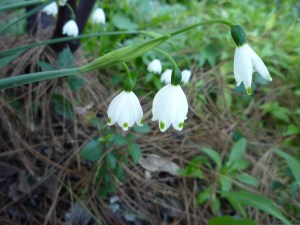
January Surprises

P1120337
snowdrops

This week I was blessed by the usual end-of-January boost that we get around here. It always surprises me, because most of the month, and probably for a good bit of February, I am struggling against the dark and sometimes the cold. I think I am depending on the Christmas lights around my kitchen window to bolster my mood. But this is the time that we get some sunny days and I have to go into the back yard to do some kind of chore, and suddenly I see buds and flowers, and smell the fresh and cool air.

P1120299

P1120323 manzanita buds
manzanita – Arctostaphylos

On the Monday holiday, Soldier son came to prune the wisteria and the plum tree, but didn’t have time to cut up the branches and get them into the trash, so he made a tidy stack under the tree.

I considered hiring a young man from church to finish the job, but it seemed like that might be more trouble than tackling it myself; I have often done this part before. On Thursday I decided to have at it for 20 minutes and see how much progress I could make.

It was so lovely to be out there, I ended up spending more than an hour, and I reduced the stack by about half. This cherry plum sends up very straight branches every year and I always want to save a bunch of them, envisioning row markers or bean poles or even just kindling for the wood stove. So I made a separate pile of those. It makes me feel young and strong to work with those loppers and my leather gloves, and I even enjoy the slight muscle ache that arrives two days later. This afternoon I pretty much leveled the pile of trimmings.

snowball bush buds 1-24-15
snowball bush – viburnum macrocephalum

I kept brushing up against the strawberry tree, and its little pale green fruits dangled around. Pale green leaves are sprouting on the rose geranium, and I wandered around the garden to admire tiny buds on the snowball bush, the earliest spring flowers, and the beginnings of manzanita blooms.
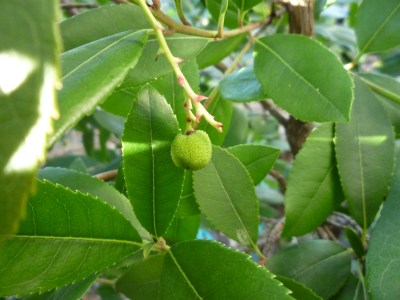
P1120314 strawberry tree
strawberry tree – Arbutus unedo

Sara inspired me this week with her post about following a tree, and I thought of observing our strawberry tree. I think I won’t take part officially in the group project, but I have observed now in January, and that’s a start!P1120309

The yard waste bin was not big enough to hold all the twigs and branches I collected, so I filled a couple of these garden containers that are a modern form of trug. After the big bin is emptied next week I’ll dump the rest of the clippings in. And then I better prune my dear rose bush!


I needed some green soup.

Some tortures are physical
And some are mental,
But the one that is both
Is dental.

~Ogden Nash

Off and on since October I’ve been the frequent recipient of the benefits of modern dentistry, at which I am amazed and for which I am greatly thankful. Still, more than once while waiting “for things to settle down” I’ve had the proverbial aching tooth that is so distracting and mentally consuming. Just to prevent pain and promote recovery I was on two different occasions instructed to eat “nothing harder than spaghetti” for three days. That means no crunchy vegetables, which are one of my favorite munchies. It’s a good thing I have many soup recipes, and it’s also good that I had made a giant batch of this one before the torture began.

I made it with kale this time, and Mr. Glad thought that version was not half as good as the original spinach, but I could still slurp it by the quart. It’s the anise seed that makes it special. The recipe is pretty straightforward; I usually multiply it x8 so that I can have it in the freezer and at-the-ready. It loses nothing by waiting in the freezer and is a great accompaniment to any Italian main dish. I like it just as well without the cheese and lemon.

P1120284kale soup

FLORENTINE SPINACH SOUP

1 T. olive oil
½ c. each thinly sliced celery and green onion
2 tsp. anise seed
1 10-oz. pkg. frozen chopped spinach (other leafy greens may be substituted)
3 c. regular-strength chicken broth
¼ tsp. freshly ground pepper
lemon wedges
grated Parmesan cheese

Pour oil into a 3-4 qt. Pan over medium-high heat. When oil is hot, add celery, onion, and anise seed to pan; stir occasionally until vegetables just begin to brown, 8-10 minutes. Add spinach, broth, and pepper; bring to a boil, then reduce heat and simmer 10 minutes.

Pour soup, a portion at a time, into a blender or food processor (or use immersion blender?), and whirl until smoothly puréed. Reheat if necessary, pour into bowls, and offer lemon wedges and cheese to add to taste. Makes four servings (unless you are serving someone like me, who would want to eat this whole pot.)

It even comes to the boulder.

I have read this poem so many times, and still feel that I’m not equal to it, I can’t hope to plumb its depths. In that way the poem is like its subject, which speaks to me of the grace of God, something of Himself He gives us even though we are undeserving, unworthy, dense as rocks. It falls in the form of joy or peace or repentance, and when you’ve recovered from the surprise, you want to bake a cake and give a party.

HAPPINESS

There’s no accounting for happiness,
or the way it turns up like a prodigal
who comes back to the dust at your feet
having squandered a fortune far away.

And how can you not forgive?
You make a feast in honor of what
was lost, and take from its place the finest
garment, which you saved for an occasion
you could not imagine, and you weep night and day
to know that you were not abandoned,
that happiness saved its most extreme form
for you alone.

No, happiness is the uncle you never
knew about, who flies a single-engine plane
onto the grassy landing strip, hitchhikes
into town, and inquires at every door
until he finds you asleep midafternoon
as you so often are during the unmerciful
hours of your despair.

It comes to the monk in his cell.
It comes to the woman sweeping the street
with a birch broom, to the child
whose mother has passed out from drink.
It comes to the lover, to the dog chewing
a sock, to the pusher, to the basket maker,
and the clerk stacking cans of carrots
in the night.

It even comes to the boulder
in the perpetual shade of pine barrens,
to rain falling on the open sea,
to the wineglass, weary of holding wine.

~ Jane Kenyon

Collis refutes thin air.

You cannot make things out of thin air, people say. There is no such thing as thin air, if by that is meant something empty. It is really very thick and powerful, and from it all things are made that are made, or without it cannot be made, whether tree, plant, person, or army tank.

What is the atmosphere? It is an air ocean. We walk at the bottom of an air ocean at a depth of from two hundred to five hundred miles. We cannot see it, we cannot touch it, and yet it presses down upon us with a pressure of a ton to every square foot. Each acre of land sustains forty-six thousand tons of air. It is possible to carry this surprising weight on our heads owing to the way it equalizes the pressure all around us.

The atmosphere is composed, as everything is composed, of small items called molecules. They are not all of the same kind. Some contain oxygen, others carbon dioxide, some nitrogen, others argon; some ozone, others nitric acid; some water vapour, others ammonia. In quantity nitrogen heads the list and oxygen seconds it, while in importance the carbon dioxide is second to none. When we grasp that water, carbon, nitrogen, nitric acid, and ammonia contribute ninety per cent of all the materials that are built into the tissues of plants, it is easy to see how necessary it is that they should have roots in the air as well as roots in the soil.

The leaves are these upper roots or mouths — plants are pretty well all mouth.

— John Stewart Collis in The Worm Forgives the Plough

lamium & plum leaves Nov 08