We kiss and name and praise.

I have a few hours to myself this afternoon and have been perusing a book of poetry that my husband gave me for Christmas, Dana Gioia’s Interrogations at Noon. I think I borrowed this collection from the library once, but long enough ago that even the poems I vaguely remembered are now fresh gifts — like this one on the first page.

WORDS

The world does not need words. It articulates itself
in sunlight, leaves, and shadows. The stones on the path
are no less real for lying uncatalogued and uncounted.
The fluent leaves speak only the dialect of pure being.
The kiss is still fully itself though no words were spoken.

And one word transforms it into something less or other –
illicit, chaste, perfunctory, conjugal, covert.
Even calling it a kiss betrays the fluster of hands
glancing the skin or gripping a shoulder, the slow
arching of neck or knee, the silent touching of tongues.

Yet the stones remain less real to those who cannot
name them, or read the mute syllables graven in silica.
To see a red stone is less than seeing it as jasper –
metamorphic quartz, cousin to the flint the Kiowa
carved as arrowheads. To name is to know and remember.

The sunlight needs no praise piercing the rainclouds,
painting the rocks and leaves with light, then dissolving
each lucent droplet back into the clouds that engendered it.
The daylight needs no praise, and so we praise it always –
greater than ourselves and all the airy words we summon.

— Dana Gioia
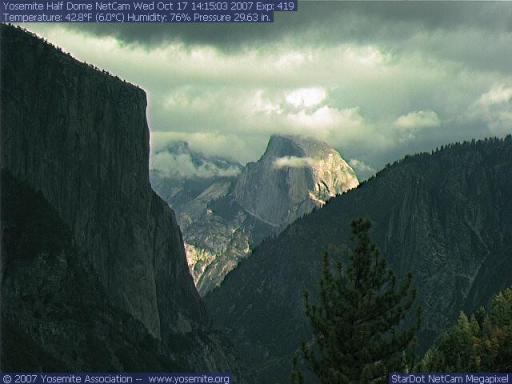
half dome 4 more sun yet
Webcam of Half Dome, Yosemite National Park

Collis cannot hear ants.

I’ve continued reading along in The Worm Forgives the Plough by John Stewart Collis, though days and weeks did go by when I neglected that paperback sitting on my nightstand and followed instead the lives of fascinating characters in Pearl S. Buck’s novels.

After the first half of the Collis book and its descriptions of farm work, the author begins to give lessons on clouds and chalk, geology and evolution. He explains botany in lucid prose, and earthworms. I wasn’t so interested in some of these topics and did skim a bit, but when he started writing in vivid detail about the kingdoms of ants and how they live, I paid closer attention. Just a short example here:

Thus ants are specialized in activity, but they all share common destinies and dooms. All, for instance, are without ears, and live in a world dedicated to silence. Here again we cannot easily conceive this life. There is silence along their streets, and even on the field of battle there is no sound. And since they are deaf it seems certain that they are also voiceless. It may be that we have not the ears to hear the utterances of insects even as we have not the eyes to see the tiniest of their brothers. Anyway the fact iant-trail-2s that we don’t hear anything and it is probable that the silence is absolute. Just as we can watch a spider attack a fly caught in its web and see it slowly eat its living meal without a sound being heard, so also, however close we might bend down upon cohorts of embattled ants, we will hear no shout of insectual command, no cry of triumph, no moans of the dying, and even when a head is sawn off or a severed limb falls to the ground, no shriek of pain will humanize the scene.
— John Stewart Collis

Hard bones and precious pearls.

….if you want to understand “bones” as “works,” know then that the works of the unrighteous are as smoke, and the works of the righteous are powerful and as lasting as hard bones. Not even one righteous deed will fade away or disappear in the course of time. God knows them and God watches over them, so that He may reveal them like precious pearls before the assembly of angels and men on that Day.

O All-seeing Lord, Master and Protector of the righteous, multiply our righteous deeds by Thy Holy Spirit, without whom nothing good can be done; and save us by Thy mercy, not according to our deeds.

–St Nikolai Velimirovic The Prologue of Ohrid

A poem like ammunition.

millerw


The poet Miller Williams died on the first day of 2015. I had not been familiar with his poetry, though I knew of the book he co-authored, How Does a Poem Mean? As I browsed some of his works I came upon this one that I liked right away.


Love and How It Becomes Important in Our Day to Day Lives

The man who tells you which is the whiter wash,
the woman who talks about her paper towels,
the woman whose coffee holds her home together,
the man who smells the air in his neighbor’s house,

the man who sings a song about his socks,
the woman who tells how well her napkin fits,
the man who sells the four-way slicer-dicer,
the woman who crosses tape between her tits,

and scores besides trample my yard, a mob
demanding to be let in, like Sodomites
yelling to get at my guests but I have no guests.
I crawl across the floor and cut the lights.

“We know you’re in there,” they say. “Open the door.”
“Who are you?” I say. “What do you want with me?”
“What does it matter?” they say. “You’ll let us in.
Everyone lets us in. You’ll see. You’ll see.”

The chest against the door begins to give.
I settle against a wall. A window breaks.
I cradle a gun in the crook of my elbow.
I hear the porch collapse. The whole house shakes.

Then comes my wife as if to wake me up,
a case of ammunition in her arms.
She settles herself against the wall beside me.
“The towns are gone,” she says. “They’re taking the farms.”

–Miller Williams