The metaphor of windows in this poem by R.S. Thomas I find to be brilliant. I know I have a lot of nerve writing about poetry, because I am fairly ignorant, and do not show myself to be a dedicated or persevering student of the art. I also don’t write it, though I wish I did, because I appreciate the economy of words and the respect for the language that a good poem demonstrates.
That is, when it serves as a window, a possible purpose of a poem that one of the “old poets” in Thomas’s poem mentions. From my limited experience, it seems that many poem-windows are only good for being in a window museum. Someone puts a variable amount of work and skill into a poem, and many times all they end up with is an artsy window frame that is indeed unique and an expression of the hopeful poet’s individuality, but has nothing to do with light. It may be interesting, it may have been fulfilling for the artist, but it completely fails as something useful to anyone else; it has no “beauty of function.”
Easy for me to say, who might be described by the last line of this poem, “glib with prose.” I do find it challenging to talk about poetry, but talking is always easier than writing it.
POETRY for SUPPER
‘Listen, now, verse should be as natural
As the small tuber that feeds on muck
And grows slowly from obtuse soil
To the white flower of immortal beauty.’
‘Natural, hell! What was it Chaucer
Said once about the long toil
That goes like blood to the poem’s making?
Leave it to nature and the verse sprawls,
Limp as bindweed, if it break at all
Life’s iron crust. Man, you must sweat
And rhyme your guts taut, if you’d build
Your verse a ladder.’
‘You speak as though
No sunlight ever surprised the mind
Groping on its cloudy path.’
‘Sunlight’s a thing that needs a window
Before it enter a dark room.
Windows don’t happen.’
So two old poets,
Hunched at their beer in the low haze
Of an inn parlour, while the talk ran
Noisily by them, glib with prose.
— R.S. Thomas
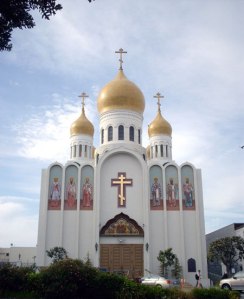 Our friends Mr. and Mrs. C drove Mr. Glad and me to San Francisco this morning for a visit to Holy Virgin Cathedral, the “Joy of All Who Sorrow.” We were going there for the same reason many people come from all over the world, to pray at the relics of St. John (Maximovitch) of Shanghai and San Francisco.
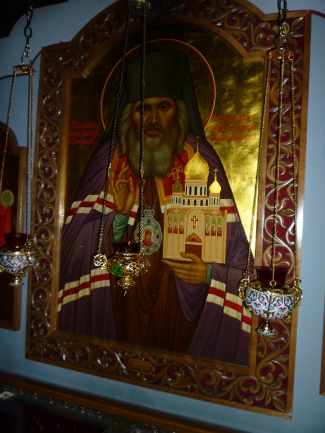
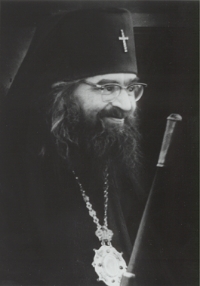 were coming to power there he helped 5,000 of these expatriates to emigrate, eventually to the United States. Later still he established the cathedral in San Francisco where his incorrupt relics remain.
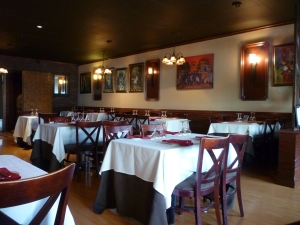 Afterward we needed some lunch, so we followed the advice of the candle desk attendant at the cathedral and ate at a Russian restaurant called The Red Tavern that was also in that Richmond District neighborhood. We were the only people there, too, though from the name we half expected when we went through the door to see a group of Bolsheviks plotting in the back corner.
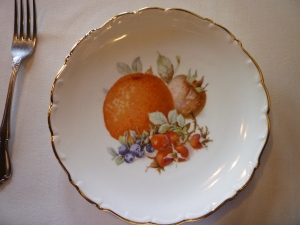
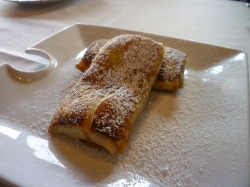 man only recently from Ukraine was our waitress and we enjoyed talking to her and eating the wonderful food. I didn’t think that I liked Russian food much, but everything I tasted was superb: dark brown bread scented with caraway, fresh cabbage salad with golden raisins and tomatoes; thinly sliced fried potatoes; and barley-mushroom soup with a complex and rich flavor. We all shared some Polish poppy seed dessert that we could tell had marzipan in the filling. We cut the two pieces into two more and ate them off these pretty dishes that the waitress said were their “dessert plates.”
 The forecast had been for cold and foggy weather in San Francisco today, but the sun was shining on our day and we didn’t even need our sweaters. Also, in our souls, we felt the warmth of Christ and of our friendship.

