My necessary Bird has flown.

This season of Thanksgiving is a good time to remember my friend who was known on this blog as “Bird.” She fell asleep in the Lord last year, but at the time I couldn’t find the words to write about her passing. She had been very dear to me, affectionately motherly and sisterly at the same time. Even past her 100th birthday she was thoroughly engaged in the present and was a good counselor and truth-teller. Not in platitudes or the kind of universally applicable advice that fails to touch the individual in a warm way, but in the manner of a Christian, a “little Christ” who comes alongside and shares the joy or pain. Bird took me Bird +K 97into her heart and gave me of her self: her motherhood of thirteen children, her married womanliness shaped by devotion to a passionate and visionary man, her thankfulness to a loving Father.
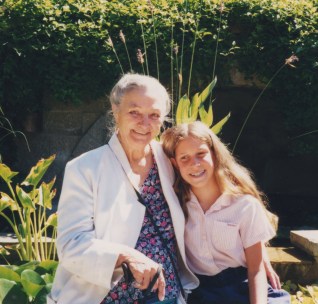
I didn’t meet Bird until she was already in her 80’s and had been a widow for some time, so I am not qualified to speak about her life as a whole. But certainly if someone can be supremely happy and content from the ages of 85 to 102, that is a huge accomplishment, not to speak of the many good people having descended from her. Even if she hadn’t been so good a friend to me, just the example of her life would have been encouraging. There was nothing flashy about Bird, no career or teaching ministry or fame; her habit of self-giving was gentle and quiet.

Recently her son kindly sent me a copy of the special journal thP1110738at she liked to write in, her Gnome Gnotebook, repository of decades of treasures she had collected in the form of poems, quotes and proverbs. I had enjoyed exploring the original book whose pages had long ago been filled up; when she ran out of room Bird simply wrote any new notes and poems on scraps of paper and kept them tucked between the pages, the whole bundle getting fatter and fatter, held together with a rubber band and always kept within arm’s reach.

As I began to browse the contents this month, a couple of entries jumped right out at me as completely expressive of truths that she had learned deeply and lived out every day. They happen to be written conveniently  right next to each other on one of the bound pages of the Gnotebook, and if any maxims might have been formative for the woman I knew, these would be likely ones.
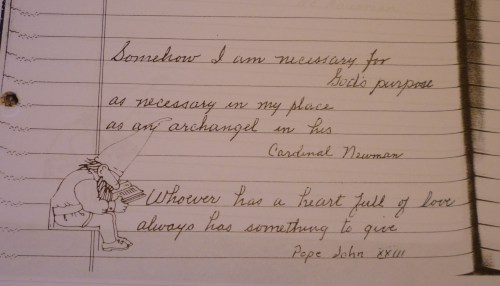
P1110740 Bird's book

When I tried a year ago to write this tribute, the words “Bird has flown” were in my mind, and when recently the following autumn poem by John Updike came to my attention it seemed to complement my feelings. The world is a bleaker place without her – there is no replacement. And yet, there is that “certain loveliness” still present, spread abroad and noticed by those giving thanks in the spirit of my Bird.

NOVEMBER

The stripped and shapely
Maple grieves
The loss of her
departed leaves.

The ground is hard,
As hard as stone.
The year is old,
The birds are flown.

And yet the world,
Nevertheless,
Displays a certain
Loveliness —

The beauty of
the bone. Tall God
must see our souls
this way, and nod.

Give thanks, we do,
each in his place
Around the table
during Grace.

–John Updike


If you didn’t get a chance to read what I’ve written about my friend before, this post on Bird’s Open Heart features a photo of her as a young woman, and A New Apron for Bird tells a story about our friendship.

How I learned Longfellow.

In my 5th Grade class each of us pupils must memorize a poem; our teacher gave us suggestions and I liked the look of this one. It was the first poem I ever paid that much attention to or learned “by heart,” and it is a sweet one to be laid down as a foundation stone.

THE CHILDREN’S HOUR

Between the dark and the daylight,
When the night is beginning to lower,
Comes a pause in the day’s occupations,
That is known as the Children’s Hour.

I hear in the chamber above me
The patter of little feet,
The sound of a door that is opened,
And voices soft and sweet.

From my study I see in the lamplight,
Descending the broad hall stair,
Grave Alice, and laughing Allegra,
And Edith with golden hair.

A whisper, and then a silence:
Yet I know by their merry eyes
They are plotting and planning together
To take me by surprise.

A sudden rush from the stairway,
A sudden raid from the hall!
By three doors left unguarded
They enter my castle wall!

They climb up into my turret
O’er the arms and back of my chair;
If I try to escape, they surround me;
They seem to be everywhere.

They almost devour me with kisses,
Their arms about me entwine,
Till I think of the Bishop of Bingen
In his Mouse-Tower on the Rhine!

Do you think, O blue-eyed banditti,
Because you have scaled the wall,
Such an old mustache as I am
Is not a match for you all!

I have you fast in my fortress,
And will not let you depart,
But put you down into the dungeon
In the round-tower of my heart.

And there will I keep you forever,
Yes, forever and a day,
Till the walls shall crumble to ruin,
And moulder in dust away!

– Henry Wadsworth Longfellow

Apart from which we have no experience.

I’ve just started reading David Bentley Hart’s The Experience of God: Being, Consciousness, Bliss. The purpose of this book is stated in the first chapter like this:

“…I also believe there are certain common forms of experience so fundamental to human rationality that, without them, we could not think or speak at all….All I want to do in the pages that follow is to attempt to explain, as lucidly as I can, how traditional understandings of God illuminate and are illuminated by those experiences.”

I heard Hart tdavid-bentley-hartalking about his book on the Mars Hill Audio Journal, and it thrilled my philosopher’s soul. Because the man can be a little hard to follow when he’s speaking quickly and extemporaneously — and I am not a good auditory learner — I am even more delighted in the book.
I can’t wait to share one gem of a thought from the introduction:

“God is not only the ultimate reality that the intellect and the will seek but is also the primordial reality with which all of us are always engaged in every moment of existence and consciousness, apart from which we have no experience of anything whatsoever.”

The Absence

Blessed are the poor in spirit: for theirs is the kingdom of heaven. Matt. 5:3

I liked the first poem I read by R.S. Thomas so well that I borrowed a collection of his poems from the library. It had some water damage already so I don’t worry about leaving it in the bathroom or reading it at the breakfast table, and I’ve been perusing it for a few weeks.

One doesn’t have to explore this book for very long to find that Thomas’s poetry is full of the feeling of coldness between us and God. Themes of harsh landscape and winter reappear, with lots of stone, stone, stone. My husband has been watching a TV detective series set in Wales and he commented that he would not want to live there, it looks so bleak. Maybe Thomas’s perspective is touched by the geography of his homeland.

This poem below is an example of this tone, though it’s not as painful as some of his verse that describes the alienation that is so common to the human experience. The last line relieves me with its hopeful turn and reminds me of what I’ve heard elsewhere: It’s only when we are truly empty of anything to offer God, and present ourselves humbly before Him, that He can speak to us, with His fullness that is silence, His presence that is His Word.

THE ABSENCE

It is this great absence
that is like a presence, that compels
me to address it without hope
of a reply. It is a room I enter

from which someone has just
gone, the vestibule for the arrival
of one who has not yet come.
I modernise the anachronism

of my language, but he is no more here
than before. Genes and molecules
have no more power to call
him up than the incense of the Hebrews

at their altars. My equations fail
as my words do. What resource have I
other than the emptiness without him of my whole
being, a vacuum he may not abhor?

— R.S. Thomas

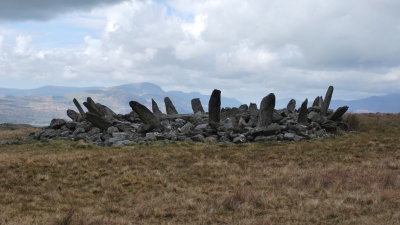
wales stones
Bryn Cader Faner cairn in Wales