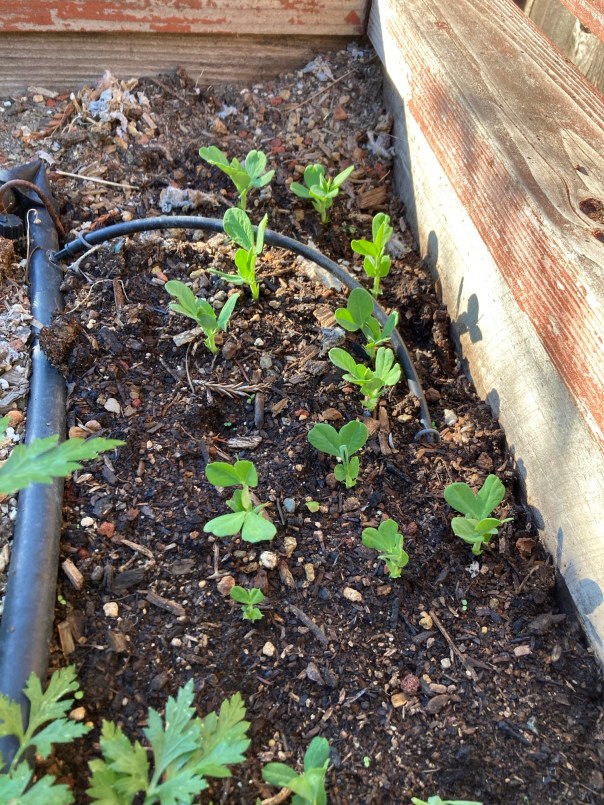
I was thrilled when my newly planted peas came up within a few days. That was one benefit of the Hot Week, when it was over 100 degrees for many days in a row. The seeds were bedded in a temporarily partly shady place behind the zinnias and parsley, so the earth stayed moist.
They are petite and very cute, growing close together next to the tall trellis where I planned to train them upward… until after they were up I read online, and then confirmed it by checking the packet, that Sugar Ann snap peas are a Bush Type of plant, and typically grow only 1-2 feet tall. I have grown peas for more than half my life, so why would I have read the description and instructions?? The packet had been a kind gift a few months ago from Hearth and Field; my thought process on rediscovering them in my box of seeds went quickly from “Oh, goody!” to “Must plant these right away!” and I did that very efficiently.

Efficiency is not one of the guiding principles of Hearth and Field, however, and I should have embarked on my pea project more in the spirit and manner of the vision expressed on the website of that journal:
Welcome to Hearth & Field!
We are the only journal you’ll find
that makes the internet move
at the pace and rhythm of real life.
Hearth and Field also quotes G.K. Chesterton at the top of that home page, saying,
“The simplification of anything is always sensational.”
I don’t have time to think more about how that second quote relates to my peas. [Update: I originally put something here about Winston Churchill’s Chartwell peas, which I attributed to Chesterton, which is very embarrassing, and there is no way to fix it, so I removed it. Thank you to my blessed reader Amy who noticed.]
In Real Life, “Haste makes waste,” right? But that motto doesn’t convey quite everything about how I will need to spend an extra hour today that I was not planning on. I will transplant those little starts to the middle of the planter box, so as to free up the trellis for planting Green Beauty snow peas from Baker Creek, because it would be a waste of my beautiful trellis to do otherwise. This is how “the pace and rhythm of real life” works in real life!


 “Time marched on. Each day seemed long, each week short. It was already autumn. What is the salient characteristic of autumn? The spiders’ threads in the early morning frost. I am not thinking much of the circular networks, marvellous as these are, hung along the gate, but rather the threads that are strung across everything, so that if you bend down till your eye is level with the field you can see a white veil over the whole expanse. They are everywhere, on everything. ‘Do they drape the cannons in France?’ asked Mr Ralph Wightman, true poet, in a striking image, the other day. To look down at these things is like looking up at the stars — we are baffled by quantity.”
 Gladsome Lights