Anthony Esolen features this poem by Richard Wilbur on his site Word & Song; here is a clip from his introduction:
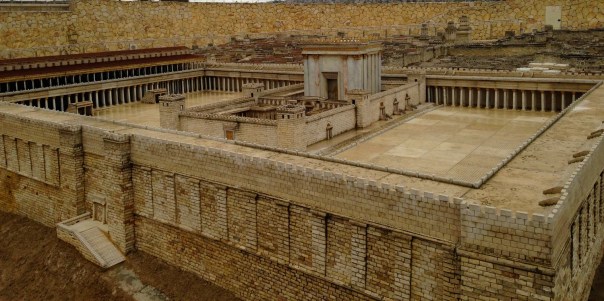
“Wilbur takes his inspiration from the words of Jesus, when he was entering Jerusalem at the beginning of that fateful and sacred week, and the people hailed him, laying palm branches before him and crying out, ‘Blessed be the king who comes in the name of the Lord!’ Then the Pharisees appealed to Jesus, asking him to make the people be quiet, but Jesus said, ‘I tell you, if these should hold their peace, the stones would immediately cry out.’ And we may remember, too, that when the disciples tried to play the tour guide with Jesus, remarking upon the grandeur of the Temple and its precincts, Jesus, who loved the Temple dearly from when he was a boy, said that there would soon come a time when not one stone would be left upon a stone.”
A CHRISTMAS HYMN
A stable lamp is lighted Whose glow shall wake the sky; The stars shall bend their voices, And every stone shall cry. And every stone shall cry, And straw like gold shall shine; A barn shall harbor heaven, A stall become a shrine.
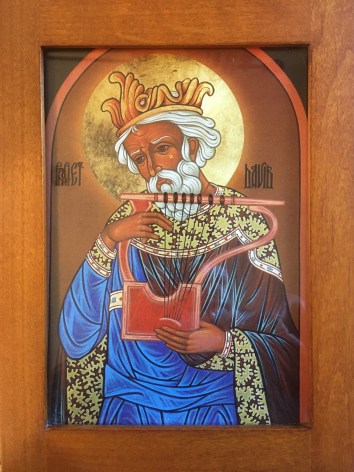
This child through David’s city Shall ride in triumph by; The palm shall strew its branches, And every stone shall cry. And every stone shall cry, Though heavy, dull, and dumb, And lie within the roadway To pave his kingdom come.
Yet he shall be forsaken, And yielded up to die; The sky shall groan and darken, And every stone shall cry. And every stone shall cry For stony hearts of men: God’s blood upon the spearhead, God’s love refused again.
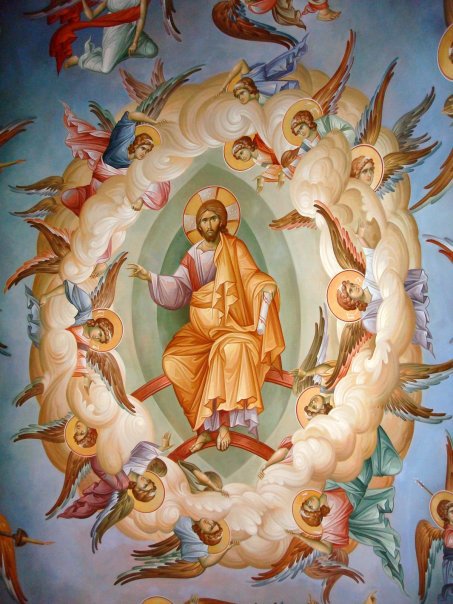
But now, as at the ending, The low is lifted high; The stars shall bend their voices, And every stone shall cry. And every stone shall cry In praises of the child By whose descent among us The worlds are reconciled.
“Why We No Longer But Still Could Have Beautiful Things” is something Anthony Esolen discusses in an article titled “The Ugly and the Good,” which was first published in Touchstone in 2020. This month he republished it in his Substack newsletter.
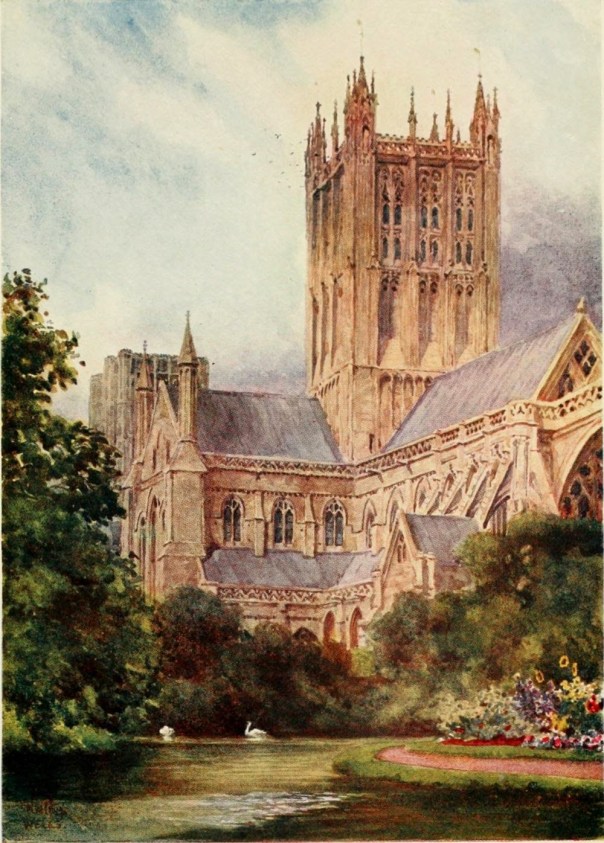
Wells Cathedral, England
Esolen begins by talking about beautiful cathedrals built in the Middle Ages:
“I’ve come to see the medieval cathedrals of Europe as the most glorious works of folk art the world has ever known…. They rose up as a lofty expression of the piety of ordinary people, the work of hundreds of men’s hands, digging the deep cavity for the foundation, hewing and setting delicate half-ton stones without mortar, mixing colors for paint or the glazing of windows, searching the forests for the tallest oaks to fell and to carve into beams to span a roof; far more kinds of work than I know and can name.
“They did it because they loved doing it. They were free.”
He contrasts freedom with license, using the example of Ebenezer Scrooge for the latter:
“To be free is not, O modern man, to be rid of all claims upon your love, your duty, your person, and your substance. If that were true, then Charles Dickens crafted a truly blithe and free spirit in the unregenerate Ebenezer Scrooge, crouching alone in his dismal flat and eating gruel gone sour. If you are talking about freedom and you are not talking about love and devotion, then you are not talking about freedom at all; you are talking about moral license, or a permission guaranteed by statutory law, that you may in some regard do exactly as you like, which may include gazing endlessly at evil pictures on your computer screen, and thus transforming yourself, cell by cell and pulse by pulse, into a thing, an automaton.”
Van Gogh, The Good Samaritan
His college students ask him for a definition of freedom, because, unfortunately, many of them are puzzled by his statements about what it is not. This is his answer:
“Freedom is the unimpeded capacity to attain to the perfection proper to the kind of creature you are. But since man is made in the image of the God who is a three-personed communion of love, his perfection, the enlargement of his soul, can only come by means of a gift, by the gift of grace from God, which enables him to make of himself a gift to others. There is no truly human freedom without grace, and the love that is its proper response.”
As to modern man’s failure to develop a love, or even a desire for beautiful things, Esolen proposes three reasons. If you’re interested enough that you’ve read this far, you can read them in the article: “The Ugly and the Good”
He also exhorts us to work on the restoration of the culture we have lost:
“We must take back the heart, the chest, the seat of proper passions, which is to take back from Satan those commanding heights of the imagination, which is to reject the errors I have mentioned and to repair the harm they have done. We must not value the useful over the beautiful. We must not reduce beauty to a commodity. We must not forget that our experience of beauty should lead us back to the source of beauty, who is God.”
Esolen suggests that we spend more time cultivating an appreciation for art of every sort; and that we start with the beautiful things that are most accessible:
“Song and poetry are the most immediately available of all the arts, requiring only a human mind and a human voice. If you want a Rembrandt, you have to go see it, or carry a copy with you under your arm while you avert your eyes from the glare of the policeman. Grand pianos, with Van Cliburn sitting at them, are not to be found on every street corner. You cannot from your porch in New Hampshire gaze upon the great arms that Bernini conceived for St. Peter’s piazza, extending in the shape of a key to embrace the thousands who would come to worship there.
“But anyone can possess a song or a poem. If you have a voice, you can sing, and if you have a mind, you can remember what you sing. If you have a voice, you can utter a poem, and remember what you have uttered. In a way, you can best possess a song only by singing it, and a poem only by giving it the performance of your mind and heart and voice and body. Song and poetry should be the most democratic of the arts, more truly by the people, of the people, and for the people than anything else in our experience.”
That brings me to — Poetry Month! I have a little experience of what he’s talking about here, knowing by heart several poems from A Child’s Garden of Verses, which give me joy when I have occasion to recite them, usually to a grandchild, these days. How many songs do I know? Oh my, countless! After reading Esolen, I am extra grateful for all the songs and singing I have loved throughout my life. I am singing these days more than ever.
This short and beloved poem below, which I think I’ve shared here more than once — maybe I should compose a tune for it. Because of its simplicity and rhythm it embedded itself in my mind very easily, long ago, and years later it was right at hand to speak aloud, one night when my late husband and I were peering over a bridge into the dark, where with the help of a street light we could see ripples in the stream down below.
The tide in the river, The tide in the river, The tide in the river runs deep. I saw a shiver Pass over the river As the tide turned in its sleep.
–Eleanor Farejon
May we nurture ever more beauty, music and poetry in our lives,
and offer the joy with thankfulness up to God.
The Rise and Triumph of the Modern Self by Carl Trueman is a thorough treatment of the history of Expressive Individualism and what modernity has come to. The author is a good thinker and writer, but he wearied me by incorporating into his thesis every possible thought and phenomenon that might contribute to the conclusion that “We are all expressive individualists now.” It’s a long book. After a hundred pages I jumped to the last fifty pages, and read the end first, to find out if it was worth the slog. I decided it was: I read every word, and underlined thought-provoking passages on every page.
So I’m glad I read it, and I’m much more glad that Anthony Esolen read it, because his writing is not just good, but sublime, and he calls the book a “mountaintop work.” He wrote a great review, which I heartily recommend. Because you probably want to know if you really are an Expressive Individualist, right?
Many people seem to think that politics will save us, that if we could just get the right people, or “our people” in office, they would begin to set things right, however we envision that. Anthony Esolen in the article Listening Up, in the Nov-Dec 2019 issue of Touchstone magazine, discusses some reasons for this idea, and its often corresponding impulse to judge our human forefathers for their sins, judgment not “by eternal verities, but by the cheap modern substitute, the ‘political.'”
He believes we lack historical imagination, and he sets out to consider the different ways one might make better use of stories and history in general, giving examples first from antiquity:
“So to attempt to transpose Xenophon or Cyrus to the current day, and to grill him with ‘political’ questions, is not to think politically at all, but to replace reality with a caricature. You will learn nothing from Xenophon that way. You may instead be out to teach him a lesson, him, that is, being the cartoon Xenophon you have made. At no time do you allow yourself to be still and to learn, so that the poetry of a wise man might penetrate your shell, crack it open, and show you the stars.
“Once you enter the world of history, you encounter the maddening complexity of human affairs, not to mention that labyrinth called the human heart. With hindsight we can say, with some confidence, that the young Octavius was far better suited for governing the Roman world than was the elder and more experienced Antony. We cannot be so sure of ourselves, though, when it comes to the noble-minded Brutus, and the ambitious and capable Julius Caesar, whom he assassinated.”
Esolen goes on to mention American leaders of note, and of complex history and character, such as William Tecumseh Sherman, and Stonewall Jackson, “a genuinely kindly owner of slaves.” And then he comes to his “three broad categories of modern man, each of them characterized by the stories they listen to and tell”: The Man of Faith, The Man of Wistful Unbelief, and the Man of Superstition.
I found his categories to be very helpful in understanding differences between people in the first two groups especially, and their stories that nourish our hearts. Oh, if only the third group would quiet down and listen to some true stories! But they don’t like the stories of the other two groups, and have their own ever-changing and doubtful heroes.
“History is too dark and tangled a forest for them, sacred Scripture too high a mountain to climb. Therefore they fall into worship of the biggest or most prominent things near them: sex, themselves, the State.”
“They are not brave enough to enter the dark caverns of the human heart…. they cannot forgive what men and women really are. They have no sense of sin, which afflicts everyone, including themselves, but they grasp at being among the elect, by having the most up-to-date pseudo-political opinions.”





 Gladsome Lights