A while back I mentioned how I got the bright idea, to drive out to the farm and buy some Gravenstein apples, a specialty variety that comes on early and is definitely not a good keeper. Those apples have the most appley flavor and make sauce that needs no added sugar. But because I’m not thinking about apples in August I always miss them. It was too busy a week, as I realized eventually, and dropping that project — and the resulting extra kitchen work — from the to-do list brought great relief. I knew I would manage to go sometime in October or November and bring home a box of apples of some other type.
Then when my sister Nancy was visiting last week, I thought what a nice thing to do together, to drive through the beautiful countryside and visit my favorite orchard. When we arrived, we found that the apples are late this year, and the only variety they had so far (out of dozens that they grow) was Gravensteins!
I’ve made several jars’ worth of sauce so far and eaten many out of hand, mealy as they already are. So, so yummy, and a special treat for me. Next year maybe I will try to get them earlier, but there’s no way to predict what week that might be, this far ahead. So I’ll just be ready to receive whatever gifts come my way.
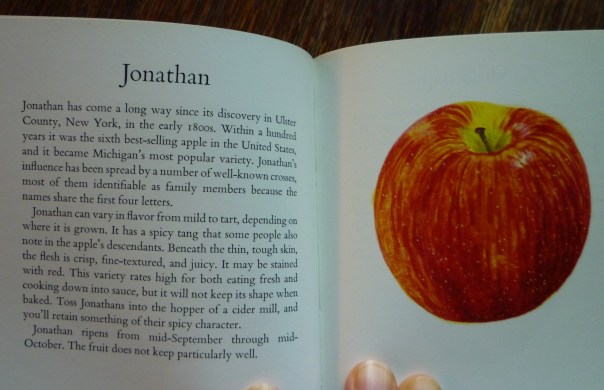
My kitchen and both refrigerators are overflowing with apples right now, as I recently made my annual visit to the apple farm I am so fond of. I’ve made jars and jars of applesauce to put in the freezer, at this point mostly from unpeeled Jonathans, which after it has cooked down and been put into pint jars, makes as pretty and pink a picture as I have ever had a hand in painting. It’s a good time to revisit as well this passage from a favorite novel, which I first shared ten years ago:
– – – – – – – – – – – – – – – – – – – – – –
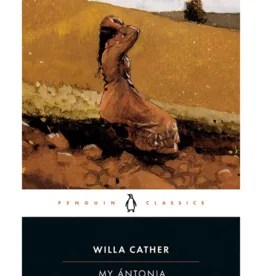
Willa Cather’s novel My Ántonia held a special place in the hearts of both my late husband and me, perhaps in our conjugal heart ? by reason of our sharing the story together more than once, and reading it on our own as well. When I’ve read it aloud it’s not uncommon for me to start sobbing at places in the narrative where the pathos hits home.
I was surprised to see recently a review in which the reader did not enjoy Cather’s writing, saying it was dry and lacking emotion. Those qualities might be why I appreciate her skill at capturing the story and drawing us in. Cather gives us the perspective of Jim, and we experience with him as narrator the various levels on which he is in love with our heroine and all that she represents, and he makes us fall in love with her, too.
Our differing response from the reviewer above probably has something to do with what we bring to the story. Though we haven’t lived in Nebraska or known any Bohemians, perhaps we are like Jim (and Willa Cather) in our grieving for the past, for the lifestyle of the pioneers and their farm life, for the good hardworking people we have lost; as I understand it, that was a theme that reappears in many of her works, but she accomplishes it without what might be called “emotional” prose. Mr. Glad and I both have farming in our roots, and our love for nature and the outdoors (and for people) is only encouraged and expanded by reading books like this.
I thought to transcribe some passages from the book on my blog, representative snatches for my own enjoyment and yours, as a way to savor again some moments from my reading experience, and perhaps introduce people who haven’t yet made friends with these characters and their world.
In the novel, there is no question but that Jim must leave the country life and go away to school and to city life. The passage below is from the last part of the book when he returns many years later for a visit, and I appreciate the way it conveys something of Ántonia’s character and also the mood of this season of the year.
“At some distance behind the house were an ash grove and two orchards: a cherry orchard, with gooseberry and currant bushes between the rows, and an apple orchard, sheltered by a high hedge from the hot winds. The older children turned back when we reached the hedge, but Jan and Nina and Lucie crept through it by a hole known only to themselves and hid under the low-branching mulberry bushes.
“As we walked through the apple orchard, grown up in tall bluegrass, Ántonia kept stopping to tell me about one tree and another. ‘I love them as if they were people,’ she said, rubbing her hand over the bark. ‘There wasn’t a tree here when we first came. We planted every one, and used to carry water for them, too — after we’d been working in the fields all day. Anton, he was a city man, and he used to get discouraged. But I couldn’t feel so tired that I wouldn’t fret about these trees when there was a dry time. They were on my mind like children. Many a night after he was asleep I’ve got up and come out and carried water to the poor things. And now, you see, we have the good of them. My man worked in the orange groves in Florida, and he knows all about grafting. There ain’t one of our neighbors has an orchard that bears like ours.’
“…The afternoon sun poured down on us through the drying grape leaves. The orchard seemed full of sun, like a cup, and we could smell the ripe apples on the trees. The crabs hung on the branches as thick as beads on a string, purple-red, with a thin silvery glaze over them. Some hens and ducks had crept through the hedge and were pecking at the fallen apples.”
It was hard to keep up with myself last week, and with all the friends, projects and tasks that fill my life to overflowing. I guess I was somewhat playing catch-up after my mountain retreat the previous week. The garden got gently rained on three times that last week of September, which is unusual. Combined with fog on other days, the dampness caused mildew in the planter boxes, but mostly the lower leaves of the tall zinnias have been affected.
When I noticed the Japanese anemones looking better than ever, it occurred to me to plant a few more this fall, maybe some pale pink ones — but I corrected my impulsivity in time, and won’t be taking on one more project, what with so many others unfinished. A more reasonable goal would be to try to take better care of the anemones I have, and see if they can be encouraged to be taller and more robust. It’s a sign of their middling health, that they do not ever spread and multiply, and their flowers are few and small.
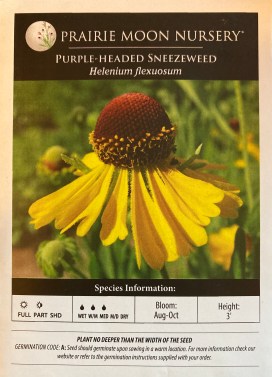
The sneezeweed I grow in a pot looks as well as it ever has. I bought it a few years ago at a native plant nursery, because I love the mountain versions of the flower. I put it in a pot so I could be sure to water it enough; the irrigation settings for most of my garden are set for drought-tolerant plants, and sneezeweed is not one of those. My type is pretty plain, or at least monochromatic, compared to the mountain ones.
In search of fancier kinds, a few months ago I browsed sneezeweeds online for quite a while, and ordered seeds for this one, Purple-Headed. When I am looking at seed catalogs or even plants in nurseries, all the options seem so do-able and desirable. But once the time comes to get on with the actual work of planting… well, I literally drag my feet. So who knows what will happen with these seeds…
I used my sourdough starter twice last week, first to make a large pan loaf of seeded wheat-and-spelt bread. This is the recipe I have been trying to perfect, but perfection hasn’t happened yet. I may have to pause the sourdough project while I branch out and reach back, to other breads I have made or have wanted to try, like chocolate bread, Indian flatbreads, and applesauce rye.
Buttery Sourdough Crackers was a satisfying recipe that used a bit of starter. This picture shows the dough as it was resting overnight, along with leaves of the lemon verbena that I am drying, after pruning my plant for the first time ever.
I used this recipe for: Rustic Sourdough Butter Crackers as my jumping off place, substituting half dark rye flour, and adding sesame seeds to one half, and poppy seeds to the other. I baked them a lot longer than the recipe called for. The resulting crackers are nice and crispy and easy to eat. The butter ingredient plus the sourdough tang is a great combination.
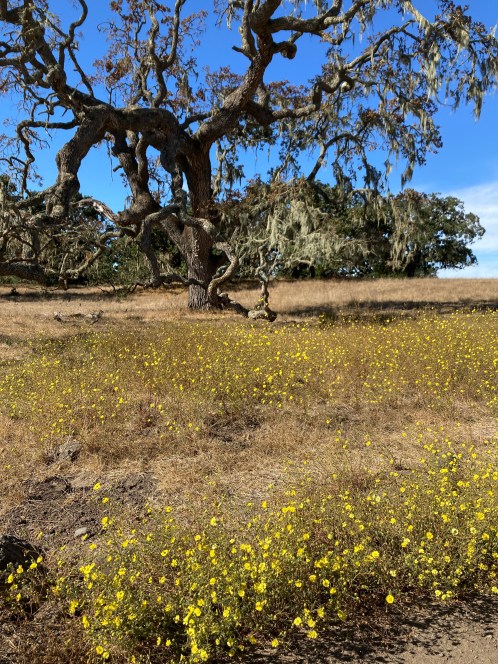
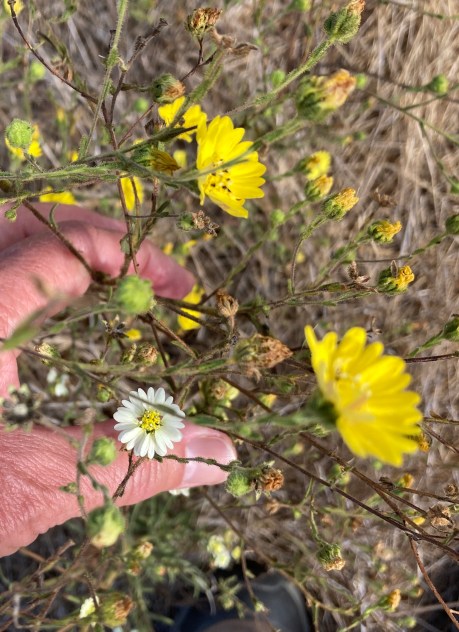
My friend Lucy and I took another one of our monthly walks, up in the hills again but to a park she hadn’t been to before. It’s mostly very brown up there now, but the poison oak is making red splashes in the landscape. And my old friend tarweed!
The Seek app tells me this is not either of the species I saw on my way up the mountain last month, but Hayfield Tarweed. And it seems to come in white or yellow versions, in one case growing side by side:
The third online Beowulf class was this week, and I spent more than two happy hours in the company of the most delightful teachers, Richard Rohlin and Jonathan Pageau. They both love the subject, and Richard is definitely a Beowulf scholar from way back. I will have to at least quote a couple of lines from the poem here eventually, though it seems that unlike me, most people I’ve talked to got an introduction to Beowulf in school. So you may already be more familiar with the story than I.
Apple orchard where I go.
At the end of the week, I remembered: apples! It’s time to make a trip my favorite apple ranch, and see which of their 30+ varieties is available now. I squeezed it in on Saturday afternoon, and added a stop at a nursery out that way, hoping they would have starts of some kind of leafy greens I could tuck into spaces in the planter boxes after I take out zucchini and tomatoes and eggplant. They did!
So here in the back of my car is a mix of apples Empire, Jonathan and Macintosh; and six packs of Swiss chard and collards. I do have chard growing right now, but I think I need more. And I wasn’t able to get collards started from seed in August.
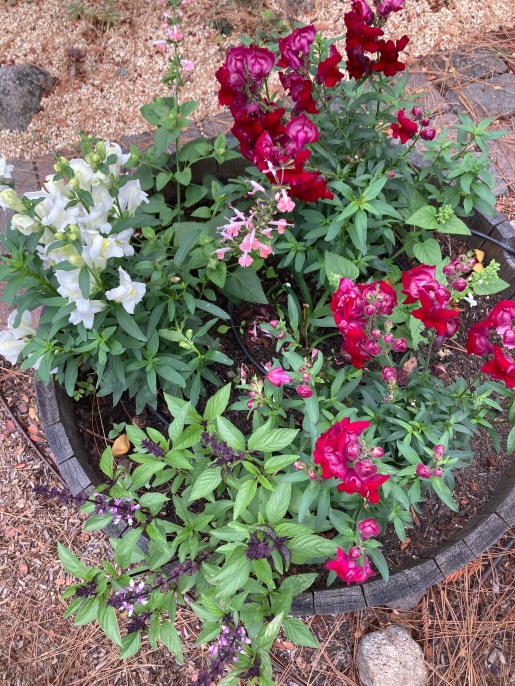
One more glad sighting of late summer I want to share, is this half wine barrel that was unplanted through last winter:
When I put in some snapdragon plants in late spring, I noticed a couple of tiny mystery plants that didn’t look like weeds, so I left them undisturbed. Now everything has filled out and I find that I have beautiful Thai basil and tropical sage complementing the snaps. Gardens are ever surprising.
At the top of the house the apples are laid in rows, And the skylight lets the moonlight in, and those Apples are deep-sea apples of green. There goes A cloud on the moon in the autumn night.
A mouse in the wainscot scratches, and scratches, and then There is no sound at the top of the house of men Or mice; and the cloud is blown, and the moon again Dapples the apples with deep-sea light.
They are lying in rows there, under the gloomy beams; On the sagging floor; they gather the silver streams Out of the moon, those moonlit apples of dreams, And quiet is the steep stair under.
In the corridors under there is nothing but sleep. And stiller than ever on orchard boughs they keep Tryst with the moon, and deep is the silence, deep On moon-washed apples of wonder.


 Our differing response from the reviewer above probably has something to do with what we bring to the story. Though we haven’t lived in Nebraska or known any Bohemians, perhaps we are like Jim (and Willa Cather) in our grieving for the past, for the lifestyle of the pioneers and their farm life, for the good hardworking people we have lost; as I understand it, that was a theme that reappears in many of her works, but she accomplishes it without what might be called “emotional” prose. Mr. Glad and I both have farming in our roots, and our love for nature and the outdoors (and for people) is only encouraged and expanded by reading books like this.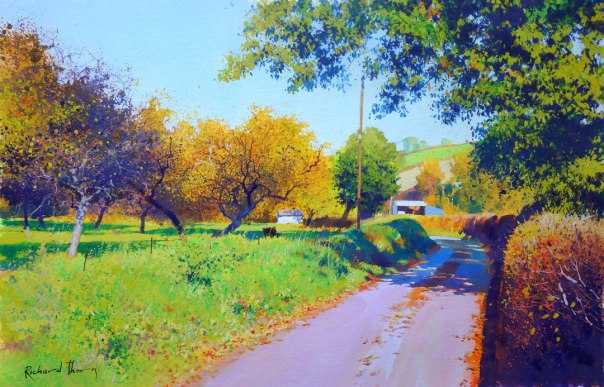
 When I noticed the Japanese anemones looking better than ever, it occurred to me to plant a few more this fall, maybe some pale pink ones — but I corrected my impulsivity in time, and won’t be taking on one more project, what with so many others unfinished. A more reasonable goal would be to try to take better care of the anemones I have, and see if they can be encouraged to be taller and more robust. It’s a sign of their middling health, that they do not ever spread and multiply, and their flowers are few and small.
 seed catalogs or even plants in nurseries, all the options seem so do-able and desirable. But once the time comes to get on with the actual work of planting… well, I literally drag my feet. So who knows what will happen with these seeds…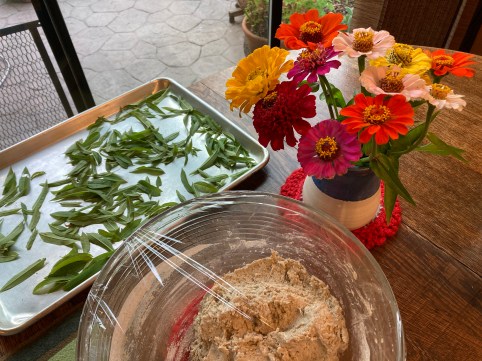




 Gladsome Lights