I listened to The Secret Language of Girls in the car on my trip to Nevada earlier this summer. It had been on my Amazon wish list for a year, so when I saw it at the librar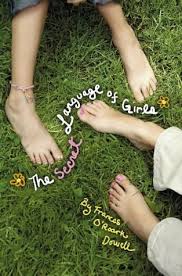 y it was an easy decision to grab that one off the shelf. I had started my browsing in the section with the adult CD’s, but so many of those would be longer than I could finish on most of the trips I take.
This is the story of a year in the lives of some middle-school girls, which is not something I would normally like to read about. But I’ve appreciated the author’s voice in other books I’ve read by her, notably Chicken Boy, which I reviewed here.
I’m comforted knowing that Dowell’s books are on the shelves as a wholesome alternative to the slime that is oozing ever lower into nihilism, and into the younger age-range, the kind of thing Meghan Cox-Gurdon critiques in this article: Darkness Too Visible. Through her characters’ stories Dowell explores the issues that are common to every generation of modern adolescents, without any of it feeling antiquated. I assume that this is how the children themselves feel about the books — if they are still on the library shelves after ten years, is it not because they are actively in circulation?
Dowell captures the self-conscious angst of adolescent girls, revealing the cattiness, unkindness, confusion and downright meanness, without passing judgment on what is a difficult time for everyone. She wrote this book about ten years ago, when perhaps it was all too fresh in her own memory. Girls are best friends in 5th Grade, and then because of their personalities and choices they grow apart, sometimes so distant that they forget to treat each other as fellow humans.
“Let’s humiliate someone,” says one girl to Marilyn, and one of our heroines reluctantly agrees to humiliate the girl who not long before was her best friend. It’s because she feels trapped by the choice she’s made to be in the popular group and pay obeisance to the leaders of that pack. Otherwise they may turn against her….
Boys are often what comes between friends. Although I’m dismayed at the sexualizing of our society to the point where this most wholesome book has to include events such as kissing games between eleven-year-olds, this (and much worse) is the reality many children have to deal with, and Dowell does everyone a favor by showing us what goes on in Marilyn’s mind and heart at a barely-chaperoned party, and how she gains self-understanding.
The older brother of the party-giver is an amputee, and all the other girls say, in effect, “Oooh, that’s creepy.” They are disgusted, while Marilyn finds him very nice. But of course it’s her peers, the gangly adolescent boys, who end up awkwardly pecking her cheek or lips when the spinning bottle stops and points to her. She finds it very unsatisfying.
“She decided she didn’t like this game very much. She wanted to choose whom she got to kiss. Other people shouldn’t be able to choose for her.”
“She also knew that legs didn’t have anything to do with kissing. In fact she was starting to think lips didn’t have much to do with kissing either. Kissing was about hearts….As far as Marilyn was concerned, she was still waiting for her first kiss.”
Considering the likelihood these days of young girls getting physically involved with boys way too early for their good, there is a need for this kind of vicarious lesson. Girls can go with Marilyn to the party and leave smarter. They will be further on their way to knowing the truth that sex and all that leads up to it are about more than recreation and experimentation.
I remember how it was at that age — you fall in love with boys right and left, because you are falling in love with the whole experience of falling in love. It’s hard to be true friends when all that is going on, but in this book there is a new girl in school who is an little unconventional, and also refreshingly sensible and kind, as she tries to help another confused protagonist.
“Paisley laughed. ‘Why don’t you quit thinking about love and boyfriends and girlfriends? Why don’t you just think about Andrew O’Shea, the human being?'” Out of the mouth of babes! Isn’t that what we all should do, what it means to grow up — to think of the other person as he is in himself, not just as someone useful for our own ego or enjoyment?
My listening to this book in audio instead of print format added an extra level of complexity to my response. I kept wondering if the narrator’s interpretation of the characters was in line with the author’s. Michelle Santopietro narrated this Random House audio edition, and I found it hard to believe that the young people spoke in a sarcastic tone half the time.
Some of the mothers in the story are obviously so consumed with their own drama that they can’t shift their focus and notice what is going on with their children. I also recall from that age the vague feeling that I was on my own. But the voices that Santopietro gives to the mothers make them sound stupid to me, not just out of touch.
Just the other day I read Arti’s thoughts on what makes a good audiobook narrator, and another post on how different the experience of reading the text yourself is, from that of listening to a recording. I know I was very aware of the narrator coming between me and the author in this case, and I didn’t enjoy that aspect at all. I began to wonder all sorts of things about the narrator, while normally I’d aim my extra curiosity toward the author. “Is Santopietro a mother herself?” was one of the central questions raised.
The box of CD’s of The Secret Language of Girls says that it’s “Recommended for listeners ages 13 and up,” which is odd for a book about 11- and 12-yr-olds. I thought perhaps that was a strategy for getting the intended age group to be more curious about it. But on Amazon the book info says for age range 8-12 yrs., or grades 4-6. That’s more like it.
So far my granddaughters are homeschooling and I can’t see them having time or need for this kind of story. They have wise mothers who are paying close attention. I wish I had found a book like this on the shelf when I was young, and if I get to know some distracted or overwhelmed mothers of pre-teens, I’ll be buying a few copies for their daughters.
 Earlier this year I was prompted to think about who were my favorite audiobook narrators. It was soon revealed how very many I have! I was glad the request was for the narrators who I find truly add to the reading experience, and not the ones to avoid, because that would not be as pleasant an activity as I was engaged in, perusing through the titles I have listened to.
 Mike Fraser in The Timeless Way of Building.


 I was slightly embarrassed to tell about my recent story-listening, because of the time of day I’ve chosen for the vicarious experience, of living in India, caught up in the web of dysfunctional families and disordered souls.
 wrote about this:
 was full of drama and suffering. In 1939 Ruth the adolescent fled with her Jewish parents from Germany to Britain, and lived through World War II and the Blitz in England. After the war, when her father learned that 40 members of his family had died during the Holocaust, he took his own life. About this trauma she said, “All my stories have a melancholy undertone. That’s probably why.”
  happy dreams since beginning to listen to this collection of her stories, At the End of the Century… until last night. If it weren’t for the dream I had, I wouldn’t try to tell you anything about someone whose writing I hold in such high esteem. And at first I did not connect the dream to my reading material; I just thought it hilarious. But then, thinking about it as I woke, it made me (a little) sad in a way that these very human stories could never do.


 I’m using this audio book now the way I have two or three others in the last years since I sleep alone, for the times when I don’t sleep. I put a well-known story to play on my phone, set the timer for 30 minutes, and let David or another nice person read me to sleep. This only works with voices that do not draw attention to themselves in various ways, usually by being overly dramatic.
 Gladsome Lights