Tag Archives: autumn

Smelling the decorations.

It’s the time of year when I go into the garden and get high on the aromas coming from the earth and the air. My immediate impulse is to take pictures of all the plants and trees that are making me love them and making me happy. I get them uploaded and find out that actually nothing looks that great: shriveling tomato vines with rotting fruit and flies underneath; weeds mixed in with the leaves blown in from the neighbors; redwood branches cluttering the surface and bottom of the swimming pool.

Around here, the excitement is coming through the senses other than the visual. Just taking some time to skim the debris poms 14from the pool somehow feels fallish to me, and is very relaxing, as I listen to the blip-blip of the water, and make things tidier there. Even though the afternoons have been hot, you can tell that it’s not summer, maybe because the rays of the sun are coming at a slant so the heat is less direct.

At the market, I’m back to the visual; heaps of pumpkins look extravagant and appropriate, signifying the abundance coming from the farms. From the highway I can see fields of corn, some of which will be carved out with paths to make a maze for the schoolchildren to wander through. And on my kitchen counter fields of tomatoes look normal for this time of year.

For many years I’ve made a habit of buying a pumpkin or two, to put on our front step, but this year I’m restraining myself. They never look as nice when I separate them from the crowd where they seem to belong, especially when squeezed into a corner on the concrete by the door. I’m not ppump bread joy 14repared to spend a bundle to buy a crowd of them with which to make a mountain on our dead lawn, though this would be the year of opportunity!

So this time, I will enjoy looking at the piles at the stores — or on Pinterest. To add to our tomato decor I bought some pomegranates, which fit better in our space, and turned out to be much more economical.

But wait — I’m not going to forsake pumpkins altogether. My favorite market didn’t have any little pie pumpkins today, but soon I will find some and invest in a couple of them so that I can have the best fruit for cooking up a pie or bread like DIL Joy brought us last weekend. That’s the way to turn a visually pleasing pumpkin into an olfactory autumn event. Mmm-mm.
IMG_7109

As the sun at noon.

This poem by John Donne I believe did not start out as a poem. Someone posted it as follows, in poetic lines, but I found the same lines as prose on Bartleby.com, in the middle of a passage in “Sermons Preached on Christmas Day.” Donne evidently did not give the title “In Heaven it is Always Autumn” to anything, but more than one person has more recently used his line to title a poem, as I found in my searching.

Donne uses several vivid words to describe the winter we can experience in our soul at any time of year, showing that he is familiar with that inner dark and coldness. We know that he did suffer terrible grief when his wife died, and it was doubtless not the only occasion when he felt desperate need of God’s presence and mercy.

What an encouraging word the preacher poet brings out of his training in God’s ways, able to comfort us “benighted” ones with the comfort that he has been comforted with, as in II Cor. 1:4. Because these thoughts were part of a Christmas sermon, I thought of sharing them later at Christmastime, but taking my cue from the first line extracted, and because it happened to be in the current season of the year I needed a reminder of God’s thawing Love, I’m not waiting.

“In heaven it is always autumn,
His mercies are ever in their maturity.
We ask our daily bread
And God never says
You should have come yesterday,
He never says
You must again tomorrow,
But today if you will hear His voice,
Today He will hear you.
He brought light out of darkness,
Not out of a lesser light;
He can bring thy summer out of winter
Tho’ thou have no spring,
Though in the ways of fortune or understanding or conscience
Thou have been benighted til now,
Wintered and frozen, clouded and eclipsed,
Damped and benumbed, smothered and stupefied til now,
Now God comes to thee,
Not as in the dawning of the day,
Not as in the bud of the spring
But as the sun at noon,
As the sheaves in harvest.”

– John Donne, 1624

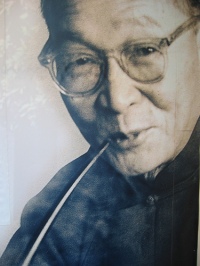
Lin Yutang likes autumn best.

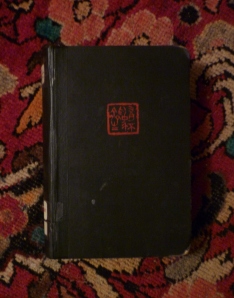
If you like thought-provoking quotes as much as I do, you might sometime run across one by the eloquent Lin Yutang. I find that I did have a quote by him about autumn in my files, so that is probably how he came under my radar recently, long enough for me to decide to borrow his book The Importance of Living from the library. It was in the closed stacks, and looks old and Chinese. But as Samuel Butler said, “The oldest books are only just out to those who have not read them,” and for me, Lin Yutang is definitely a new and exciting discovery.

I expected a small book of proverbs, perhaps, but The Importance of Living is a large conversational and philosophical treatise that I won’t be ableLin Yutang - Living to read in bed. I may have to buy a copy, because in the very first paragraph of the preface I found beautifully written lines that drew me in to his mind and his ruminations:
“Very much contented am I to lie low, to cling to the soil, to be of kin to the sod. My soul squirms comfortably in the soil and sand and is happy. Sometimes when one is drunk with this earth, one’s spirit seems so light that he thinks he is in heaven. But actually he seldom rises six feet above the ground.”

I opened the book randomly in the middle and there, also, his words were worth thinking about as poetry or motivational talk. Did someone very gifted translate the works of this Chinese man? No, he wrote in English in such a graceful way that it is pure joy to read him aloud.

Lin Yutang was born in China in 1895 of Chinese Christian parents. His father was a pastor and a very progressive, forward-thinking man who made sure that Lin learned his Bible stories and went to the schools that produced the best speakers of English. He eventually got a degree from Harvard and another from Leipzig University.

I began to read The Importance of Living aloud with Mr. Glad. I usually do the reading because I enjoy it more than he does, and I immediately noticed the easy flow of Lin’s prose and the equally smooth progression of ideas. Everything he says makes perfect sense given his worldview in 1937, and at that time he was no longer a Christian.

What happened? Mr. Glad and I were very curious, because we had information Lin didn’t have at the time; we knew that later in life he would return to the faith and live to write about it, in his book From Pagan to Christian. So we stopped reading Importance and started in on the book about his spiritual journey that he wrote about 20 years later.

Putting together what he says in the relatively little we have read of him so far, I can tell you this about Lin’s first change of mind: As soon as he came of age to notice, he realized that he had not received the usual Chinese philosophical or literary heritage, much of which was typically learned through the theater; the theater was forbidden to Lin and his siblings who were in some ways raised as Puritans. He hadn’t taken the time to learn to write beautiful calligraphy, either, so he found that he was by Chinese standards completely uncivilized. At this point the one very Chinese thing he did know was intense shame.

He felt he had to go back and learn to be an authentic Chinese man, and having learned as a child the diligence and study habits of a Puritan, he did a very thorough job of learning Chinese philosophy and literature, not to mention a stunningly broad understanding of Western culture. This knowledge base combined with the ability to think and write about all that he has figured out — or is figuring out, as the story evolves — makes him fascinating to me.

We haven’t progressed very far in either of these books, but having this articulate author “friend” to explain Chinese culture and history to me from the inside has given me an interest in that part of the world that I have always lacked. So I hope to read more, and I expect to have more to share. But for now, I’ll close with his quote from My Country and My People about the lin_yutangseasons of the year.

“I like spring, but it is too young. I like summer, but it is too proud. So I like best of all autumn, because its tone is mellower, its colours are richer, and it is tinged with a little sorrow. Its golden richness speaks not of the innocence of spring,nor the power of summer, but of the mellowness and kindly wisdom of approaching age. It knows the limitations of life and is content.”

This meditation seems to me an expression of a perspective that could be both Chinese, as he felt at the time, and truly Christian. I’m looking forward to reading more of the kindly wisdom of Lin Yutang.

earthy and herby

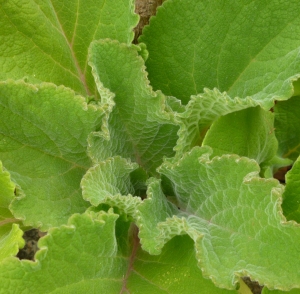
salvia leaf close-up 9-14
mystery salvia

What is so exciting about autumn? If things are slowing down and dying, wouldn’t that be depressing instead?

Maybe the season just finds us ready for change, glad to move on from the laziness of summer to the harvest and to tidying up, getting ready for the winter….The heat is not so enervating, and the air is fresher and not heavy.

In autumn, being a gardener, I get close up and intimate with the dirt and the plants’ roots, as there are so many perennials that need trimming and the planting beds cleared out. Today I reached my hands and pruners down through the swaying leaves of the lemon balm, to where its roots run all tangled together with oregano just below the surface of the ground, and their earthy and herby smells rose up and quite affectionately came right into my nose! I always leave the door open for them.

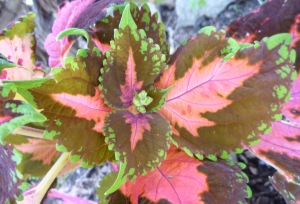
coleus 9-14
coleus

I pruned the spent flower shoots and leaves of the “mystery” salvia, revealing all the clumps of volunteer plants with their fresh new leaves. Better Homes and Gardens has a salvia guide online, but I didn’t have any more success than before in finding my plant among all the 30+ varieties they show. [update: it has been identified as Indigo Woodland Sage, Salvia forsskaolii.]

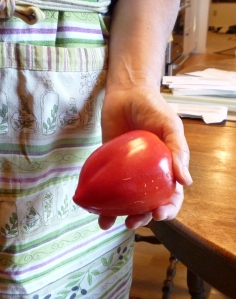
pimiento


I picked the last of the pimientos and fried them all up with slivers of garlic. Here is one of the loveliest so you can see how big and heart-shaped they typically are.

Two friends showered us with goodies from their gardens in the last few days, including things we didn’t have in our own, like lemon cucumbers and green beans and hot peppers. Tonight I managed to deal with quite a bit of the bounty and include it in a yummy dinner. The Yellow Brandywine tomato vine is loaded with fruit and now it is all ripening late. So sweet.

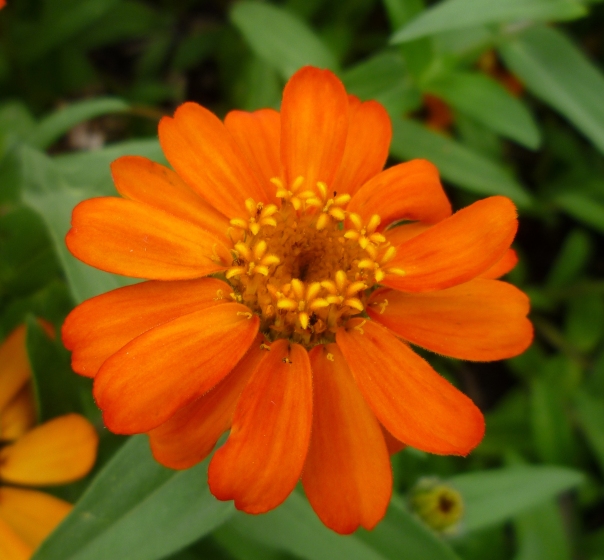
One last zinnia picture: This is one of the trailing type with blooms only two inches in diameter. When I look at it closely the detail grabs me. It almost looks as though tiny yellow stitches are holding the petals on. Orange is a good and even arousing color to go with the season; maybe it will help to energize me for the remaining garden work. Happy Autumn!

P1110362