Tag Archives: baptism

A Thousand Years

Today is the 1,000-year commestvladimir-big halifaxmoration of the repose of St. Vladimir, Enlightener of Russia. He was the emperor whose decision to convert to Orthodox Byzantine Christianity transformed Russia and turned its history in a new direction, in about 988. I was lucky enough to attend Liturgy today, in a parish with Russian roots, and to hear a homily on St. Vladimir from a priest who had graduated from St. Vladimir’s Seminary. The Orthodox Church in America has posted online a long and rich story of the saint if you would like to read more of his exploits than I can tell here.
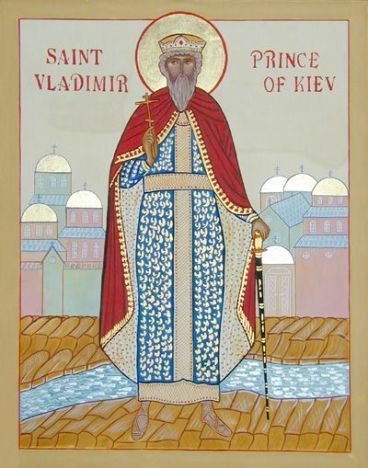
The most famous story among the faithful is an account found in the Primary Chronicle of Russia, written about this time, of how Vladimir, when he was still a confirmed pagan, sent emissaries to check out the churches and faiths of his neighboring lands.

They were completely unimpressed with the Muslim Bulgars, partly because of the ban on alcoholic beverages; of the German churches they reported, “We beheld no glory there.”

But in Constantinople at Hagia Sophia: “…they led us to the place where they worship their God, and we knew not whether we were in heaven or earth, for on earth there is no such vision nor beauty, and we do not know how to describe it; we only know that God dwells among men. We cannot forget that beauty.”

This has been the experience of so many of us converts to Orthodoxy, that we can well believe the story, which is not held to be as certain as the facts about the politics of the time and how Prince Vladimir made an arranged marriage with the daughter of the Byzantine Emperor, and was baptized before the marriage. However it came about, his conversion was providential and has had tremendous ramifications for the last 1000+ years.

He ordered the baptism of all his subjects, who dutifully went down to the River Dneipr en masse the next morning. Here I want to quote from the OCA article about how this event resulted in the continuing celebration of another meaningful church feast day:
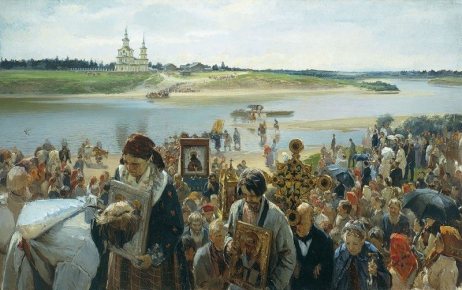
cross-procession-illarion-pryanishnikov

It is difficult to overestimate the deep spiritual transformation of the Russian people effected by the prayers of St Vladimir, in every aspect of its life and world-view. In the pure Kievan waters, as in a “bath of regeneration,” there was realized a sacramental transfiguration of the Russian spiritual element, the spiritual birth of the nation, called by God to unforeseen deeds of Christian service to mankind.

“Then did the darkness of the idols begin to lift from us, and the dawn of Orthodoxy appear, and the Sun of the Gospel illumined our land.” In memory of this sacred event, the regeneration of Rus by water and the Spirit, the Russian Church established the custom of an annual church procession “to the water” on August 1. Later, the Feast of the Procession of the Honorable Wood of the Life-Creating Cross of the Lord, which Russia celebrated with the Greek Church, was combined with the Feast of the All-Merciful Savior and the Most Holy Theotokos (established by St Andrew Bogoliubsky in the year 1164). In this combination of feasts there is found a precise expression of the Russian theological consciousness, for which both Baptism and the Cross are inseparable.

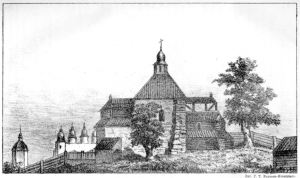
Prince Vladimir soon started to destroy pagan idols, some of which he had commissioned himself, and began serious reforms that would create a new church of the Tithes 17th cent Deśatynna_cerkvaChristian culture. He built monasteries and many and magnificent churches; hospitals, schools and orphanages. The capital city during this era was Kiev, and these first years of Christianity in Russia were a time of growth and prosperity and art. The hundreds of churches in Kiev were renowned for their beauty, for example, the fascinating Church of the Tithes, which has been destroyed many times and whose rebuildingvladimir card from vladimir 1000 yrs is under discussion again at this time.
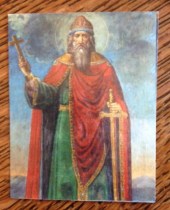
My own first experiences of Orthodox worship were not outwardly as splendorous as Hagia Sophia, but like those emissaries I felt the splendor of Heaven coming down on me. (Just this week I added to my page newly renamed “Orthodoxy and Me,” to tell much more of my story as a story and not just scattered parts.) In my parish we have a man who was born a Jew and took the name of Vladimir at his baptism somewhat late in life. This morning he joyfully passed out these little icon cards as gifts, and we were all glad that he was there so we could say, “Happy Name’s Day!”

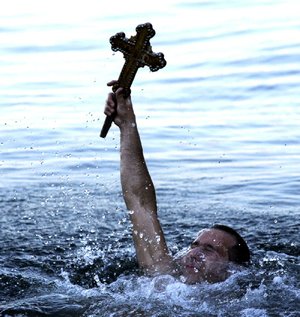
I’m jumping in with joy.

blessing-creek1

It’s the Feast of Theophany! How can I not post something on this day when there is blessing abounding to the degree that people want to jump into icy waters over it? I am caught between the impulse to spread the riches around, and the awareness of the extreme limitations of my mind when the meaning of Christ’s baptism is set before me. There is a lot to take in and try to absorb at Theophany, regarding the Baptism of Our Lord.

Orthodox Christians celebrate Theophany in various ways around the world. Some release doves as a symbol of the Holy Spirit while others toss crosses into water in remembrance of Christ’s baptism. Young boys or men often dive into the water to retrieve the cross. I know what I’ll do — I’ll post a link to Father Stephen Freeman’s recent blog on the subject. An excerpt:

St. John himself does not seem to understand the purpose of Christ’s Baptism. He is told that “whomever you see the Holy Spirit rest upon and remain” is the Messiah – but he is given little information beyond that. Witnessing Christ’s Baptism and the Spirit resting upon Him, he hears the voice, “This is my beloved Son in whom I am well pleased” (Matthew, Mark and Luke all bear witness to the voice).  The Church later celebrates this manifestation of the Trinity (Christ in the water, the Spirit descending, the Voice of the Father – hence the title “Theophany”).

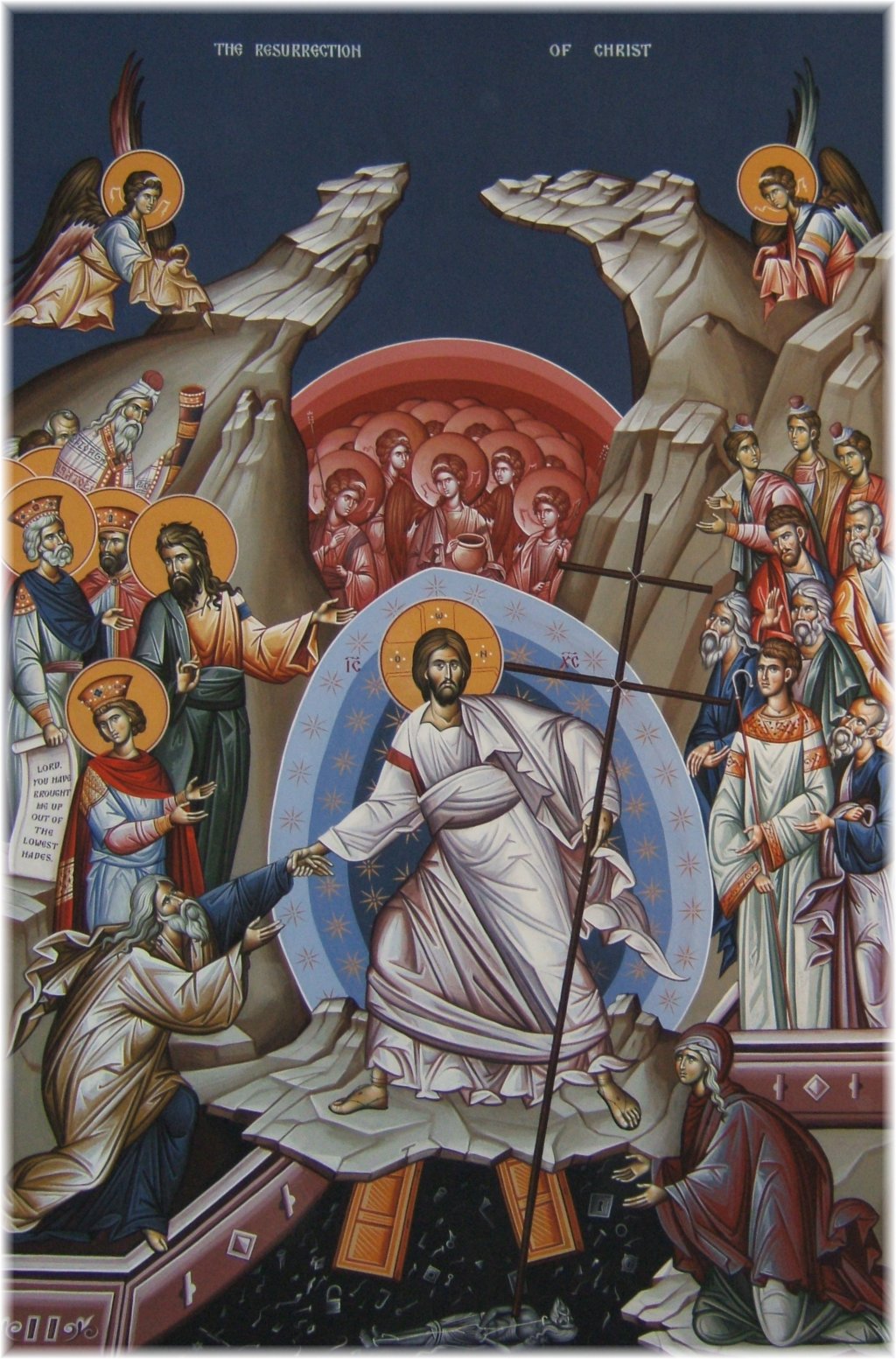
But with the text alone, on its literal level, we are left with a mystery, without context or meaning. The Tradition of the Church, however, sees the Baptism of Christ in the context of Pascha (Easter) as it sees everything in the context of Christ’s Pascha. Christ’s Baptism is a foreshadowing (and on more than a literary level) of His crucifixion and descent into Hades (just as our own Baptism is seen by St. Paul as a Baptism into Christ’s “death and resurrection”).

When he goes on to explain that in the workings of God in the world, the literal is not all there is, he quotes Fr. Andrew Louth:

Allegory is a way of entering the ‘margin of silence’ that surrounds the articulate message of the Scriptures, it is a way of glimpsing the living depths of tradition from the perspective of the letter of the Scriptures.

There is so much to think about, even if you aren’t part of the Orthodox Tradition in which we will be participating on the praxis level by blessing urns of water, creeks and lakes and oceans of water. In parishes everywhere priests will be blessing houses as my rector described in our newsletter, so as to bring “the joy of the feast of the manifestation of the Holy Trinity to each and every dwelling. Think of the house blessing as a renewal of God’s grace in your home.”

How could we not be welcoming of that? I won’t be jumping into any frozen streams, I hope ever, but I will certainly have the joy of the feast.

O Christ our God,
 Who hast revealed Thyself,
And enlightened the world,
Glory to Thee.

Who lives and was dead

Today was full of the Lord! The first thing I did on rising was go to church and take a turn reading Psalms by candlelight next to the “tomb” of Christ that had been erected on Friday and bedecked with Easter lilies. It is a special icon representing our Lord lying in the grave, and from the end of Friday night’s service the Psalms are read continuously until the next service, which was at 1:00 today.

The Orthodox also read Psalms all night by the casket of any church member at death. And if one is all alone in the church in the near dark — well, one is not alone, because God is there always, and not only He, but the saints who live and form that great Cloud of Witnesses, who are praying with us. It’s a very intimate and loving hour, and a blessed opportunity to participate in such a work.

In the middle of the Vesperal Liturgy of Holy Saturday we had baptisms. Once again we are at the anniversary of my own baptism on this day, four years ago now, and that adds to the gravity and joy of standing with those who are being newly illumined. During Lent the catechumens have been preparing for Holy Baptism, and the rest of the church pray extra on their behalf, and in our hearts and in repentance rededicate ourselves, remembering our own illumination.

Today there were six people baptized, praise God! Two couples, each with a very young boy-child, and they used our new sunken baptismal font that is just outside the church, filled with 90° water, which I’m sure made it easier for the little guys to suffer being immersed. The skies were dry, which made watching easier for all of us. In spite of the momentary displeasure and crying of the babies, everyone was beaming with smiles and songs.

Also during the service today we heard 15 Old Testament readings that have been familiar to me most of my life, but they are becoming even more beloved every year, as we hear passages as long as the whole book of Jonah and as short as the couple of paragraphs from Jeremiah that it has been my lot to chant three years in a row now. When Tom started reading the account of Abraham taking Isaac to the mountain to make a sacrifice, I realized that I have heard him read it every year, and from now on will never be able to read that moving story without hearing his voice.

We change all the altar cloths from purple to white in the middle of this service as well, two or three people nearby stepping up to do the quick work at the same time as men are lighting the chandelier and the choir is singing. Of course the choir is singing! There is rarely a quiet time during our services, filled as they are with prayers, Scripture, and hymns.

Mr. Glad went with me on Thursday evening for the Matins of Holy Friday, during which 12 Gospel passages are read, including the whole of several chapters of John, by the clergy in the center of the church. It’s a kind of total immersion in the events of Christ’s Passion, and requires three hours to get the full effect — but you get it.

Last night was Matins and Lamentations for Holy Saturday. The Lamentations consist of the whole chapter of Psalm 119, its verses interspersed with poetic verses pertaining directly to the Passion of Christ. But I didn’t go to that. I’m too old to stay up past my bedtime several nights in a row, and I wanted to be sure to make it tonight.

At my baptism, anointing with Holy Chrism

Tonight about midnight we will process around the church with candles — and maybe in the drizzle, if the weather doesn’t change quickly. Once we are back inside, a large portion of the first chapter of John will be read, often in more than one language. We will begin the happy shouts and songs of “Christ is risen!” and hymns that are the most rousing of the whole church year.

The priests and deacons will make the rounds among the people innumerable times with censing and with recitations of “Christ is risen!” and “In truth He is risen!” in many different languages in turn. Sometimes I see a cheat sheet floating around that shows these phrases, but I’m always a little too scattered to make up for my lack of preparedness right then. It’s very chummy, because we get a lot of visitors or once-a-year-ers and we fill the house. One has to pay attention to the candles to be sure that they don’t catch someone’s hair or long white scarf on fire.

Many children fall asleep on the floor as the festivities continue. The day of my baptism I was so thoroughly done-in that I couldn’t help looking again and again at the sleeping children and wishing that I were a child so that I could conk out, too. Perhaps I was being obvious; eventually a man offered me his chair, and with sleeping babe in arms moved to sit on the floor.

Of course, the highlight of the service is receiving the Holy Mysteries of Communion. When we have broken our Lenten fast with that heavenly food, and are giddy with fatigue, many of us go into the hall to share rich earthly treats that we’ve been doing without for many weeks. I’m not sure I will want to do that this year; I might need to come home and treat myself with sleep. We have a picnic Sunday afternoon with meat and everything one could want, when we are more rested.

So that’s where I’m going after I finish writing this and don my festal garments. I wanted to post at least something in commemoration of this pivotal point in history, and in our salvation history, and then I got carried away. What I first thought to share are these lines that Fr. L read to us instead of a homily this afternoon, words of the risen Christ that I hope will keep echoing in my heart.

I am the First and the Last. I am He who lives, and was dead, and behold, I am alive forevermore. Amen. And I have the keys of Hades and of Death.  

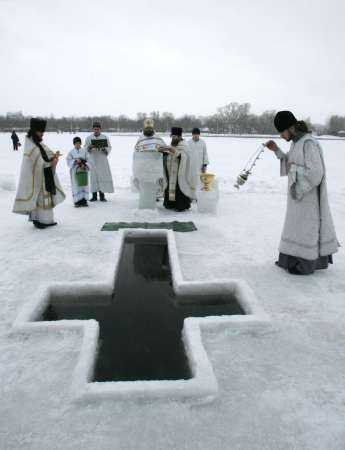
Blessing the Waters

from Google images

Church fathers tell us that the love of God warms the soul. Hell and sin are cold. So this photo, so striking in its whiteness and cultural drama, also is highly symbolic of Christ’s incarnation and salvation of the world.

I begin to grasp what Fr. Stephen writes, (link from yesterday) how the tradition of the Church “sees the Baptism of Christ in the context of Pascha (Easter) as it sees everything in the context of Christ’s Pascha. Christ’s Baptism is a foreshadowing (and on more than a literary level) of His crucifixion and descent into Hades, just as our own Baptism is seen by St. Paul as a Baptism into Christ’s ‘death and resurrection.’ ”

These Christians are blessing the waters on Theophany as Christ blessed and baptized a cold and needy Creation when He went down into the Jordan.