Tag Archives: bread

Brunch with Sophia and Brigid

ForglP1030339 a long time I’d been hoping to keep St. Brigid’s Day with some kitchen activity; I even programmed the idea into my online calendar and every year toward the end of January the e-mail reminder arrived, “If it’s not a fasting day, make Irish food.” As the day came and went year after year, always on the eve of a major feast of the Orthodox Church, there was never time or energy to enact my plan. Until this year.gl P1030341

I had invited my goddaughter Sophia for a birthday brunch on February 1st, and when I started planning the menu I realized that we could remember St. Brigid at the same time and have an Irish theme to the food.

glP1030337


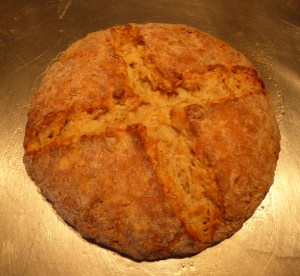
St. Brigid’s Oaten Bread would be the center of the spread, and I found many recipes for it online,  all  identical. I added a few more menu items imitating an “Irish Breakfast,” which I know was not perfectly authentic, but we relished the bread and everything else, warmed by a good fire in the stove and drinking Irish Breakfast tea to boot.

Next year I might incorporate more of the Celtic traditions surrounding St. Brigid, including the fact that February 1st is considered Celtic Spring, and the custom of not bringing snowdrop flowers into the house until that day. From Heather’s comment on my snowdrop post, and from other sources, I learned more about the saint and the season just after my party. I didn’t even think to bring snowdrops into the house on that Celtic spring day, because I had so many flowers left from our house blessing the week before.

glP1030347Confession: I actually did alter the bread recipe a bit, partly because I had an egg yolk left over from making these Candied Espresso Walnuts (a food that would have been strange to St. Brigid). I thought she would have thought it natural to use the extra yolk in the bread, because a farm girl like her would not waste it. And she would not blink an eye when she saw me adding an extra tablespoon of butter; I know this because more than one story about her reveals her appreciation of this wonderful food. Sophia and I blessed our Brigid’s bread by spreading extra butter on our thick slices.

glP1030342

The next day after St. Brigid’s we would commemorate the Presentation of Christ in the Temple, which is also called Candlemas because we bless candles. This year our rector mentioned Groundhog Day and its marking of shadows. He noted that because we came to church, we ourselves saw no shadows, only the Light of Christ shining in the world.

I like what Macrina Lewis wrote recently about these days and others through the church year:

…many of our major Christian feasts hearken back with echoes through prior centuries to pre-Christian religious and cultural celebrations, often tied closely to the earth and to the earthly rhythms of human life: birth, death, harvest, preparation, feasting. In the illuminating glory of the saBrigid2ints’ lives and the liturgical expression of the church, these feasts, these divine seasons, have been revealed in their fullness, elucidated and offered as a way for each of us to personally participate in their mysteries directly. What was formerly in shadow…has been illumined with the knowledge of faith and the fullness of God’s presence.

Thinking about those earthly rhythms, I have to say that the darkness of January did not get me down this year as it has tended to do in recent years, and I wonder why… Is it because I have so much work to do? Just watching the birds through the window as they explore my new garden must elevate my mood. Certainly being part of a worshiping community, right here in my house, keeps the gloom at the level of something “out there” that we don’t have to partake of; we worked joyfully to spiff up the house and cook a meal together for the occasion of our house blessing last week. The skies have featured rain or wind, which is not the kind of weather that leads to a prohibition of wood fires, and now three of us in one house both appreciate and even build fires almost every day.

I’ve continued to sorrow and to grieve the loss of my husband, but in sharper, briefer episodes than the kind of depression that can come from lack of sunlight. The sadness often comes over me when I’m standing in church, as sitting in my Father’s lap, and He soon comforts me by making me feel all the love and loveliness in His house. Into the darkness of a hurting and wintry world, Jesus Christ shines warm and bright.
gl P1030340

The Bread of Offering

I helped to bake Communion bread this week.

P1010401

This time I was off in a corner by myself, near the icon of famous prosphora makers Sts. Spyridon and Nicodemus of the Kiev Caves. We also have a photo of some monk bakers, and the Prayer before baking The Bread of Offering.

GL Spyridon & Nicodemus

Prayer Before Making Prosphora

O Lord Jesus Christ, only begotten Son
of the Eternal Father,
who has said with Thy most pure lips:
Without Me you can do nothing.
O Lord, my Lord,
with faith I accept your words;
help me a sinner
to prepare the Bread of Offering,
that the works of my hands
may be acceptable at Thy Holy Table
and may become
through the operation of Thy Holy Spirit
the communion of Thy Most Pure Body
for me and for all Thy people.
In the Name of the Father,
and of the Son, and of the Holy Spirit.
Amen

Three other bakers were making about 200 smaller loaves in the middle of the kitchen. While we are working the dough and forming the loaves, we pray the Jesus Prayer silently.

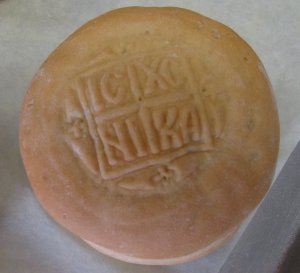
After stamping the top part, I sealed together with water the two halves, representing the two natures of Christ, human and divine, and joined them into one loaf.

P1010405

Each of these loaves called “Lambs” will be used for a Sunday Liturgy. We wrap the extras tightly and freeze them. I had to leave early and let other bakers take the bread out of the oven, but this is what I hope it looked like when baked.

prosphora lamb crp

Beautiful Artos

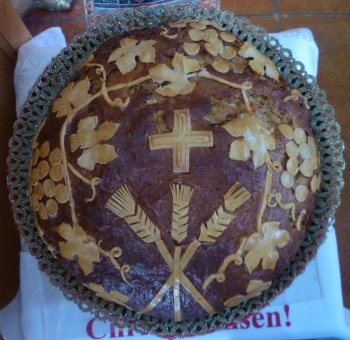
artos 15 crpHere is this year’s Artos, the blessed bread that remains in the church all during Bright Week, one more reminder of the Resurrection and of how our Lord is The Bread of Life.
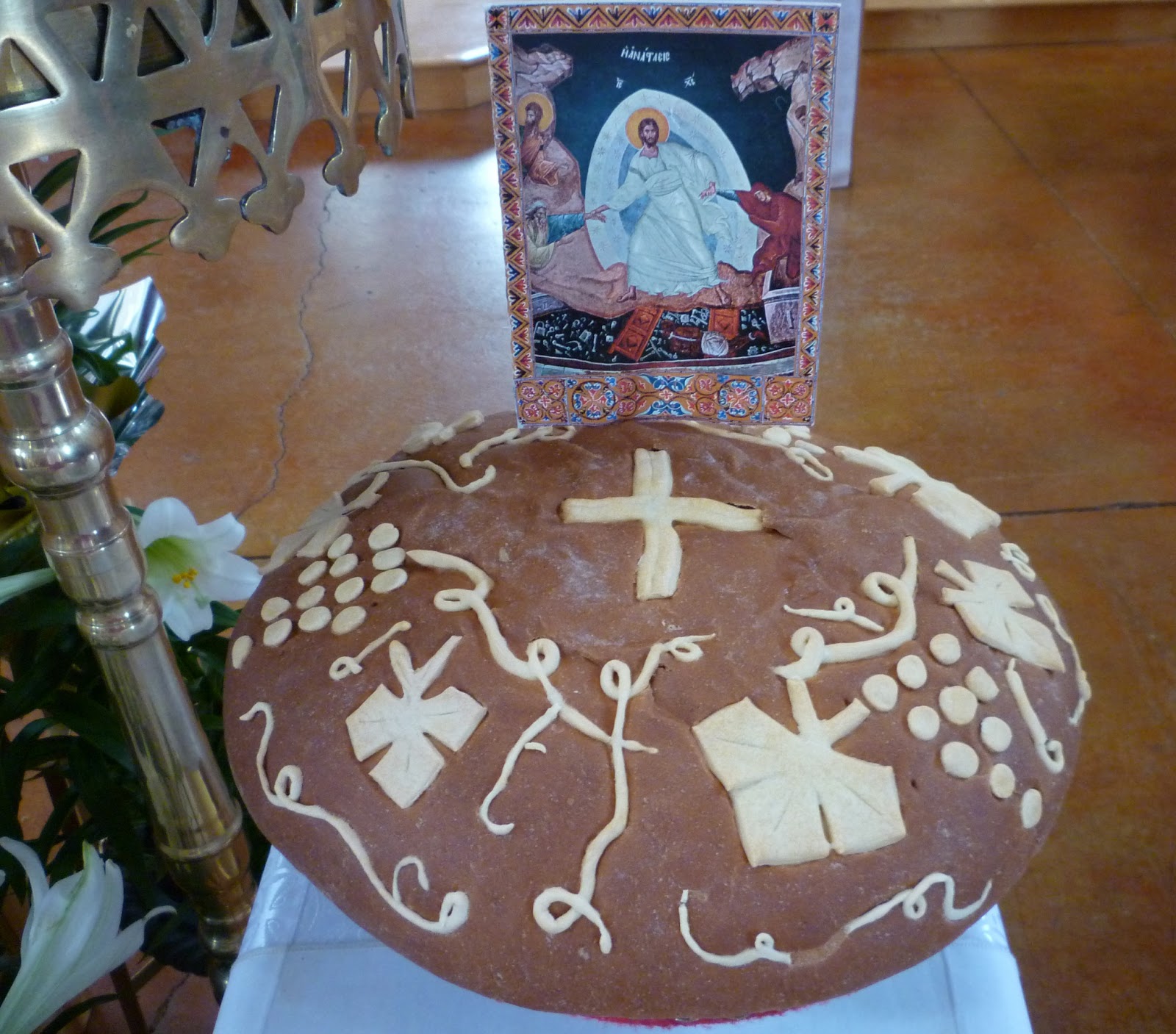
I’ve been looking at other photos of loaves of Artos and truly I think our parish has the most gorgeous! In a few days we will all get a piece to eat. I happened to go into the church kitchen last week while the dough was being kneaded, so I know it has olive oil and orange zest in it, but other than the wheat itself I don’t know what other flavors it holds.

The Gospel reading at the Bright Tuesday Liturgy told the story of the disciples meeting the risen Christ on the Road to Emmaus, and I was very moved by it. I seemed to feel as never before how their world had collapsed when Jesus was crucified and dead. How heartbroken they must have been, to be suddenly without the One who meant everything to them, who was their very life. And then to hear how He, not recognized, spoke to them, and “beginning at Moses and all the Prophets, He expounded to them in all the Scriptures the things concerning Himself.” (Luke 24) The drama of this well-loved story grew in my heart as our priest read the passage.

When they convinced Him to stay with them that evening, their eyes were opened as they broke bread and ate together, and they knew Him. Then He vanished from their sight, and they realized that even though they hadn’t at the time realized why, their hearts had “burned within them” as they had listened to Him on the road.

My heart was joyful, and I got chills thinking about the unspeakable gift of breaking bread with God, partaking of the Holy Mysteries and by that sacrament receiving a kind of knowledge that can only come by His grace.

And we are only halfway through Bright Week! Christ is risen! He is risen indeed!

artos 15

(This is my 900th blog post!!)

It’s a joyful day, whatever day it is.

Pascha goes on and on! So we have Paschal Bright Week services, Monday, Tuesday, Wednesday….

Christ rose on the first day of the week, Sunday. The Church has always considered this to be be the eighth day as well, the beginning of a new order of things. I don’t really understand this. But our bishop mentioned it this morning, Bright Monday, when he talked about the grace that extends throughout the week hinting at the newness of life given us in Christ’s Resurrection.

We all are feeling the newness. Today we lived in the joy of Christ’s presence and celebrated it in many ways, including a loaf of bread. This year it was baked by a young girl with the help of a more experienced baker. It must weigh over five pounds — I know, because I was honored to carry it in the procession around the church, and then standing on the porch as the gospel for the day was read.

This bread is called the Artos and “symbolizes the physical presence of the resurrected Christ among the disciples.” It will remain in the church all week and be carried in procession after Divine Liturgy those days; on Saturday it will be cut into pieces and distributed to the parishioners.

Below is a photo I found online of a Bright Week procession elsewhere.  It seems it might be the only photo available — maybe everyone wants to actively participate in these blessed processions and not stand apart to be a photographer.

On Pascha night I remembered that I have a piece of last year’s Artos in my refrigerator. I’m sure I was saving it for a time when I was ill or afflicted, and I must never have thought that I was terribly bad off at any time during the year. Praise God for that. So I’ll have to eat it for joy this week and put a new portion in reserve for any upcoming needs. Having been exposed to the air for a whole week it becomes dry and keeps very well!

The day of our Lord’s Resurrection is another case, it seems, of how we live in the present life and at the same time we live in the reality and anticipation of God’s coming Kingdom. St. Gregory Palamas wrote in a sermon “On the Sabbath & The Lord’s Day”:

Whatever is said in praise of the 7th day applies even more to the 8th, for the latter fulfills the former. It was Moses who unwittingly ascribed honor to the 8th day, the Lord’s Day. The Jubilee year (Leviticus 25:8ff), which Moses regarded as a year of forgiveness and named accordingly, was not counted among the ‘weeks of years’ under the law , but came after them all, and was an eighth year proclaimed after the last of these 7 year periods. Moses did the same with regards to periods of 7 weeks.

However, the lawgiver did not only introduce in this hidden way the dignity of the 8th day, which we call the Lord’s Day because it is dedicated to the Lord’s resurrection, but also on the feast called “Trumpets” referred to the 8th day as ‘the final solemn assembly’ (cf. Lev.23:36 LXX, Numbers 29:35) meaning the completion and fulfillment of all the feasts. At that point he clearly said that the 8th day would be holy for us, proclaiming in advance how divine, glorious, & august Sunday was to be after everything pertaining to the law had passed away.

But I see that Metropolitan Anthony in a passage I quoted just last week tells us that we are living this present life in the Seventh Day:

…the seventh day will be seen as all the span of time that extends from the last act of creation on the part of God to the last day, the eighth day, the coming of the Lord, when all things will be fulfilled, all things will come to an end, reach their goal, and blossom out in glory. It is within this seventh day, which is the whole span of history, that the creativeness of man is to find its scope and its place.

In this whole span of history we have much work to do, including our bread-baking and flower-arranging to celebrate Christ’s rising from the dead. St. Isaac of Syria tells a bit about how the fullness of our Eighth Day is yet to come, and seems to see things somewhat differently from Met. Anthony:

The Lord’s Day is a mystery of the knowledge of the truth that is not received by flesh and blood, and it transcends speculations. In this age there is no eighth day, nor is there a true Sabbath. For he who said that ‘God rested on the seventh day,’ signified the rest [of our nature] from the course of this life, since the grave is also of a bodily nature and belongs to this world. Six days are accomplished in the husbandry of life by means of keeping the commandments; the seventh is spent entirely in the grave; and the eighth is the departure from it.

It certainly is a mystery to my small mind, but I am always comforted by these realities of the faith that show how great is our God, and His plans for us, so high as the heavens are above the earth, that they are hard to grasp with our minds. And I’m full of that joy that is not received by flesh and blood, of the glorious risen Savior Christ. He is here every day.