Tag Archives: childhood memories

The Crosse

Friday is a day to remember The Cross. This poem by John Donne, which I first read at least 15 years ago, contributed to my own alienation from modern minimalists and anti-sacramentalists. It is long and full of theology, and by the time I get to the end I am always lifted up by joy. It must be that cup of joy He gave us by taking the cup of death. I’ve put it with the old spellings and words, to remind me of the historical context in which it was written, but it can be found in an updated form here.

I wonder if I wasn’t imbued with a love for The Cross from my earliest Sunday School classes; my teacher gave me a small plastic cross with adhesive on the back, which I stuck to the wall above my bed. I looked at it every night before I went to sleep, for years, as it was the sort of material that absorbed light and glowed for a while after the electric lights were put out.

THE CROSSE

Since Christ embrac’d the Crosse it selfe, dare I
His image, the’image of his Crosse deny?
Would I have profit by the sacrifice,
And dare the chosen Altar to despise?
It bore all other sinnes, but is it fit
That it should beare the sinne of scorning it?
Who from the picture would avert his eye,
How would he flye his paines, who there did dye?
From mee, no Pulpit, nor misgrounded law,
Nor scandall taken, shall this Crosse withdraw,
It shall not, for it cannot; for, the losse
Of this Crosse, were to mee another Crosse.
Better were worse, for no affliction,
No Crosse is so extreme, as to have none;
Who can blot out the Crosse, which the’instrument
Of God, dew’d on mee in the Sacrament?
Who can deny mee power, and liberty
To stretch mine armes, and mine owne Crosse to be?
Swimme, and at every stroake, thou art thy Crosse,
The Mast and yard make one, where seas do tosse.
Looke downe, thou spiest out Crosses in small things;
Looke up, thou seest birds rais’d on crossed wings;
All the Globes frame, and spheares, is nothing else
But the Meridians crossing Parallels.
Materiall Crosses then, good physicke bee,
And yet spirituall have chiefe dignity,
These for extracted chimique medicine serve,
And cure much better, and as well preserve;
Then are you your own physicke, or need none,
When Still’d, or purg’d by tribulation.
For when that Crosse ungrudg’d, unto you stickes,
Then are you to your selfe, a Crucifixe.
As perchance, Carvers do not faces make,
But that away, which hid them there, do take.
Let Crosses, soe, take what hid Christ in thee,
And be his image, or not his, but hee.
But, as oft Alchimists doe coyners prove,
So may a self-dispising, get selfe-love.
And then as worst surfets, of best meates bee,
Soe is pride, issued from humility,
For, ’tis no child, but monster;  therefore Crosse
Your joy in crosses, elso, ’tis double losse,
And crosse thy senses, else, both they, and thou
Must perish soone, and to destruction bowe.
For if the’eye seeke good objects, and will take
No crosse from bad, wee cannot scape a snake.
So with harsh, hard, sowre, stinking, crosse the rest,
Make them indifferent; call nothing best.
But most the eye needs crossing, that can rome,
And move;  to th’others th’objects must come home.
And crosse thy heart:  for that in man alone
Points downewards, and hath palpitation.
Crosse those dejections, when it downeward tends,
And when it to forbidden heights pretends.
And as thy braine through bony walls doth vent
By sutures, which a Crosses forme present,
So when thy braine workes, ere thou utter it,
Crosse and correct concupiscence of witt.
Be covetous of Crosses, let none fall.
Crosse no man else, but crosse thy selfe in all.
Then doth the Crosse of Christ worke fruitfully
Within our hearts, when wee love harmlesly
That Crosses pictures much, and with more care
That Crosses children, which our Crosses are.

-John Donne

My Valley Oak

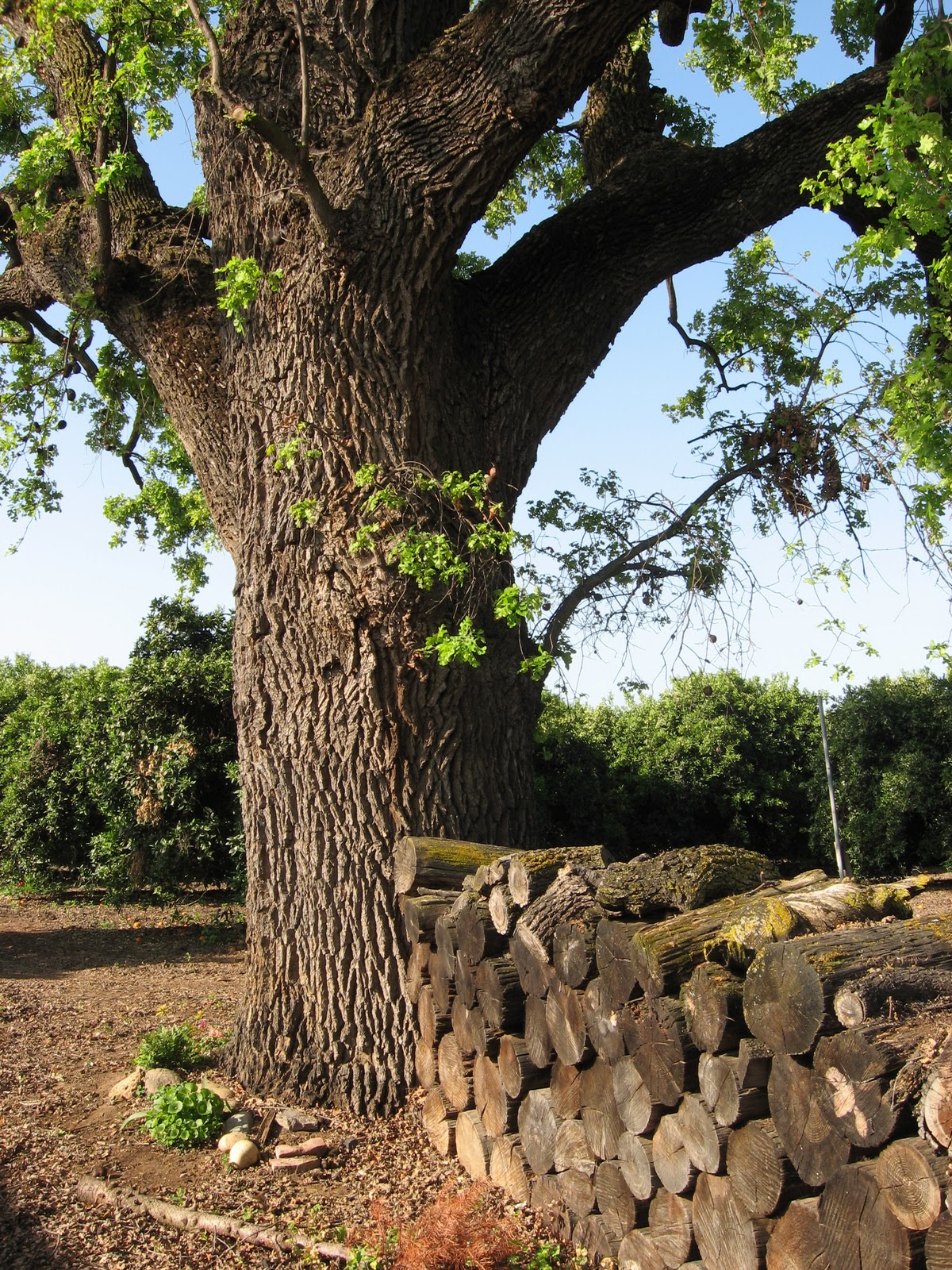
My father bought 30 acres of land with oranges and lemons growing on it, and no house. There was a large oak tree looming above a spot where a house might have stood in the past. And he thought that the tree was pretty much grown up, so he planted a house nearby.

This is the oak under which I lived after we moved in, until I went away to college about twelve years later. Only twelve years? Those formative years have an impact far beyond their numerical value, and that tree has to be my favorite tree, because there hasn’t been a particular beloved tree between then and now that I can bring to mind.  I realized that this week when Elizabeth was telling about her favorite trees and I wondered if I had one.

In these first pictures, taken decades after I had married, the tree had recently been trimmed with great care and patience by a tree man who was in love with it. I was amazed at its beauty and took a lot of pictures.

At that point the oak had grown mightier than my father ever expected, and its limbs were leaning dangerously over the house. My father said that if he had known how big it would get, he wouldn’t have built the house so close to it. At least one large limb had to be cut off to protect the house, and the whole tree was refreshed and lightened by being pruned all over.

When I was growing up I only knew that it was an oak tree. If someone told me it was a Valley Oak I didn’t remember. People in our family rarely talked about the birds and trees in those days. I didn’t know those were mourning doves I used to hear every evening as I was lying in my bunk. But one year a flock of bright orioles lived in our tree for a few weeks and we heard some talk then.

When I used to play under the tree, this is the way I mostly saw it, as a thick trunk. There was no reason to look up into the branches, excepting the times when orioles visited, and it was usually so messy up there that some twigs or dirt or even tree frogs might fall in your face.

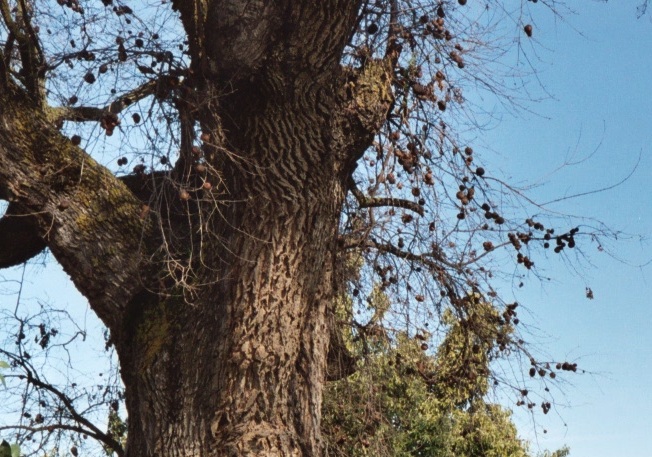
oak galls/balls in winter

Yes, more than once we had veritable plagues of tiny tree frogs swarming in the branches, on the trunk, hopping all over the ground under the leaves. When we walked under the tree they jumped onto our legs as though they were little trunks.

And our tree suffered many times from all varieties of galls, the most common of which we just called “oak balls.”

Always Daddy had stacks of firewood under the canopy of branches, usually fruit wood that he’d gleaned from neighboring orchards that were being replaced. But here we see it is logs cut from our tree’s own pruned limbs.

One year my grandma gave me a little tent for my birthday and I set it up under the tree to lie in the summer long, reading comics and books and sucking on cubical cinnamon suckers.

Doghouses were common at the base of the trunk, and one year we had a banty chicken coop there. The basketball hoop that my father built for me was shaded by this tree friend. And as I think more about the shade it provided, I wonder how much money was saved on cooling bills because we had a partial shield from the burning Central Valley sun.

In his last years my father would walk out under the tree to the edge of the orange grove and scatter grain for a family of wild pheasants that visited. You can tell that this picture was taken pre-trim. One pheasant can barely be seen between the rows of trees.

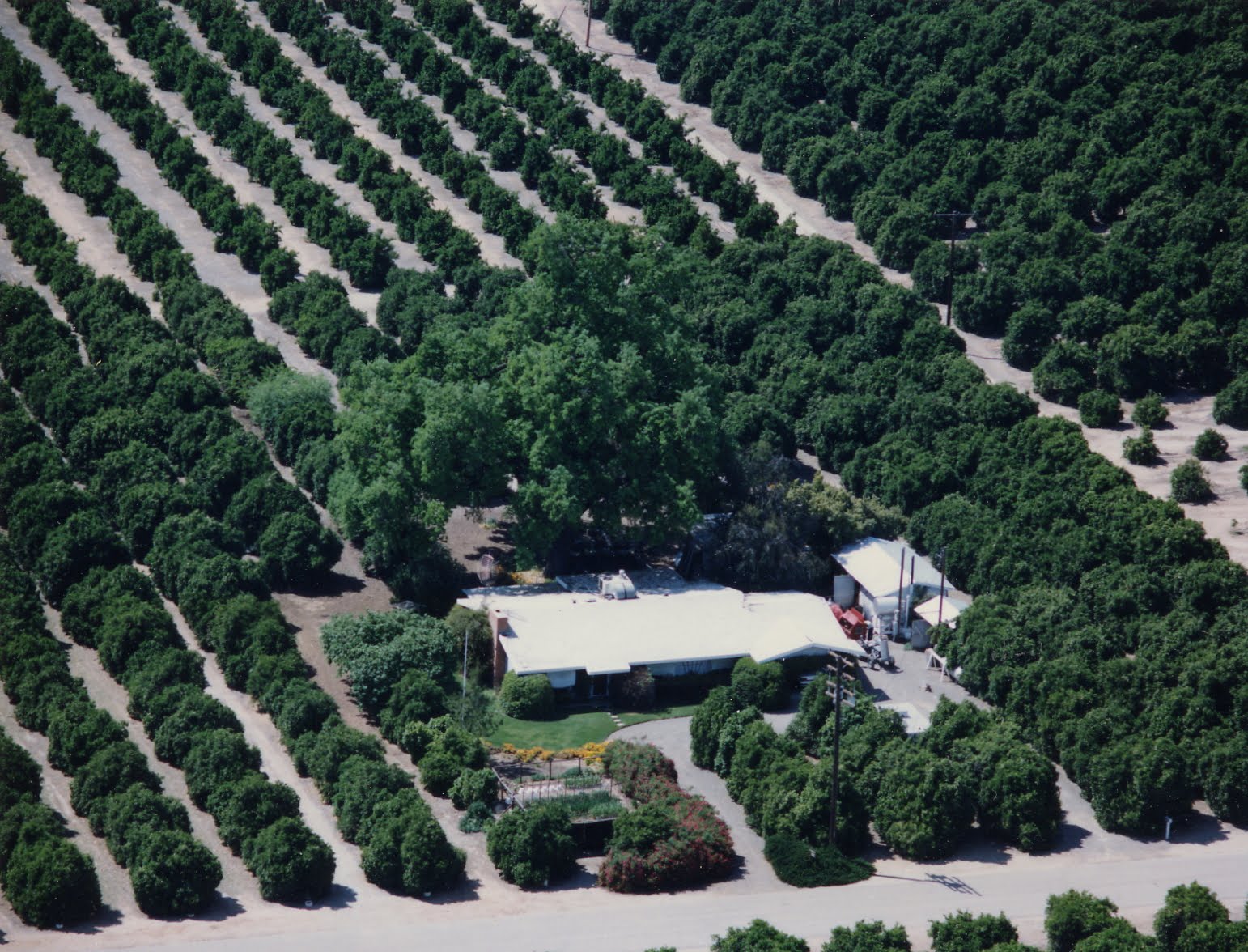
One view of our tree that we didn’t have as children was from above. But some time after we were all grown up an aerial photographer took the photo below and came to the door after the fact to present his wares. Of course Daddy couldn’t say no. As he studied the picture he could see his spray rig in the driveway and him bending over it. And soon each of us kids received a gift of a framed picture of our childhood home — and my favorite tree.

My Famous Pipe-Smoker

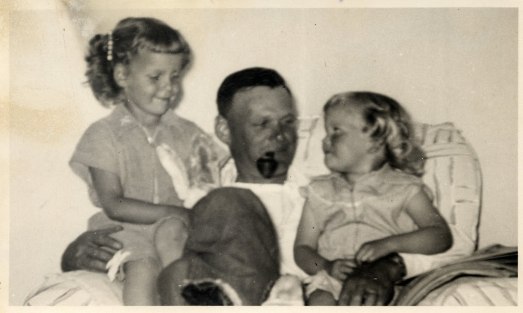
Pipe tobacco was what my siblings and I gave our father for Christmas year by year. He smoked his pipe every evening while reading after dinner, and when my grandfather was visiting, they would settle down in armchairs side-by-side and smoke together.

My understanding of the health risk is that it is significantly less than cigarette-smoking, because one doesn’t inhale very much. Those who smoke a pipe testify that it is incredibly relaxing, and the practice has even been prescribed as a treatment for anxiety disorder.

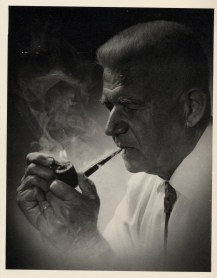
I can see how the habit might preclude other worse habits from developing, such as overeating, hurrying and worrying. My father lived to the age of 90, but to make a full disclosure, I must say that he stopped smoking a pipe when he was in his 50’s. Grandfather (his is the arty pic below) also lived past 90; he stopped when my father stopped, as he no longer had a smoking companion.

That pipe-smoke smell is one of my favorites from long ago, but one that I haven’t encountered for many years. Let it here be noted that if any of my sons or grandsons take up the custom, I will start making gifts of tobacco again. This offer doesn’t apply to the girls.

I recently discovered a blog honoring  Famous Pipe Smokers , hundreds of them, from Clark Gable to Winston Churchill and Oscar Peterson. None of the fascinating photographs of these people pipes-in-mouth is as charming to me as the one of my sister and me on the lap of our dear pipe-smoker. He is not likely to be noted with the celebrities, but he is the most famous to me.

Trains and Stations

Lying in bed at night as a child, I used to hear trains pass less than a mile away, as the whistle blew at the intersection where I also would catch the school bus in the mornings. We were out in the middle of citrus orchards, on a dead-end road, so there was little else to hear at night. The coyote howling was a different tone from the locomotive’s warning. Now that my daughter lives where trains toot-toot as they go by many times throughout the day and night, I find that the sound still strikes a chord of comfort and regularity.

While we are busy about our work and play and sleep, thousands of people are being diligent to do their jobs driving the trains, loading them, keeping the schedules updated, whatever all is necessary. I know so little about it, it’s like magic.

Books I enjoyed with my children fed this romantic feeling I have: The Little Red Caboose, The Boxcar Children, The Railway Children, even The Narnia Chronicles with its train trips here and there during holiday. Children and trains.

When I was still a young child I was allowed to ride the Santa Fe with just my two sisters, four hours to my grandmother’s house, which no doubt also makes me love trains, and the train stations just as much. Excitement and heightened emotion pervade these meeting places of people who might be returning from exotic and faraway lands, or perhaps are just now being reconciled face-to-face with kinfolk after years of estrangement….One never knows all the stories, one hardly knows all that churns in one’s own heart at meeting one’s own people.

When I rode the train, it was to visit my most dearly beloved maternal grandparents. I can see in my mind’s eye, just as I saw them from the train window before they could see me, Grandma and Grandpa, standing in the crowd waiting for us. We climbed down the steps and went to them, and got a kiss, and Grandma’s warm hands in ours (those were the days before hugging was expected), and her remarking how cold my own hands were.

There is mention of British trains and stations, even Victoria Station, on this blog recently. I’ve been on some British trains, and the last time I was on that island, my hotel was quite near Victoria Station, which was awfully modernized from the first time, and certainly a different world from what lives in my memory and heart’s imagination. When you can’t even throw your own trash away, but must hand it to someone walking around in a sort of spacesuit, it feels like a new age, and not of flower children.

One recent sight jived with the old world, though. Driving through the mountains of forests last week, I looked down the wooded slope at a railroad track snaking along a river, and thought I caught a glimpse of the little red caboose.