Tag Archives: death

Athanasius – All the disciples despise death.

On this Sunday in the Orthodox Church we remember the Holy Forefathers, the faithful ancestors of Christ, many of whom are named in a long list in the services yesterday and today, men and women like David, Jael, Daniel, Rachel, Moses and Ruth….
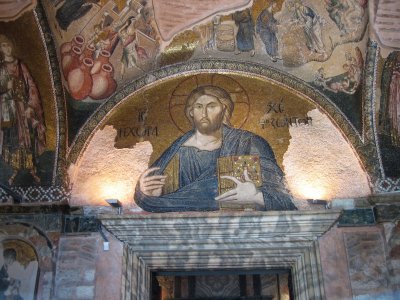
“The Land of the Living” – Chora

And the hymns sing of how they all, long since passed from this earthly existence, are even now “in the Land of the Living.” Thomas Hopko in The Winter Pascha mentions a church near Constantinople where a huge mosaic of Christ is named: “The Land of the Living.” I found a photo of it (above).

I learned in the short account of the life of Athanasius at the beginning of his On the Incarnation that the last and worst persecution of Christians ended in Egypt in 311 A.D., when Athanasius was about fourteen. From the age of five he had lived with the constant threat of death, and with the ever-present reality of persecution of his friends and family. The behavior of the ungodly is irrational and inhuman, and tends to cause great pain and suffering, often unto death, not only of the innocent but also of the most Christ-like. As an adult the scenes and events of his childhood seem to be fresh in his mind when he writes:

“A very strong proof of this destruction of death and its conquest by the cross is supplied by the present fact, namely this. All the disciples of Christ despise death; they take the offensive against it and instead of fearing it, by the sign of the cross and by faith in Christ trample on it as on something dead. Before the divine sojourn of the Saviour, even the holiest of men were afraid of death, and mourned the dead as those who perish. But now that the Saviour has raised his body, death is no longer terrible, but all those who believe in Christ tread it underfoot as nothing, knowing full well that when they die they do not perish, but live indeed, and become incorruptible through the resurrection. But that devil who of old wickedly exulted in death, now that the pains of death are loosed, he alone it is who remains truly dead.”

I started composing this post about death and the saint’s childhood before the horrific murders at a Connecticut school last week. I found the description Athanasius gives, of people bravely and even joyfully facing death daily, foreign to my 21st-century suburban self. But the topic turns out to be pertinent, and the recent stories of gutsy teachers in our own country inspiring — especially when taken with the letter from our Archbishop Tikhon after that event:

“Concerning those who have fallen asleep, Saint Paul exhorts us not to “grieve even as others who have no hope” [1 Thessalonians 4:13]. And yet, herein he does not forbid us from grieving. Now is the time for us to weep, but we must weep with the firm hope that comes from our faith in our Lord Jesus Christ. “Shed tears, but remain calm; weep modestly, and with fear of God,” writes Saint John Chrysostom. And following this example, each of us must strive to transform our sorrow into prayer.

Just this week I was asked to tell one of my favorite Bible verses, one that readily comes to mind without effort. It is always this one, that speaks of our complete dependence on the Lord as our LIFE, whether living or dying. Our leaves will not wither, because Christ Himself is The Land of the Living.
But I am like a green olive tree
in the house of God:
I trust in the mercy of God
for ever and ever.
Psalm 52:8

A sleeping place is blessed.

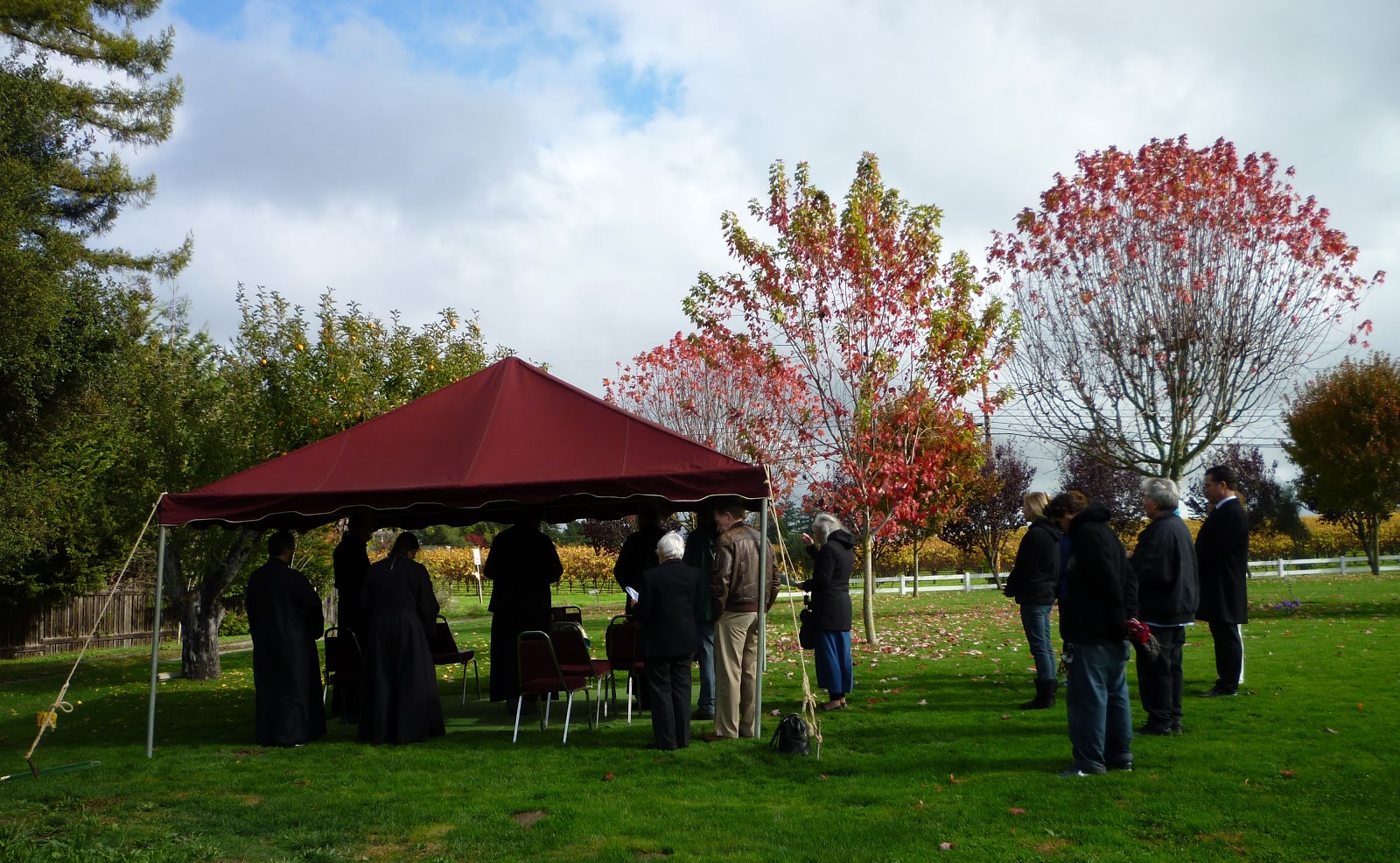
When our rector went to a nearby cemetery to bless a section designated for new gravesites, I was eager to go along and be among those praying and singing. A small group of us gathered at noon after a morning of rain. The light changed often as the clouds came between us and the thin autumn sunshine. The trees cast shadows in the middle of the day, and I never took off my fleece jacket.

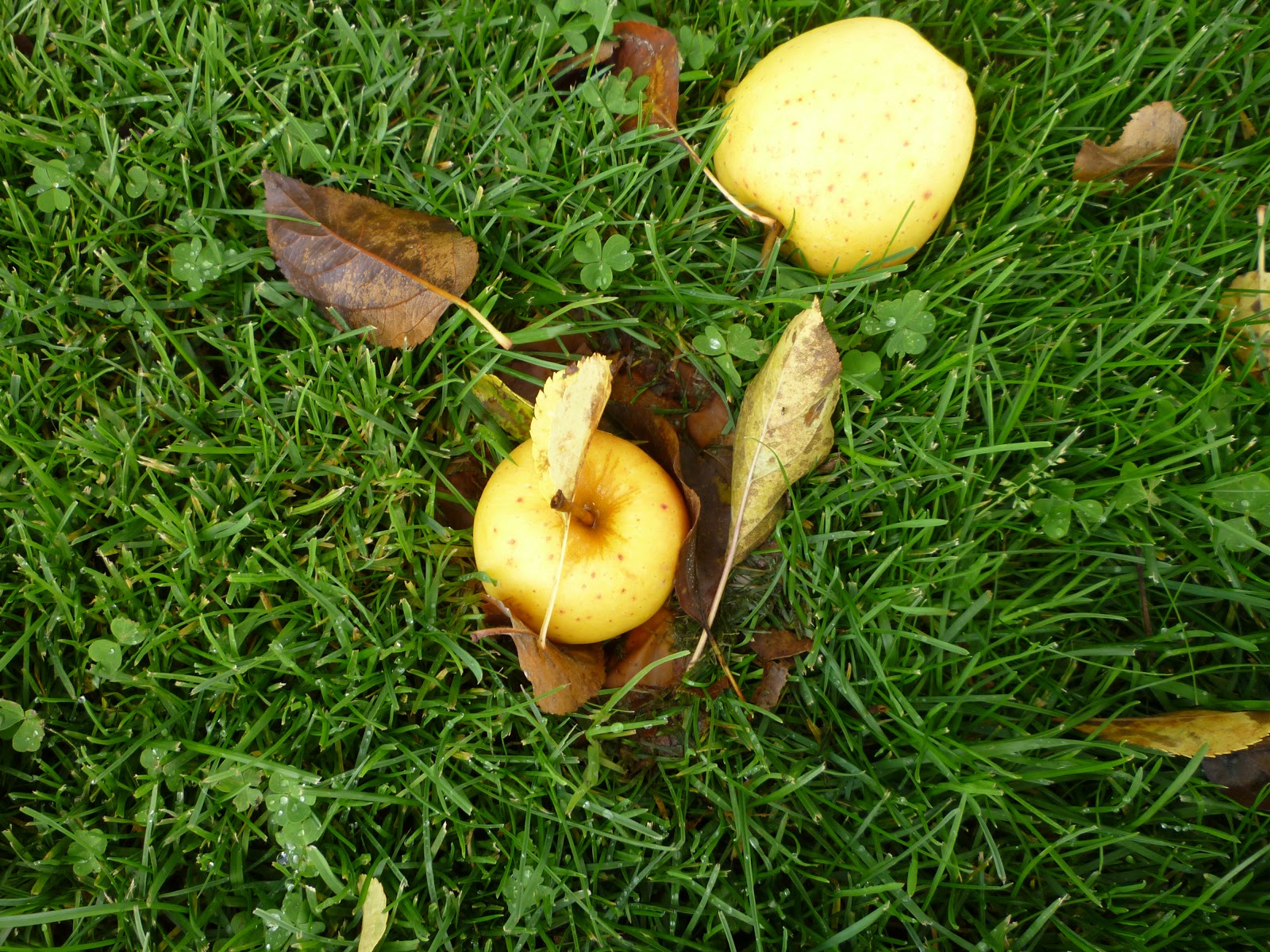
Not long into the service three words, “quickly flowing life,” pressed on my mind, referring to our earthly existence. It seemed the perfect time of year for this opportunity to turn our minds to death and corruption; I could see the vineyard across the street all in gold, and apples had fallen from trees all around the awning that had been set up for us.

Strangely enough, my husband was in another town not far away, attending the funeral of a Christian man. His body was put into the grave at about the time we were hearing the Gospel reading, about how Joseph of Arimathea took Christ’s dead body and cared for it. Here is the account from the Gospel of John:

After these things Joseph of Arimathea, who was a disciple of Jesus, but secretly for fear of the Jews, asked Pilate that he might take away the body of Jesus, and Pilate gave him permission. So he came and took away his body. Nicodemus also, who earlier had come to Jesus by night, came bringing a mixture of myrrh and aloes, about seventy-five pounds in weight. So they took the body of Jesus and bound it in linen cloths with the spices, as is the burial custom of the Jews. Now in the place where he was crucified there was a garden, and in the garden a new tomb in which no one had yet been laid. So because of the Jewish day of Preparation, since the tomb was close at hand, they laid Jesus there.

Our bodies are temples of the Holy Spirit, and when at death our souls are separated from our bodies it is right that they be laid in the earth to await the resurrection. Fr. Alexander Schmemann (in an article that is worth reading in its entirety) makes clear what is Christian faith as regards this event:

…it is with faith or unbelief, not simply in the “immortality of the soul,” but precisely in the Resurrection of Christ and in our “universal resurrection” at the end of time that all of Christianity “stands or falls,” as they say. If Christ did not rise, then the Gospel is the most horrible fraud of all. But if Christ did rise, then not only do all our pre-Christian representations and beliefs in the “immortality of the soul” change radically, but they simply fall away.

…..

He alone arose from the dead, but He has destroyed our death, destroying its dominion, its despair, its finality. Christ does not promise us Nirvana or some sort of misty life beyond the grave, but the resurrection of life, a new heaven and a new earth, the joy of the universal resurrection. “The dead shall arise, and those in the tombs will sing for joy…” Christ is risen, and life abides, life lives… That is the meaning; that is the unending joy of this truly central and fundamental confirmation of the Symbol of Faith: “And the third day, He rose again according to the Scriptures.”

The soul won’t be separated from the body forever, but for a time the body will be as asleep, while we anticipate our rising, when we will sing with joy at the final defeat of death. Until then, this spot on the earth would be as good as any for waiting.

When the service was over, we were invited to pick as many apples as we wanted from the trees, which I think were Golden Delicious. It didn’t take me long to finish my apple. The service was less than an hour. In a couple of months there won’t be any leaves left on the vines or the apple trees, and the years of each of us are quickly flowing.

Lord, teach us to number our days, that we may apply our hearts to wisdom.

[We had no idea of it at the time, but not three years after I wrote this post, my husband joined the ranks of those waiting here for that rising.]

Every season feeds upon the past. -Gioia


VETERANS’ CEMETERY
The ceremonies of the day have ceased,
Abandoned to the ragged crow’s parade.
The flags unravel in the caterpillar’s feast.
The wreaths collapse onto the stones they shade.
How quietly doves gather by the gate
Like souls who have no heaven and no hell.
The patient grass reclaims its lost estate
Where one stone angel stands as sentinel.
The voices whispering in the burning leaves,
Faint and inhuman, what can they desire
When every season feeds upon the past,
And summer’s green ignites the autumn’s fire?
The afternoon’s a single thread of light
Sewn through the tatters of a leafless willow,
As one by one the branches fade from sight,
And time curls up like paper turning yellow.
— Dana Gioia
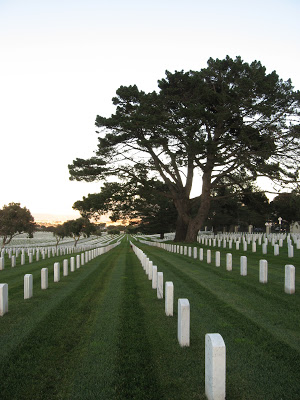
Golden Gate National Cemetery

Bog Cotton and Other Book Encounters

It’s been a long time since I’ve posted a real book review. I read, but never feel that I can do justice to any book. If it’s bad, just what makes it bad? If it’s at all good, how do I assess it thoroughly and convey the worth of it? I don’t, obviously, do any of that lately.

Still, it is no fun keeping all the books to myself. So I’m going to try brief mentions of a stack of them, and tell only a little bit of what got my attention. So as to Get Something Done.

Bog cotton by Loch Glenbrittle
A Shine of Rainbows is one of many enjoyable books by Lillian Beckwith. Everything I’ve read by her has been set in the Hebrides Islands of Scotland, and most of her writing is light and humorous. This one was more serious, about an orphan who finds a good home, and the unwilling adoptive father who is eventually greatly helped by having a son. The thing I liked best about the story, which was fairly predictable and mostly an aid to falling asleep at night, was the mention of “bog cotton.”

When I read that name immediately a picture came to my mind of the plant that Pippin and I saw in Scotland years ago. I scribbled the name on a post-it note next to my bed and months later got around to looking it up; indeed, it is the very plant, a fairytale sort we encountered on the Isle of Skye as we began to hike up from Loch Glenbrittle into the Cuillin Mountains.

It’s also called Common Cottongrass: Eriophorum angustifolium. This plant is in the sedge family and is said to grow all over North America, but I’ve never encountered it before or since. These photos are by Pippin, from way back then.

Nothing to Do But Stay: My Pioneer Mother is by Carrie Young, the author of a book possibly more famous, The Wedding Dress. It’s a small book about growing up in a community of Norwegian immigrants in the Dakotas. The pioneer mother, Carrine Berg, grew up in the last decades of the 19th Century; the author graduated from college in 1944. Carrine was a plucky lady who homesteaded on the plains as a single woman, then when she was in her mid-30’s married another homesteader and managed to bear six children, of whom the author was the last.

All the stories of these hardworking people were well-told, but perhaps my favorite, that made me laugh out loud, was about when Carrine decided to raise turkeys as a moneymaking enterprise, in spite of the fact that her husband did not like the meat. The author and her sister were to “keep track of the turkeys” all summer long for four years, until their mother quit the business. “We soon learned that turkeys are congenitally indisposed to the principle of herding. Neither are they compatible with chasing, shooing, or rounding up.”

I also enjoyed reading about the way this extended family celebrated July 4th, as a children’s holiday focused on churning and eating as much ice cream as they could all day long. The vicarious experience of their family life makes me want to read The Wedding Dress, too.

Dust to Dust or Ashes to Ashes by Alvin Schmidt is a historical critique of the practice of cremation. This is likely the most poorly written book I’ve read in my life. The main points were well taken, but repeated over and over, with whole passages quoted almost verbatim from one chapter to another. The author has decent credentials, and I wonder why the publisher did not insist on some editing. Even the syntax is convoluted and confusing, and though Schmidt mentions the Orthodox view on cremation and the book is (I was ashamed to see) published by an Orthodox publishing company, he is not Orthodox himself and fails to convey the Orthodox understanding of burial.

Since I read that book, I bought another, newer book that promises to be a better treatment of the important subject: A Christian Ending: A Handbook for Burial in the Ancient Christian Tradition, by J. Mark and Elizabeth J. Barna. I also attended a lecture and discussion of the subject at a nearby monastery, which included the reading of many Bible passages that lament the breaking and grinding of human bones. One of the unchristian things about modern cremation is that it includes the grinding up of the bones. I still hope that some day I will find the time to organize all my thoughts on this subject.

Mrs. Mike by Benedict and Nancy Freedman I had read about 20 years ago, a public library copy. This time I ordered my own book online and got around to reading it when my brain was too tired for anything more strenuous. “Mr. Mike” is a Canadian mountie who takes his very young city-raised bride to the northern reaches of America, where they live through a lot of adventure and suffering along with the natives whom they often serve. It seems to be based on the life of a real woman, whose story is told honestly enough to be believable and to keep me turning the pages. I was glad to read it a second time but probably won’t again.

Echoes of a Native Land by Serge Schmemann: I picked up this book because it’s written by the son of Fr. Alexander Schmemann, one of my favorite authors. Serge was able to spend a decade living in the land of his forefathers and even in the very village where his mother’s people lived before the Russian Revolution, and this is the fascinating account of the genealogical history and the current residents, against the backdrop of 200 years of Russian politics and culture. Schmemann was a journalist for the New York Times who won a Pulitzer Prize for his coverage of the reunification of Germany. He’s always very readable and fair in this very personal history, which I liked very much.

I will let myself off the hook for a while, having mentioned a handful-sized stack of recent reads. Now turn aside from these brief and dull accounts to hear George Orwell on the subject of book reviews, even if it might be hard to connect what he says to my particular assemblage:

Prolonged, indiscriminate reviewing of books is a quite exceptionally thankless, irritating and exhausting job. It not only involves praising trash but constantly inventing reactions towards books about which one has no spontaneous feeling whatever.