Tag Archives: drought

Anthropology of water and radio.

One Friday I set off for the mountains to our family’s cabin in the southern Sierra Nevada. P1000688 sf close w roadThe homesickness that always comes on in advance seems to be even worse these days. I did not want to leave what feels like my soul’s safe place,  and it took me all the next morning to drag myself away. The sun was high in the sky before I got on the road, but from then on I was the Happy Wanderer. And I didn’t get lost, at least not very soon.
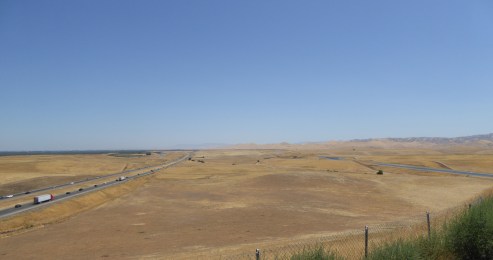
It’s dry out there, folks! Even so, crops are growing, and canals are full of water. This view of Highway 5, the interstate that runs right down the middle of the state, shows the most barren looking stretch. I took the picture looking south, and you can see the California Aqueduct running along in the same general direction and to the west of the highway here.
P1000662 5 & aqueduct

I was listening to the radio and thinking about the anthropology of radio stations. Close to home I had tuned into my favorite jazz or classical stations, but after a while there were more Christian, Spanish, and talk radio options. I landed on a gospel station as a rich woman’s voice began to sing meaningfully, “Bless the Lord, O my soul, oh-oh-oh my soul….” and I wept with joy. I think it was joy. I weep so much lately, I probably don’t know all the reasons.

Soon I turned east toward the mountains and drove through miles and miles of farmland as I crossed the Central Valley. Huge plantings of tomatoes and cotton and alfalfa, and what I think were safflower plants maturing all coppery gold. Around here farmers are rightly worried about the future, and they put up billboards asking, “IS GROWING FOOD A WASTE OF WATER?” and “DAMS or TRAINS – BUILD WATER STORAGE NOW.” Over a farm machinery dealership yard, surrounded by fields of corn, the largest American flag I’ve ever seen billowed in the wind.

I kept stopping to take pictures, assuring myself that I had time, because the summer sun wouldn’t set too early. I didn’t really want to arrive by myself in the dark at the cabin. My sister would not join me until the next day.P1000703
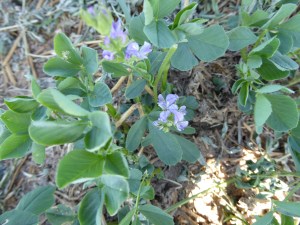
After years of knowing alfalfa only by its summery sweetness in the air, I parked near a freshly mown field and bent down to see its lavender flowers and clovery leaves.

The temperature outside had reached 102° by this time, so when I stopped for gas it seemed the right thing to do, to buy myself a Snapple Kiwi Strawberry drink, hearkening a long ways back to a time when that was the “special” drink that many in our family favored. That disappeared fast.

P1000709

P1000712

And then I came upon the pistachio trees, which I didn’t recognize until I walked through the pale plowed dirt and got close to them, too. I noticed that the orchards were not flooded as nut trees sometimes are, but were irrigated by means of very localized misters.

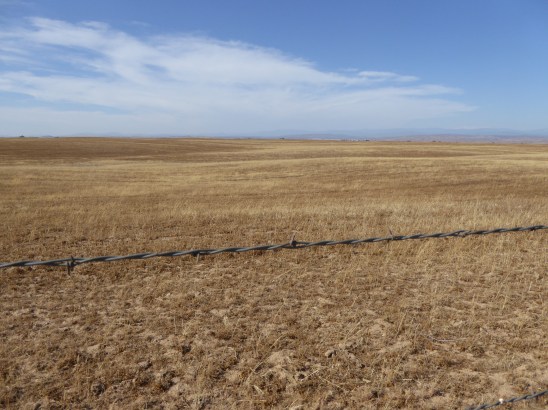
A sign read: “50% of THE FRUITS, VEGETABLES and NUTS of THE NATION ARE GROWN in CALIFORNIA.” But often, directly across the highway from the orchards, would be land like this:
P1000713

P1000720

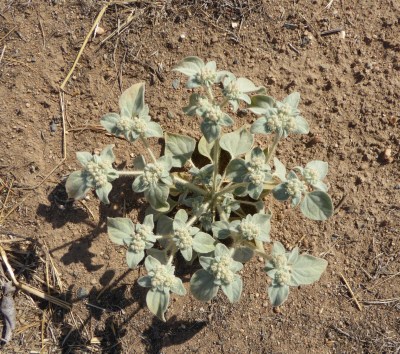
…..and these gray-green weeds and tumbleweeds were common wild plants, showing what the natural state of affairs is in these parts.
P1000687


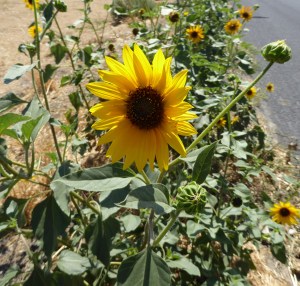
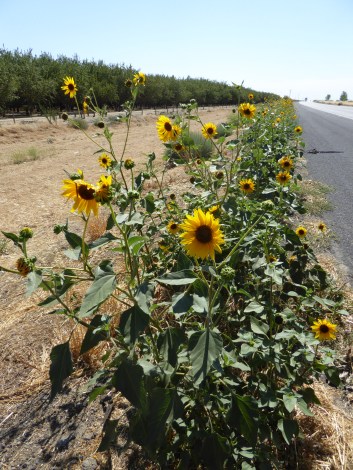
But I think the most common roadside plants are probably not considered weeds at all, because they are wild sunflowers that brighten up long stretches of highway and wave at the traffic whizzing past.

The singer on the country station was asking, “Mama, should I run for President? Mama, should I trust the government?”

When I lost that station I came upon more Christian radio with the blessing, “God be with you till we meet again….,” and you can imagine who was on my mind right then.

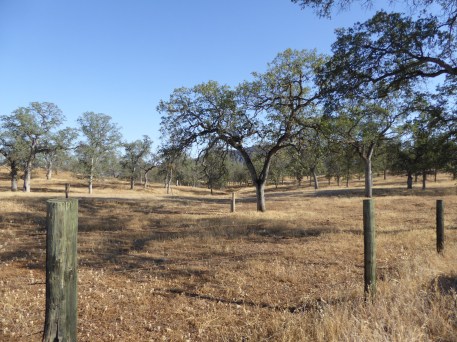
I was just starting to climb into the foothills, where there were oak trees, but no crops. The temperature had dropped to 99°, and I kept the AC on. This area slightly above the hottest parts of the valley like Fresno or Bakersfield is where a lot of people have liked to retreat at 2,000 feet or so above the valley floor. Over the years I many times heard my father wonder at the foolishness (and he used stronger descriptors) of building houses where there is no groundwater in all but the wettest years. I saw houses on hilltops and wondered myself if the occupants were still living there, or if they have to bring all their water in by truck nowadays.

Maybe cattle are grazed here in greener seasons, but all I saw were a few beehives. As the road climbed up toward my destination, pines began to appear. And in this transition zone of the foothills I will break my story in two. The next installment will be: Mountains!P1000739
Hoarding sap and hope.

I’m reading Tuck Everlasting again. Tonight I was grabbed by this paragraph about late summer that could be describing our neighborhood, and much of California and the West:

The pastures, fields, and scrubby groves they crossed were vigorous with bees, and crickets leapt before them as if each step released a spring and flung them up like pebbles. But everything else was motionless, dry as biscuit, on the brink of burning, hoarding final reservoirs of sap, trying to hold out till the rain returned, and Queen Anne’s lace lay dusty on the surface of the meadows like foam on a painted sea.

As you can read and see in the news, in many places we have passed over the brink, with more fires than I can keep track of engulfing towns and forests. We are hoarding hope like sap and holding up our prayers till the rain returns.

P1070677

September Views

This morning I pulled the heavy wooden shades halfway up the window, I was that hungry for the sun. Usually I just adjust the louvers, with the advantage that the dirty window is not much exposed.

bird on rosemary Sept 14

But looking out through the space, I saw five finch-sized birds pecking away at the rosemary, which is in bloom again. I wondered what are they doing? They weren’t hummingbirds, who might drink the nectar. And we don’t have a huge insect infestation on that bush. All but one flew away when I brought out my camera, and this one is not too sharp with the glare coming at me.

P1110308 vegies

See how brown the lawn is? It’s crisp now as well. Almost everyone is letting their lawn die this year; in fact, it might be a rule during drought that a few people are breaking. We do water the rest of the yard as needed, but our tomatoes only need a soaking once a month.

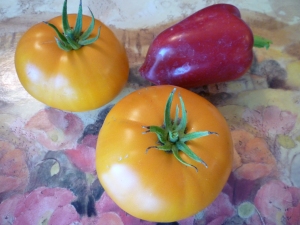
I hope everyone has noticed my restraint in publishing tomato reports. Except for the BLT post, I don’t think I’ve mentioned tomatoes all summer. We do have them, and my favorite this year is the Yellow Brandywine, pictured here with a pimiento.

little girl in church 9-14

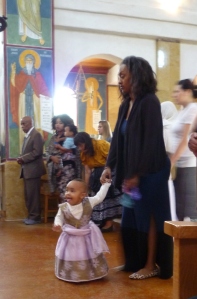
Sunday I took a couple of pictures in church. This little girl in a big dress was just learning to walk. When her mother let go of her hand she sat down and did a little crab walk instead of toddling.


And here is a view looking up into the dome, Christ Pantocrator surrounded by angels, and a little lower down, twelve prophets.


P1100790crp

We are in the middle of a lovely warm week. I haven’t been sleeping well, which makes me lazy. Laziness and summer go together by tradition – but how will I get all those tomatoes picked? Maybe when the weather turns cooler for good, I will become more energetic and productive. But for now I’m glad to have interesting things to look at.

Beauty in Time of Drought

This map drought May 2014 usdm_2014126shows how severe our current drought is, affecting half the nation. The darker areas are the worst, named “Exceptional Drought,” and my part of California is down a notch from that, at “Extreme Drought.” You can see this and  four other instructive maps more clearly here: Five Maps of America’s Massive Drought.

We began several months ago in our household to collect water in buckets in the shower, to use for flushing the toilets. We are also letting our lawn die. I didn’t want a lawn anyway; I’d rather have flowers like these below, which I snapped at the library this morning.

P1100204 P1100209


They are Matilija Poppies (Romneya), and if you have a big space they can be a good fit – so dramatic and graceful. I tried them once but didn’t really have room. They prefer dry soil.

P1100213
love-in-a-mist


I don’t remember what these fun blue flowers are, but they were also decorating the parking lot at the library, obviously part of a planned xeriscape. [Thanks to Jeannette for enlightening me in a comment below.]

Over the years we Glads have emphasized drought-tolerant ornamentals in our landscaping and have collected quite a few. Sweet alyssum and Lamb’s Ears are always ready to sprout up and fill spots where thirstier plants languish, so much so that we are constantly cutting them back so that other less invasive plants like this salvia and California poppies can also thrive. California poppies grow all over the bare golden-brown hills in the summer, where where not a drop of rain falls.

P1010952(2)

As I went looking through my pictures for examples of plants that are good choices for the arid West, I discovered more than I remembered, like aloes, rosemary and lavender.

gr morn glory & aloe 6-07

Even the ground morning glory that grew beneath the manzanita for years required little water. The orange-topped succulent is an Aloe Saponaria.

In the front yard my favorite of these plants that thrive in drought is the pink Mexican Evening Primrose. In the middle of summer it doesn’t need water more than once a month, and it never stops blooming from spring through fall.IMG_5255

And in the back, the prize goes to the Mexican Bush Sage (do you notice a theme here?). It likewise has its long spikes of purple for half the year, and makes me happy by the hummingbirds that love to visit it and that I can watch through the window.

I don’t know what lesson to take from all this beauty. So I guess I’ll just take the beauty. And pray for that sake of all the plants that next winter will bring lots of rain.

IMG_7544