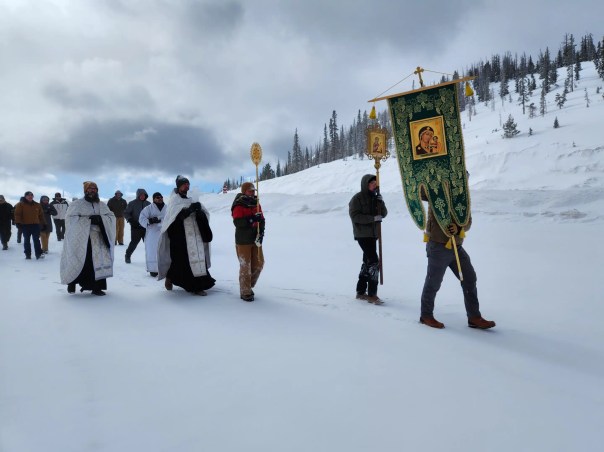
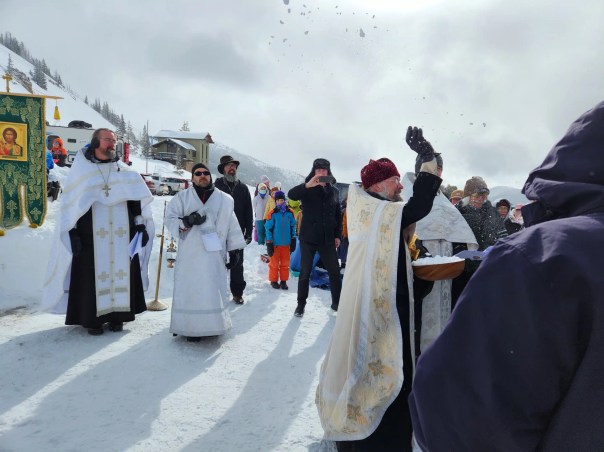
We have come to the Feast of Theophany, when we commemorate Christ’s baptism by John in the Jordan River. On this feast we have the Great Blessing of Water, which often is done outdoors at the ocean or a river or lake. I was interested to see a collection of photos from 2025, of Holy Theophany Church in Colorado Springs, a parish that I happened to visit a few years ago when my son Soldier’s family first moved to that state.
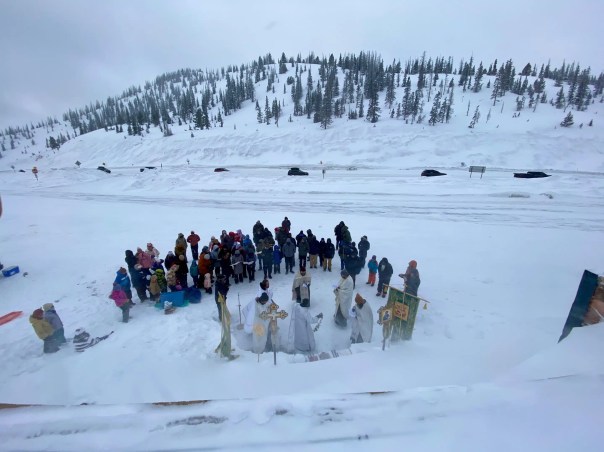
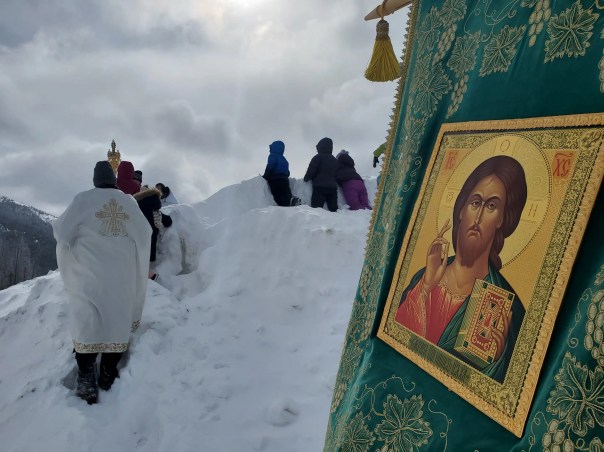
A few hardy members of the congregation trekked up to the crest of the Rocky Mountains, where along the invisible line that is the (hydrological) Continental Divide, or Great Divide, the rivers flow on one side toward the Pacific Ocean, and on the other toward the Atlantic and Arctic Oceans, and to the Gulf of Mexico.
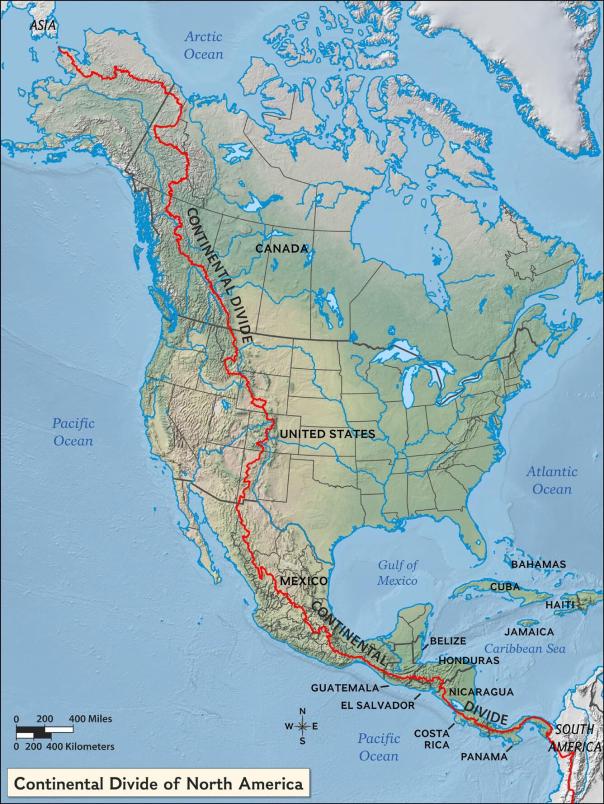
Christ blessed the waters of the entire earth when He was baptized in just one river, and renewed the nature of all of Creation, as one of the hymns below explains. To  whatever extent we participate in His continuation of that blessing, whether we symbolically perform the rite on the water in an urn or lake or a single ocean, the blessing is equally cleansing and renewing.
Still, it is a joy to contemplate the blessing of many waters, so to speak — many, many rivers flowing into many oceans, from that snowy point in the mountains. Why not do this, if you can? It may be for the same reason we baptize by immersion, if we can, and not sprinkling.
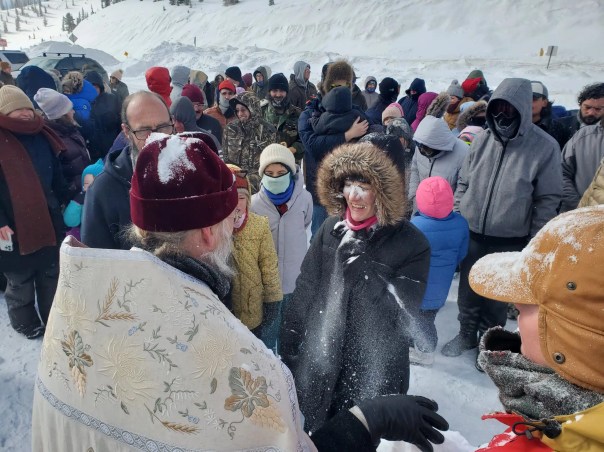
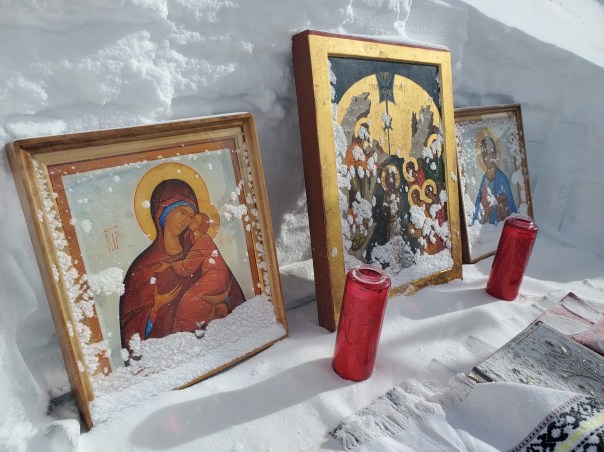
I’ve seen many pictures of holes cut in the ice for this ceremony, but this is the first time I’ve seen its celebration without any liquid H2O at all. Below I will share a few lines from various portions of Orthodox Theophany services, and a few more photos of my brothers and sisters in Colorado.
Thou didst wrap Thyself in the streams of the Jordan,
Who dost clothe Thyself in light as with a garment;
in the waters, O Word of God, Thou didst renew the nature of Adam
broken by wicked disobedience.
Therefore we praise Thee and glorify Thy holy Epiphany.
Jesus, the Source of life,
came to free from condemnation Adam the first-formed man.
As God He needs no cleansing,
yet for the fallen He is cleansed in the Jordan.
In it He brings an end to hostility
and grants peace beyond all comprehension.
Sent from the Father, O most radiant Word,
Thou hast come to dispel the evil darkness of night
and to uproot the sins of mortals,
and to draw up by Thy baptism, O blessed Lord,
radiant children from the streams of the Jordan.
With piety and vigor let us run
to the pure springs of salvation’s stream
and gaze on the Word born of the all-Pure Virgin,
He gives living water to satisfy our holy thirst,
and gently heals the sickness of the world.
The true Light has shone forth granting enlightenment to all.
Though He is beyond all purity, Christ is baptized with us.
He sanctifies the water, and it becomes a cleansing for our souls.
What is seen is earthly, but what is known is above the heavens.
Through washing comes salvation, and through water comes the Spirit.
By descending into the water we ascend to God.
Thy works are wonderful, O Lord, glory to Thee!




 Gladsome Lights