Father Stephen Freeman by his writing has been helping us for a long time, to understand how shame motivates our behavior, both good and bad. There is both healthy shame, which we are “hardwired” with, and toxic shame, which often has unhealthy ramifications down through the generations.
One particular article, “Shame and the Modern Identity,” I’ve wanted to share a link to for some time. In it Fr. Stephen explains how it happens that we start with a necessary form of shame and end up with the painful and crippling emotion of shame.
“We could say that toxic shame, or damaging shame, is the abuse of something that is essential and necessary. That is a useful understanding, and points to just how tricky the acquisition and formation of identity is. It is a razor’s edge and pretty much no one survives the years of its acquisition without a legacy of unwanted shame. The years following that acquisition can often be occupied with the patient work of cleaning up the unwanted bits that shadow our existence. Adults gradually gain a sense of their identity, but very few feel entirely secure about it. ‘Who am I’ can be a haunting question, for example, for someone going through a divorce or a loss of employment. When the props that we have gathered in the establishment of an identity are removed, it’s easy to fall apart.”
If you read the article linked above and still want more, you are in luck. Just last spring Fr. Stephen’s book came out: Face to Face: Knowing God beyond Our Shame. It is good to have much of his wisdom on the subject gathered in one place. Even those of us who aren’t plagued with these emotions ourselves likely know someone who is, and could possibly benefit from more understanding for their sake.
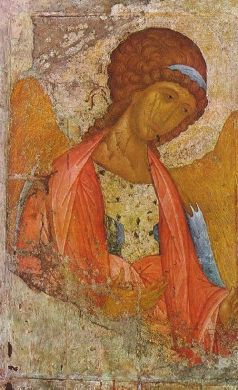 When the Holy Trinity said, “Let there be heaven and earth,” Thou, O Christ, didst serve as a Thought and a Tongue of the divine Trinity. Choirs of angels formed themselves on Thy voice, receiving their form from the multi-colored light; thereupon many armies, as multi-colored clouds, cried out as an echo of the divine glory and divine blessedness, and stood in ranks around Thee, their Leader, singing the triumphal hymn: Alleluia.


 Repentance is not self-flagellation;
 milieu in which Technopoly flourishes is one in which the tie between information and human purpose has been severed, i.e., information appears indiscriminately, directed at no one in particular, in enormous volume and at high speeds, and disconnected from theory, meaning, or purpose.” -Neil Postman in Technopoly
 “Faith is not a matter of ‘belief,’ an act of intellectual willing. Faith is a perception of things that do not necessarily appear obvious. In the language of Scripture – ‘faith is the evidence of things not seen.’ But the perception of faith is similar to the perception of objects beneath the surface of a lake. If the surface is disturbed, the objects disappear. The objects do not go away – but we can no longer perceive them.