Tag Archives: G.K. Chesterton

Closest to the child comes the woman.

I’ve long been familiar with the thing that G.K. Chesterton is reported to have said, that if a thing is worth doing, it is worth doing poorly… “While you practice” was the explanatory clause to tack on if necessary; but it doesn’t seem to me likely that Chesterton would have added it. Because it makes a false distinction between the present and some future time, assumed to be qualitatively different… But who decides if you’re doing the thing for real or just practicing?

My son’s Suzuki violin teacher used to beg us not to use the word practice at all. She would ask her students, “Did you play your violin every day?” and we parents were supposed to speak after the same fashion. Even if no one saw evidence of improvement in musicianship on a given day, we were all  encouraged to be satisfied nonetheless, because “You played. That’s good.”
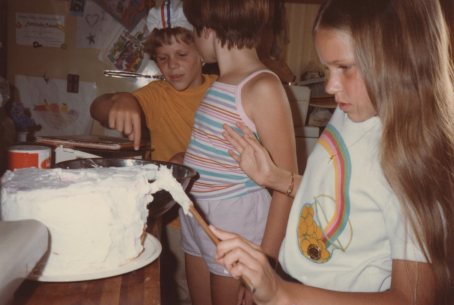
What Chesterton did say, which is included in the whole article linked at bottom, is that “Somebody must renounce all specialist conquests, that she may conquer all the conquerors.” He calls the uproarious amateurishness of the universe “true sanity,” which sounds good, because it’s essentially how I myself approach life.

His hearty approval of what he sees as the way of women confirms to me that G.K. and I have the same personality style. But I’m not sure all of us women are alike in this… Do you think that some women actually prefer to be more focused, or specialized, in their pursuits? To the women reading this, I wonder if you feel that his statements below ring true of you. Chesterton has a very high opinion of the female sex, but how many women did he really know that well?

“There was a time when you and I and all of us were all very close to God; so that even now the color of a pebble (or a paint), the smell of a flower (or a firework), comes to our hearts with a kind of authority and certainty; as if they were fragments of a muddled message, or features of a forgotten face. To pour that fiery simplicity upon the whole of life is the only real aim of education; and closest to the child comes the woman—she understands. To say what she understands is beyond me; save only this, that it is not a solemnity. Rather it is a towering levity, an uproarious amateurishness of the universe, such as we felt when we were little, and would as soon sing as garden, as soon paint as run.

“To smatter the tongues of men and angels, to dabble in the dreadful sciences, to juggle with pillars and pyramids and toss up the planets like balls, this is that inner audacity and indifference which the human soul, like a conjurer catching oranges, must keep up forever. This is that insanely frivolous thing we call sanity. And the elegant female, drooping her ringlets over her water-colors, knew it and acted on it. She was juggling with frantic and flaming suns. She was maintaining the bold equilibrium of inferiorities which is the most mysterious of superiorities and perhaps the most unattainable. She was maintaining the prime truth of woman, the universal mother: that if a thing is worth doing, it is worth doing badly.”

— G.K. Chesterton, from What’s Wrong with the World, the chapter on “Folly and Female Education.” 

Notable birthdays of May 29th.

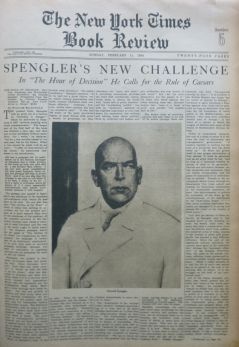
I frequently look in on Garrison Keillor’s The Writer’s Almanac, but rarely do I find every item from his column interesting, as I did today. Today is a reprint of what was in the column in 2017. Of course, it being the birthday of G.K. Chesterton, I wanted to read what Keillor might say about that favorite writer of mine. But Bob Hope and Oswald Spengler were also born on the 29th of May. Spengler studied the history of civilizations, and published the book The Decline of the West in 1918.

A quote from Christopher Hitchens is included in this piece, which I found quite a contrast to the legacies of the other three men; it made me feel sorry for him.

Keillor leads off with the poem, “A Dream of the Future,” by Joyce Sutphen, which I think ties in nicely with the subject of Spengler’s thesis about the “blossoming and withering” of cultures over time.

If any of this piques your interest, check out The Writer’s Almanac.

The very smallness of children.

“The essential rectitude of our view of children lies in the fact that we feel them and their ways to be supernatural while, for some mysterious reason, we do not feel ourselves or our own ways to be supernatural. The very smallness of children makes it possible to regard them as marvels; we seem to be dealing with a new race, only to be seen through a microscope.

I doubt if anyone of any tenderness or imagination can see the hand of a child and not be a little frightened of it. It is awful to think of the essential human energy moving so tiny a thing; it is like imagining that human nature could live in the wing of a butterfly or the leaf of a tree. When we look upon lives so human and yet so small, we feel as if we ourselves were enlarged to an embarrassing bigness of stature. We feel the same kind of obligation to these creatures that a deity might feel if he had created something that he could not understand.” 

-G.K. Chesterton 

We always seem to have a baby or two in our parish at any given time, but in the last couple of years we have lots. It’s a joy to see them growing up through their first year: First they come in a sling or pack on their mother’s chest. After a while, they are sort of “free floating,” carried about by their godparents or friends for admiration and greeting. In Orthodox churches it’s traditional to stand during services, and in my parish we have no pews, so babies often crawl or sit on the floor looking up and around at the tall people; older children like to sit down beside them and engage in silent conversations with their eyes.

Then, surprise — one Sunday the baby will be up on its feet and toddling, and his father probably is following at a short distance, to make sure he doesn’t toddle right up into the altar. My goddaughter Mary, who was born just before my husband died, is now a big girl, and it’s been a while since I could carry her. These days we sometimes go about hand in hand, which is good, because if it came to a chase I would lose that race.

Today during Divine Liturgy I was happy to notice for a few minutes a particular child who has the most beautiful face I have ever seen on a baby. Her temperament, by all accounts, and by what I have seen, is serene. She toddled very near me as I stood near the north wall, and I bent down to whisper “Good morning.”  Later after plopping on the floor by her grandmother’s feet, she turned around and gave me a little wave with her tiny hand.

Sowing in late winter…

…or is it early spring?

The best time to plant some of these seeds would have been two or three weeks ago, but I was otherwise busy on the mild days, and when the weather turned colder I wimped out. But this week, at the end of a day when the sun was shining and my hands didn’t hurt from the cold, I was able to organize my thoughts and my packets enough to get some seeds into the ground. The rain has returned, blessed be God, and has watered them thoroughly.

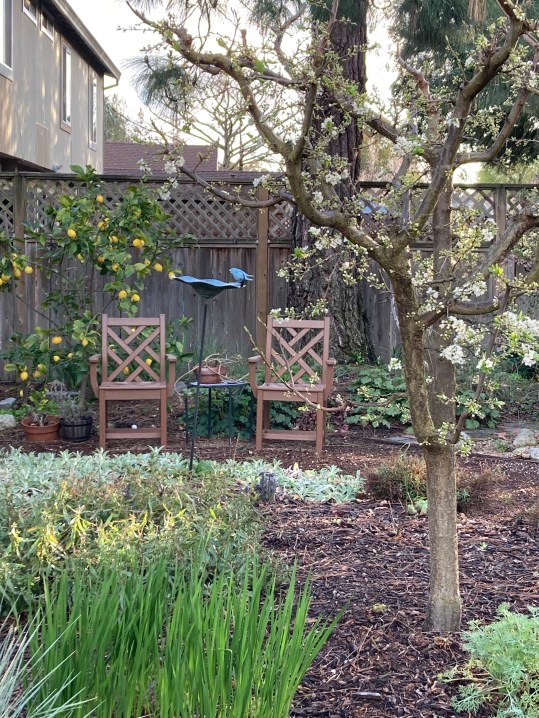
Calendula plants and stock are growing in a couple of places in the garden; after the hardest winter battering, the stock are covered with little flower buds. The lemon tree having been pruned to a less gangly form, it’s showing off its dozens of fruits to better effect. I love the two plum trees! If they never produced another plum, I’d still count them well worth having, for the way their blossoms brighten these cloudy days and remind me that every hour brings us closer to summer.

Working in the garden through only the late afternoon made me incredibly happy. When I came in the house I could only pray “Thank you, thank you, thank you!”

It’s been quite a week, indescribable for the most part, at least, in the way I would prefer to write about things. My report must be vague: The days have been full of friends, those Lenten services that are characterized by bright sadness, and the mercies of God new every morning. Mostly I came here to write about my garden that He uses to bestow on me His also indescribable gifts…

Here ends another day, during which I have had eyes, ears, hands
and the great world around me. Tomorrow begins another day. Why am I allowed two?

-G.K. Chesterton