Tag Archives: gluten-free

Homey doings in early spring.

This month I had two occasions when friends visited me for one or two nights, two different friends each time. It was fun to have people to cook for. About an hour before the first pair of guests were to arrive I found out that one of them couldn’t eat the bread I had planned to serve with soup, because of gluten intolerance. I have just enough time to make muffins, I thought, using Bob’s Red Mill gluten-free flour again. I mixed up the wet ingredients, and then — could not find that flour anywhere.

Though I rarely bake anymore, I have a dozen sorts of flours in a refrigerator in the garage. I rummaged through those and decided to use one cup of cassava flour and one cup of buckwheat flour. The latter was the sort one would use for buckwheat pancakes, that is, from roasted groats. Some people don’t like that flavor, so I was taking a chance that my guests would.
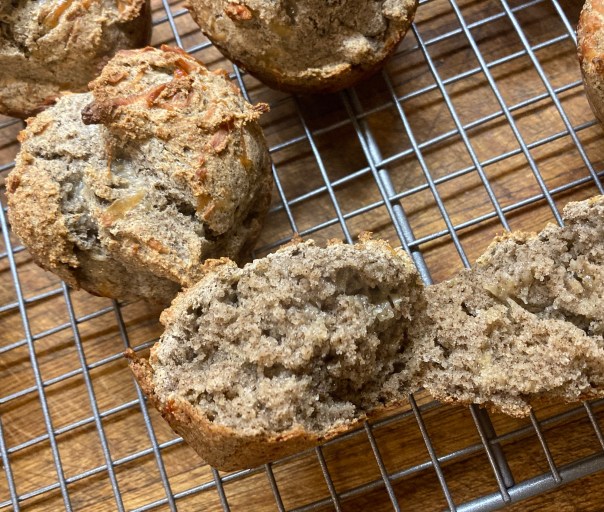
The muffins turned out very nice, we all thought. But the cassava flour is a little heavy, and I think if I try this again, I’ll use more buckwheat and less cassava. That very evening I discovered the missing flour, in the wrong refrigerator.

The last time I made pancakes I did not use buckwheat flour, but I did use this beautiful batter bowl that I received as a Christmas gift. It holds an amount of batter that is just right for one person, and its presence on my kitchen counter has encouraged me to make pancakes for just myself, for the first time ever.

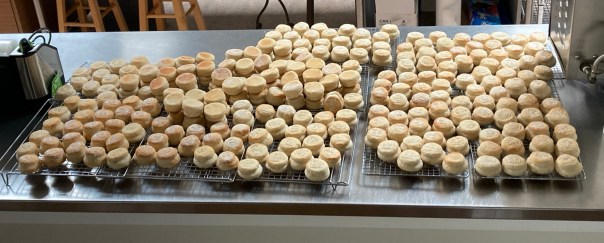
Another type of bread I helped to bake recently was the little prosphora that our parish uses as one type of altar bread at Divine Liturgy. That day we only made these small ones, and two people prepared dough. One of the dough makers used more flour than usual, and we ended up with a record number of prosphora — so while they were cooling I took their picture:
Lent is coming right up — for us Orthodox it begins on Monday. Many people I know like to choose some “spiritual reading” for Lent, and I have done that many times. Our women’s book group has often chosen a book to read together and discuss after Pascha. But this year we didn’t; we still haven’t discussed the last book we chose, to read during Advent.

At one point I thought I would read The Seer: The Life of the Prophet Samuel and its Relevance Today during this season. And then I looked around my house and noticed so many other worthy titles. Maybe I would cast lots among these below, and let God decide for me:

But the finality of that action frightened me. It’s not likely that I will finish any of these big books during Lent anyway, because I always seem to use any extra time to attend the lovely Lenten services at church. So in the end I decided to read (from) all of them, and I’ve stacked them up next to my reading chairs as my Lenten Library; my plan is to read at least a little from one or two of them every day. Being goal-oriented does not come naturally!
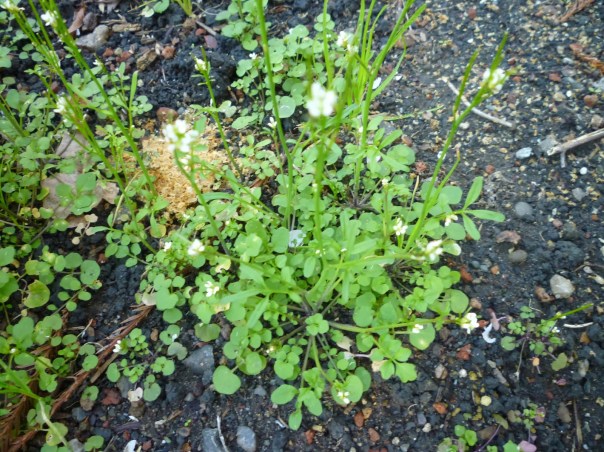
hairy bittercress

The last couple of days have been sunny at times, and the weeds in the garden are getting my attention, as they grow like weeds in springtime. So I got out there and pulled a bunch. I try to keep a thick layer of mulch on my garden to prevent weeds, but I guess I got behind in adding to that layer. I’m hoping to do that this week.

The anemones and crocuses that I planted at the end of November are starting to bloom, and the muscari and daffodils are showing leaves; obviously so late in the fall was not optimal for getting them in the ground. One reason I got busy weeding was to make sure they won’t be hindered from lifting their pretty faces to the sun. Of course, it’s good for me to do that with my own face when I get the chance, and I trust that will be the case more and more as springtime unfolds, in the earth and the air, and in these anemones.

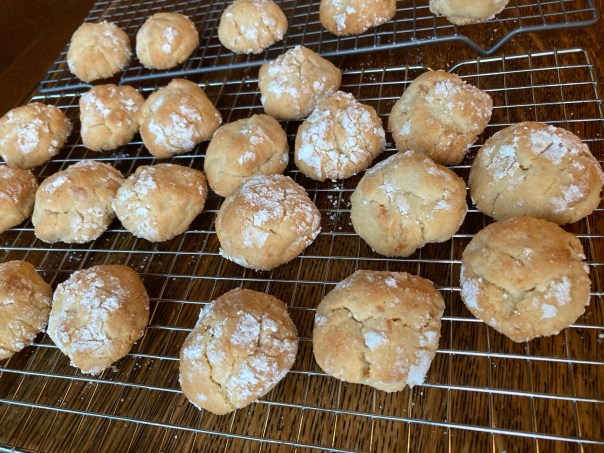
The Julian Christmas cookies are my favorite.

Many of us have completed the Twelve Days of Christmas, but I haven’t finished telling about all my activities connected to the Nativity Feast. My fellow Orthodox Christians who are on the traditional Julian calendar have just begun to count the days, however, so if we keep them in mind it won’t seem strange to muse a while longer on Christmas cookies. Plus, they are only Christmas cookies because I bake them at Christmas; you could enjoy them at any season of the year.

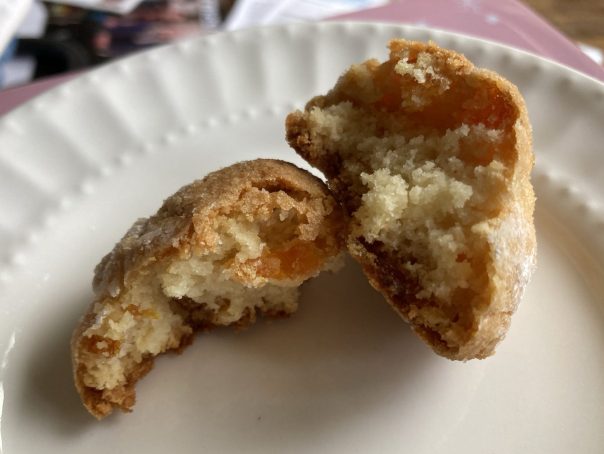
These are my favorite because of their chewy texture, the flavors of citrus and almond, and because my friends and family who are gluten-intolerant can fully enjoy them.

Last year I made two batches of this invention, but I wasn’t completely settled on the amounts of a couple of the ingredients. This time I made only one batch (so far), but after my latest tweaks I’m confident that if you try them, you are likely to be happy with the result. There are no grain flours in the recipe, so they are gluten-free.

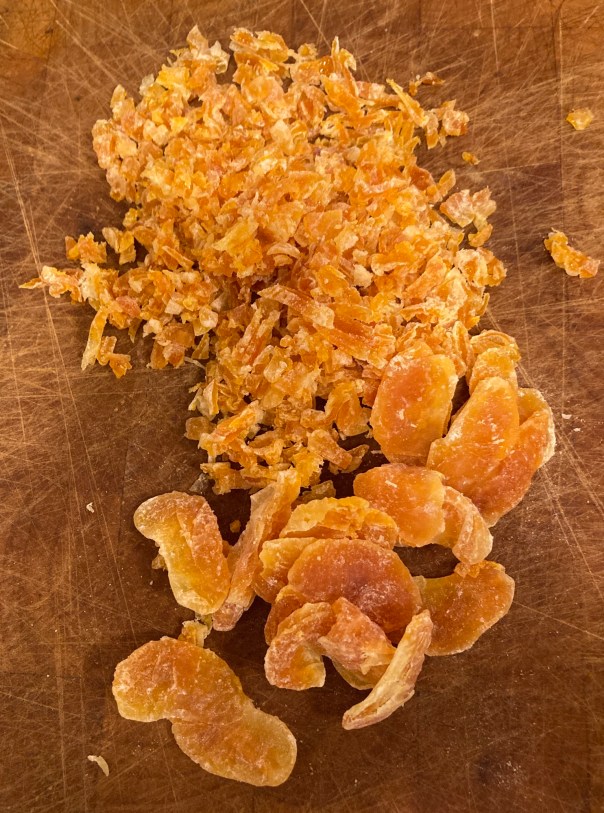
Dried (sweetened) mandarin oranges

MANDARIN ALMOND COOKIES

7 oz. almond paste, in pieces
4 oz. cold butter, salted or not
1/3 cup sugar
1/3 cup powdered sugar
scant 1/4 teaspoon salt

Combine the above ingredients in a food processor until evenly mixed. Add and process:

4 large egg whites, one at a time.

Remove from processor to a bowl and add:

2 3/4 cups finely ground almond flour
6 oz. package of dried mandarin oranges (found at Trader Joe’s), finely chopped

Put the dough in the refrigerator for an hour.

Put 1/2 cup granulated sugar in one bowl, and
1/2 cup powdered sugar in another bowl.

Drop heaping tablespoonsful of dough into the sugar; gently coat and shape into 1 1/2″ balls. Repeat in powdered sugar.

Set 1 inch apart on parchment-lined baking sheets. Bake until golden or golden brown, at 325 degrees, 22-25 minutes. Remove to racks to cool. Cookies will be crumbly until thoroughly cool. They keep well in the refrigerator or freezer.

The amount of sugar here is a reduction from my original experiment, and I might try cutting back a little more next time, hoping that the chewiness of the cookie won’t be affected too much. The recipe that inspired me was an Italian Orange Fig Cookie that my son had made in 2022. I tried that last year with disappointing results, and created this one instead because I had the mandarin oranges on hand. I hope Trader Joe’s continues to carry that item!

Pão de Queijo

It’s Cheesefare Week, a.k.a. Butter Week, for Orthodox Christians, this week before Lent. That prompts me to post this recipe again, for Brazilian Cheese Rolls. Maybe you have found them in the freezer aisle of Trader Joe’s or elsewhere in recent years, but they are easy to make at home. They are full of eggs and cheese, and gluten-free, because the starchy component is tapioca flour. I am fond of the mochi texture, and will likely enjoy a few this week.

I’ve copied below what I found on the website years ago, and also linked to the site, where the author shares some of the culture behind the eating of these rolls in Brazil, where they are very popular, to put it mildly, and often eaten for breakfast. The pictures are of my own results.

Pão de Queijo

There seems to be widespread consensus that these are quite tricky to make, but I didn’t find this to be the case. One thing I would recommend is to measure the tapioca starch by weight if you can, which is infinitely more reliable than by volume. If you do measure by volume, note that I use the lightly-aerate-then-scoop-and-level method. In the recipe I’ve given some clues as to the texture you’re aiming for in the dough – the important thing to note is that it should not actually be firm enough to make balls, but rather soft, misshapen little mounds. If you’re worried, you can always test-bake a couple to see if they puff up like they should. As for the tapioca starch/flour, you should be able to locate some in an Asian or other ethnic market (where you might find it under the names yuca, manioc, cassava or polvilho azedo/doce, any one of which will fit the bill), or any place that stocks gluten-free baking supplies.

yield: 20-30 rolls, depending on size
source: adapted from Valentina and other online sources

4 cups (500g) tapioca starch (aka polvilho, yuca, manioc or cassava flour/starch), plus more if needed
1 1/2 teaspoons salt
1 1/2 cups (375ml) milk
1/2 cup (115g/125ml) unsalted butter or vegetable oil (oil is traditional, butter gives more flavor)
2 eggs, at room temperature
7oz (200g) finely-grated parmesan cheese

In the bowl of your heavy-duty stand mixer* combine the salt and tapioca starch. In a saucepan combine the milk and butter and bring to a boil, stirring occasionally to prevent scorching. Fit your mixer with the paddle attachment, turn on medium-low, and begin drizzling in the hot milk mixture. At first it will all clump up, but keep drizzling in, stopping and scraping down the bowl and paddle as necessary, until it comes together and forms a smooth, thick, gluey dough. Beat for a minute or two, then turn the mixer off, cover the bowl with a cloth and let rest for 15 minutes, or until just warm to the touch.

Preheat the oven to 425F/210C. When the dough has cooled down a bit, turn the mixer to medium speed and add the eggs one by one. When they are completely incorporated add the cheese and mix for another minute. The dough should have a sticky, stretchy consistency somewhat like spent chewing gum (but a little softer). It shouldn’t be firm enough to roll into balls, but it should be firm enough to hold its shape on a spoon. Add a bit more starch or a splash more milk if needed.

Line two large baking sheets with parchment paper. Using a well-greased spoon (or a couple of spoons, or a spoon and your hands – whatever works), drop mounds of dough about the size of unshelled walnuts onto the sheets, spacing them at least an inch (2.5cm) apart. Don’t worry if they are not perfectly shaped, or if the surfaces are not smooth – in the heat of the oven the irregularities will melt away. Bake them for about 20-25 minutes, rotating the baking sheets halfway, until they’ve puffed up nicely and are golden brown in spots. Remove immediately to cooling racks and allow them to cool slightly before eating. The recipes say to enjoy them warm, but I liked them at room temperature as well – the texture is slightly different but still very good.

(*I don’t think I’d trust a handheld mixer to confront this sticky, viscous dough and survive, but it can be mixed by hand in a large bowl with a sturdy spoon – just be prepared for a good workout!)

https://travelerslunchbox.com/2007/02/04/list-making-for-dummies/

Brownies prompt a question.

I was searching for a different recipe when I ran across this one for brownies, which I decided to take to a potluck last week. In reading the comments on the recipe, on the New York Times cooking site, I came upon the question of whether one could use “regular” cocoa powder instead of cacao in this recipe. Because the spelling is so similar, I hadn’t even noticed that the recipe called for cacao. Cocoa is what I always keep in my cupboard, so I needed to know.
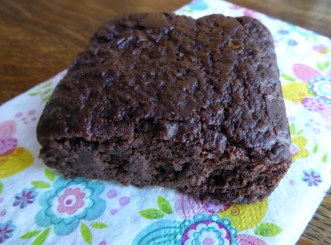
The question wasn’t answered definitively enough for me, and I soon found a long discussion of cocoa vs. cacao on a different site, comments long ago closed. Most of the chefs and cooks on that site said there was no real difference besides the spelling, though a few insisted otherwise. My take is that at least some brands of “natural cacao powder” likely retain more nutrients than cocoa. Everyone did agree that you don’t want “Dutch process” cocoa because that is used to make poor quality cacao beans saleable.

When I went to the pantry for my cocoa powder, I saw that it was cacao powder after all, a big bag I’d bought at Costco without wondering why they were using that spelling. So I didn’t have to substitute that ingredient. If I’d had both cacao and cocoa on hand, I’d have baked one pan with each ingredient, for taste-testing purposes. Maybe next time.

I loved these brownies. They seemed very rich in spite of having no butter or eggs. I ate one and a half, and felt buzzed by them, they were so chocolatey. But I slept well that night anyway.

MEXICAN BROWNIES

Vegan and gluten/grain-free; adapted from the NYT recipe which was adapted from Julie Piatt.

3 Tablespoons/14 grams ground flaxseed
6 tablespoons water
Coconut oil, for greasing pan
¾ cup chickpea flour (besan)
½ cup cacao powder
½ cup tapioca flour
1 teaspoon cinnamon
1 teaspoon mild chili powder
¾ teaspoon xanthan gum
½ teaspoon salt
¼ teaspoon baking soda
1 cup almond meal
1 1/3 cups sugar
8 oz. Earth Balance vegan butter, softened
½ cup unsweetened almond milk
1 teaspoon vanilla extract
5 oz. dark chocolate chips
1 ½ oz unsweetened chocolate
3 tablespoons olive oil

1) In a small bowl, whisk together the flaxseed and water until mixture has an egg-like consistency. Set aside.

2) Heat oven to 350 degrees. Lightly oil the bottom and sides of a 9-inch square pan, and line the bottom of the pan with parchment paper. Set aside.

3) In a large bowl, sift together the chickpea flour, cacao powder, tapioca flour, cinnamon, chili powder, xanthan gum, salt and baking soda. Add almond meal and stir until fully incorporated.

4) In a double boiler or in the microwave melt the unsweetened chocolate and stir until smooth. Set aside to cool.

5) Whisk the flaxseed “egg” again, then put in the bowl of a stand mixer along with the sugar, vegan butter, almond milk and vanilla. Stir on low. Gradually increase speed to medium-high and continue beating until mixture is fully combined and mostly smooth, 5-7 minutes. Add the melted chocolate and olive oil and beat for 15 seconds.

6) Add the wet ingredients to the dry ingredients and fold with a rubber spatula until fully combined and streak-free. The batter should be thick and gooey. Add additional almond milk if it seems too dry. Fold about half of the chocolate chips into the batter, then spread it in the prepared pan. Sprinkle the top with the remaining chocolate chips.

7) Bake until a toothpick inserted in the center of the brownies comes out mostly clean, 50-60 minutes.

The NYT recipe had more chocolate bar and chocolate chips. I added the olive oil to make up for the missing fat. I used unsweetened chocolate instead of a dark chocolate bar so I increased the sugar a tiny bit.

I doubled the recipe and baked it in a 9×13 Pyrex pan, which made for tall brownies and probably necessitated the full hour of baking.

For those interested generally in vegan cakes and brownies, this recipe, Chocolate Carrot Cake, is vegan, and has been accidentally, and then later intentionally, made into brownies. The brownie-eaters could not believe they were vegan. They are easier to make than the Mexican Brownies here in this post, but I like better the texture and complex flavors of the more involved recipe, the chili and cinnamon, almond and vanilla. Let me know if you try one or the other.

The Accidental Carrot Cake Brownie