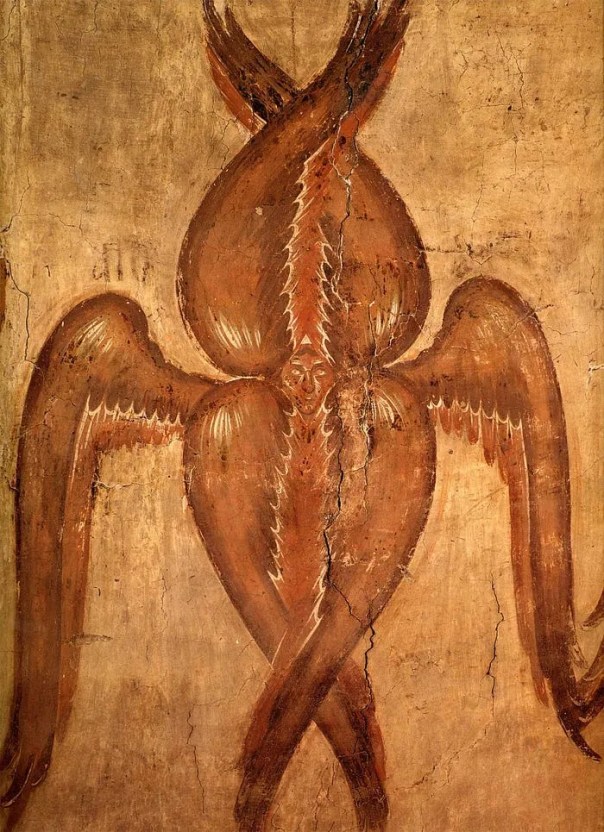
Seraph – Fresco by Theophanes the Greek, 14th century
From the Akathist to Jesus Conqueror of Death, composed by St. Nikolai Velimirovich on Pascha 1923 — Kontakion Nine, “The Choir of Seraphim”:
“We are the first light of Thy light and the first song of Thy voice; all the angels’ tongues together cannot express the glory and light of the seraphim, just as we seraphim cannot express Thy glory and radiance, Thou only begotten One, Beloved of the Father and the Holy Spirit. Among seraphim Thou art Seraph, among cherubim Thou art Cherub, among angels Thou art Angel, among men Thou art Man. Thou art all in all; and since Thou art all in all, Thou art servant of all and Lord of all; therefore, we who rule countless worlds below us serve in humility amid the unburning flame of the Divinity of the Trinity, carrying Thy love downward to Thy creature and the love of the creatures upward to Thee, singing the triumphant hymn: Alleluia.”
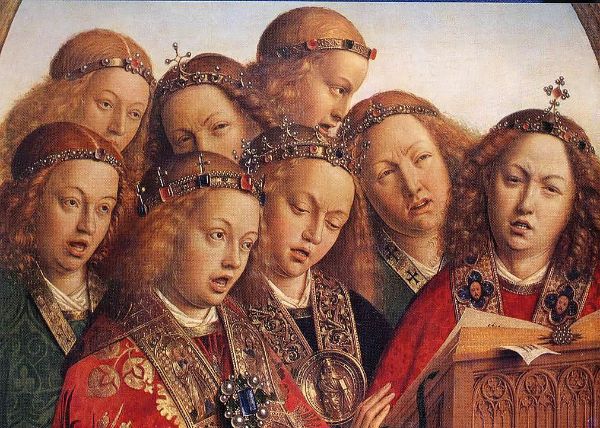
Last year for the Feast of Archangel Michael and the Other Bodiless Powers, I shared the songs that St. Nikolai gives to the Angels and Archangels. But I’m not sure I’ve posted a link to this article before: “The Divinely-Revealed Appearance of Angels in Icons.” It is so full of the mystery and glory of angels, as they reveal God’s great love toward us, that my heart was near to bursting from considering a small part of it.
This is a good day to join with cherubim, seraphim,
and all the ranks of angels as they sing
praises to the Holy Trinity.
More than two years ago I began to engage with Timothy Patitsas’s bookThe Ethics of Beauty. It’s an inconvenient book because of its unwieldiness, and I didn’t get very far into it until this summer, when I determined to read it on a regular basis, with its weight resting on my kitchen table and I hefting only a cup of tea.
Just in time for my trip earlier this month and the necessary sitting on airplanes, I discovered that the book is now on Kindle, Hallelujah! By the time I returned home I had made my way through 31% of its 729 pages, to page 224, in the middle of the chapter titled “Shame and Sacrifice.” I will start sharing my gleanings on that theme.
Father Stephen Freeman has written many times on his blog about shame, and until now I hadn’t read about it elsewhere. I particularly appreciated his explaining the toxic shame that cripples so many people in the modern world. In the last couple of years he’s written about healthy shame, too, as in the article “Can Shame Ever Be Healthy?” He credits the author John Bradshaw and his book Healing the Shame That Binds Us for clarifying the difference between the two, in an era when many people don’t want to acknowledge such a thing as the healthy version. But they are ignoring the science, according to Fr. Stephen:
“We are hard-wired for a response (one of the nine identified neuro-biological affects) that is accurately described as ‘shame.’ It is not a product of culture. It is universal, timeless, and biological. It can be compared to other effects such as the ‘surprise-startle’ effect, or the ‘distress-anguish’ effect, or the ‘interest-excitement’ effect. The ‘mechanism’ of the shame experience, whether toxic or healthy, is the same, differing only in its intensity and the issues that surround and embed themselves as complex, emotional triggers.”
Patitsas likewise sees the tendency of modern therapy to disbelieve in healthy shame, because:
“…it is so busy promoting self-regard and, ultimately, self-love, that it can’t possibly also teach us to look to the source of healthy shame outside ourselves. To replace the wrong kind of shame in us with the pure quality of shame, soul therapy must bring us face to face both with God and with other human beings who’ve seen what we’ve seen and yet have done better than us – that would be, in one person, Jesus Christ. Or, if you like, God and the saints…. Healthy shame is a fruit of deep organic processes; it is the glory upon the face of Moses when he descends from Mt. Sinai.”
It is interesting to put the insights of these two paragraphs together and begin to understand that to deal with our neurobiology and psyche, trying to create self-esteem without any reference to our Creator and Savior is a dead end, an unworthy goal. Yes, the inner man is essential, but the true self is only revealed by the Kingdom of God within, after “deep organic processes.”
To replace toxic or unhealthy shame with healthy shame, Patitsas continues,
“…we must also see Christ crucified, or else we will never overcome our false ideas about what is and isn’t shameful. Without seeing ‘the King of Glory’ hanging from the cross, a person will never be able to understand those times when accepting to be shamed by others is a necessary part of receiving God’s glory.”
Fr. Stephen points out a scriptural reference to shame that lines up with this, from Sirach 4:21:
“For there is a shame that leads to sin, and there is a shame that is glory and grace.”
May the Lord strengthen us in the latter direction!
Icons of Mary with Christ seated on her lap are venerated in the sacramental churches of East and West, Orthodox and Catholic, and have their commemoration days just as saints do. I’m most familiar with the Orthodox tradition, and how these days are scattered liberally throughout our liturgical calendar. Today I was at Divine Liturgy in the morning, but we were remembering various other saints and events in my parish, and I didn’t notice until I was home again that today we also commemorate the Smolensk Icon of the Mother of God.
I would never have foreseen, fifteen years ago, that I would have favorites among icons of this subject, but it happens; this version is possibly my favorite of all because for ten years or more it was the only one I had in my house. My humble print resembles this one:
Icon Reader tells us that “It is known as “directress” (in Greek Hodigitria) because the Mother of God is shown directing our gaze to Jesus Christ with her hand. This style predates the Smolensk icon, and is one of the original ‘types’ traced back in Church tradition to St Luke.”
The tradition is that the first icon thus depicting Mary and Jesus originated in Antioch, and went from there to Jerusalem, then Constantinople, where it remained until, “In 1046, Byzantine Emperor Constantine IX Monomachos gave his daughter, Anna, in marriage to Prince Vsevolod Yaroslavich, the son of Yaroslav the Wise. He used this icon to bless her on her journey.” And there it stayed in Kievan Rus’.
Many, many versions have been painted based on this style, and even the Black Madonna of Czestochowa in Poland, in its less innovative versions, can be seen to contain the same elements:
It seems that Orthodox Christians in Ukraine and Belarus are also fond of the Black Madonna version of this icon, as well as sharing a love with Russians of the style generally. One of the icons in this article from 2014 is a Smolensk icon of Mary: “Weeping Icons of Ukraine and Russia.”
While Icon Reader has reservations about the meaning of these tears, he was able to affirm one clear word from the news reports that surely still stands:
“What is certain is [the] tears of the Mother of God
speak directly to the heart of every Orthodox believer,
calling all to repentance, amendment of life and return
to Orthodox faith and tradition in their fullness.”
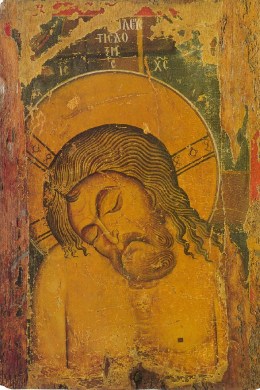
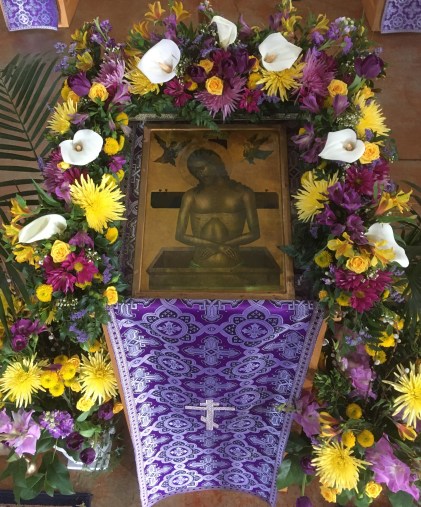
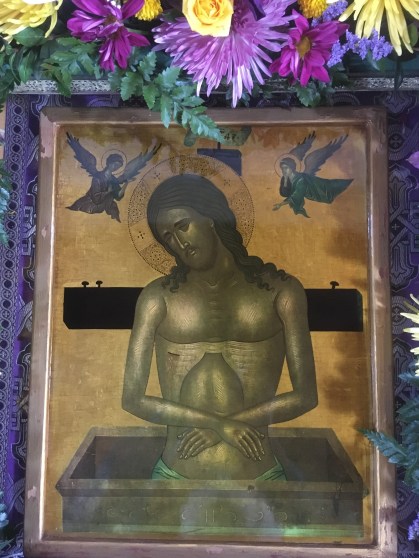
While I was at church between services today, a fellow parishioner, George, came with his little truck and removed all the palm branches from yesterday’s feast. Now we have this icon of Christ, “Extreme Humility,” lavishly adorned in the middle of the church:
Icon Reader shares an explanatory quote about the icon:
“At the arrival of unjust persecution, bow your head. At the jeers of false accusations, cross your arms over your heart, whether physically or interiorly, and gratefully receive what is spitefully offered. And when faced with the question, ‘How far, how far do I tolerate this shame, this injustice,’ remember that the answer is the grave. This is what the icon labels ‘Extreme Humility,’ and it is humility that we must strive to emulate each day.”
-Hieromonk Irenaeus
One of the Old Testament readings for this day is from the first chapter of Exodus, the story of how, generations after Joseph, the Israelites as a people group grew large and strong, and the current Pharaoh began to feel threatened and to oppress them. Here is one little story within that story:
“And the king of Egypt spake to the Hebrew midwives, of which the name of the one was Shiphrah, and the name of the other Puah:
“And he said, When ye do the office of a midwife to the Hebrew women, and see them upon the stools; if it be a son, then ye shall kill him: but if it be a daughter, then she shall live. But the midwives feared God, and did not as the king of Egypt commanded them, but saved the men children alive. And the king of Egypt called for the midwives, and said untothem, Why have ye done this thing, and have saved the men children alive?
“And the midwives said unto Pharaoh, Because the Hebrew women are not as the Egyptian women; for they are lively, and aredelivered ere the midwives come in unto them. Therefore God dealt well with the midwives: and the people multiplied, and waxed very mighty.”
 It is interesting to put the insights of these two paragraphs together and begin to understand that to deal with our neurobiology and psyche, trying to create self-esteem without any reference to our Creator and Savior is a dead end, an unworthy goal. Yes, the inner man is essential, but the true self is only revealed by the Kingdom of God within, after “deep organic processes.”
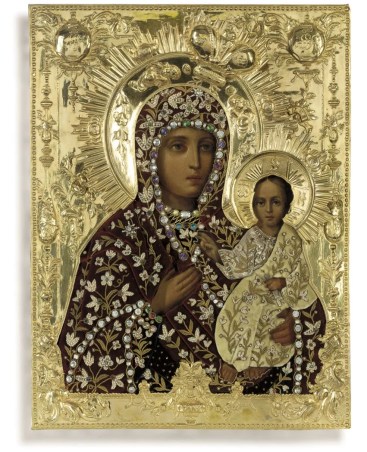 Icons of Mary with Christ seated on her lap are venerated in the sacramental churches of East and West, Orthodox and Catholic, and have their commemoration days just as saints do. I’m most familiar with the Orthodox tradition, and how these days are scattered liberally throughout our liturgical calendar. Today I was at Divine Liturgy in the morning, but we were remembering various other saints and events in my parish, and I didn’t notice until I was home again that today we also commemorate the Smolensk Icon of the Mother of God.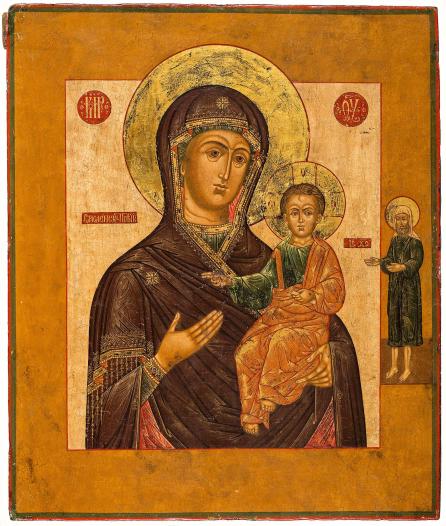


 Gladsome Lights