They stand in parks and graveyards and gardens. Some of them are taller than department stores, yet they do not draw attention to themselves.
You will be fitting a heated towel rail one day and see, through the louvre window, a shoal of olive-green fish changing direction in the air that swims above the little gardens.
Or you will wake at your aunt’s cottage, your sleep broken by a coal train on the empty hill as the oaks roar in the wind off the channel.
Your kindness to animals, your skill at the clarinet, these are accidental things. We lost this game a long way back. Look at you. You’re reading poetry. Outside the spring air is thick with the seeds of their children.
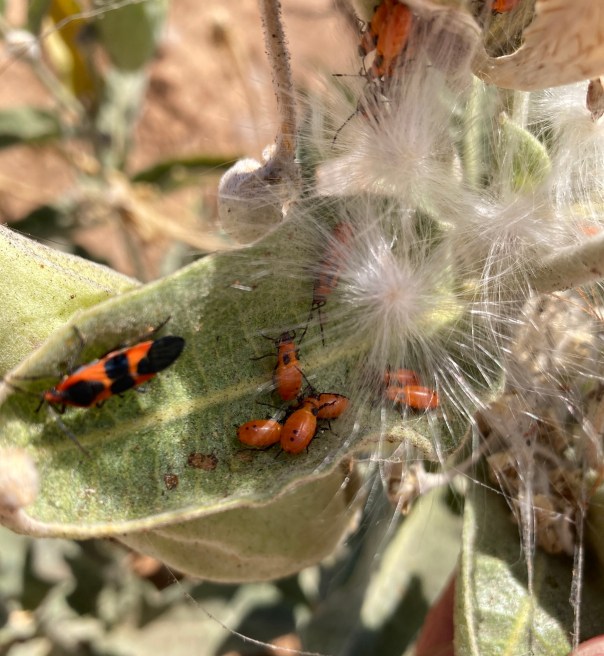
When I drove up into the mountains this month, it was through the area burned by the Creek Fire in 2020. The year following that devastation I’d also passed that way and shared a picture or two here. This time, four years later, I mostly noticed a couple of the plants that are thriving in the changed landscape. Along the road scores of milkweeds were lined up, and lots of young oak trees. I didn’t manage to take a picture of a little oak, but I got close enough to the milkweeds to see two kinds of bright insects on them.
The oaks in this case were the daughters of acorns that sprouted soon after the tall canopy above them had burned off. I read that “…fire directly promotes the establishment of oak seedlings by reducing competing understory vegetation, releasing needed soil nutrients and reducing numerous pathogens.”source
I think the ones I saw might be black oaks, Quercus kelloggii; the photos I found online.
EPIGRAM 9.312
Refrain, sirrah, from cutting the oak, the mother of acorns; refrain, and lay low the old stone-pine, or the sea-pine, or this rhamnus with many stems, or the holly-oak, or the dry arbutus. Only keep thy axe far from the oak, for our grannies tell us that oaks were the first mothers.
-Diodorus Zonas, 1st century BC, Italy
Translated by William R. Paton, The Greek anthology, Vol III
Oak, by Ivan Shishkin, 1865
In The Odyssey Homer refers to a legend that men were sprung from oaks or rocks,
e.g. “But tell me of your family, since you did not spring from a tree or a stone as in the ancient tales.”
Homer’s Odyssey XIX.

 When I drove up into the mountains this month, it was through the area burned by the Creek Fire in 2020. The year following that devastation I’d also passed that way and shared a picture or two


