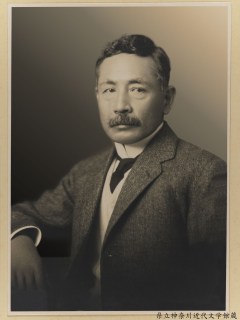
 Kusamakura is a complex novel, a small expression of the broad literary and artistic vision of its author, Natsume Sōseki; he said he took one week to write it. Sōseki was born in 1867, on the brink of the historic moment of the opening of Japan after its 250 years of isolation. This story written about 30 years later is a hearkening back to the classical and inward culture even as it portrays a protagonist in a world that has quickly changed and will never be the same.
The unnamed artist narrator, no doubt somewhat autobiographical, is not the sort who might move the action of the story. He doesn’t really do much but philosophize about beauty and art.
His plan for his holiday is to paint, and to maintain a detached, disinterested perspective on everyone he meets, so that he can fit them into the mental painting or poem he imagines, his artist’s way of seeing the world. There the humans might be on a plane with nature, which “…instantly forges the spirit to a pristine purity and elevates it to the realm of pure poetry.”
You can hear how elevated his opinion of his own spirituality is, and his pride at knowing true art, as contrasted again and again with particular behaviors and with phenomena tangible or intangible that he calls “vulgar.” But he does truly have an eye and a feeling for beauty, demonstrated in many instances throughout the book.
He muses in detail about every aspect of the beauty of the the old woman who hosts him at a wayside inn. When he gets drenched by a rainstorm, he transforms the miserable aspects: “If I picture myself, a sodden figure moving in this vast inkwash world of cloud and rain shot through diagonally with a thousand silver arrows, not as myself but as some other person, there’s poetry in this moment.” When Sōseki wrote that scene in Kusamakura I wonder if he was thinking wryly about the attitude he might have had toward his own miserable years that he later pictured poetically: “Among English gentlemen I lived in misery, like a poor dog that had strayed among a pack of wolves.”
Of such described scenes and experiences my favorite is this: “…times when the ineffable beauty around one, some presence one can scarcely grasp, mysteriously masters the heart….” For several pages he tries to capture with words this “ecstatic motion,” that “does not originate from outside,” and is tenuous only in that it is “ungraspable.”
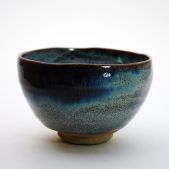 With abandon the Painter describes pottery, landscapes, food and people, at times in such a way that a tea-sweet becomes food porn. Humans are considered, to use his image, heartlessly: “I shall aim to observe the people I meet from a lofty and transcendent perspective, and do my best to prevent any spark of human feeling from springing up between us. Thus, however animatedly they may move hither and yon, they won’t find it easy to make the leap across to my heart….”
This coolness is maintained even toward the forward and unattached young woman of the inn where he stays. They have occasional conversations and several provocative encounters, and she seems herself to be the sole element of potential plot, while he remains impassive. He is, however, very interested in her as a sublime object to be painted, if he could just figure out what is missing from her face.
Elsewhere he muses over a question I had never heard posed before, and in the end I thought this dilemma was significant, too: “…whatever has motion is always finally vulgar…. Should we depict motion or stillness? — this is the great problem that governs the fate of us artists.”
I think that the Painter’s familiarity with the wider world and the culture of the West have made him a bit smug. He judges the West by the refinements of Japan, yes, but he also seems to have lost the modesty and restraint that are part of the Japanese expression of beauty, and can’t help revealing his arrogance to the reader.
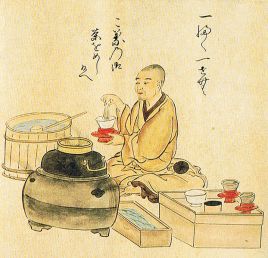 Having recently read the reverent Book of Tea, written by a contemporary of Sōseki, I was shocked when the narrator ranted about this Japanese art form, the tea ceremony: “No one is more assiduously pompous than a tea ceremony master, who will fancy himself the quintessence of elegant refinement. Your typical tea master is deeply conceited, not to mention affected and fastidious to a fault. He ostentatiously clings to the cramped little territory he’s marked out for himself within the wide world of sensibility, savoring his bowl of foam and bubbles with a quite ridiculous reverence.” And then I realized that it was the Painter who “fancied himself the quintessence of elegant refinement.” He breathes deeply of the vapors rising from his bowl of peeves and perceptions, and is pleased. On the other hand, doesn’t ranting at least border on the vulgar?
And yet, Sōseki himself did write about this book that he intended it to be a “haiku-style novel,” and that “all that matters…is that a certain feeling, a feeling of beauty, remain with the reader. I have no other objective.”
I felt more confident of my idea that Sōseki intentionally imbued the Painter with these ironic aspects after I read on the Literary Hub site about the author’s stay in Britain, where the government had sent him as “Japan’s first Japanese English literary scholar.” During his two unhappy years there he read constantly, and one tome he devoured and evidently thoroughly comprehended was the three-volume Tristram Shandy, which I have only read about, and doubt that I would be able to grasp the satire of it. In his first book, I Am a Cat, his cat narrator makes fun of the intellectual humans, speaking “with Sōseki’s voice, now bitingly critical, now cynically amused.”
Kusamakura may be a book ab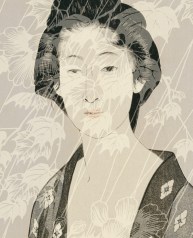 out the feeling of beauty, but the human relationships naturally get our human attention. My own philosophy and theology are that beauty originates in the Holy Trinity, the relationship of love of the Father, Son, and Holy Spirit. To try to know and appreciate another human by seeing them “objectively,” in a non-emotional or detached way, will never work. You will not see them truly. The Painter is perceptive enough in this case to realize what he isn’t able to do.
Indeed, that “something missing” in the face of the woman the Painter wants to paint, because she is so beautiful, he doesn’t discover until the very end of the story. Perhaps that is the plot, the character development and the problem solved, all on the last page. In a moment of emotion, a motion of the heart toward another person, if you will, he sees in her face the beauty that will make it worth painting.


 This is not the moon,
 Gladsome Lights