Tag Archives: Japan

Drop it gently onto the tongue.

It’s always nice to have a piece of toast, or some tasty thing to go with tea. At least, that’s how many of us think. In Kusamakura, the narrator takes tea with the host of the inn where he is staying, and there is a tea-sweets plate on the table, but it is bare. It’s there to be itself, a blue stone artifact that the owner wants to show off, and the narrator muses without speaking:

“It is nothing short of astonishing to consider the fine dexterity of the master craftsman who has carved such a large piece of stone to such thinness, and with such delicate precision! Spring sunlight shines through the translucent stone, seemingly captured and held there within its depths. It is right that such a plate remains empty.”

At a tea time earlier in the story, the guest does mention a tea-sweet, “…the firm bean jelly known as yōkan…. Yōkan happens to be my very favorite tea sweet. Not that I particularly want to eat it, but that velvety, dense texture, with its semitranslucent glow, makes it a work of art by any standards. I especially enjoy the sight of yōkan that has a slightly blue-green sheen, like a mixture of gemstones and alabaster — and this bluish yōkan piled on the plate glistens….” Sorry, I can’t go on. In a later post I hope to have more to say about this character who, while his mind overflows with voluptuous details pertaining to what he likes, dismisses more and more other things and behaviors as “vulgar.”

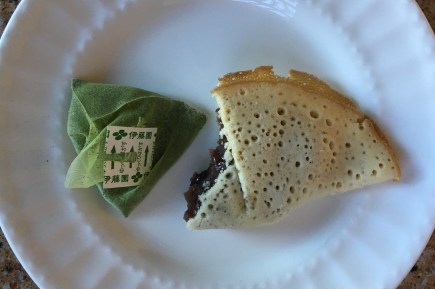
Because of him, I am feeling more welcoming of Lent. But before that shift toward better feasts, I want to show you my own edible works of art from blogger friend Orientikate in Japan; she wanted to contribute to my research on the land where she dwells. 🙂 In my case, I was so vulgar that I did want to eat them all! The dorayaki below is made with the same red beans that our artist praises above. Made into a sweetened paste and wrapped in a soft pancake, they make a lovely treat to eat with tea.
A packet of crispy snacks was in the package, and several types of green tea, and all of those gifts have been much enjoyed; sometimes I drank the tea from one of the ornate teacup twins that were given to our family more than 20 years ago, by a shy Japanese exchange student who was with us for only a week.

I try to drink tea only in the morning, because I seem to be more sensitive to caffeine the older I get. I know that green tea contains substances that have a calming effect as well, and there was a time when I could drink it all day, as I know many people do. But I laughed out loud at the end of this passage from the same book, when after admiring the plates and the kettle and the calligraphy on the wall, the guests take some nourishment:

“A connoisseur with time on his hands will elegantly taste this rich, delicately sweet liquid, ripened in the precise temperature of the hot water, by letting it run one drop at a time on to the tip of the tongue. Most people believe that tea is to be drunk, but that is a mistake. If you drop it gently onto the tongue and let the pure liquid dissipate in your mouth, almost none of it remains for you to swallow.

“Rather, the exquisite fragrance travels down to permeate the regions of the stomach. Using the teeth on solid food is vulgar, while mere water is insipid. The best green tea, on the other hand, surpasses fresh water in its delicate, rich warmth, yet lacks the firmness of more solid substances that tire the jaw. Tea is, in fact, a marvelous drink. To those who spurn it on the grounds of insomnia, I say that it’s better to be deprived of sleep than of tea.”

Simply lolling and not wasting breath.

A couple of weeks ago I was writing about the muddiness of the pool (my mind) in which all the rich material of Japanese history and culture has been collecting. I anticipated the waters clearing eventually making it possible for me to compose a book review or two by way of participating more fully than I yet have in the Japanese Literature Challenge.
But just as things were coming into focus, the body in which my mind resides became afflicted with a fat head cold. My head feels huge and achey and that makes it hard to think. After picking up one book after another this morning, reading a few lines, realizing that I was not interested, I finally lit upon a novel I was already a couple of chapters into, Kusamakura (also known as The Grass Pillow), as the one that was not too heady and not boring either. This book by Natsume Sōseki is nothing like his other novels, and it was meant to be a “haiku-style” novel, hearkening back to old Japan just as most writers were eagerly embracing western culture. He published it in 1906.

The narrator is taking a little holiday for the purpose of contemplating the beautiful. I have been enjoying his lighthearted philosophical musings and descriptions that are not too hard to engage with in my compromised state of mind.

This afternoon I was reading by the fire, and became so sleepy and warm, I kept nodding off, so I went up to my bed and lay in the cool room, continuing to find on every page his delighted descriptions of the beauty of the tea sweet, the silvery bamboo in the distance, the pleasant arrangement of the rooms of the inn, and the calligraphy on the wall. When his mind was briefly agitated he wrote haiku as a way to practice mindfulness and calm down, and it restored his sense of humor.

Our narrator is an artist, and he wants to paint many things he sees; other times he says that he feels that he is in a painting, because of the sublimity of the scene he inhabits. When I came upon this passage as I lay on my bed I really engaged with his mood:
“Drawing a picture feels like too much trouble just now, and as for coming up with a poem, my mind is already immersed in the poetic — to actually compose something would be merely a waste of breath. Nor do I have any inclination to undo the box of two or three books that I’ve brought along, tied to my tripod, and read. I feel perfect happiness simply lolling here on the balcony in the company of the shadow cast by the blossoms, my back toasting in the warm spring sunlight. To think would be to sink into error.”

For different reasons than this man, I’m sure, I have felt that my trying to write anything  analytical about my readings thus far would surely have been to sink into error. The risk of reductionism is more of a certainty than a possibility. Rather, I will try to follow his example and pay attention to each “thing” I encounter without worrying about how it’s related to all the others. I know I won’t be writing any haiku to distill my experiences, but after contemplating the literary scene it might happen that I find something to “paint” here.

The Japanese Literature Challenge is going through March. The books I still want to delve into more or finish are:

Silence and Beauty by Makoto Fujimura
Kusamakura by Natsume Sōseki
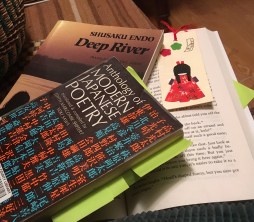
Deep River by Shusaku Endo
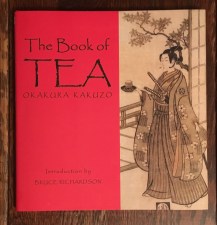
The Book of Tea by Kakuzo Okakura
Modern Japanese Literature edited by Donald Keene

I realize that during this read-along, a few of the things I’ve been reading are in the non-fiction category, not the literature genre. I chose them in hopes of getting a little more background knowledge so that I could better appreciate the literature, and I’m content with how it’s going.

My brief exposure to the literary world of Japan has started me on a deeper study of broader and universal aspects of our humanity. But more on that later. Right now, I’m going back to the countryside of Japan where I can loll about and absorb some beauty. Come to think of it, I’ll put the kettle on and brew a cup of tea for good measure.

Japanese cats and poetic lives.

Yōko Sano was an award-winning Japanese children’s author and illustrator. I found out about her because until her death in 2010 she was the wife of Shuntarō Tanikawa, “one of the most widely read and highly regarded of living Japanese poets, both in Japan and abroad, and a frequent subject of speculations regarding the Nobel Prize in Literature.” (Wikipedia)

I read poems by Tanikawa that I liked, while reading a bit in the Anthology of Modern Japanese Poetry, translated and compiled by Edith Marcombe Shiffert and Yuki Sawa. Here’s one:

PICNIC to the EARTH

Here let’s jump rope together, here.
Here let’s eat rice balls together.
Here I will love you.
Your eyes reflect the blue of the sky,
Your back will be dyed with the green of the herbs.
Here we will learn the names of the stars together.

Staying here let’s imagine all the things that are far off.
Here let’s gather seashells.
From the sea of the daybreak’s sky
let’s bring back the tiny starfish.
At breakfast we will throw them out
and let the night go away.

Here I will keep on saying “I have returned!”
as long as you repeat “Welcome back!”
Here I will keep on returning to again and again.
Here let’s drink hot tea.
Here sitting together for a while
let’s have the refreshing wind touching us.

I like to think he was writing this to his wife Yōko. She illustrated a volume of his poetry, but she is especially famous in the West for her own book The Cat That Lived a Million Times, which was the inspiration for one of my favorite movies, “Groundhog Day.”

The cat in the story, which I’ve only read about, because my library doesn’t have that book, is reincarnated again and again but never learns to love until he has a cat “wife” and family. This is a little different from Bill Murray’s character in the movie, because when the insufferably conceited Phil Connors is punished, he is forced to live the same day over and over again. He tries to escape by death but that is evidently impossible; eventually he gets over himself and is released from the torturous day.
I did borrow I Am a Cat by Natsume Sōseki from my local library. Its beginning chapter was the first short story that Sōseki ever wrote, and he intended for it to stand alone. But the editor of the magazine in which it was published — more than a hundred years ago now — persuaded him to continue it as a series, and that is how the novel was born. I did read that first chapter, but I don’t know if I will go on, much as I enjoyed the character of the nameless cat. My stacks of books from the broad genre of Japanese literature are tall, and life is short!

In the same poetry anthology mentioned above I read Makoto Ōoka, a contemporary of Tanikawa, and this evocative poem:

TO LIVE

I wonder if people know
that there are several layers in the water?
Fish deep in it and duckweed drifting on its surface
bathe in different lights.
That makes them various colored.
That gives them shadows.

I gather up pearls on a pavement.
I live inside a phantom forest;
upon notes of music scattered over the strings of my being.
I live in hollows of drops that trickle upon snow;
in damp ground of morning where the liverwort opens.
I live upon a map of the past and future.

I have forgotten the color my eyes were yesterday.
But what things my eyes saw yesterday
my fingers realize
because what my eyes saw was by hands
patted like touching the bark of a beech tree.
O I live upon sensations blown about by wind.

Cats do not seem to be a common subject for Japanese poetry. In two anthologies I didn’t find one on that subject, though at least two poems mentioned babies teething. To conclude my ramblings on my browsing I give you this 11th-century verse from One Hundred Poems from the Japanese translated by Kenneth Rexroth:

Involuntary,
I may live on
In the passing world,
Never forgetting
This midnight moon.

-The Emperor Sanjō

japanese moon


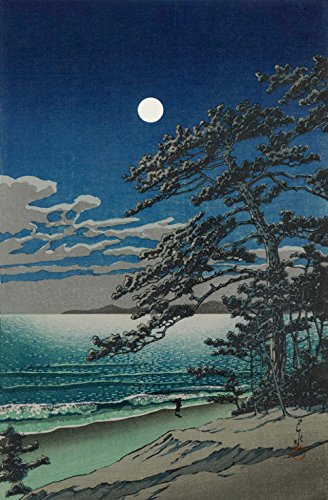
“Spring Moon at Ninomiya Beach”  by Kawase Hasui

Japan – journeys and excursions

I am certainly a newcomer to the genre of Japanese literature; before this month I think I had only read one other book by a Japanese author. Never in my life have I given serious attention to the literature or culture or history of Japan, probably sensing that I could never deeply understand its soul, being an outsider, very much from the West, not East.

It seems a little random that I have now embarked on only a short excursion, if you will, into things Japanese. Last year when I traveled to India and tried to learn about that country, there was a familial motive; otherwise I would have felt similarly. It’s not that I have a lazy mind, but rather that I know myself: it’s very frustrating to go only shallowly into any subject. I always want to keep going and going and ….

I’ve now finished the third novel on my original list, Convenience Store Woman. The library is holding one I’d forgotten I reserved, The Gate by Natsume Sōseki, and since my last post I discovered another book that I have already begun reading as well: Silence and Beauty: Hidden Faith Born of Suffering by Makoto Fujimura.

“This is an elegy in the form of a weeping cherry, Japanese symbol of ephemeral beauty and now my personal symbol of enduring hope during dark times.”

Fujimura is a Japanese American artist who spent years in the country of his ancestors learning traditional nihonga painting. You can click through his name above to his website if you would like to see more of his painting and learn about the layering technique, about which he says, “The nihonga process, which flows out of a thousand-year refinement, overlaps as a metaphor for the journey of faith that is refining me.” Here I show one of his Post 9-11 series.

In the book he explores the postwar Japanese novel Silence by Shusaku Endo, and shares his own soul’s journey of faith and the many events, people and gifts that have nurtured him:

“God took me to Japan, a country of my roots, to become a Christian. Thus, my aesthetic journey overlapped with my faith journey. This book reflects on both those pilgrimages, through the lens of my encounter with Shusaku Endo’s postwar masterpiece, Silence.

“…The three critical themes in understanding Silence are hiddenness, ambiguity and beauty.”

I have barely begun reading, but I have hope that Fujimura’s gentle and reflective way of conveying his own engagement with Japan and its legacy to humanity will enrich my own mind and heart, and lay more reference points on the grid, if you will. [Update: This did not happen; on the contrary, his book was the opposite of enlightening, and I can’t recommend it, or justify taking the time to write about it.] Right now I wouldn’t know how to write about the books I have read so far for Bellezza’s Japanese Literature Challenge, because no matter that they have been translated to my native tongue, they remain foreign. Perhaps down the road, before this read-along has ended, I will have made a little progress in understanding. It might happen that I will gradually find the map easier to read, and who knows, my excursion may turn out to be not so short after all.