After I left my car at the mechanic’s shop for its routine service, I set off walking down the road to the bus stop. After only a few steps I stopped to admire plants along my way; I did that a few times. The California Buckeye startled me as it always does, looking like the dead of winter in early fall. The large conker peeking out redeemed the scene.

It was fun, walking for ten minutes through a sort of industrial park, where all the people arriving for work gave their energy to the atmosphere, and lots of pickup trucks lined the road, bare of sidewalks most of the way. The air was crisp but not harsh.
On a bench at the bus stop, I looked briefly across the frontage road at the seedy mobile home park whose sign was missing some letters and read “Taylo.” A mockingbird’s song came to me from somewhere, surprisingly not drowned out by the heavy traffic noise. And then my gaze rose, hungry, to the sky.
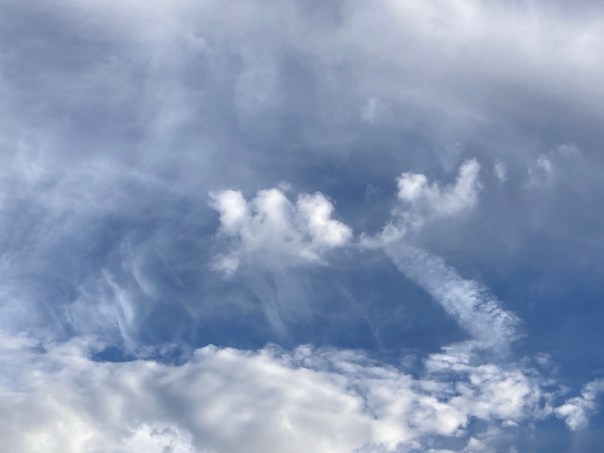
I recognized the remains of a jet stream (or chem trail?) as one element of that picture above, but there was so much else going on up there! I began to think about what Emerson said, that “The sky is the daily bread for the eyes.” I mused on how sometimes we are given all sorts of fancy bread, but at other times the sky is plain blue, or white, or gray….
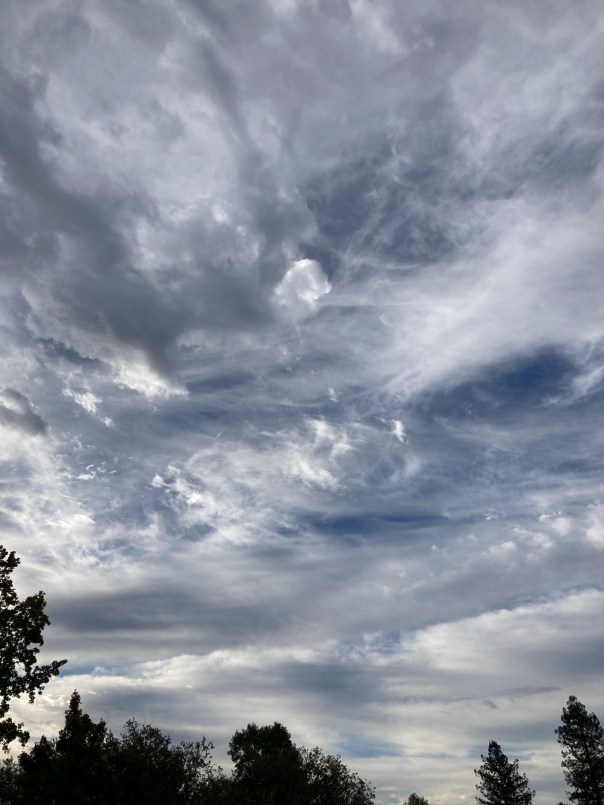
After a short ride on the bus, I got off and started walking the rest of the way home, along a boulevard where I had plenty more of those big spaces to wonder at. I was struck by the realization that I was the only human on earth to whom each particular picture was given, because I was the only one at that GPS location, at that moment in the constantly changing arrangement of images.

If one lives in the big city, with skyscrapers hogging the sky, usually a little bit at least will peek through; I like to get my bearings occasionally by looking at whatever patches are available for viewing. Being in prison, though… now that would be hard. I guess they do often let at least some of the prisoners outside sometimes, but they might not feel safe and relaxed enough to feast on their daily bread in that setting.

Twice now I’ve started reading The Marvelous Clouds, and shared some quotes here. I reread some of Albert’s comments that I included in one post about the book ; he passed on some excerpts from an article about it, which is about media. One thing the author said was that “Clouds illustrate media ontology. [They] exist by disappearing.”
I gave that book away a while back. It’s very thought-provoking, to be sure, but I think if I had continued reading it I would have just been page by page arguing with the author over various things. I don’t like that he uses clouds for anything. I’d rather receive the gift of clouds as bread for my eyes. This arrangement of clouds below looked like it was pretending to be mountains in the distance:

The author of that book, John Durham Peters, also said that clouds are the original white noise. If you want to follow that thought, read the article linked in that more recent post of mine. But I think it’s more profitable for the soul to go out and look at the sky, whether there are clouds in it or not. When there are no clouds, or they have merged into a less enthralling picture, watching them might be like staring out at the ocean. It’s always moving, but it can be boring at the same time. Sometimes we need that plain bread. Feasting all the time is not good.
While my thoughts were on the clouds, my legs carried me into neighborhoods closer to mine, but I took a less familiar route and saw this beautiful plant that I found out is called a Common Lionspaw. I got distracted from the sky and started thinking about where I could fit one of those in my garden.

My cloud show seemed to go to intermission for a few minutes, with the actors going off stage — but quickly it started up again, as the sun began to break through.
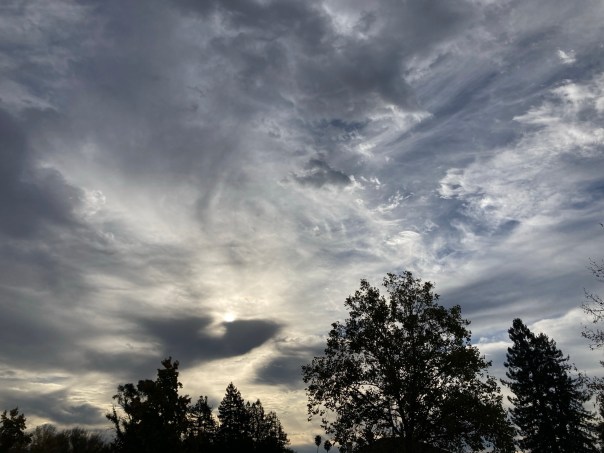
Then, I was home again. It was time to start the rest of my day, and figure out what to eat… but my eyes had already had a big breakfast.

 “Books you have read share a deep ontological similarity with books you haven’t: both can be profoundly fuzzy. At times books you haven’t read shine more brightly than those you have, and often reading part of a book will shape your mind more decisively than reading all of it; there is no inherent epistemic superiority to having read a book or not having read it.”
 we have the same feeling in a forest, at the beach, in a big city, or simply in breathing? There is more going on in our body every second than we will ever understand, and yet we rarely feel bothered by our inability to know it all. Books, however, are designed to make demands on our attention and time: they hail us in ways that nature rarely does. A thing is what Heidegger calls zunichtsgedrängt, relaxed and bothered about nothing. A plant or stone is as self-sufficient as the Aristotelian god or Heidegger’s slacker things, but books are needy. They cry out for readers as devils hunger for souls.”
 erson once declared that language is fossil poetry. Many words that we use carelessly have, embedded within their amber-like exterior, the remnants of long lost perceptions and intuitions. When received thoughtfully and with some delicacy, words have the capacity to allow us to travel back in time, to imagine how and what the world meant to our ancestors. But unlike the insects, or dinosaur DNA fixed in amber, the meanings within words are changing, evolving, as human perceptions change.”

 Chapter 7 is titled “God and Google,” and the last chapter, “A Sabbath of Meaning.” My goodness, but I wonder how the meat of the chapters will satisfy my appetite that has been whetted by so many provocative phrases. But it does sound fun, especially from chapter 2 on, to make a philosophical journey through sea, fire, and sky, going on to explore “earthy” media… God will surely balance out whatever about Google might bore me in Chapter 7, and if I’m exhausted by the end, well, Peters has wisely put a sabbath right there in a helpful place.
 Gladsome Lights