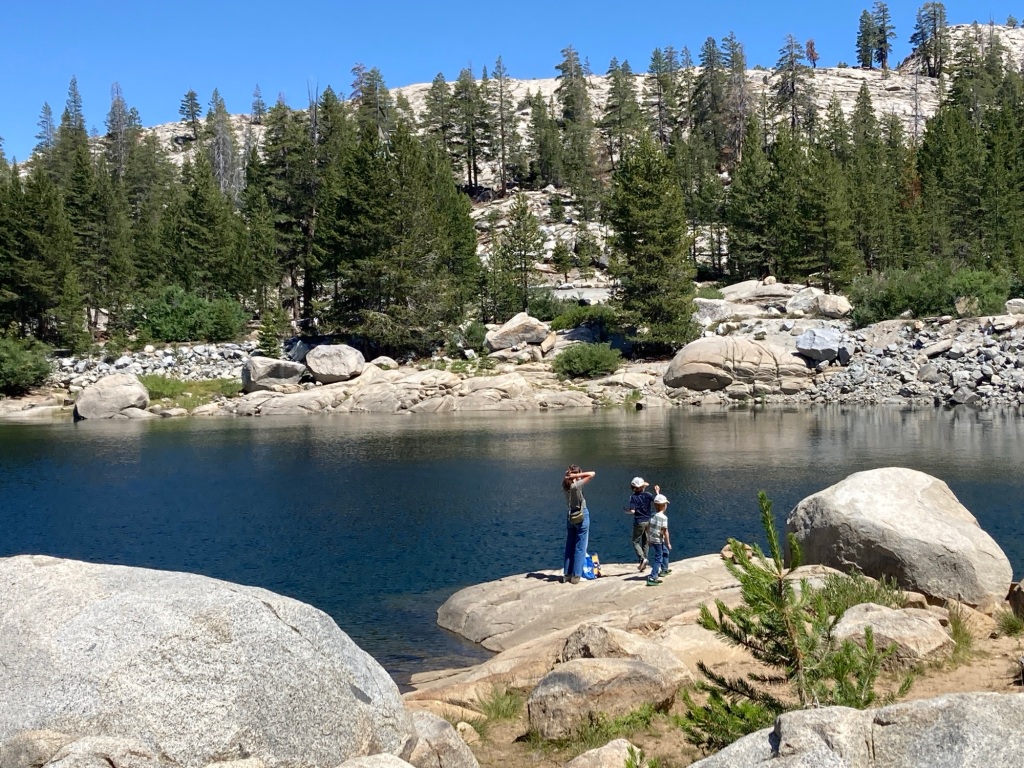
Kate and her family joined me at the cabin yesterday, and we’ve already packed in a lot of fun. This afternoon Kate and Tom introduced the boys, whom I nicknamed Raj and Rigo at their births, to fishing.
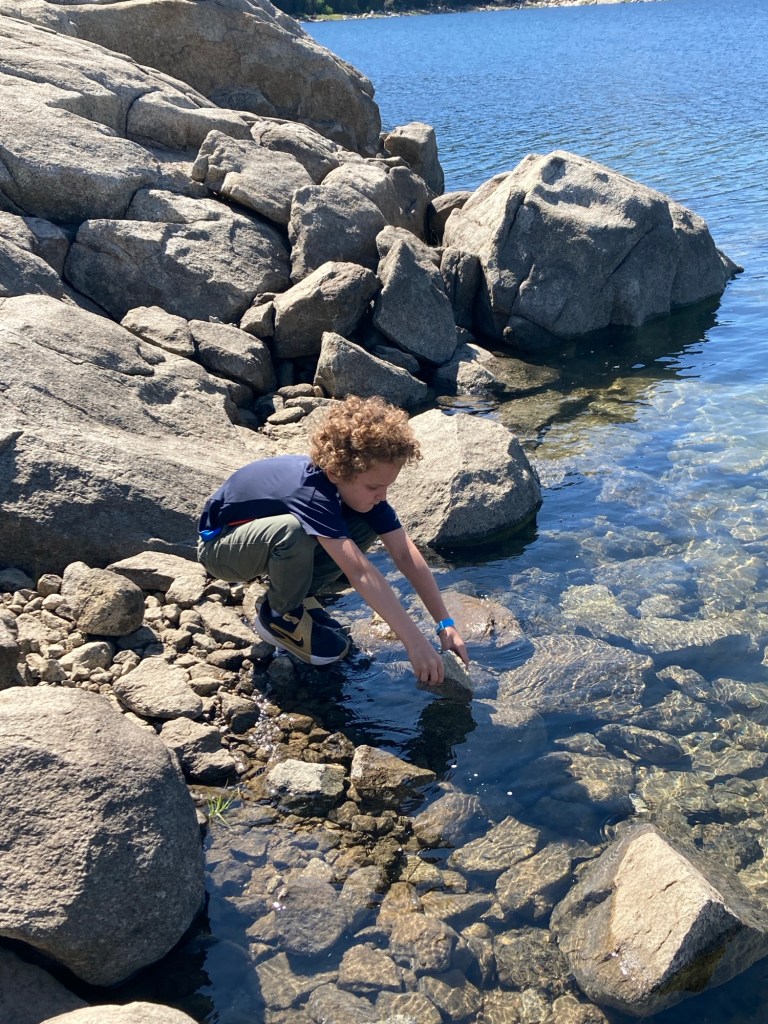
The boys also climbed around on the granite boulders near the shore, and after discovering tangled messes of used fishing line and candy wrappers, they began to enthusiastically hunt down every piece of trash they could find, crawling into crevices and scrambling up and down to score just one more item, to get the lake shore a tiny bit cleaner.
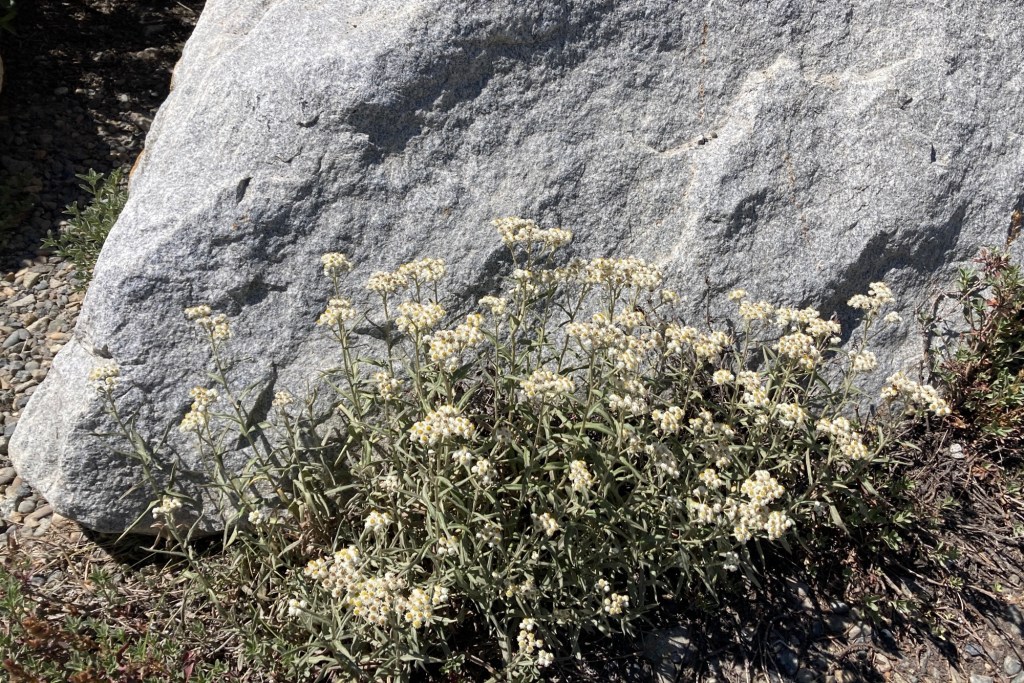
I identified a new buttercup I hadn’t met before, and saw again the lovely Pearly Everlasting, which in July has just opened the flowers that will continue to look nice for several more weeks.
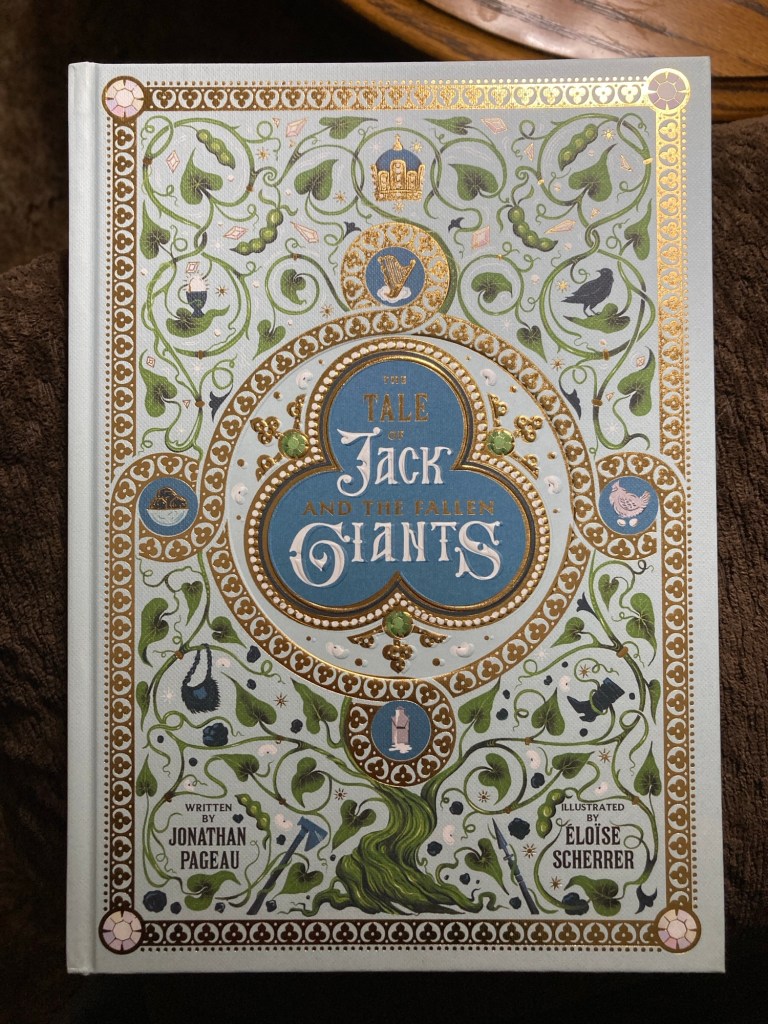
Later after dinner, while they drank hot cocoa, I read to Raj and Rigo the story of Jack and the Fallen Giants, a recent retelling of the traditional tale by Jonathan Pageau. It has beautiful and evocative illustrations by Eloise Scherrer, and thought provoking elements such as riddles: “What has more weight, heaven or earth?”
In this telling, Jack is frequently famished and worn out, but he perseveres and climbs higher and higher every time, and receives bursts of strength that give him renewed zeal.
I think that whether they realized it or not, my grandboys could relate to Jack’s exertions because of all the tasks they’d accomplished for themselves this afternoon. In any case, in spite of a cliffhanger ending, we had a good time reading that story.
Early this morning I waved good-bye to the last Christmas guests as they drove off toward home in Colorado. A few minutes later I was back in bed, and soon after that had fallen asleep while listening to Jonathan Pageau’s podcast on “Christmas: The Anchor of Reality.”
Now it’s afternoon, I just finished breakfast, and decided to try one of the new teas I received recently from Tea Runners. The grandchildren who just departed liked this one, called Winter Wonderland Rooibos. I added half and half, and served up a slice of the stollen Soldier gave me for Christmas.
I was arranging my stack of Christmas books and realized that I have not read Winter Fire during either of the Christmas seasons since I got it; it is subtitled Christmas with G.K. Chesterton, and is compiled by Ryan Whitaker Smith. So I opened its pages and browsed a little, and remembered that it is arranged as somewhat of a 30-Day Advent collection. Yet for myself I think it will be a good read in the next few days, as winter has only begun here, and I could use more meditation on the Incarnation, as I process all the events large and small that have whirled around me of late.
There are so many things I want to write about, to highlight here, of our splendid Glad celebrations over the last ten days, but at this point my head is still spinning a bit too crazily, and my heart just wants to go to church, light a candle on St. Basil’s Day and The Circumcision of Christ, and give thanks for all that God has done.
Today was Ascension Day for the Eastern Orthodox. During his homily our pastor drew our attention to the fresco we could see behind him, of Christ ascending, with the disciples looking up at him, 40 days after his resurrection. He said that in our temple that event is depicted above the altar as a reminder that in the Divine Liturgy we also ascend to Heaven. The icon shows what St. Luke tells in the first chapter of the Book of Acts:
“The first account I composed, Theophilus, about all that Jesus began to do and teach, until the day when He was taken up, after He had by the Holy Spirit given orders to the apostles whom He had chosen. To these He also presented Himself alive, after His suffering, by many convincing proofs, appearing to them over a period of forty days, and speaking of the things concerning the kingdom of God.
“And gathering them together, He commanded them not to leave Jerusalem, but to wait for what the Father had promised, “Which,” He said, “you heard of from Me; for John baptized with water, but you shall be baptized with the Holy Spirit not many days from now.”
“And so when they had come together, they were asking Him, saying, ‘Lord, is it at this time You are restoring the kingdom to Israel?’ He said to them, ‘It is not for you to know times or epochs which the Father has fixed by His own authority; but you shall receive power when the Holy Spirit has come upon you; and you shall be My witnesses both in Jerusalem, and in all Judea and Samaria, and even to the remotest part of the earth.’
“And after He had said these things, He was lifted up while they were looking on, and a cloud received Him out of their sight. And as they were gazing intently into the sky while He was departing, behold, two men in white clothing stood beside them; and they also said, ‘Men of Galilee, why do you stand looking into the sky? This Jesus, who has been taken up from you into heaven, will come in just the same way as you have watched Him go into heaven.'”
St. Paul mentions our own situation when he writes to the Ephesians :
“God raised us up with Christ and seated us with him in the heavenly realms in Christ Jesus.”
In our daily prayers, we no longer start with the Paschal Troparion, “Christ is risen from the dead, trampling down death by death, and upon those in the tombs bestowing life,” but replace that line with the Troparion of Ascension:
Thou hast ascended in glory, O Christ our God, and gladdened Thy disciples with the promise of the Holy Spirit. And they were assured by the blessing that Thou art the Son of God, and Redeemer of the World.
In only ten days we will come to Pentecost, and return to the usual beginning, “O Heavenly King, the Comforter, the Spirit of Truth….” But for now, we are with the disciples, waiting for the Spirit, Whom Christ said would “come upon” them.
“They were looking intently up into the sky as he was going, when suddenly two men dressed in white stood beside them. ‘Men of Galilee,’ they said, ‘why do you stand here looking into the sky? This same Jesus, who has been taken from you into heaven, will come back in the same way you have seen him go into heaven.’
Albrecht Dürer
“Then the apostles returned to Jerusalem from the hill called the Mount of Olives, a Sabbath day’s walk from the city.When they arrived, they went upstairs to the room where they were staying. Those present were Peter, John, James and Andrew; Philip and Thomas, Bartholomew and Matthew; James son of Alphaeus and Simon the Zealot, and Judas son of James.They all joined together constantly in prayer, along with the women and Mary the mother of Jesus, and with his brothers.”
In anticipation of Pentecost, I might revisit the history of that feast in the Old Testament, and in the Book of Jubilees, which Richard Rohlin and Jonathan Pageau discuss in two podcasts, which are also about the giving of the Law on Mount Sinai, and about the Tower of Babel. What — are all these connected? Yes.
Pentecost is traditionally considered an inversion of the curse of Babel. I heard some of these thoughts at the Symbolic World Summit I attended earlier this year, but it is a lot to stretch my mind toward. To consider how “the confusion of tongues is resolved,” explained by a philologist like Rohlin — I have to say, it reveals God’s glory, and His wonderful plan through the ages.
Four years ago I shared this rich iconographic tour that Jonathan Pageau gives us of “The Icons of Holy Week,” posted on the website of the Orthodox Arts Journal. World events since then made me forget everything I read and saw here, so I am glad to have come across this post again in time to have my understanding broadened in time for this last leg of our journey to Pascha.
I encourage you to click on the link if only briefly, just so you can see Pageau’s exquisite stone carving of the Crucifixion at the top of the page. But of course his actual tour (of about 30 minutes) begins with Palm Sunday, and he continues through the week bringing to light mysteries of Christ’s passion as depicted and revealed in the several featured icons, leading up to and including His glorious Resurrection.
Jonathan introduces the topic with brief comments about the Notre Dame fire that was probably still burning as he spoke, and about the state of the arts and Christianity in the West. He goes on to show us the interrelatedness of the images specific to the season and how they sort of “talk to each other” as they reveal the deep theology and meaning of these holy days.
The video is posted on the website of the Orthodox Arts Journal, but if you like to hear Jonathan talk about the arts, philosophy and theology, he has a YouTube channel, The Symbolic World. Some people lose track of time playing games on their computer, but my personal temptation is to watch Jonathan’s videos late into the night.
Whenever it comes to you, I wish you all a most blessed and salvific Easter!




 Early this morning I waved good-bye to the last Christmas guests as they drove off toward home in Colorado. A few minutes later I was back in bed, and soon after that had fallen asleep while listening to Jonathan Pageau’s podcast on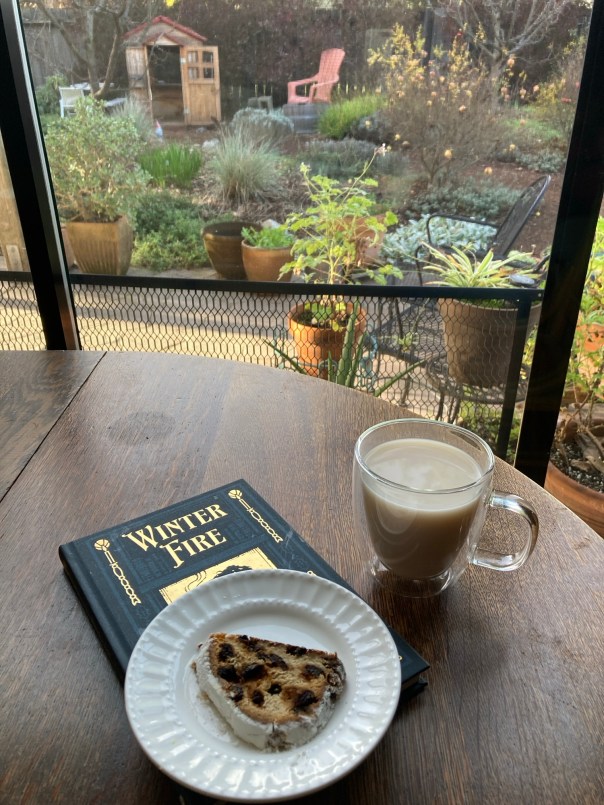


 Gladsome Lights