“When hit by boredom, let yourself be crushed by it; submerge, hit bottom. In general, with things unpleasant, the rule is: The sooner you hit bottom, the faster you surface. The idea here is to exact a full look at the worst. The reason boredom deserves such scrutiny is that it represents pure, undiluted time in all its repetitive, redundant, monotonous splendor.
“Boredom is your window on the properties of time that one tends to ignore to the likely peril of one’s mental equilibrium. It is your window on time’s infinity. Once this window opens, don’t try to shut it; on the contrary, throw it wide open.”
― Joseph Brodsky
It’s interesting how metaphorical the poet Brodsky gets in this passage on boredom — and his metaphors are so physical. Boredom hits us, and crushes us. We sink under water, we hit bottom. Then we surface fast, and even when encountering a window, we don’t just look through it but throw it open. Take the bull by the horns, I might add. Don’t miss the opportunity — go for it!
It may be that my interest in boredom has something to do with its connection to Time. When we are experiencing the restless kind of boredom, it’s often because we think whatever we are doing is a waste of time, or at least that there might be a better use of our time than what has been given to us, what we are stuck doing. But Brodsky doesn’t see time that way, as something to use. We are beings in time, and just letting the seconds and minutes go by as we contemplate that reality — something splendorous — can reveal aspects of our existence that we might miss, if we keep ourselves constantly busy.
Contemplation is mental and hopefully spiritual work. Not laziness, not sloth. Possibly the opposite of sloth, which is another word for acedia. I still hope to explore the idea of acedia, but that will probably not happen soon. In the meantime, I’m growing bored with thinking about boredom. Here’s one last thought to contemplate:
Boredom is the feeling that everything is a waste of time; serenity, that nothing is. –Thomas Szasz
“…winter is an abstract season: it is low on colors, even in Italy, and big on the imperatives of cold and brief daylight. These things train your eye on the outside with an intensity greater than that of the electric bulb availing you of your own features in the evening. If this season doesn’t necessarily quell your nerves, it still subordinates them to your instincts; beauty at low temperatures is beauty.”
Joseph Brodsky was born in St. Petersburg, what was then Leningrad, in 1940. He writes in the first, title essay of his book, about his generation in postwar Soviet Russia, how they were “somewhat spared” the full experience of what their country had become: a “drab hell, with a shabby materialist dogma and pathetic consumerist gropings.”
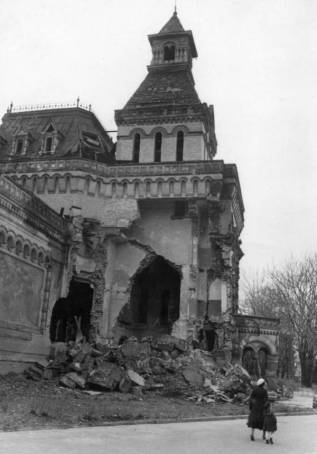
“We emerged from under the postwar rubble when the state was too busy patching its own skin and couldn’t look after us very well. We entered schools, and whatever elevated rubbish we were taught there, the suffering and poverty were visible all around. … The empty windows gaped at us like skulls’ orbits, and as little as we were, we sensed tragedy. … The amount of goods was very limited…. we didn’t develop a taste for possessions. Things that we could possess later were badly made and looked ugly. Somehow, we preferred ideas of things to things themselves….”
I can’t help comparing the cultural environment in which Brodsky came of age to that of the generation currently in their teens and twenties. When those young people in Leningrad were trying to survive the privations at every level of their being, they didn’t have the option of comforting themselves with marijuana or escaping to the metaverse. Their daily life didn’t include such diversions as shopping at the mall for the current fashions in jeans or phones. What they did have was books:
“If we made ethical choices, they were based not so much on immediate reality as on moral standards derived from fiction. We were avid readers and we fell into a dependence on what we read. Books, perhaps because of their formal element of finality, held us in their absolute power. Dickens was more real than Stalin or Beria. More than anything else, novels would affect our modes of behavior and conversations, and 90 percent of our conversations were about novels. It tended to become a vicious circle, but we didn’t want to break it.
“In its ethics, this generation was among the most bookish in the history of Russia, and thank God for that. A relationship could have been broken for good over a preference for Hemingway over Faulkner; the hierarchy in that pantheon was our real Central Committee. It started as an ordinary accumulation of knowledge but soon became our most important occupation, to which everything could be sacrificed. Books became the first and only reality, whereas reality itself was regarded as either nonsense or nuisance. Compared to others, we were ostensibly flunking or faking our lives. But come to think of it, existence which ignores the standards professed in literature is inferior and unworthy of effort. So we thought, and I think we were right.”
-Joseph Brodsky, Less Than One
This passage gives me a clue as to a question I’ve had about Brodsky: How, born a Jew and growing up under atheist Communism, did he come to be a “Christian poet”? Not only does he say (quoted in a previous post about him) that he tries to be a Christian, but Wikipedia tells us:
Daniel Murphy, in his seminal text Christianity and Modern European Literature, includes Brodsky among the most influential Christian poets of the 20th century, along with T. S. Eliot, Osip Mandelstam, Anna Akhmatova (Brodsky’s mentor for a time), and W. H. Auden (who sponsored Brodsky’s cause in the United States). Irene Steckler was the first to categorically state that Brodsky was “unquestionably a Christian poet”.
What the writer tells us about this education he and his friends got for themselves shows the power of the vicarious experience that can be had from reading good stories. The best books helped them to endure the “nonsense or nuisance” of totalitarian society, and at the same time gave them a broad, universal understanding of Reality. What a blessed bookishness; as Brodsky says, Thank God for that.
When I am reading any sort of literature I often think of what fellow blogger M.K. has said, (forgive me, M.K., if I am distorting this) that when she finds someone whose writer’s voice she particularly appreciates, it doesn’t matter the topic of the writing, she enjoys reading everything he or she produces.
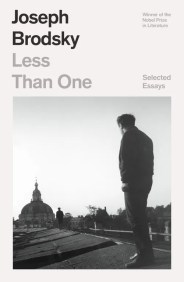
For me, the poet Joseph Brodsky is one of those writers. His intellect, his experience, his abilities, are so far removed from my own, it seems strange that I would feel the connection with him that I do. The attraction is there, but my time is limited, so I’ve actually read very little of his work. But this particular book, Less than One, got my attention recently, calling out from the mobile bookshelf that sits along the short path I often traverse, from the kitchen to the computer. I took it in hand and saw that it is a book of essays, but I didn’t remember why I had bought it.
Maybe it was after reading something like this, from the publisher:
This collection of essays thrusts Joseph Brodsky—previously known more for his poetry and translations—into the forefront of the “Third Wave” of Russian émigré writers. Originally published the year before Brodsky received the Nobel Prize in Literature, Less Than One includes intimate literary essays and autobiographical pieces that evoke the daily discomfort of living under tyranny. His insights into the works of Dostoevsky, Mandelstam, and Platonov, as well as the non-Russian poets Auden, Cavafy and Montale are brilliant; Seamus Heaney said of Brodsky’s treatment of one of Auden’s most famous poems, “There will be no greater paean to poetry as the breath and finer spirit of all human knowledge than Brodsky’s line-by-line commentary on ‘September 1, 1939.’”
Joseph Brodsky
That paragraph also made me interested to delve into Auden. But the first thing I read about the poem Heaney references, “September 1, 1939,” gave me pause. It was a blog post by Dr. Oliver Tearle, in which he points out that Auden disowned the poem and was “ashamed to have written” it.
When Brodsky was made unwelcome in the Soviet Union in 1972, W.H. Auden was one of the people who helped him to settle in the U.S. But long before that, as a young student, he was learning Polish and English with the goal of being able to translate poets like Czeslaw Milosz and John Donne. He said of his Jewish parentage, “While I am related to the Old Testament perhaps by ancestry, and certainly the spirit of justice, I consider myself a Christian. Not a good one but I try to be.”
When he was denounced and stood trial before a judge, the examination went like this:
Judge: And what is your occupation in general? Brodsky: Poet, poet-translator. Judge: And who recognized you to be a poet? Who put you in the ranks of poet? Brodsky: No one. And who put me in the ranks of humanity? Judge: Did you study it?…How to be a poet? Did you attempt to finish an institute of higher learning…where they prepare…teach… Brodsky: I did not think that it is given to one by education. Judge: By what then? Brodsky: I think that it is from God.
I immediately thought of Milosz and in particular his book The Captive Mind, when I read this paragraph from Brodsky, quoted on The Poetry Foundation website:
“Language and, presumably, literature are things that are more ancient and inevitable, more durable than any form of social organization. The revulsion, irony, or indifference often expressed by literature toward the state is essentially the reaction of the permanent—better yet, the infinite—against the temporary, against the finite. … The real danger for a writer is not so much the possibility (and often the certainty) of persecution on the part of the state, as it is the possibility of finding oneself mesmerized by the state’s features which, whether monstrous or undergoing changes for the better, are always temporary.”
No doubt one aspect of the poet’s voice I find compelling is this unwillingness to be captivated by things lesser than the infinite — anything less than the full expression of the human soul.
Czeslaw Milosz became an admirer, writing: “Behind Brodsky’s poetry is the experience of political terror, the experience of the debasement of man and the growth of the totalitarian empire. … I find it fascinating to read his poems as part of his larger enterprise, which is no less than an attempt to fortify the place of man in a threatening world.”
I enjoyed seeing the poet on video in this very short clip of an interview, in which he is speaking about how he personally strives against this debasement, not just of his own person, but of his fellow humans. Even without knowing the context of his words, we get another glimpse of his own soul when he tells about his efforts not to reduce people in his mind to simple categories, but to see their complexity, and their bravery. He says this is how you “winnow their essence.”
My minimal encounters with Joseph Brodsky encourage me to resist my own reductionist, categorizing tendencies. His is a voice I will continue to listen to.
“By failing to read or listen to poets,
society dooms itself to inferior modes of articulation,
those of the politician, the salesman or the charlatan.”

 opportunity — go for it!

 When I am reading any sort of literature I often think of what fellow blogger M.K. has said, (forgive me, M.K., if I am distorting this) that when she finds someone whose writer’s voice she particularly appreciates, it doesn’t matter the topic of the writing, she enjoys reading everything he or she produces.
 Gladsome Lights