Tag Archives: juniper

Thorny and Byzantine

In Lefkes

The skies had cleared and the wind was still blowing when we set off for the high country of Paros, on our first whole day here. In the village of Prodromos signs for Public Parking led us to a dirt lot, and the bus stop a short walk from there, where we hoped to catch a bus up to the town of Lefkes.

We could make out from the roadside sign, conveniently right outside a bakery, that our bus would not arrive for another hour and a half, so we did a little shopping —yes, including of pastries — and found a taverna where we could have an unfortunately quick lunch in the meantime.

The only other people in the restaurant were five older Greek men in a traditional and more relaxed midday gathering, for whom the five of us chatting and laughing over our menus clearly provided an interesting diversion; they couldn’t stop watching us. We petted the cat while waiting for our orders, and kept an eye on the time so we wouldn’t miss the one bus that we needed.

At every restaurant in Greece so far we’ve found that restaurant wait staff are reluctant to bring the check, which applies a gentle pressure to linger, and enjoy to the max the great food and ambiance. We felt ourselves to be rude and unappreciative of the chance to experience a village taverna complete with cat, and old men gossiping over their coffee.

We even had to leave an entire kebab untouched, but I stuffed the extra bread in my shoulder bag to take along, with breakfast toast in mind.
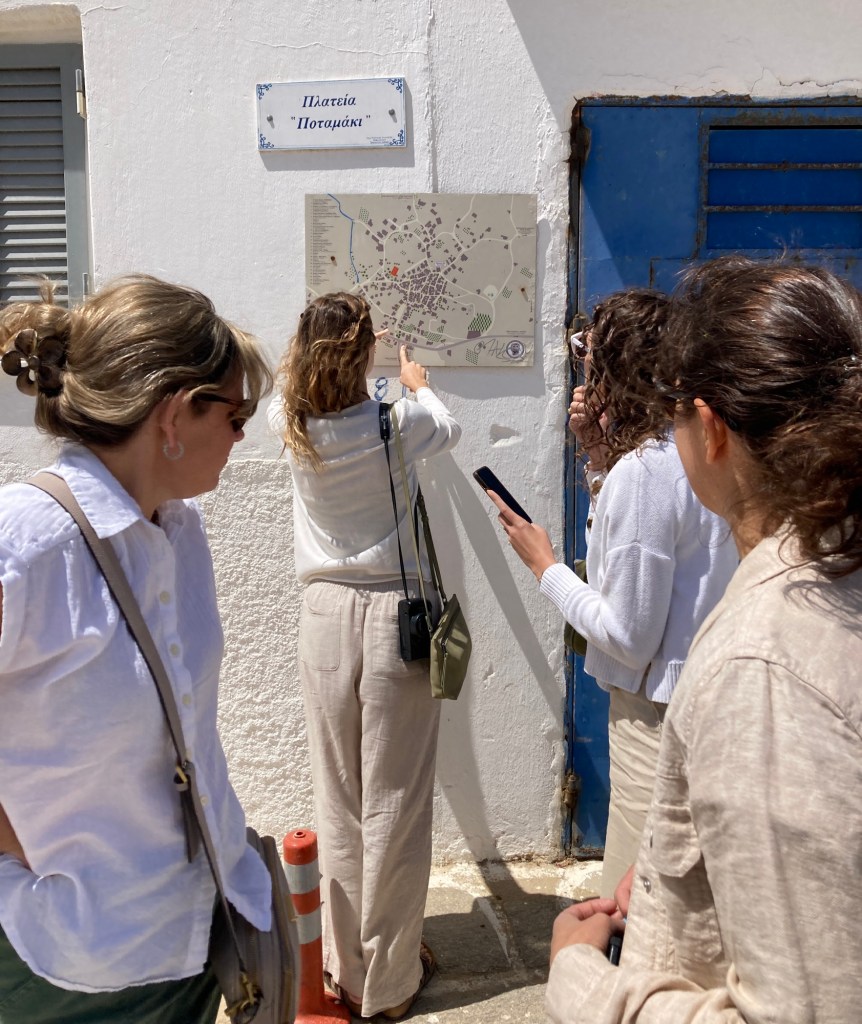
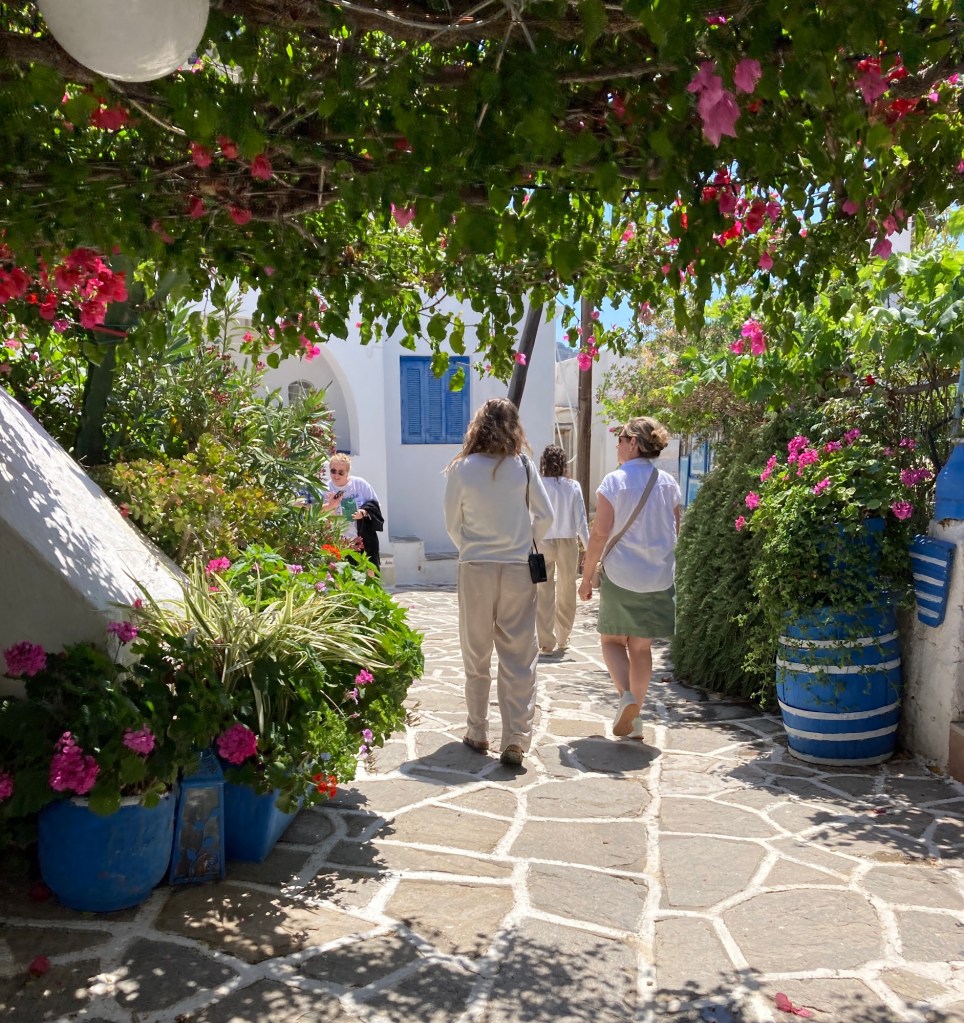
After a quick bus ride up to Lefkes, we strolled through the town, always heading gently downhill, on the Byzantine Trail, a thousand year old road that is by modern standards a path between Lefkes and Prodromos. The huge 19th century Agia Triada church that was built of local marble we found closed; reportedly services are held morning and evening every day.
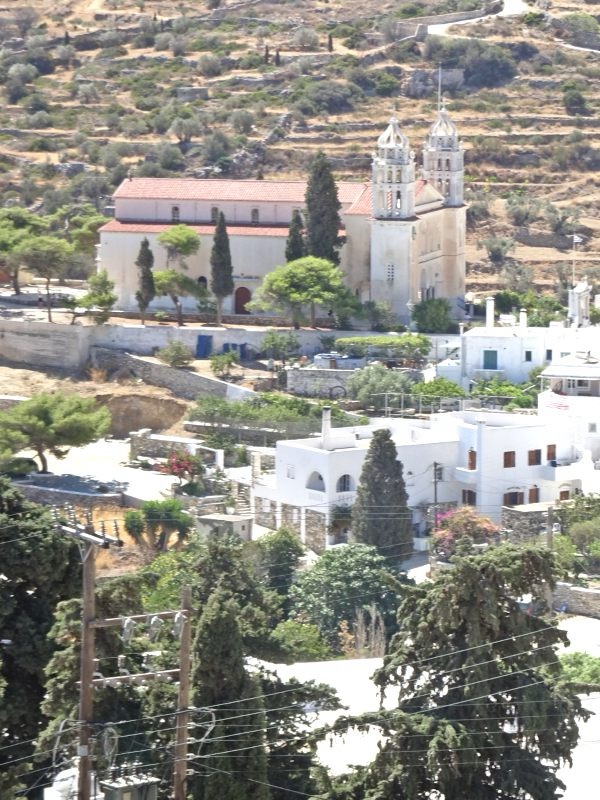
Lefkes, Internet photo

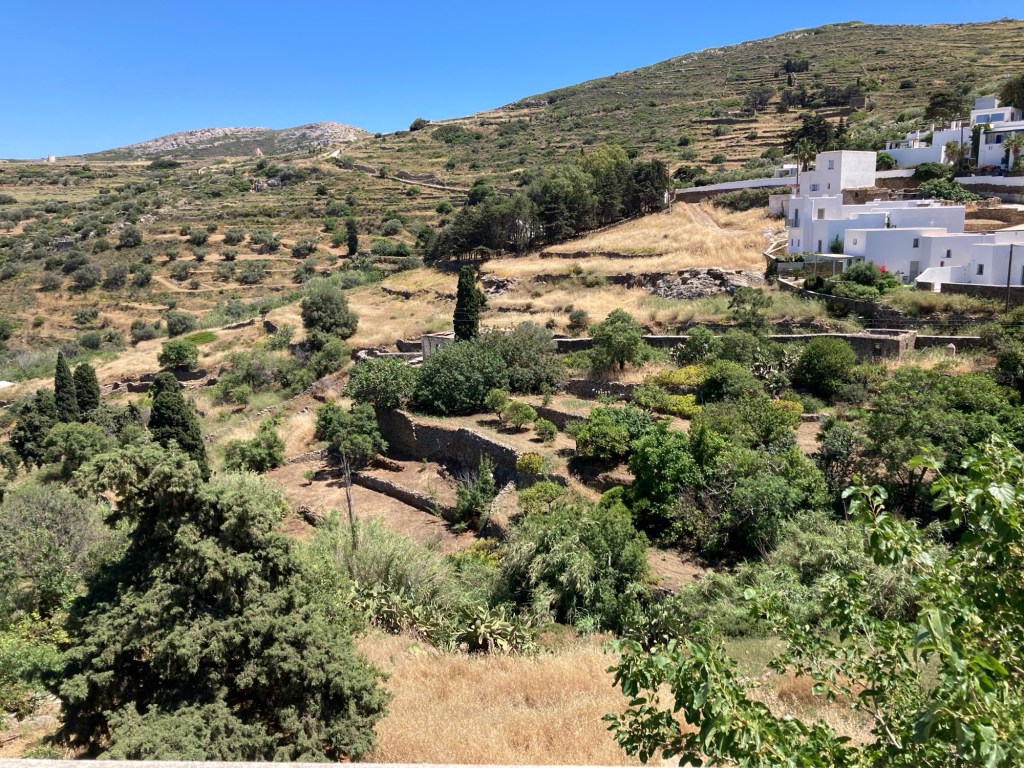
The trail soon left the town and wound on down the hill, with views on all sides of ancient terraces built of stones pulled from the earth that is rich with them, and naturally poor from the stoniness. A few of the thousands of plots are evidently being used again, though tourism has supplanted agriculture in the island economy.
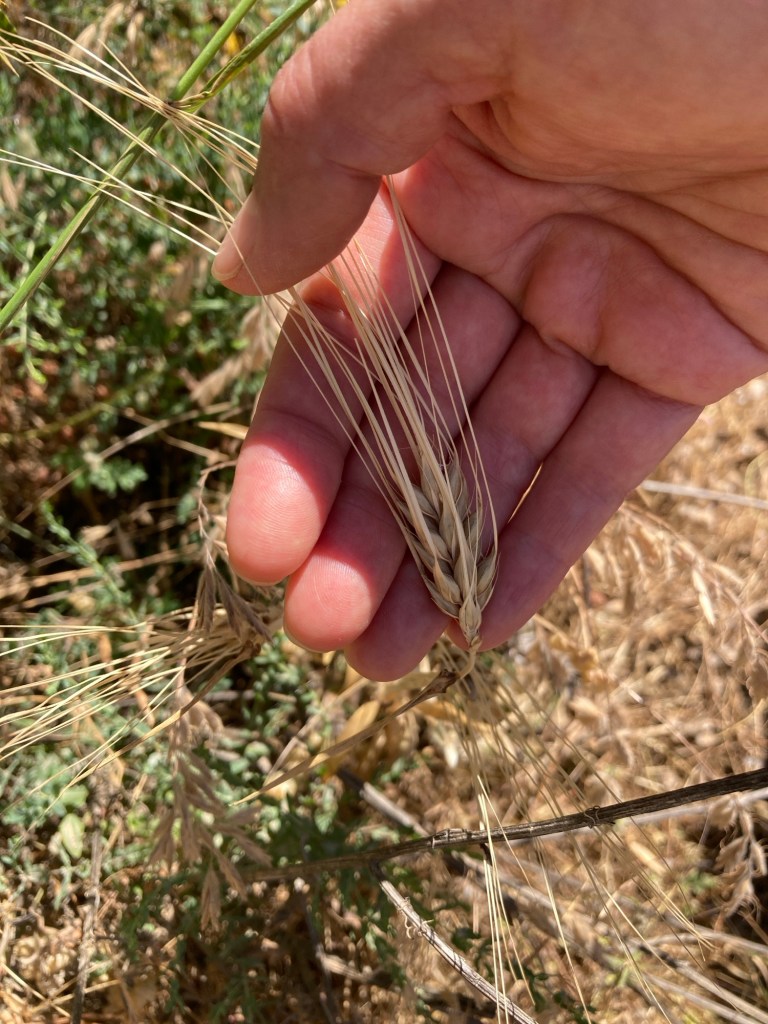
Barley

It is easy to imagine the farmers in the old days growing fava beans and keeping goats on those terraces. We did pass one old man keeping watch over his goats that very afternoon.
Pippin and I kept lagging behind the others to investigate all the strange or familiar plants along the path, which included at least a dozen species of prickly types.
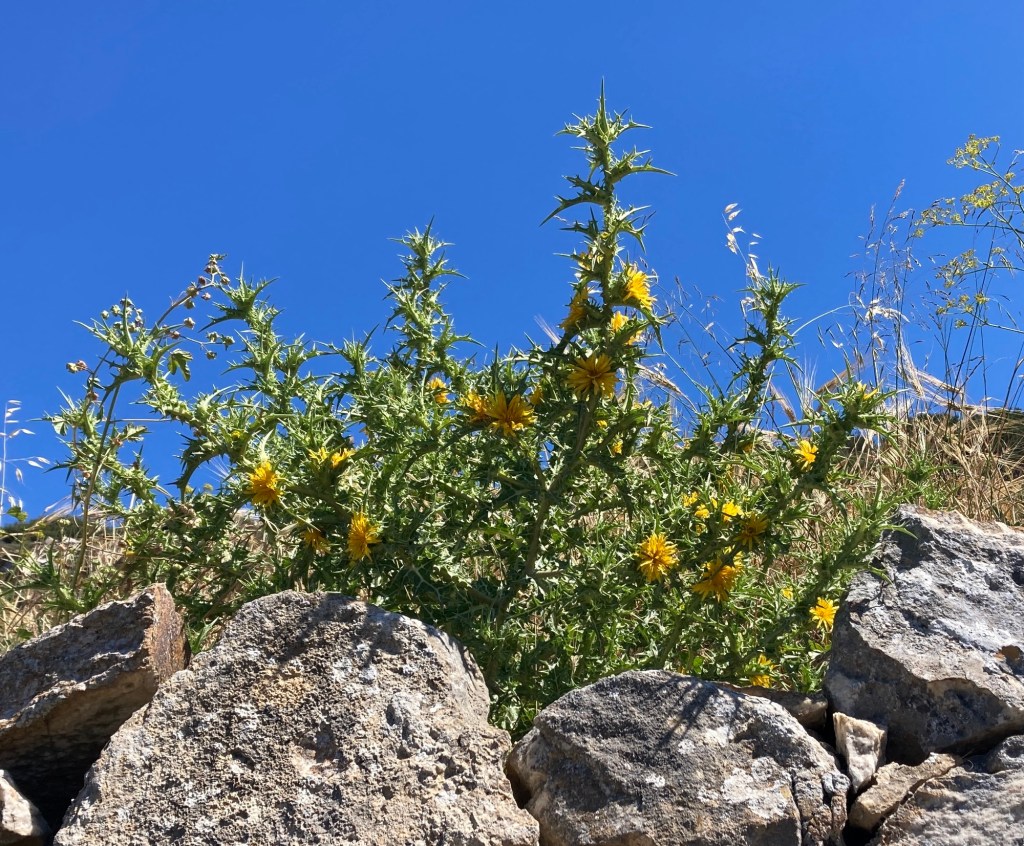
Common Golden Thistle

There was even a beautiful but thorny type of acanthus, which it took me a few sightings in different stages of its flowering to recognize as being related to the majestic version in its glory right now, back home in my garden.
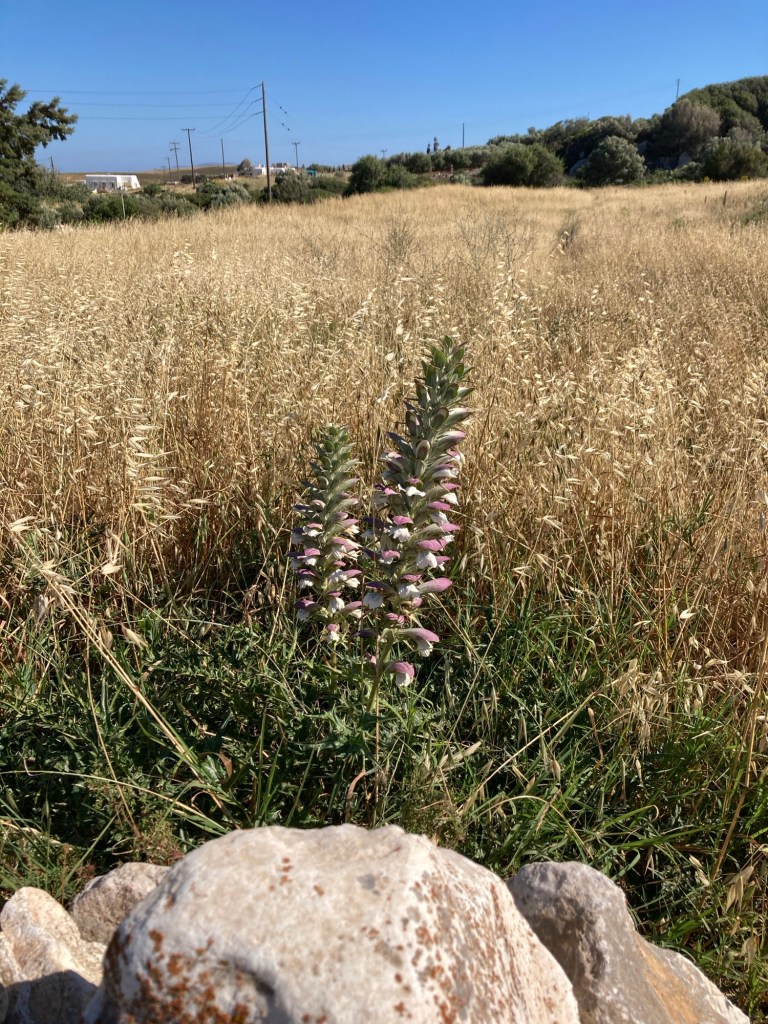
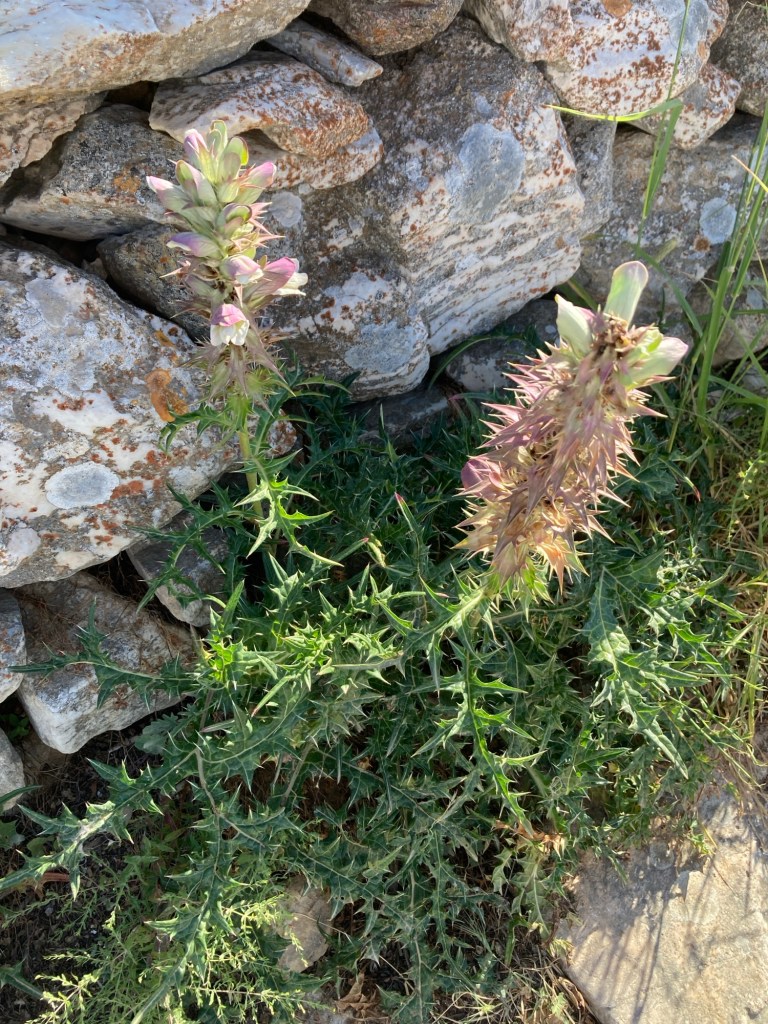
Acanthus

I was so happy to be wearing my new hiking boots that kept me comfortable and mostly steady on the road that was sometimes dirt, sometimes roughly rocky and uneven, and often paved with wide and flat marble that had been polished smooth over the centuries.

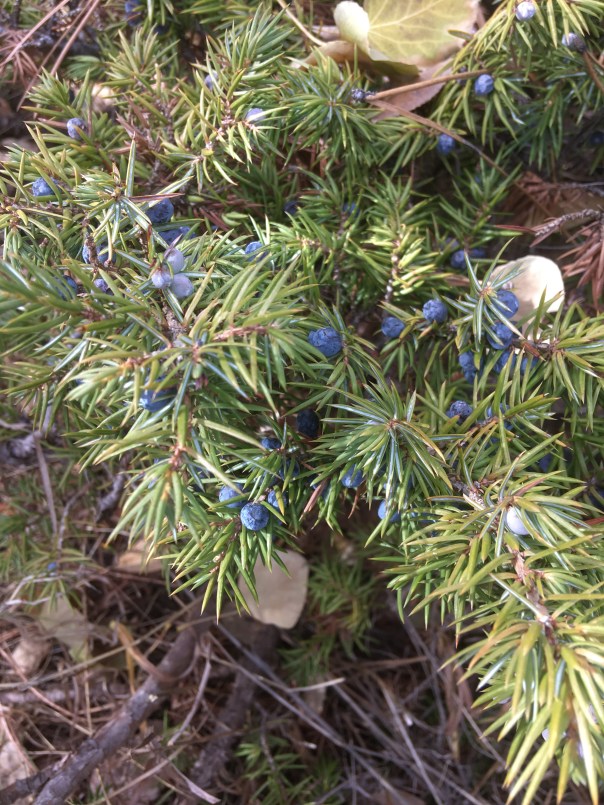
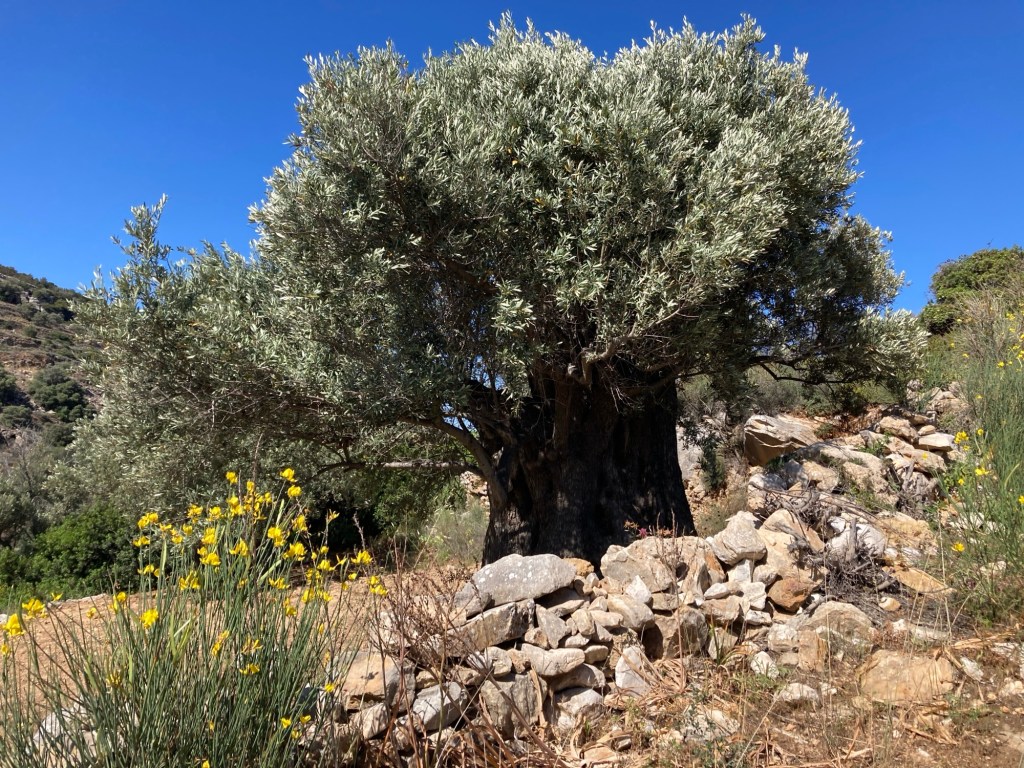
Phoenician Juniper

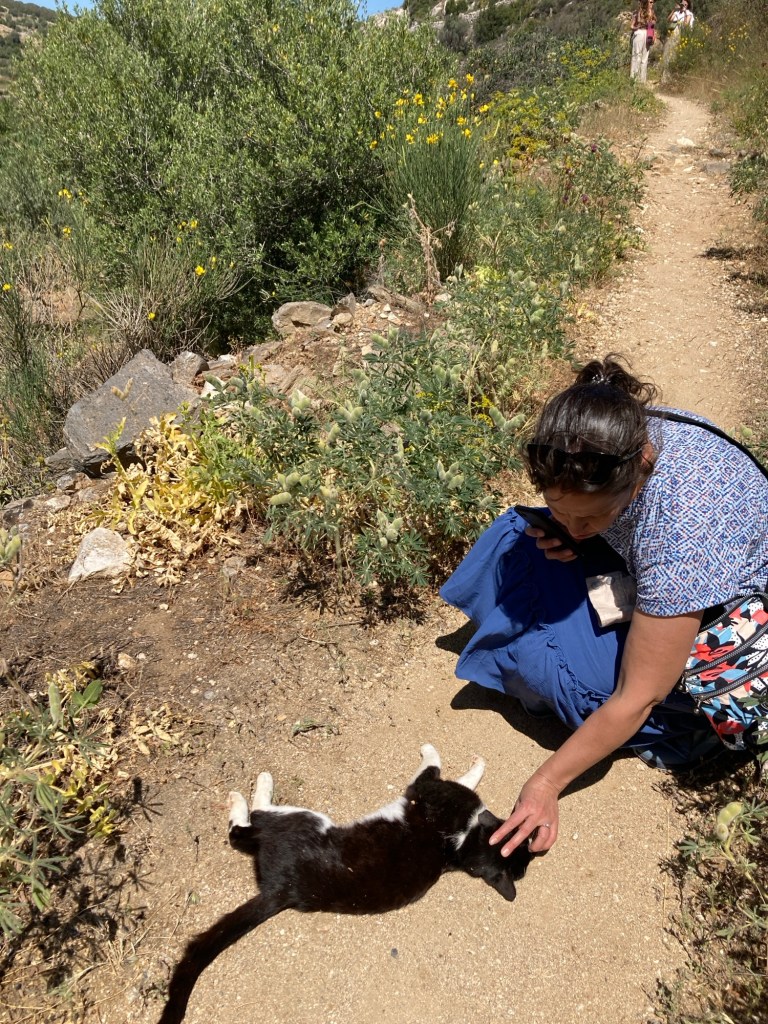
The ubiquitous cats greeted us on the Byzantine Road, begging attention, which at least a couple of us were happy to give.
I was in my element, under the warm sun, so many interesting plants to see, with my favorite botanist partner and in the company of other family favorites, getting good exercise among terraced hills — it all was so healthy and alive that I could forgive the wind that tangled my hair, and the thistles that grabbed at my legs.

Yellow Spine Thistle

I hadn’t known ahead of time just how much of a nature walk this trail was going to be, and I couldn’t get over my good fortune at being the recipient of this blessing, accomplished through the labors of my girls, from Kate who was willing to drive to Maggie who buys us pastries.

Eventually our walking trail brought us back to our car in Prodromos, and we returned to our house across the island. At the end of the day we had walked more than five miles, and we all slept very well that night under Aegean skies.
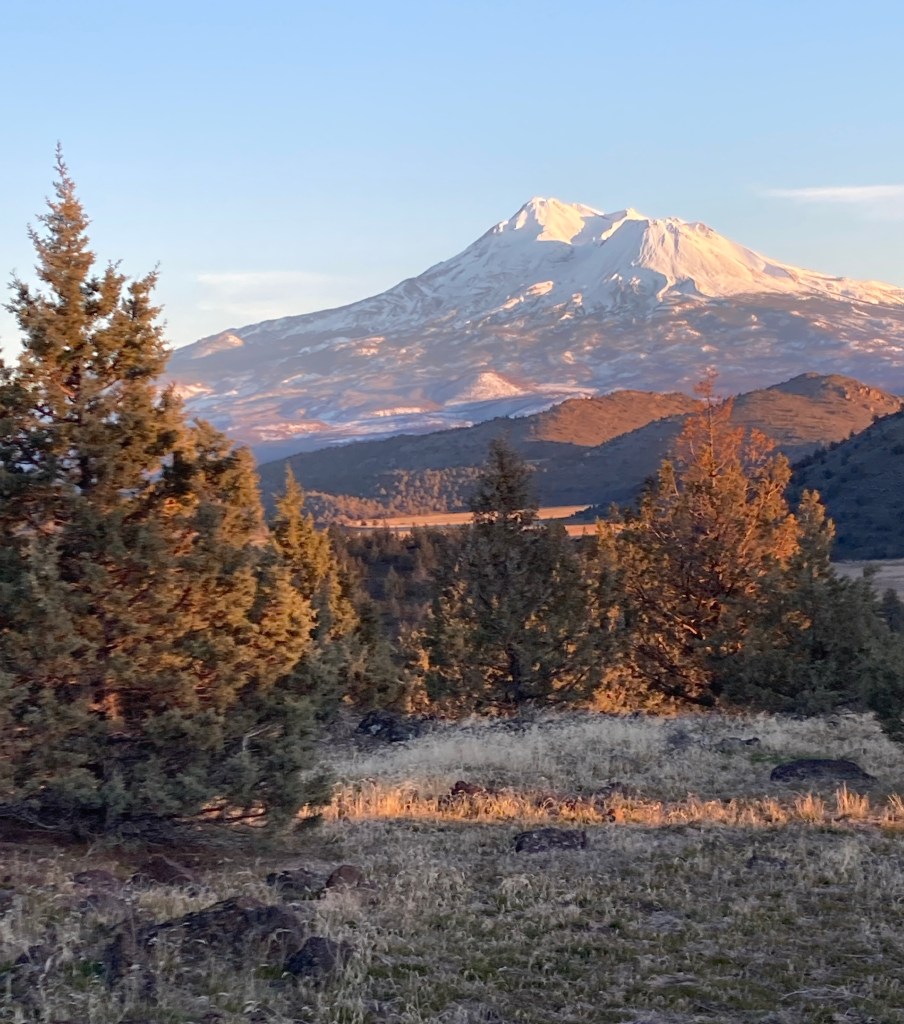
Looking at Shasta and lichens.

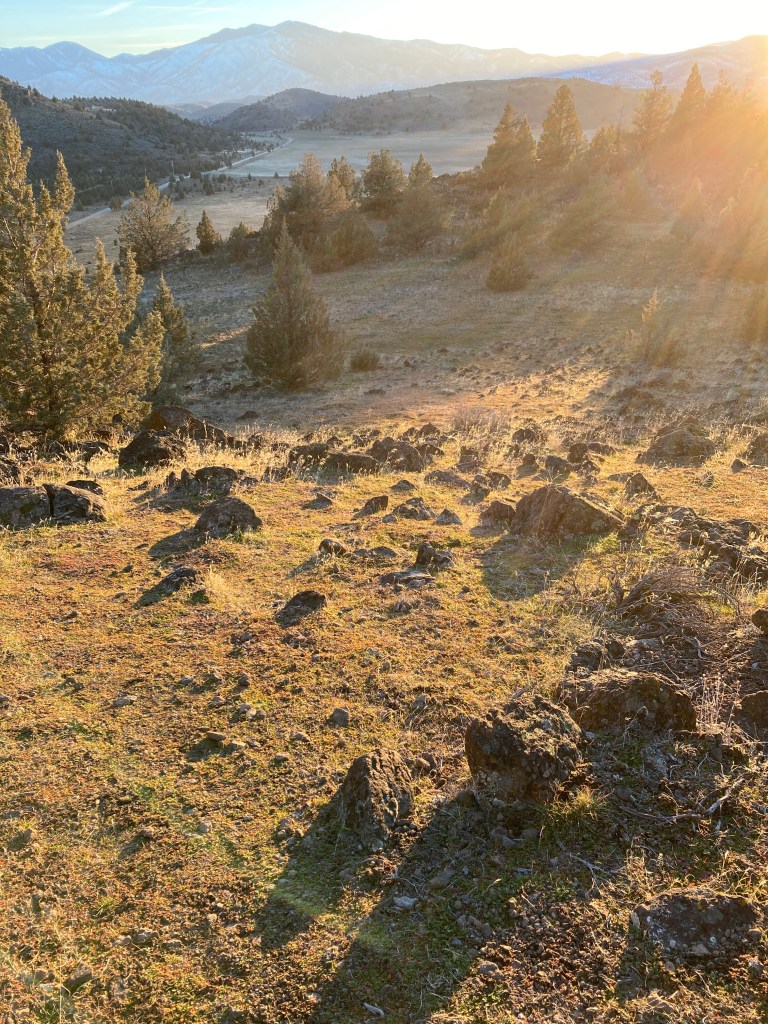
The thermometer hovered at the freezing point all day, everywhere we went. The places we explored, though, were out of the woods and piles of snow, in more arid expanses dotted with rocky hillocks and juniper trees.

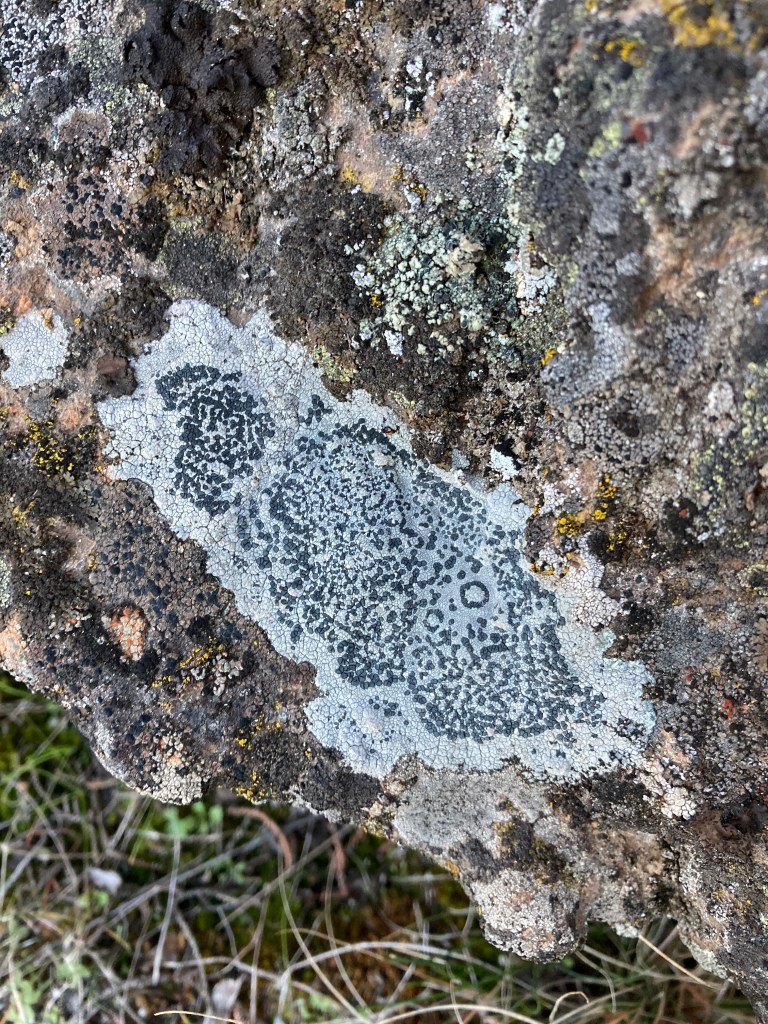
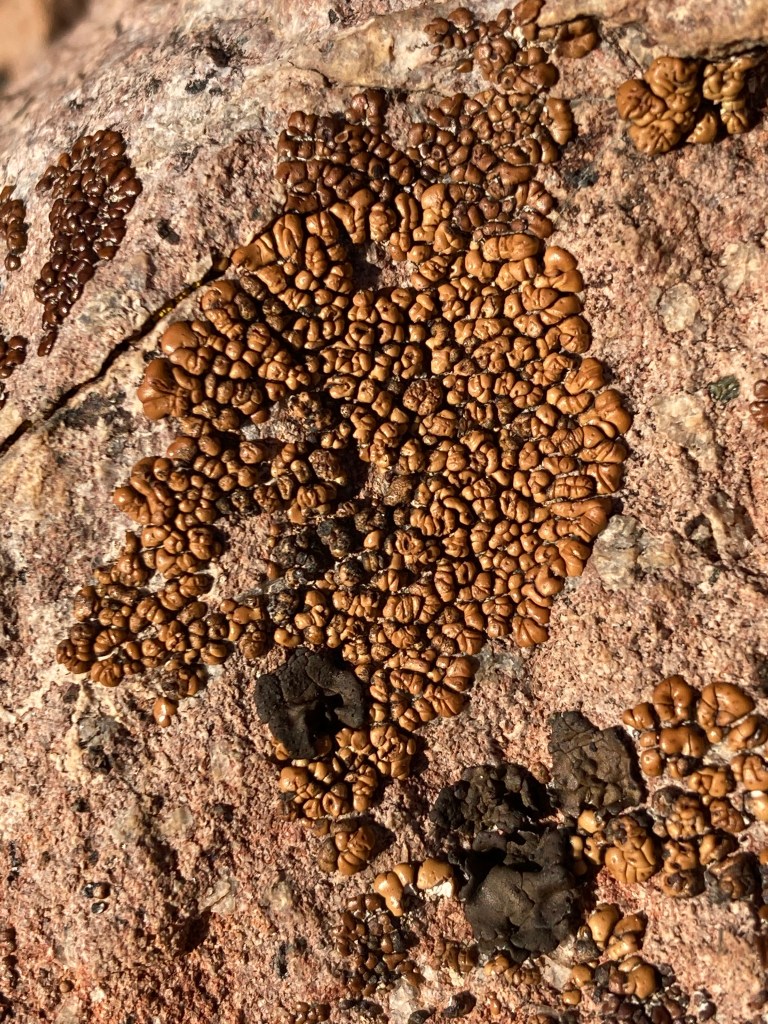
The volcanic peak of Mount Shasta rose high above the rest of the land to the south. Closer to the ground, lichens and mosses grew thickly on rocks.

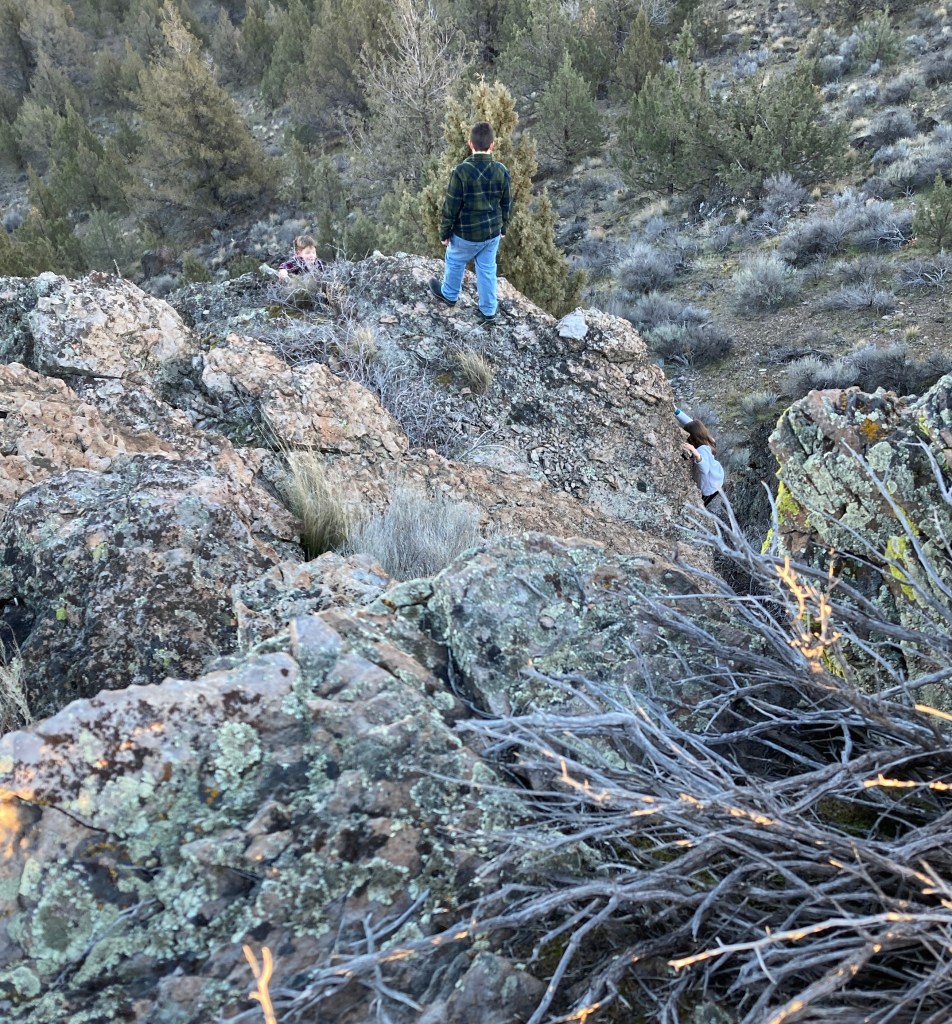
We ate a snacky lunch on the highest pile of boulders, and the children scrambled up and down and climbed rock faces with bare hands that eventually turned red and numb with cold.

I was surprised at how the slightest breeze cut right through my several layers of under and outer winter garments. It was so gorgeous, I wished we could have roamed for more hours. Maybe in another season.

We departed as the sun was going down and taking its tiny bit of warmth from us. The first day of 2022 had been pretty nice!

Tears in my paint box.

As I walked this morning, I took pictures of beautiful things, and mused.

As I thought about Christmas season heartache, I couldn’t remember any teary sessions last Christmas over missing my husband. I was too busy navigating airports, interacting with family, dealing with extreme temperatures low and then high, ending the season in India of all places.

But it’s true what they say, that the holidays are the hardest. And now I’m back at it, though even what is hardest gets a little easier all the time. I suppose it helps that my life has been awfully busy again this December, though with an entirely different set of challenges that consume my attention and distract me from dwelling on things I can’t have. The challenges are much less than most people I know have to deal with! They can be grouped under two categories: 1) Being a single homeowner and 2) Getting older.

It’s also true, that I am creating my new life. At first, when I read that phrase in Fr. Alexis Trader‘s series on grief, which had providentially been written in time for my initial bereavement, I questioned it from my philosophical viewpoint. We can view our existence primarily as a given, as in, each breath that we breathe is a gift from God; our DNA is what it is, the home that nurtured us was not a result of our efforts. Or we can go with the modern idea that life is what we make it, we create our own reality.

But now we’re not talking about a philosophical stance; rather, it is each person standing with their heart before God in humility and thanksgiving. Every decision I make, at every fork in the road every moment of the day, is like choosing to dip my paintbrush in one color or another, to apply the paint in a unique way to the canvas that is my life. This imperative to choose is also a gift from God, an aspect of our humanity that can’t be avoided. The first choice to be made is whether to accept our life from God and thank Him for it.

As to the opportunities, limitations, paints allotted, it appears that some of us have only a few colors to choose from, while others seem to have thousands. And the palette changes daily. This was always true; I don’t know if something about the process changed when I became a widow, or if I have only needed to keep reminding myself of it to be assured that something creative is still going on.

Do I have legs? A home and a bank account? An idea, an urge, health, or pain? Did I sleep well, or am I suffering from foggy brain because of sleep deprivation? I can “paint” a prayer with everything, and that is the most divine creation; most days I make some kind of outward “picture” as well that is more or less satisfying. It’s not profitable to spend much time looking at the painting, but rather to keep the given tools in hand and keep working.

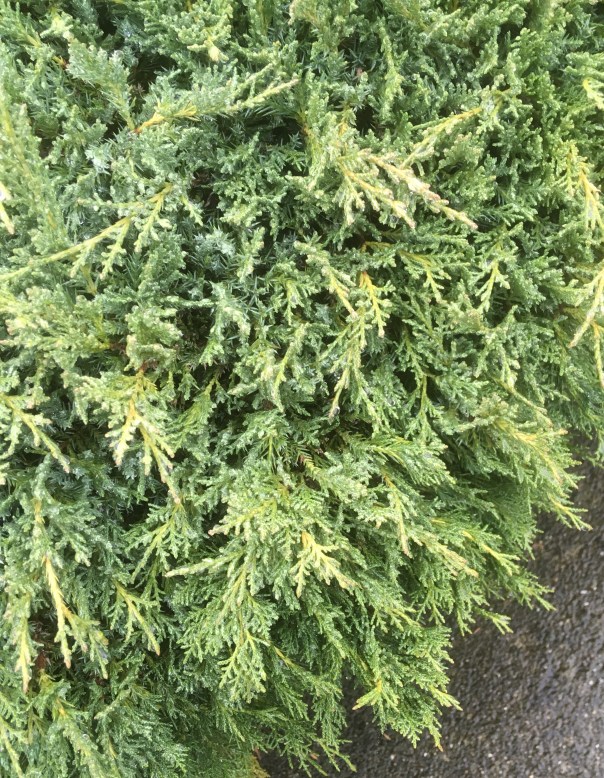
Walking in the fog this  morning, I was trying to get through the Lord’s Prayer without my thoughts flying off in a hundred directions. I must have started over five times and was as far as “Give us this day our daily bread,” when I was brought up sharp by a sensation, and all my thoughts vanished. I stopped and looked around, to see where the scent was coming from, and there was the juniper hedge along the sidewalk, pouring out its essence via every drop of drizzle.

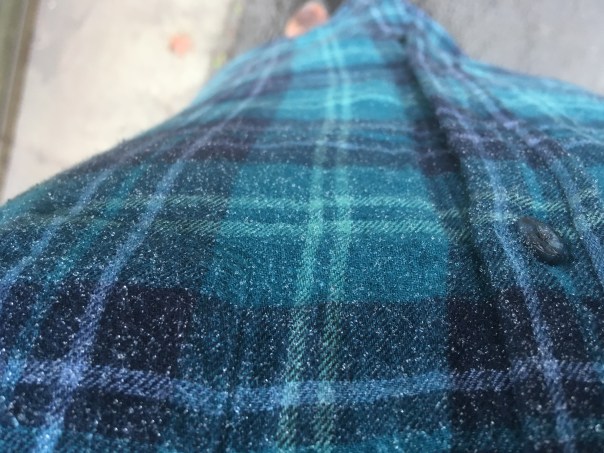
Daily bread. If the sky is bread for the eyes, this intense juniper aroma, rich with memories of walks with my grandma, is certainly bread for my nose, and it goes right to my soul. I closed my eyes and stood next to the juniper long enough to take several deep breaths, and then continued on my way, and the fog continued to turn into something thicker and wetter. My flannel shirt was all fuzzy-misty, and water trickled down my face.

As I walked I kept thinking about my grandma, whose husband died when she was over 80 years old. She immediately sold the house that they had shared for 40 years, which everyone thought was hasty. The apartment she moved to was not smaller, and she still had three floors of stairs to climb, until she was over 100. But she could call the landlord about problems instead of calling the handyman directly. I’m not sure that was an improvement.

But wait — Didn’t that juniper smell get painted directly by God on to my life’s canvas? It was given as a completely whole and splendid thing; I contributed nothing.

And while I began this preachy ramble in the morning, by evening I could not understand the metaphor that seemed clear at noon, because I was feeling so achingly the absence of my husband. It was as though my tears spilled all over my paintbox and my vision was muddied. But I had planned to go to church, and I went. My spiritual father said that if I weren’t emotional during this season, he would worry that my heart had hardened to a stone. At times, my grief is the only color available.

When I came out of church, the full (solstice) moon was still rising. I drove down the road toward home and away from other lights, and the moon straight ahead of me became huge and clear and bright. It took my breath away, and as Christmas carols automatically started playing over my Bluetooth, I felt that the moon was also singing, “Glory to the newborn King!”

Before I reached my house the Kingston Trio were singing, “All Through the Night,” which they had made into a Christmas carol by tweaking a couple of lines. If you’d like to hear the music, sung in the original Welsh, this is a nice rendition. One version I found online has a verse that expressed how I was feeling this evening:

Love, to thee my thoughts are turning
All through the night
All for thee my heart is yearning,
All through the night.
Though sad fate our lives may sever
Parting will not last forever,
There’s a hope that leaves me never,
All through the night.

But for the first time ever I heard the traditional two verses of the lullaby not as something to sing to my child, but as God singing to me, and though the moon had gone behind a cloud, I knew that it, too, had been painted on my canvas.

Sleep my child and peace attend thee,
All through the night
Guardian angels God will send thee,
All through the night
Soft the drowsy hours are creeping
Hill and vale in slumber sleeping,
I my loving vigil keeping
All through the night.

While the moon her watch is keeping
All through the night
While the weary world is sleeping
All through the night
O’er thy spirit gently stealing
Visions of delight revealing
Breathes a pure and holy feeling
All through the night.

Rabbitbrush and butterscotch.

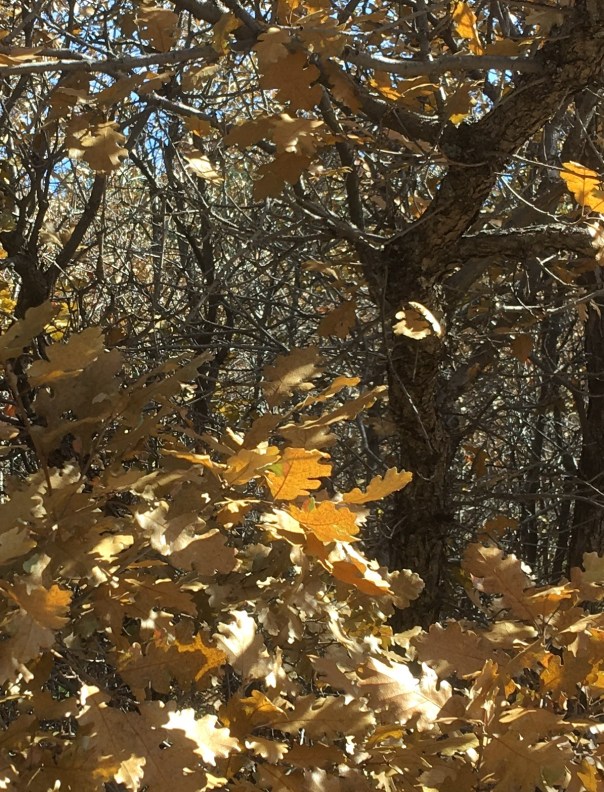
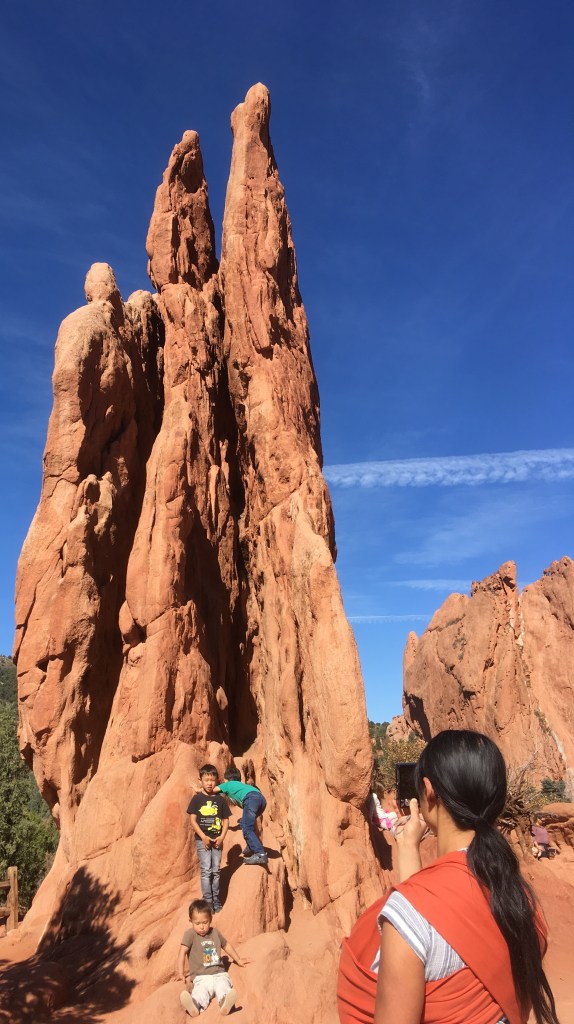
Last week was full of rocks and trees and even flowers. Joy and I took the children to Garden of the Gods, where red sandstone in ragged forms towers above the walking paths. Even the littlest guy walked more than two miles among the juniper and mountain mahogany, and wildflowers mostly gone to seed. The Gambel oaks, also known as Rocky Mountain white oak or Colorado scrub oak, had probably displayed more varied shades of orange and yellow a few weeks ago, but when we encountered them the leaves had aged to a rich, mellow gold.

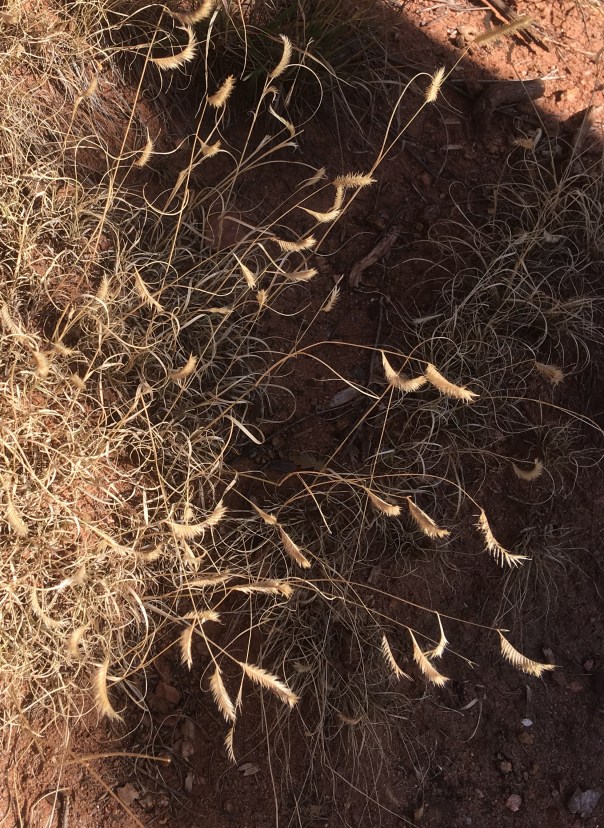
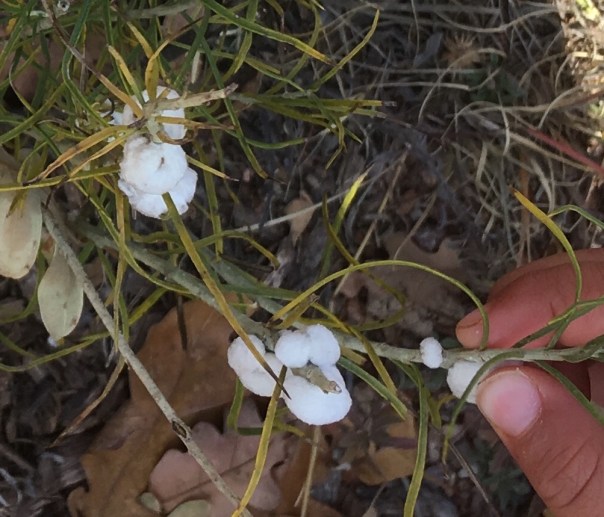
We saw the rabbitbrush in many forms and places, but didn’t know what it was until just before we left the park and saw its picture in the visitor center. I have known of rabbitbrush for decades and I hope that after this extended encounter I will not forget it so easily. We saw its flower, two sorts of galls on the plants, and noticed its needly leaves and how they are softer than conifer needles. One of the galls is cottony gall; the other I haven’t been able to identify.

The very next day the whole family drove up to Woodland Park; it’s less than an hour to this town that lies at 8500 feet. We walked along Lovell Gulch Trail, among several species of conifers and groves of aspens. We suspected they were aspens, but we knew that birch have similar bark, so when we got home I googled around and it became clear that yes, what we saw were aspens, so plentiful in the Rockies and in dry places high up, while birches like floodplains and shade. And the few leaves that we saw  — most had fallen after turning bright yellow — matched the pictures of aspen. I only saw one bright leaf, of another species.

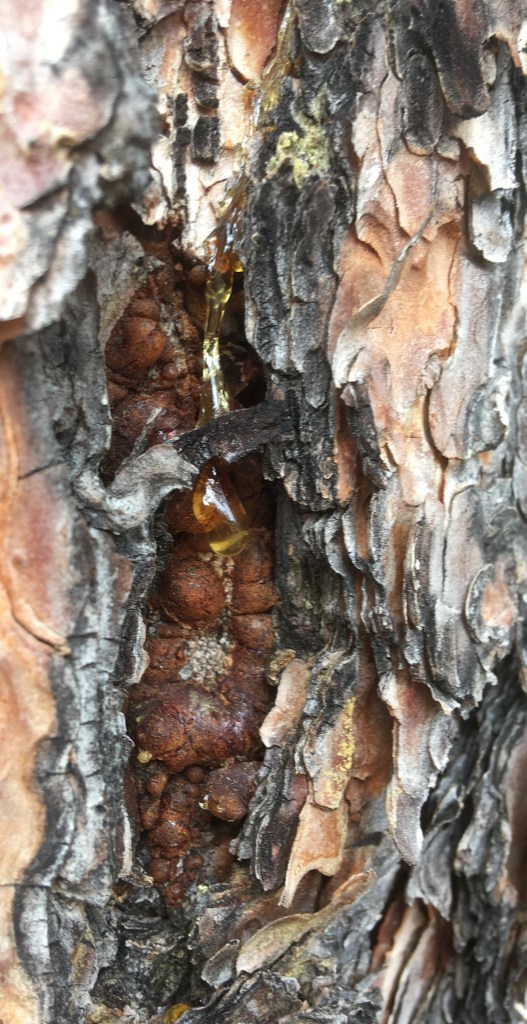
We admired the bark of other trees, especially one that had lots of texture, and fresh sap flowing. Soldier had a sudden thought, came close to get a whiff, and concluded, “Oh, it must be a Jeffrey pine — they smell like butterscotch.” Indeed. Oh, that was delicious! I made up a mnemonic story for myself about a boy named Jeffrey who was walking down the trail and discovered a butterscotch drop on a tree trunk.

The view of the mountains is striking from there, a different perspective from our daily one. We have seen Pikes Peak from several angles now, and don’t know the names of any of the other peaks visible from here. Soldier just read that Colorado has more than 50 peaks over 14,000 feet. Colder temperatures are coming this week, and yes, snow is on the forecast, too. So our views will grow even more spectacular.