The most exciting thing that happened this week was the delivery of trees, and the most beautiful one that came was the pineapple guava. I don’t think I have ever seen a more beautif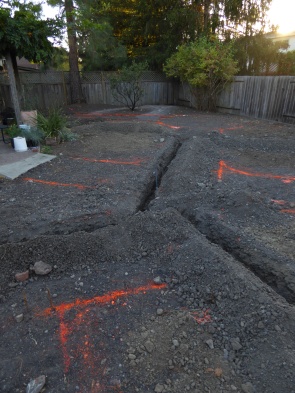 ul specimen of tree. And so big already, stretching its arms wide, eager to grow on a trellis in the corner of my yard, behind a sitting area.
The trellis will provide support for a generous eight feet in each direction, sideways and up, and the tree will be one part of the design that blocks out things like the neighbors’ big boat across the fence; it will be one of the many plants that help to turn my yard into a sheltered and cozy oasis.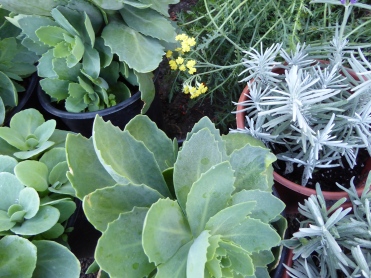
Early in the week workers drove noisy machines into the hard soil and clay to make trenches for irrigation pipes, and for electric wires to the spot where a fountain will play water music.
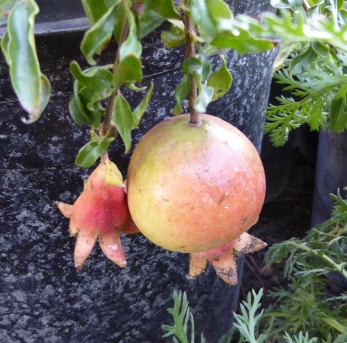
Landscape Lady brought more plants in the back of her car and we carried them together to the back, succulents and yarrow and salvia; lavender, phlomis and kangaroo paws, some still in bloom or with fruit, like this darling dwarf pomegranate.
Now when I look out the window I can see so much more than the sea of dirt. In addition to the many pots of colorful plants, huddled in the spot reserved for the play house, I see orange or hot pink paint, drawing out the lines for paths and planting beds, so the edging will go in the right place, after the dirt goes in the right place. Landscape Lady has had to draw these lines several times because the workers tend to smudge them into oblivion.

Huge trucks have dumped three kinds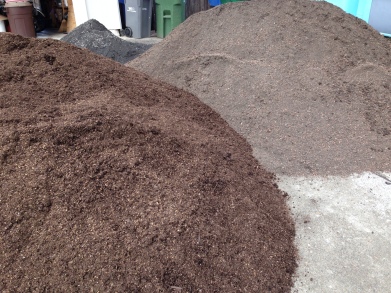 of dirt/rock into my driveway: base rock to form a good foundation for the gravel utility yard, compost to mix into the unknown stuff that was packed into the pool cavity, and vegetable planting mix to fill the boxes.
This is what it looked like before it all was carted to the proper places. Tomorrow another truck will roar slowly down the street and back into my driveway to dump three times this much, 20 yards of soil ! that Andres and Juan will push in wheelbarrows to the back yard and mound up in the planting areas. 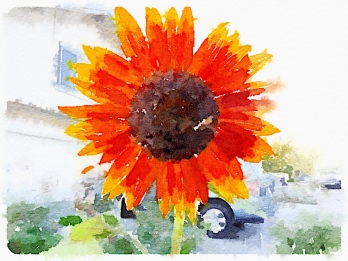
In the front yard my chard and collards and kale are growing; they liked the recent rain. The late sunflowers are pretty still, waving at the people walking by; I let the Waterlogue app paint one for me. I weeded and trimmed salvias and roses and more things out front, and staked the heavy mums again, on one of these gorgeous fall days that make a person fall in love with the e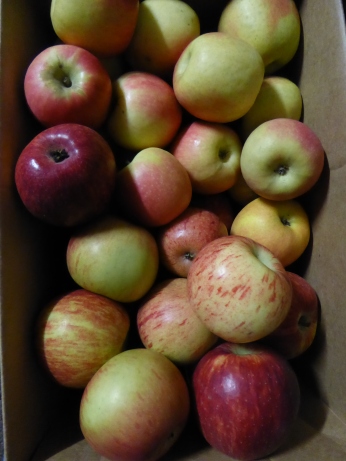 arth.
arth.
This afternoon I made my first-ever solitary trip to the apple farm that has supplied our family for at least 25 autumns now. It’s a little late, so they only had four of their 27 varieties for sale: Arkansas Black, Granny Smith, Pink Lady and Rome Beauty. Even their names are delicious! I brought home Ladies and Beauties, and ate one as soon as I got back in the car.
I stopped to get some supplies for yet another koliva, the ceremonial dish we Orthodox make for memorial services. Tomorrow we will have prayers before Vespers, in memory of a parishioner who helped me learn to bake communion bread many years ago. As she doesn’t have any family in the parish who might want to do it, I offered to make the koliva.
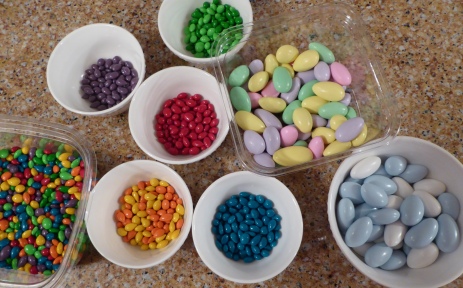
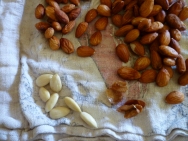
In this town I can’t get single colors of Jordan almonds, which are very traditional to include, so I sorted out the colors I wanted from an assortment. The bright chocolate-covered sunflower seeds looked appealing, too, so I picked over and separated some of those. I don’t know yet which I will use for decorating the dish of boiled wheat — except for the chocolate pastilles; they will go on top for sure.
Some recipes say that pomegranate seeds are essential, to mix in with the wheat and nuts, etc., but of course they aren’t always in season, and they weren’t when I made my first batches. Now I guess you can often find them frozen in upscale markets, but certainly in centuries past not all memorials were held in late summer or fall. So I didn’t worry about not having them. 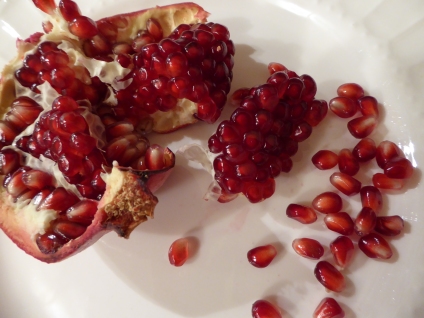
Now that Pearl has moved back to California, she has a giant pomegranate tree right near her front door! And this time I have the seeds to add to my recipe. A pomegranate is a wondrous thing; I remember an orchard of them near my house as a child, and the first time I broke into a fruit and discovered the honeyc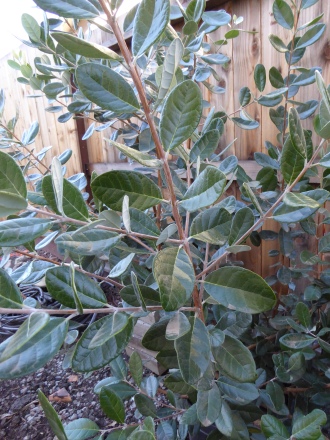 omb of juicy red seeds. My grandson Liam eats each seed carefully, biting it and sucking out the juice, discarding the (mostly) pithy part.
One pomegranate yielded just over a cup of seeds. I boiled my wheat tonight, and ate another apple, and now that I have told you some of the story of my week, I will go to bed happy and in love.
 in the Orthodox Church a memorial service is often held at three months (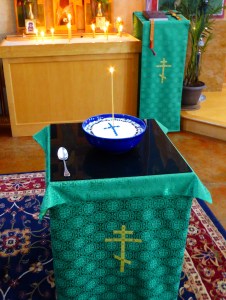
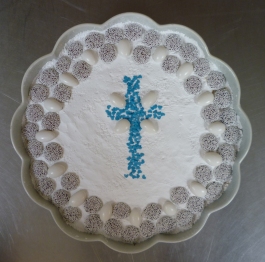 It is traditional in Orthodox churches to have a short memorial forty days after a death, and though my husband was not Orthodox, I am, and I am the one remembering and praying for him. Last week my priest generously held this service, called a panikhida, and I prepared the dish of boiled wheat called koliva for us all to eat together at the end of the service.
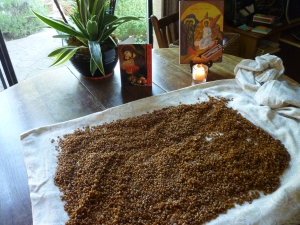 The essential ingredient is boiled wheat – but actually, even that is not essential, because sometimes it is rice, or lacking wheat, barley or another grain can be substituted. But the image of a kernel of grain being buried endures, as in the Gospel of John Christ speaks of His own coming death, “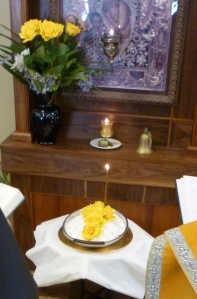
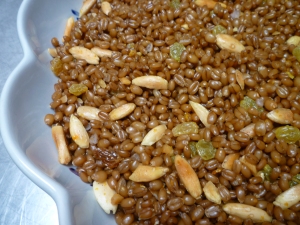
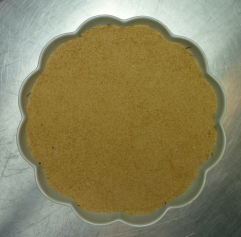 t I put the final layers of my dish together in the church kitchen where I could not find any waxed paper. My alternative method didn’t work so well, which is why the surface of my finished product has some flat areas, some imprints of my fingers, and some sugar untouched.
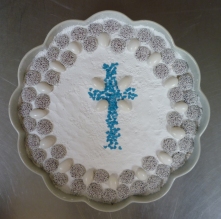 f chocolate or a candy. The koliva recipe was judged to be excellent.