Tag Archives: Lent

How to become fresh and youthful.

“The Paschal season of the Church is preceded by the season of Great Lent, which is also preceded by its own liturgical preparation. The first sign of the approach of Great Lent comes five Sundays before its beginning. On this Sunday the Gospel reading is about Zacchaeus the tax-collector. It tells how Christ brought salvation to the sinful man, and how his life was changed simply because he “sought to see who Jesus was” (Luke 19:3). The desire and effort to see Jesus begins the entire movement through Lent towards Pascha. It is the first movement of salvation.”

This excerpt from our church bulletin explains why this date on the church calendar is a good one for someone to become a catechumen, as two people did on Sunday in my parish, and as I did seven years ago. It was not my first introduction to life in Christ, but it was definitely the time when I climbed up to the best vantage point to see Christ and His Church in all its fullness.

When I was a little child in Sunday School I learned some details of the story by way of a song:

“Zacchaeus was a wee little man, a wee little man was he.
He climbed up in a sycamore tree for the Lord he wanted to see.
And when the Savior passed that way He looked up in the tree;
And He said, ‘Zacchaeus, you come down, for I’m going to your house today.'”

In his Gospel homily Sunday our rector pointed out that the Lord also said, “Make haste.” In other words, “Get down here, man! Don’t be dilly-dallying about, but begin right now to mean business with God.” And this week St. Nikolai explains how this man and his experience are meaningful to each of us:

“Today, salvation has come to this house.”
(St. Luke 19:9).

“Thus it was spoken by the One Whose word is life and joy and restoration of the righteous. Just as the bleak forest clothes itself into greenery and flowers from the breath of spring, so does every man, regardless of how arid and darkened by sin, become fresh and youthful from the nearness of Christ. For the nearness of Christ is as the nearness of some life-giving and fragrant balsam which restores health, increases life, give fragrance to the soul, to the thoughts and to the words of man. In other words, distance from Christ means decay and death and His nearness means salvation and life.”
….
“Draw near to us O Lord, draw near and bring to us Your eternal salvation.”

I go nuts with sweet and sour.


The sourdough experiment continued, through Ash Wednesday and Valentine’s Day. It felt a little hectic and chaotic (and nostalgic) to make cookies, pancakes, and bread, and eat candy, all in one week’s time. The chaotic part came from me being the only cleaner-upper of the kitchen. I always cook as though I have at least two of those following behind.

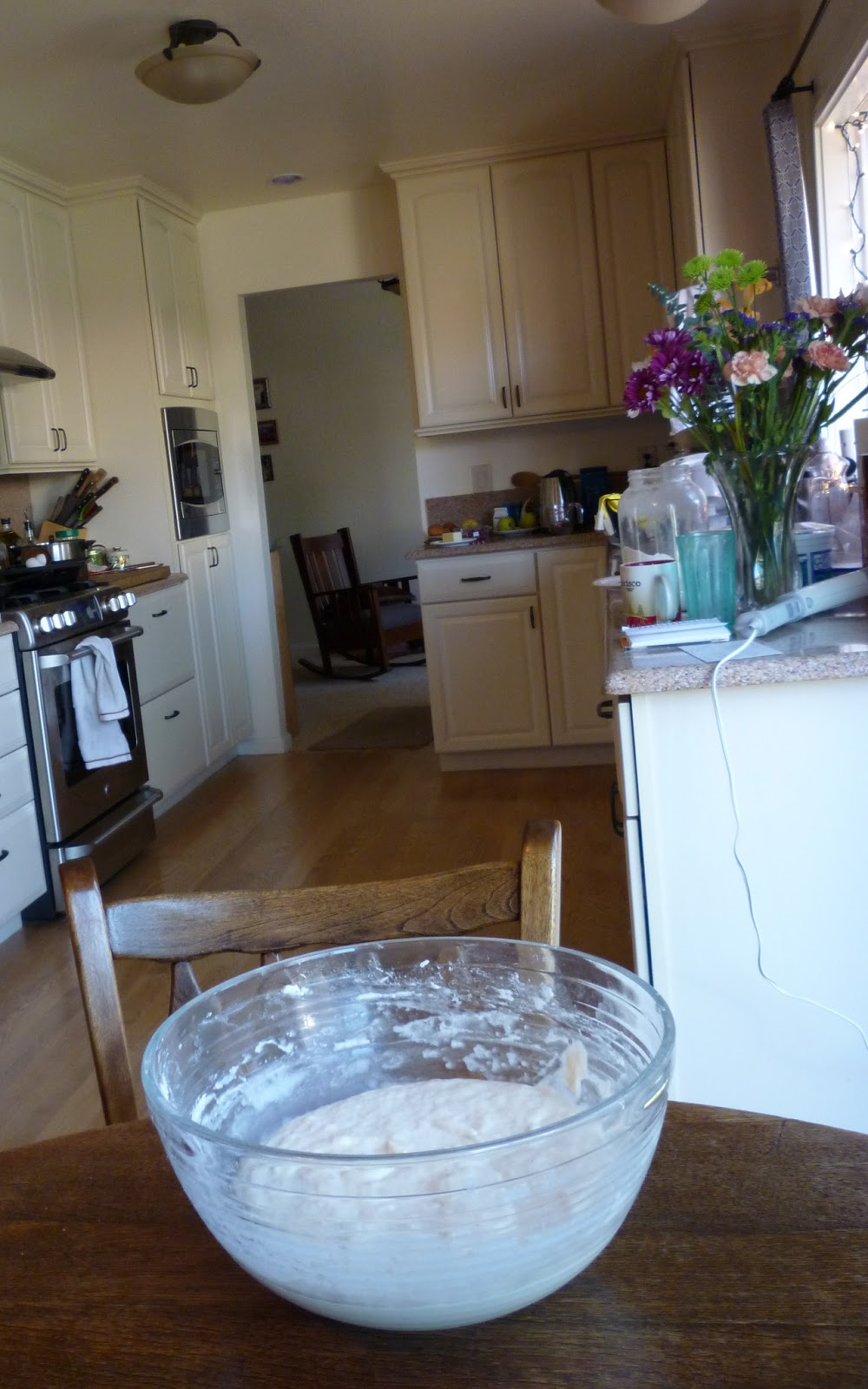
On Monday I put another sourdough sponge to ferment. This time I used the one made with pineapple juice, that took so long to get going. I had added a little buttermilk after a week or so and that seemed to give it a boost. At this point I added some flour and water and instant mashed potato flakes.

The next day was Shrove Tuesday or Pancake Tuesday, and for the first time ever I intentionally made pancakes for the day. I have never been in a church other than the Orthodox Church that had a liturgical calendar, and we don’t have Ash Wednesday. But Mr. Glad is Anglican now and I did it for the sake of that church’s tradition, even though there isn’t any need to use up all the eggs and butter in this era when Anglicans normally go on eating as they did before. All the while, the sponge sat nearby and got more sour and yeasty with those wild and local yeasts.

Wednesday morning I went to my first Ash Wednesday service with my husband. I didn’t take the ashes on my forehead, because I am not starting Lent yet, and when that time comes it will last just long enough.

In the evening I put together shortbread dough so that on Valentine’s Day I could cut out heart sweets for my honey. I used the Hearst Castle Shortbread recipe from 101 Cookbooks. Have you seen Hearst Castle? I went there and other places with my 8th Grade class on our Spring outing and don’t remember a thing.

All day I had thought about whether any minute I should finish up the bread dough and put it into pans to rise…I planned to make this batch without adding any commercial yeast, the way I used to do at the beginning of my sourdough career. In those days it was the usual thing for the dough to proof in the pans for several hours before it had risen enough to put into the oven. A couple of times I’d let it go all night.

As it happened, it just didn’t happen until the evening, that I could manage to get to it, and add the rest of the ingredients, i.e. some olive oil and mostly white flour. I forgot to add any sweetening, and I wrote down to put in 1 tablespoon of salt. But did I do it?

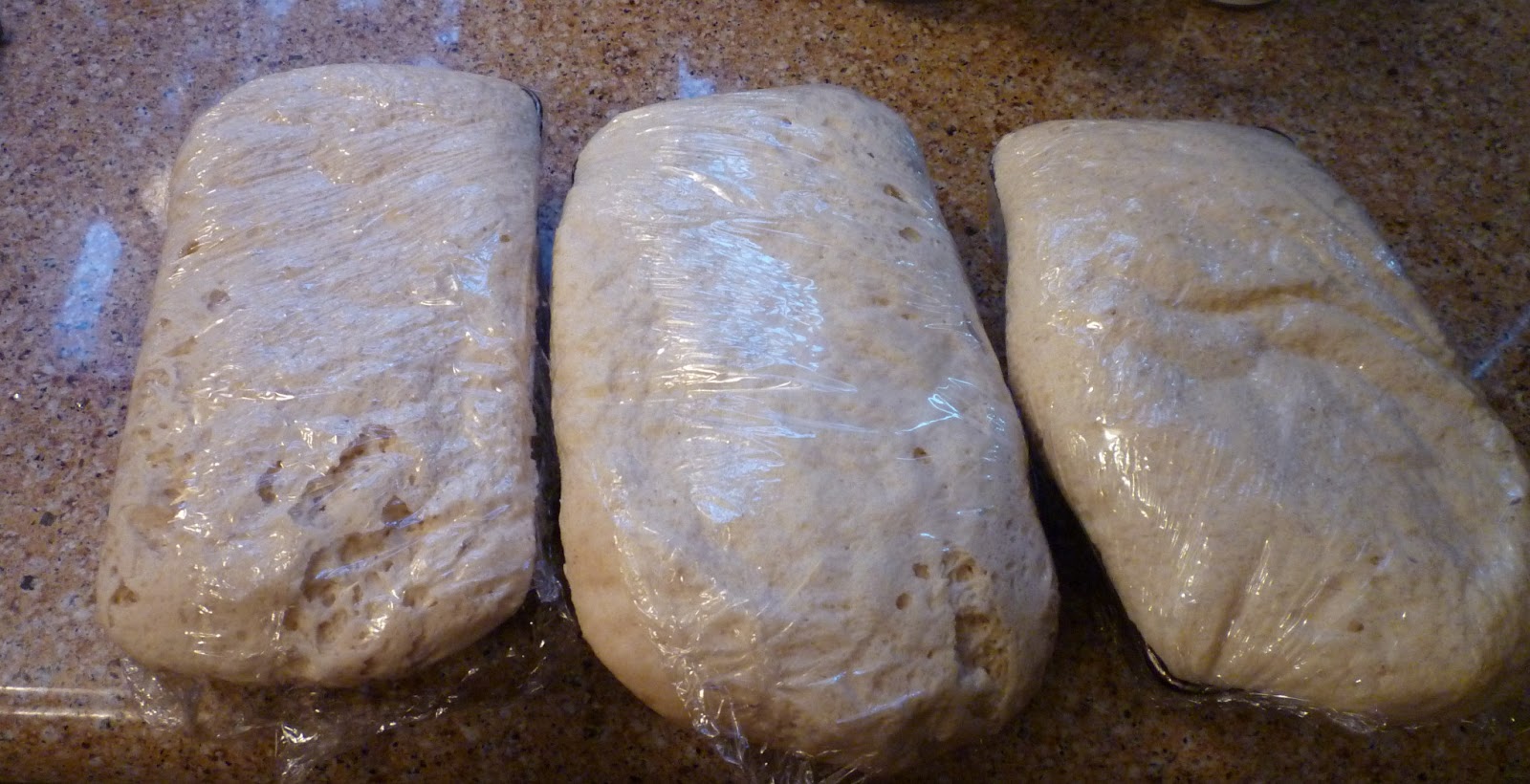
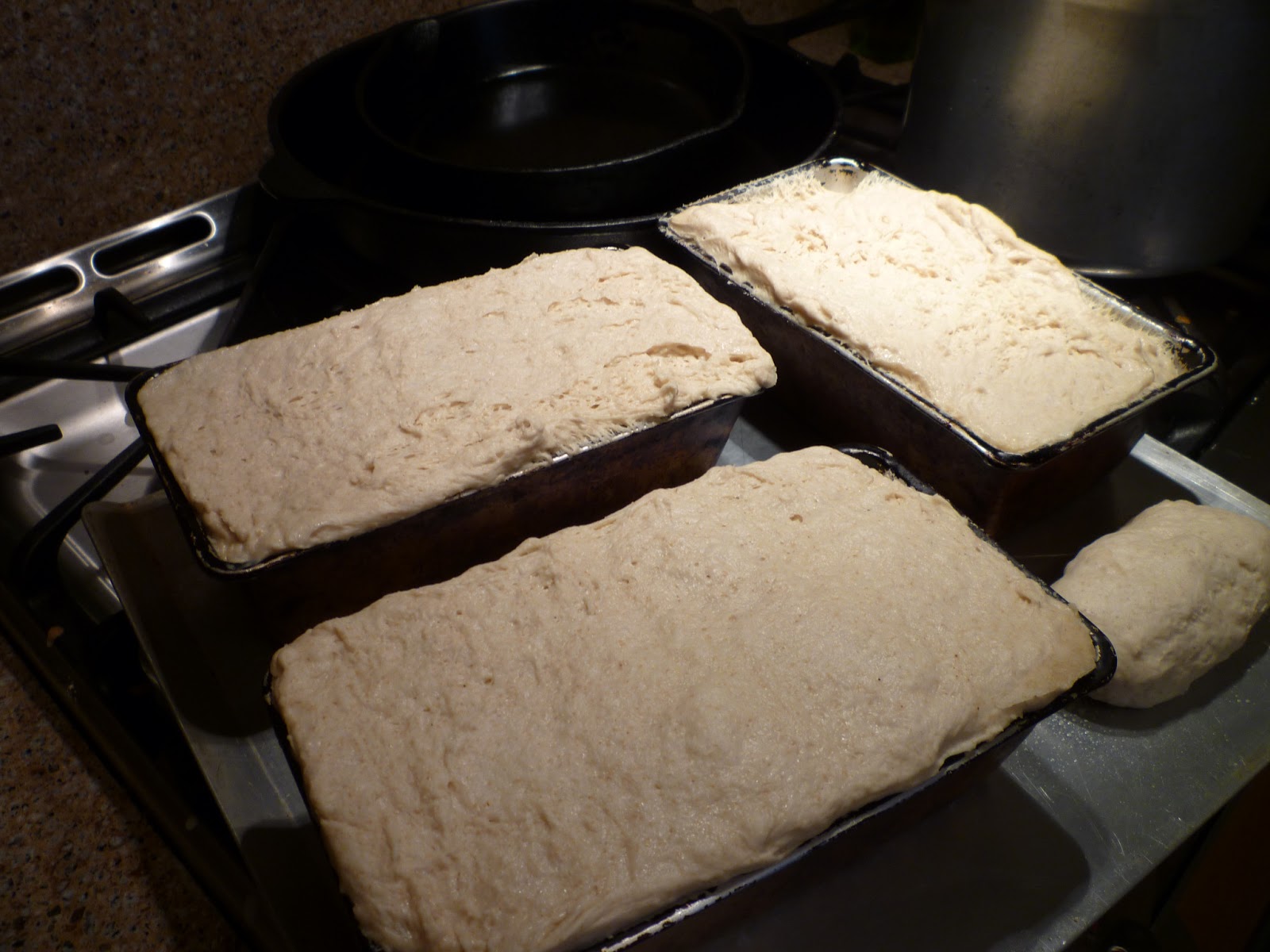
I shaped loaves and put them into three medium loaf pans on the counter. It was late by then, so I didn’t linger in the kitchen, but even in those few minutes before heading upstairs I saw that the dough was rising. Uh-oh. I was so tired, the clever idea of letting them rise in the refrigerator or in the cold garage never occurred to me. I went upstairs to crash.

Next morning….as soon as I woke up I ran down in my nightgown to find this:

So there was nothing for it but to do this:
And get those loaves into the oven as fast as possible. The little loaf was made of the trimmed-off pieces of dough.

We were expecting our out-of-town friend Myriah for lunch, but I had plenty of time to make the cookies I’d planned, or so I thought. But the slabs of buttery dough were too firm to roll out right away, so while they softened up on the counter I searched upstairs and down and all over for the pink and red baking decorations I had recently bought. Nope. Not to be found.

Finally I cut out hearts, and sprinkled on the remainder of a bottle of pink crystals left from some long-ago Valentine project. The cookies took much longer to bake than the recipe said, perhaps because my cookies were larger and my cookie sheet was insulated. All through lunch with our good friend I jumped up and down from the table to check the cookies and slide a few more on to the racks.

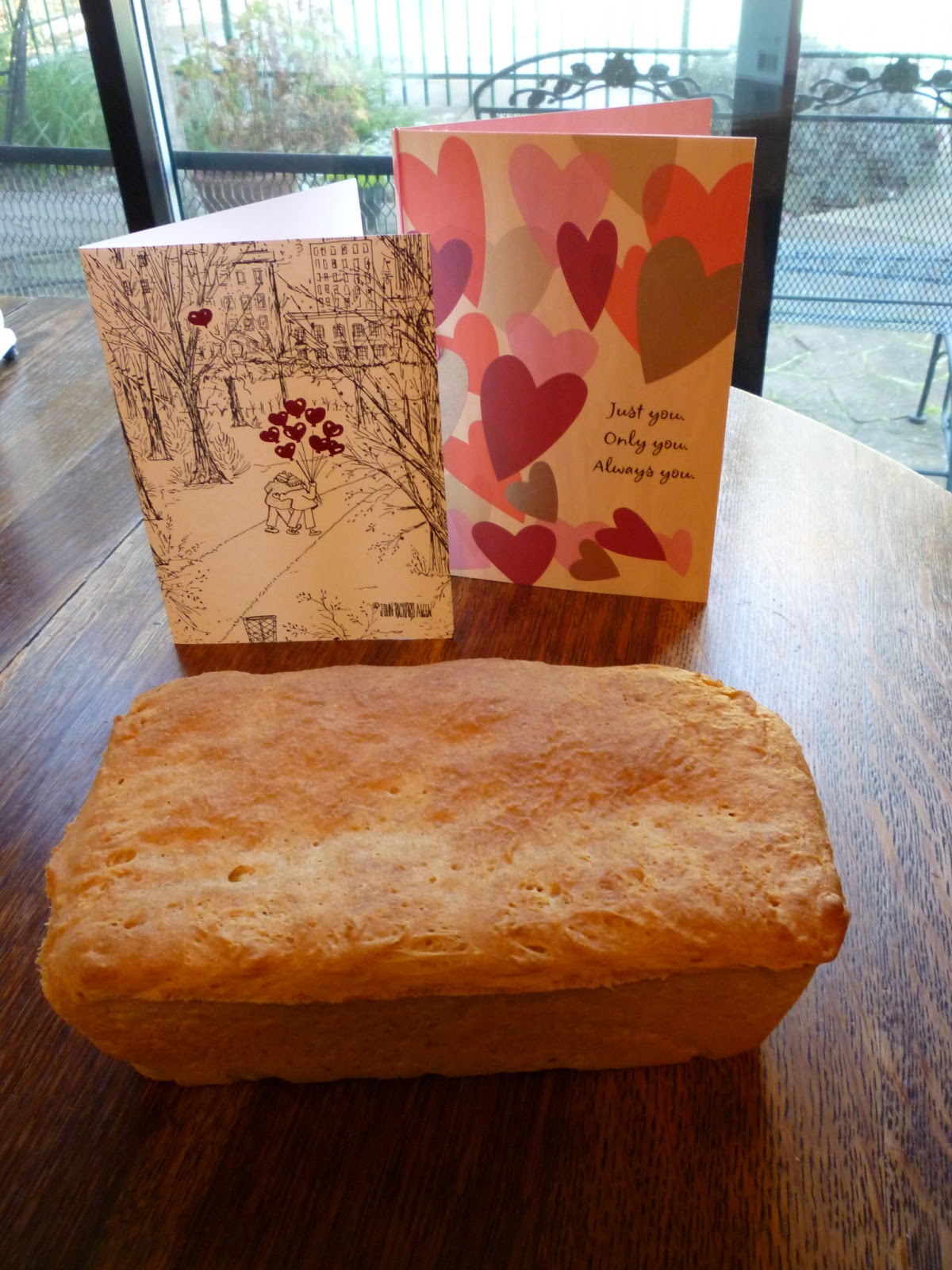
Meanwhile, the bread baked 50 minutes, cooled a little, and was soon tasted. The tops were rough and ugly where I had peeled off the plastic wrap, but the crust was just the right crunchiness and the crumb was lovely — chewy and moist. My first thought, though, was that I hadn’t added enough salt to the dough. After eating several slices I’ve concluded that I completely forgot to put in any salt at all. No wonder the dough rose so fast!

Myriah and Mr. Glad said they didn’t notice anything wrong with the sandwiches I made with the bread — they thought it was good. I’m eager to try doing pretty much the same method on a day when I have my wits about me. What to do with the Super Bland Sourdough? It’s perfect with Super Tangy and Salty Marmite spread on it.
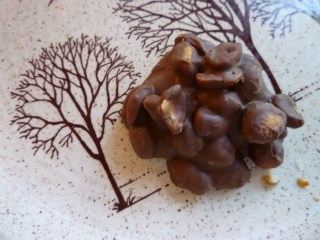
Myriah brought some Crockpot Peanut Clusters that she and her daughters had made. They call for dry-roasted peanuts and the saltiness with the chocolate was addictive. The shortbread was heavenly. We ate plenty of both, no doubt out of salt-deprivation. The fact is, the flavor of sourdough does not come through without a little salt and maybe even a little sugar in the mix.

I didn’t think of taking the cookies’ photograph until I had put most of them into the freezer to have handy when Mr. Glad wants just one cookie, so I took out the container again so you can see them all piled up in it.

Am I not the maddest sourdough scientist you ever heard of? I should be embarrassed to tell this story, but instead it makes me laugh. I am strangely unflappable — I even considered starting another sponge today, but I got a grip on myself and even cleaned the kitchen before writing my tale.

How to Get Light instead of Fog.

St. Isaac of Syria

Thanks to Christ is in our Midst for this posting appropriate to the beginning of Lent. To me it is a helpful elaboration on C.S. Lewis’s statement that “Virtue — even attempted virtue — brings light; indulgence brings fog.”

…If you cannot be still within your heart, then at least make still your tongue. If you cannot give right ordering to your thoughts, at least give right ordering to your senses. If you cannot be solitary in your mind, at least be solitary in body. If you cannot labor with your body, at least be afflicted in mind. If you cannot keep your vigil standing, keep vigil sitting on your pallet, or lying down. If you cannot fast for two days at a time, at least fast till evening. And if you cannot fast until evening, then at least keep yourself from satiety.

If you are not holy in your heart, at least be holy in body. If you do not mourn in your heart, at least cover your face with mourning. If you cannot be merciful, at least speak as though you are a sinner. If you are not a peacemaker, at least do not be a troublemaker. If you cannot be assiduous, at least consider yourself lazy. If you are not victorious, do not exalt yourself over the vanquished. If you cannot close the mouth of a man who disparages his companion, at least refrain from joining him in this.

Know that if fire goes forth from you and consumes other men, God will demand from your hands the souls which your fire has burned. And if you yourself do not put forth the fire, but are in agreement with him who does, and are pleased by it, in the judgment you will be reckoned as his accomplice. If you love gentleness, be peaceful, if you are deemed worthy of peace, you will rejoice at all time. Seek understanding, not gold. Clothe yourself with humility, not fine linen. Gain peace, not a kingdom.

~St. Isaac of Syria

Readers and Doers

Janet has a discussion going on about reading and what our reasons are for doing it. I’ve been thinking a lot about the decrease in the habit of reading among Americans, which was discussed recently on a Mars Hill Audio interview with Dana Gioia.

Gioia was Chairman of the National Endowment for the Arts when the agency did a large survey of the nation’s reading habits. We’ve known for decades that people are reading less…and less…and less. Isn’t this interesting, when a bachelor’s degree is becoming more common? Just this week I heard of a young woman who has a degree, who flat-out refuses to read anything, saying, “I don’t read,” at the same time she declares that she must need to get a job, she is so bored. This in spite of having a lively young child.

The phenomenon links right in to another observation by a college professor I also heard on Mars Hill, that the vast majority of students of “higher education” today do not connect their studies to their life outside the classroom. When they are with their friends, they would never think of discussing a novel or how the wisdom of the ancients applies today. Is reading a task they have only ever done to pass a test or please a teacher? One doesn’t want to call what these people have undergone “education.”

Still, there are those of us who read, and not out of duty! Not for escape, either. As it turns out–and this surprised Dana Gioia–people who have a rich internal life with books are more likely to be involved in their communities and do volunteer work than non-readers. Reading is not truly a solitary activity, because the reader and the writer are interacting, and as the reader’s interior world is enlarged, his engagement with his fellow humans broadens accordingly.

The research gives a lot to think about–and I would write down my thinking, too, if I weren’t embarking more intensely now on a very different sort of work, that of remodeling our kitchen and downstairs floors and ceilings. Just look at this bookcase that has been denuded! A pitiful sight.

It marks only the beginning of the destruction and deconstruction and disorder around here. My computer will be moved to another room, not as handy. I will be packing and packing, and scraping and painting, and cooking without a kitchen. Then I will be unpacking and setting up my home again. Though it’s certain I won’t give up reading altogether for this while, I must think of the next few months as more in the realm of doing good in “my community.”

Every Lent presents a new challenge, because even if our circumstances or station in life might be the same as last year, rare enough as that is, we as individuals have changed from last year’s season of the fast. As I heard the exhortation at Matins this morning that we would show compassion on the needy, it confirmed the idea that had been growing on me, that this house project is not this year’s distraction from Lent, but provides a perfect setting for me to learn compassion.

Having my house torn up and chaotic, wondering which task I should do next and where I stashed the item I didn’t think I would need but now I do–all this causes me anxiety. But my poor husband suffers more, I am certain, and he needs me to show compassion and patience and love.

It wouldn’t hurt me to pray the Lenten Prayer of St Ephrem throughout the days of my opportunity:

O Lord and Master of my life!
Take from me the spirit of sloth, faint-heartedness, lust of power, and idle talk.
But give rather the spirit of chastity, humility, patience, and love to Thy servant.
Yea, O Lord and King!
Grant me to see my own errors and not to judge my brother;
For Thou art blessed unto ages of ages. Amen.