Tag Archives: Met. Anthony Bloom

See and be His art.

The second chapter of The Hidden Art of Homemaking is short, and titled “What is Hidden Art?” I love reading all the many women’s thoughts on this topic, which [used to be found, but not these several years later] on Ordo Armoris where the discussion [was] taking place.

It’s a huge topic! Each human is a living and complex demonstration of creative powers, as is revealed by the uniqueness of each woman’s life as expressed in her contributions to these discussions. The stories, the photos on the Hidden Art Pinterest page, the glimpses into the families whose wives and mothers are taking time to share their creativity online in addition to the never-ending work they do in their homes….it’s all a glory to the Creator.

Obviously, art is hidden as long as you don’t see it. That seems a basic point of this discussion. For me, having children opened my eyes to the world in a new way, because I often thought of my babies as tiny foreigners who were themselves seeing things in this new “country” for the first time. It was fun being the tour guide, and it challenged me to look afresh at my environment.

Sometimes just pointing a camera at some everyday scene helps to reveal a pattern of beauty – or to preserve the art when there isn’t time for a quick sketch. My picture that I titled “Butter Art” so many years ago still makes me happy with its hominess, and it calls to mind the intangible kinds of creativity that I also brought to bear on the task of mothering my children, small “art” projects that took place in the kitchen, or the garden, or — the heart.

I’m still pondering the thoughts of my previous post on this inward kind of creativity, which the author I quoted says “begins with the ability to change — to change intentionally. Creativeness begins with the ability a being has…to become what he is not yet, to start at the point at which he was created and then grow into a fullness that he did not possess before…”

Might this not include the developing in us of the fruits of the Spirit, the love, joy, peace, kindness, longsuffering, etc. that are so essential to making a home? I know that Edith Schaeffer in the book under discussion is primarily dealing with outward, visual or sensory beauty. But what if we could “create” peace by our very presence, or transfer some of our own joy into our children’s hearts?

Mothers naturally do those kinds of things, and often it’s by the attitude they have while they are accomplishing practical works such as laundering the socks, changing them from stiff and smelly to soft and fresh. It all starts with something we are. The artistry of our God is not just something to imitate, but is His active work in us, with which we participate, and by which we become ourselves lights in the world.
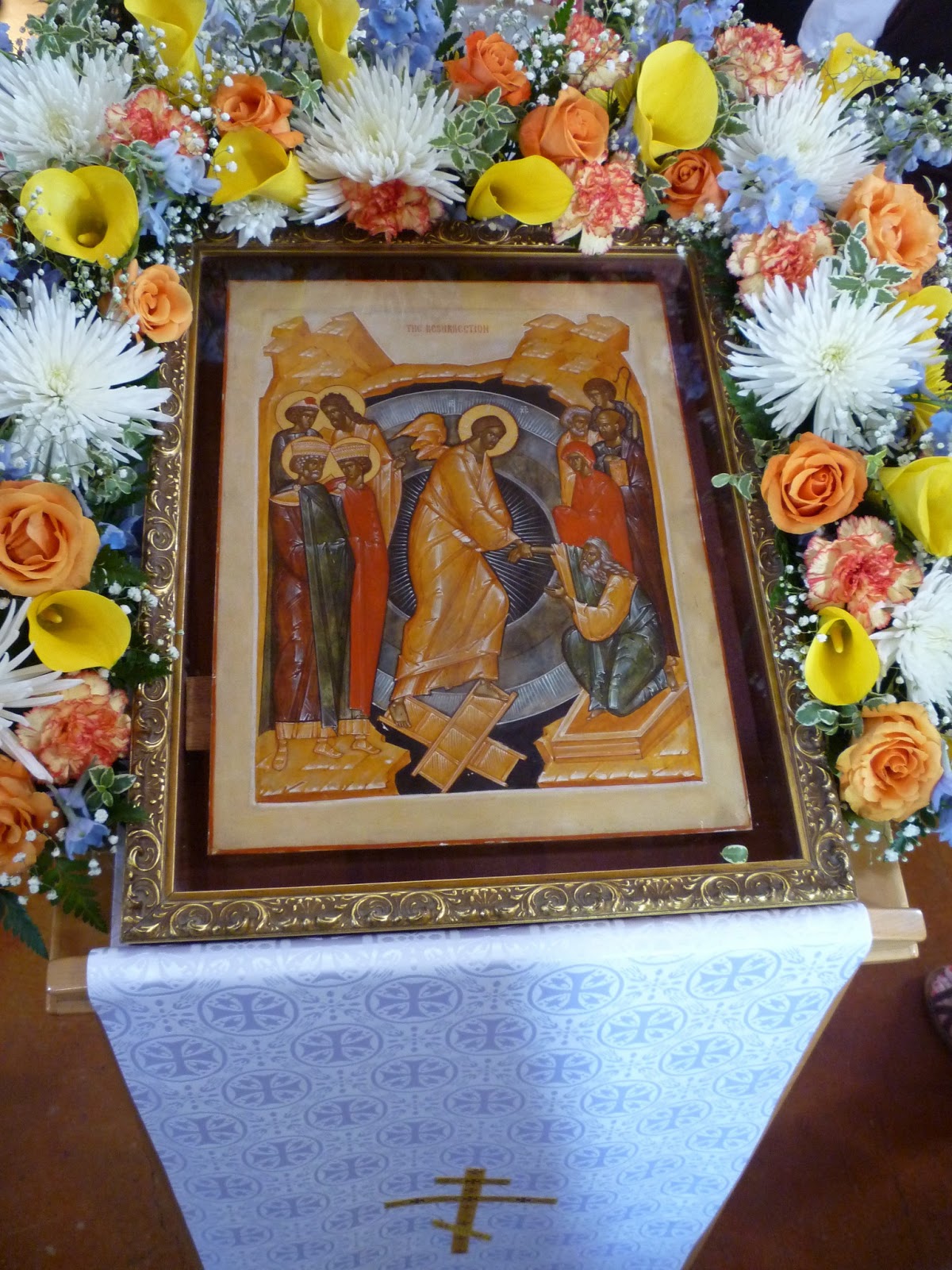
Tonight’s the night!

The victory is in each of us, the victory is in all those of us who believe that death cannot separate us from God….However frightening and dark the world is nowadays, we know that victory has already been won, that God has won and that we who believe in him partake together with him in his victory. And therefore, let us bring, to all around us, this message of life and glory!

— Metropolitan Anthony Bloom

The beginning of a true newness

I am somewhat apologetically writing already another post on The Hidden Art of Homemaking, because it is the philosophy and theology, the heavenly underpinnings perhaps, that inspire me and give me the energy to carry out the practical details. From looking at the chapter titles it seems that this introductory chapter might be the one about which I have the most musings.

As to the oddness of me taking my inspiration from yet another man, when it is we women who traditionally do the homemaking and who are discussing a woman‘s book, I will just say that, Christ who enables us also was a man, and the Life of The Holy Trinity is something greater than our gender roles. The reality of the Holy Spirit operating in the world through us is our means of living out our humanity. Homemaking is one of the many facets of our calling and our life in God, and this particular pastor always encourages me in the fact of “Christ in you, the hope of glory.”

The passages from Metropolitan Anthony are from a talk on Genesis given in June, 1986, from the book Metropolitan Anthony of Sourozh: Essential Writings by Gillian Crow.

Creativeness, however, is something more complex than the ability to call out new forms, to shape one’s surroundings or even to determine to a certain extent…our destiny. It begins with the ability to change — to change intentionally. Creativeness begins with the ability a being has…to become what he is not yet, to start at the point at which he was created and then grow into a fullness that he did not possess before: from image to likeness, if you will — having begun to be, as it were, a reflection, to become the reality itself; having begun to be in the image of the invisible Creator, to become the image of God incarnate.

…And this process is a creative process. It is not an organic one; it is not something that must develop inevitably; it is something that we must choose and that we must achieve with the grace of God.

Amy mentioned the possibility that we might, contrary to our calling, create ugly or bad things, and even sometimes express not craftsmanship but craftiness. Other and various sinful impulses can also rob us of our creative strength. On the other hand, many times just creating something can give us a boost in the right direction. For example, I am learning not to be discouraged by the disorder of my messy house. Instead I can take joy from the chance to create order and space to replace — or at least reduce! — the chaos that so easily develops. But creating order out of chaos is huge. That seems like a good description of one aspect of the creative work God is always doing in our lives.

Met. Anthony says that the creative work he is primarily talking about is not the art and music and literature that we tend to think of right away,

…both of heart and intelligence, of skill and of hand, but is much more essential and also much more important because all the rest can flow from this basic source of creativeness but cannot derive from anything else.

So that here we are confronted with man, whom God has called and loved into existence, endowed with His image, launched into life, and when on the seventh day the Lord rested from his works, the seventh day will be seen as all the span of time that extends from the last act of creation on the part of God to the last day, the eighth day, the coming of the Lord, when all things will be fulfilled, all things will come to an end, reach their goal, and blossom out in glory. It is within this seventh day, which is the whole span of history, that the creativeness of man is to find its scope and its place.

And this is a wonderful call to us because each of us can be a creator within his own realm, within his mind and his soul, by making them pure and transparent to God, within his actions and life, and become what Christ said we are called to be: a light to the world, a light that dispels darkness, a light that, as in the beginning of creation is the beginning of a new day — that is, the beginning of a true newness and a new unfolding of the potentialities that are within us and around us.

(Cindy was hosting a discussion of Edith Schaeffer’s The Hidden Art of Homemaking, and this post was written as a contribution.)

Snow falls but I am warmed.

On the plane to Philadelphia I got halfway through Metropolitan Anthony Bloom’s God and Man. It helped to calm my jitters that had developed since the initial excitement and decision to go to my last remaining aunt’s memorial service. I was about to arrive at an event and to enter a house and family where every person was a stranger.

Eeek! What was I getting into? Metropolitan Anthony encouraged me with words about love and life, and before I knew it a first cousin once-removed was hugging me at the airport and driving me to a houseful of other huggers and gracious people. I stayed up with them later and later every night sharing stories of our grandparents and parents, digging up memories and laughing with happiness over all the many connections we have by way of genetics and family traditions.

The realities of The Kingdom I had been reading about are certainly pertinent to the activity in my heart last weekend, but I’m still debriefing myself about what happened. I may never figure it out enough to put it down in words, but it was exciting and glorious.

What I am able to do is share some photographic images of the little bit of Philadelphia I experienced. Cousin #1 put me in The Nursery at her house, which is decorated in the most comforting and cozy way, with pictures of the Teddy Bears having their picnic, and Babar, and more pictures and items that probably helped me feel that I was falling asleep with the Sandman’s help as when I was a child. Stuffed animals sat around on the stuffed chair and on the extra bed, and green leaves were painted on the creamy yellow wood floor.

In the kitchen Revere Ware pots had been hung on the wall – hey! just the way Grandfather used to do! – and science “experiments” I won’t describe sat on a shelf all ready for the grandchildren, my first cousins twice-removed. Flowers filled the air with sweetness – We would soon load them in the back of the car to drive to the memorial service and reception.

See that orange towel on the kitchen counter above? I brought it with its citrus-y design as a gift to remind my cousin of the boxes of oranges my father sent across the country to their family every Christmas in bygone days.

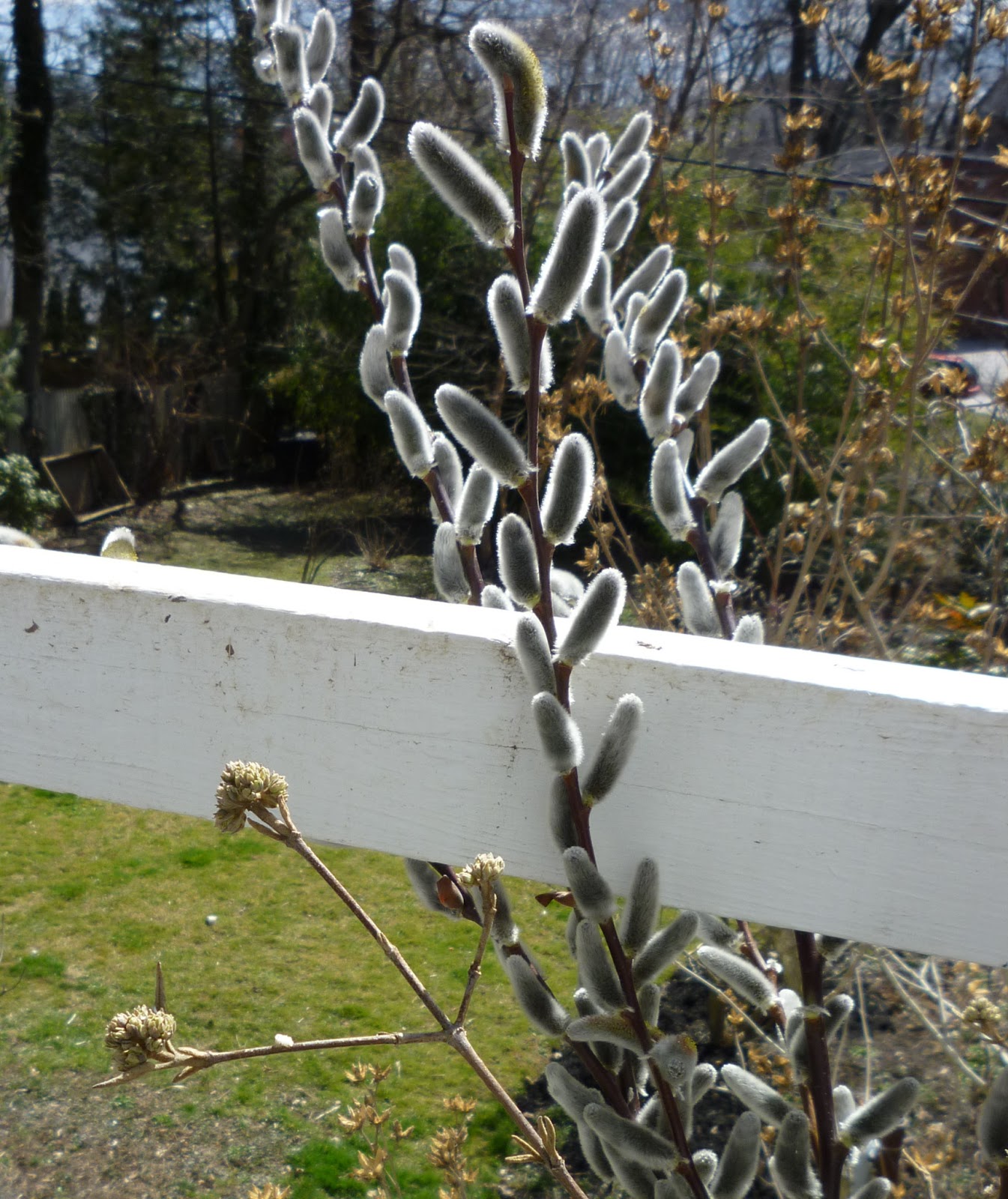
Out back, raised beds were awaiting spring planting, and pussy willows budded right off the kitchen porch. I sat on the steps going down to the garden to talk on the phone to Mr. Glad who was still back in California missing me.

The morning of the memorial service we walked a block to the train station to meet daughter Kate who had come from D.C. to be with me. She had never even met her great-aunt whose life we were honoring that day, but she was happy to get acquainted with the cousins, and she slept in The Nursery in the bed next to me.

One night Cousin #3 cooked dinner for the two of us at her place, a very “vertical” row house in South Philly, narrow and rising five levels. She honored the first owners with a photo on the wall showing a very sober and Italian wedding party featuring the bride-and-groom owners. It’s a pretty old house of the sort that has (newly refurbished) rosettes on the ceiling in some rooms.

All the long weekend, all the folk I met were amazed at how much I resemble my late aunt; the cousins in our branch of the family haven’t been together in a long time, and for most of their lives they had been daily surrounded by people related to my aunt’s former husband. I was happy to provide a facial link to her instead. We pored over all the old photos we had assembled, staring at the faces as though trying to penetrate the souls of our ancestors to understand who we are.

I woke up the morning of my departure to see the ground all white, and snow falling. The birds arrived at the feeders, and I even saw a female Cardinal for the first time. I’ve never lived where this classic red bird does.

After I was dropped at the airport, I wandered around waiting for a flight that was delayed for weather, and wondered at how fast I had made a fast friend of my cousin. Someone told me before I set off on my adventure that a cousin is sort of like a sister, but better in that you don’t have the tension that can happen between siblings.

So it seems at this point, and I’m grateful for the gifts of God. He is everywhere, of course, even in the middle of a bunch of strangers. We don’t have any love that doesn’t come from Him. But that provides plenty.