Tag Archives: Middlemarch

Coax them downstairs.

This Lord’s Day we were remembering the paralytic, who sat by the pool waiting for a chance to get into the water at those times when an angel stirred it, so that he might be healed. After 38 years, Jesus came by and healed him.

Father John in his homily highlighted one aspect of the Gospel story: how we are like that man in our seeming paralysis when it comes to overcoming our sins. Priests often hear in confession the lament of the Christian who continues to battle the same weaknesses and failings year after year, feeling that he makes little progress.

I think a lot about the truism that habits are like a second nature to us. As we read in Jeremiah 13:23: “Can the Ethiopian change his skin or the leopard its spots? Neither can you do good who are accustomed to doing evil.”

It sounds very little like one chipper exhortation you might have read: “It’s never too late to be what you might have been.” Well, yes, why not just start today? When I read that on Tuesday, I remembered the paralytic, and I thought on my own unchanged bad habits. After his 38 years, wasn’t it in fact too late for many things? (The assumption is that one might have been greater; the reverse is probably more true, that it’s never too late to start a downward spiral.)

George Eliot (Mary Ann Evans)

For myself, let’s see…how many years have I been cultivating certain of my bad habits? More than that, I’m afraid. But it’s a simple thing: “The only thing that stands between me and greatness is me.” (Woody Allen)

George Eliot is credited with having made that bold assertion, “It’s never to late to be what you might have been.” She was the subject of a New Yorker article from February, 2011, “Middlemarch and Me,” by Rebecca Mead, who questions the validity of the quote and whether it even reflects the true outlook of the author Mary Ann Evans.

Mead has been a lifelong lover of Eliot’s books, Middlemarch in particular, and she points out some hints that the author leaves in her novels, as well as forthright confessions from her journals, to show that her general attitude was wiser and more modest.

In Middlemarch, we read of the main character,  “Dorothea herself had no dreams of being praised above other women, feeling that there was always something better which she might have done, if she had only been better and known better.”

Mead writes: Middlemarch is not about blooming late, or unexpectedly coming into one’s own after the unproductive flush of youth. Middlemarch suggests that it is always too late to be what you might have been — but it also shows that, virtually without exception, the unrealized life is worth living. The book that Virginia Woolf characterized as ‘one of the few English novels written for grown-up people’ is also a book about how to be a grownup person — about how to bear one’s share of sorrow, failure, and loss, as well as to enjoy moments of hard-won happiness.”

Let’s look back at the Paralytic by the Sheep’s Gate Pool. He must have had some way to propel himself, perhaps one limb that was functional, so that he could sit there for much of his life hoping to get down to the water first. He certainly had patience — and perseverance, to keep trying.

Father John said that even if we feel we have nothing more than a big toe’s worth of strength against our sins, we must keep struggling. Because we never know when Jesus will come to us. When he came to the cripple by the pool, He Himself was the source of the healing, and the man was delivered from his afflictions and was able to walk and carry his bed. For most of us, we will not receive the equivalent healing until we are resurrected in the coming Kingdom.

In the meantime, we will have failures. Maybe we will even think we are failures. It is very discouraging when one realizes what Samuel Johnson found: “The chains of habit are generally too small to be felt until they are too strong to be broken.” On another aspect of this human experience, Dorothea said in Middlemarch about her husband’s intellectual labors: “Failure after long perseverance is much grander than never to have a striving good enough to be called a failure.”

The most helpful sort of activity to persevere in, if one wants to be on the path to God, is prayer. “A long perseverance” of this sort would never be disappointing. The very moments of prayer have the potential to be Heaven itself, in the presence of the God Who is Love.

“In patience you possess your souls,” we read in Luke 21, and Mark Twain elaborates: “Habit is habit, and not to be flung out of the window by any man, but coaxed downstairs a step at a time.”

Whether we are being too easy on ourselves is the question. If we are being lazy, of course, that is one of the sins we are trying to overcome. And pride in thinking we are equal to any task, we can be anything we put our minds to — that also must be set aside.

Mary Ann Evans put it this way in her journal: “The difficulty is, to decide how far resolution should set in the direction of activity rather than in the acceptance of a more negative state.”

But I like best the way St. Seraphim of Sarov speaks about this, and will close with his gentle words: “One should be lenient towards the weaknesses and imperfections of one’s own soul and endure one’s own shortcomings as we tolerate the shortcomings of our neighbours, and at the same time not become lazy but impel oneself to work on one’s improvement incessantly.”


[From the archives, 2011]
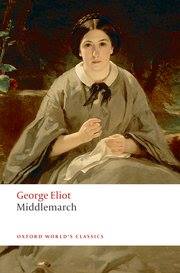
Shame or no shame… Middlemarch.

I had a brilliant idea for my concluding blog post about Middlemarch, which I read as part of an online read-along that Arti initiated. We were pretty much finished by the end of June. Even I had read the last page before the last day of that month, but I’ve been ruminating and composing in my mind for weeks more now, with nothing substantial to show for it.

The title of my article would be “Shame-Bearers of Middlemarch,” and I had in mind Dorothea, Lydgate, Mrs. Bulstrode, and probably some others. But I have decided that I don’t know enough about shame or about the characters of Middlemarch, even if I have read the book twice, and read a few articles by Fr. Stephen Freeman on the subject of shame, and… well, nothing more, really.

The world of this novel is so vast and deep, it gives me the feeling of having only passed through briefly, and making the barest acquaintance with the rich characters. Eliot has been generous to let us listen in on conversations, even within the townspeople’s own hearts, but I find I still don’t have don’t have enough material to give me confidence in my thesis.

I don’t feel any shame in admitting my paucity of wisdom, though I do feel a little embarrassment at my feeble farewell. I am humbled in the face of this magnificent book. It really is worth reading many times, but I fear that I didn’t get started early enough in life. Thank you, Arti, for prompting this read, which has been so worthwhile, and thank you to Pippin for letting me revisit and use her lovely photos of England; now I think I will watch the TV series!

Caleb’s my man.

I came to the last page of Middlemarch, and it’s not even the last day of June! Ah, but now begins the work that is harder than the reading: sifting and organizing my thoughts about the story and stories of that novel so as to write some of them here in a way that might edify.

In the meantime, I have to say that I love the character of Caleb Garth more than anyone. His kind of “business” is not at all what people think of these days who are majoring in Business in college. They often think mostly of making a living somehow, but Caleb is intent on improving the land and doing good by people, the livestock and the earth. He often forgets to make provision for his own financial needs, and loves nothing better, as he says to his wife, than:

“…to have a chance of getting a bit of the country into good fettle, as they say, and putting men into the right way with their farming, and getting a bit of good contriving and solid building done — that those who are living and those who come after will be the better for. I’d sooner have it than a fortune. I hold it the most honourable work that is.” … “It’s a great gift of God, Susan.”

“That it is, Caleb,” said his wife, with answering fervor. “And it will be a blessing to your children to have had a father who did such work: a father whose good work remains though his name may be forgotten.”

A good man or woman adorns the earth by his presence alone, but if in addition he is able to oversee the wise management of farms and estates, with honesty and without greed, it is satisfying and holy work.

The last two weeks I’ve been working at less enduring tasks, but I’m still pleased with the results. Of course, there is always my garden which I tend. In the third year of being on my own I became acutely aware of the importance to my heart and psyche of my house as well, of the whole property that is mine alone now, and which I manage and am responsible for. The changes in my feelings are complicated and subtle; I see how God and His angels carried me through the time when I seemed to have little strength of will to apply. Now we will see how He guides me in this new phase when I am ready to participate more fully in my own affairs!

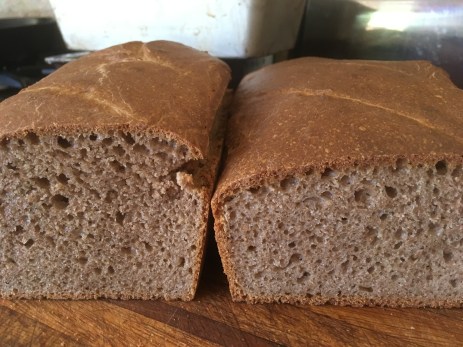
I’m working on the sourdough bread experiments again — yes, and they result in very short-lived products of my efforts, being highly desirable consumables. Today a Swedish seeded sourdough rye boule that is still rising will be cooked in the Dutch oven. Last week, these loaves:

But no time yet, to dwell on details of dough and ovens, or on great themes of Middlemarch, because Pippin (who took the photo in England above, by the way) is arriving with two grandchildren for a few days. I’ll be taking care of Ivy (almost 6) and Jamie (3) while she attends a conference for work nearby. Scout won’t be in the group because he is backpacking with his father.

I’ve joined a book group of women in my parish. I didn’t finish the recent read, but I’m confident that I’ll have time to read Fidelity by Wendell Berry before our next discussion this summer.

My computer is giving me fits as usual, and the Computer Guy is on his way, so I will get back to my real, tangible work now, and give him this space, and see you next week! May your summer reading and work be satisfying.

Small, hungry and shivering.

Continuing with my mini-miniseries on the men of Middlemarch, I give you an exemplary passage in which the author explains Casaubon to us. The metaphors she uses to convey the intricacies of his stunted self are many but not too many for me. Even with their being descriptive of a truly pitiable man, my own soul can’t help but “thrill into passionate delight” over George Eliot’s imagination and skill.

He had not had much foretaste of happiness in his previous life. To know intense joy without a strong bodily frame, one must have an enthusiastic soul. Mr. Casaubon had never had a strong bodily frame, and his soul was sensitive without being enthusiastic; it was too languid to thrill out of self-consciousness into passionate delight; it went on fluttering in the swampy ground where it was hatched, thinking of its wings and never flying. His experience was of that pitiable kind which shrinks from pity, and fears most of all that it should be known: it was that proud narrow sensitiveness which has not mass enough to spare for transformation into sympathy, and quivers thread-like in small currents of self-preoccupation or at best of an egoistic scrupulosity.

…even his religious faith wavered with his wavering trust in his own authorship, and the consolations of the Christian hope in immortality seemed to lean on the immortality of the still unwritten Key to Mythologies. For my part I am very sorry for him. It is an uneasy lot at best, to be what we call highly taught and yet not to enjoy: to be present at this great spectacle of life and never to be liberated from a small hungry shivering self – never to be fully possessed by the glory we behold, never to have our consciousness rapturously transformed into the vividness of a thought, the ardour of passion, the energy of an action, but always to be scholarly and uninspired, ambitious and timid, scrupulous and dim-sighted.

From the movie I’ve not seen.

If Dorothea could only have seen into Casusbon’s mind and heart the way his creator does, then she would have realized that he is not a man prepared to be a husband — maybe. But more on Dorothea later.

My tendency to be flippant or dismissive of Casaubon flows from his being fictional. (In the earlier version of this post I wrote fictitious, but then I realized that fictitious connotes false to me, which is reason enough not to use that word for a book character who is drawn so clearly in the shape of reality.) We can examine him closely and analyze each of his parts and guess at his destiny without being gossips. He is an archetype of one form of Lost Soul, and thinking about him and his engagement with other characters can enrich our understanding of humanity, and perhaps even instruct us in love.

Celia hasn’t the ability to debate the “notions” and idealism that are leading her sister toward marriage to Casaubon, but her instincts tell her that something is not right about this “death’s head warmed over.” That her beloved sister is planning to join her life with his disturbs her greatly.

“O Mrs. Cadwallader, I don’t think it can be nice to marry a man with a great soul.”

“Well, my dear, take warning. You know the look of one now: when the next comes and wants to marry you, don’t you accept him.”