Tag Archives: Middlemarch

Men of Middlemarch

Before buying an audio recording of Middlemarch I listened to many samples from different readers, most of them women. I chose the one I did because I didn’t mind the voice and diction of the reader, and it was less than half the price of some of the newer ones. It happens to be read by the English actor Gabriel Woolf, and I had not listened for a half-hour before I was very glad to have accidentally chosen this recording. The voices and Middlemarch audiobook cover artaccents and even chuckles he gives to the various characters are wonderful — and with so many interesting men as main characters, it now seems quite the best thing to have a male voice to bring them alive.

The reviews point out that this is a “vintage” recording, and that the production quality may not be up to snuff. There are actually some background noises occasionally that don’t fit the time period, but they didn’t bother me. Woolf trips over a word now and then, too, but his overall dramatic gifts more than compensate for his lack of constancy.

And speaking of flaws, our Middlemarch characters certainly have them. Eliot delves deep into their personalities and motivations, and knows what primitive weaknesses are the reasons for their peculiar behaviors as though she were God Himself. And like God, she urges us to be kind and to forgive.

I already shared one excerpt that gives a glimpse into Will Ladislaw’s character. (On a side note, why do you think that he is always called “Will” or ” Will Ladislaw,” while most of the men, including Lydgate, are referred to by only their last name? Is it age, or social standing? Fred Vincy is also in this category of naming, and he is like Will in that he isn’t established in a profession or even a direction yet.)

Some of the people in the town are more disagreeable than others, but then they might be ridiculous in their pride, and make me laugh; it’s easier to be patient with them, especially when I don’t have them in my own real life. (Mrs. Cadwallader is best left in someone else’s neighborhood!) Lydgate the young doctor takes himself too seriously to be lovable in that way, though, and I tend to not like him. In talking about this man Eliot writes:

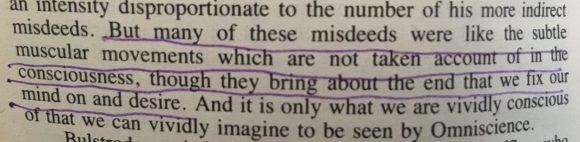
…character too is a process and an unfolding. The man was still in the making, as much as the Middlemarch doctor and immortal discoverer, and there were both virtues and faults capable of shrinking or expanding. The faults will not, I hope, be a reason for the withdrawl of your interest in him. Among our valued friends is there not some one or other who is a little too self-confident and disdainful; whose distinguished mind is a little spotted with commonness; who is a little pinched here and protuberant there with native prejudices; or whose better energies are liable to lapse down the wrong channel under the influence of transient solicitations? …. Our vanities differ as our noses do: all conceit is not the same conceit, but varies in correspondence with the minutiae of mental make in which one of us differs from another. Lydgate’s conceit was the arrogant sort, never simpering, never impertinent, but massive in its claims and benevolently contemptuous. He would do a great deal for noodles, being sorry for them, and feeling quite sure that they could have no power over him.

Noodle was 19th-century slang for “dummy.” I’m afraid my own attitude toward Lydgate might fall into the category of “benevolently contemptuous,” and I hate that, so here’s hoping I can develop more real sympathy for him soon. He didn’t know how fast he would get into deep water when he stepped into the pond of Middlemarch life!

photo credit: Pippin

Middlemarch – Ladislaw’s force of unreason.

One Saturday evening Will Ladislaw is thinking about the foolishness of his current situation, in which he has taken work in the town near to where our heroine Mrs. Casaubon lives, because of his feelings for that woman “for ever enthroned in his soul.” But he has been forbidden by Dorothea’s jealous husband to visit their home. So, “he could hardly ever see her.”

His thoughts are going irritably round and round on this subject when, “suddenly reflecting that the morrow would be Sunday, he determined to go to Lowick Church to see her.” It’s not his parish, and his presence would annoy Casaubon certainly, but he reasons,

“It is not true that I go to annoy him, and why should I not go to see Dorothea? Is he to have everything to himself and be always comfortable? Let him smart a little, as other people are obliged to do. I have always liked the quaintness of the church and congregation; besides, I know the Tuckers. I shall go into their pew.”

Having silenced Objection by force of unreason, Will walked to Lowick as if he had been on the way to Paradise, crossing Halsell Common and skirting the woods, where the sunlight fell broadly under the budding boughs, bringing out the beauties of moss and lichen, and fresh green growths piercing the brown. Everything seemed to know that it was Sunday, and to approve of his going to Lowick Church. Will easily felt happy when nothing crossed his humour, and by this time the thought of vexing Mr. Casaubon had become rather amusing to him, making his face break into its merry smile, pleasant to see as the breaking of sunshine on the water — though the occasion was not exemplary…. Will went along… chanting a little, as he made scenes of what would happen in church and coming out….The words were not exactly a hymn, but they certainly fitted his Sunday experience….

…. Sometimes, when he took off his hat, shaking his head backward, and showing his delicate throat as he sang, he looked like an incarnation of the spring whose spirit filled the air — a bright creature, abundant in uncertain promises.

This is one of a thousand passages in Middlemarch that so delightfully convey the personality and the feelings of one of the characters. I wish that I could transcribe a score of them just because I admire so much Eliot’s art. In this case Will is to himself in happy concord with even the weather and the season, and with the landscape that the author paints with a few perfect phrases. I think that Eliot is a little bit in love with Will Ladislaw, for how else could she make me fall in love with him?

The last phrase, though, comparing Will and springtime, is suddenly ominous, because, as we all know, the weather is unpredictable at this time of year. And the spirit of spring — I am as susceptible to its easy promises as anyone.

I did read this novel aloud with my husband 15 years ago, an acquaintance that was too shallow and distant for me to retain more than vague impressions. This time, on my own, I’m more engaged and enraptured, but still, I don’t want to take a year to read as thoroughly and meditatively as this book seems to warrant. So I’m glad Arti proposed two months, and I look forward to the remaining weeks and stories.

photo credit: Pippin

Middlemarch has me laughing so soon.

Today is May 1st, so it’s the official date of the Read-Along of Middlemarch that Arti is hosting for the next two months. She wrote a new post about the project for today, which you can read by clicking on the book cover image in my sidebar. It includes some ungracious things that Henry James said about how George Eliot’s mind made him fall in love with her even though she was not pretty – but he did not put it so euphemistically.

I did start reading the book about ten days ago but I haven’t read every day, so I am only three days’ worth of pages jump-started. I was surprised at how quickly the author makes  her characters’ personalities known to the reader, through the most natural and revealing dialogue, as when Dorothea and her sister discuss Mr. Casaubon’s looks, only a few pages in. The two girls had already endeared themselves to me, charming opposites to one another but both sympathetic, and their conversation about their differing perspectives made me laugh out loud in spite of myself as I sat in the corner of my garden.

Because I’m not traveling so much in the coming months, it seems I should have time available to enjoy this big and wonderful book, though it’s been a very long time since I have used my leisure for deep reading of such a long novel. It will be good.

Middlemarch in May with Arti

Arti at Ripple Effects blog is hosting a read-along for the next two or more months, and I am joining in! She invites us to the party with this inducement:
“In 2015, BBC Culture contributor Jane Ciabattari surveyed 82 book critics around the world outside UK, ‘from Australia to Zimbabwe’, and asked them to rate the greatest English novels of all time. Guess which book came up on top of the list? Guess right. Middlemarch by George Eliot.”

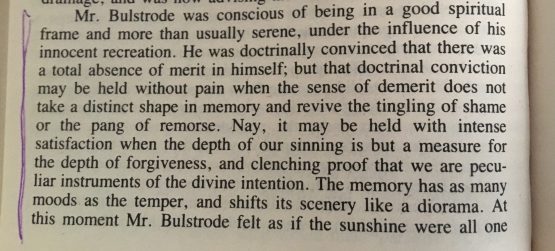
More than a dozen years ago my husband and I read this novel aloud together, and found it a rich and complex world to visit for several months, with well-drawn characters living through their thought-provoking questions and dilemmas. I knew I wanted to read it again, and here is my chance. I remember back then that occasionally when I was the one doing the reading I could not help being so rude as to stop suddenly (with apologies) because I really needed to underline a passage.

When I took my fat paperback off the shelf this week I looked inside to see just what had seemed so compelling at the time. It’s certain that of context of the whole novel I don’t recall the characters well enough at this point to fully appreciate how wise was the author’s assessment of their character and inner lives.

So I’m returning to Middlemarch, pretty confident that I will find it a rich exploration, and I’m not waiting for May, to start reading. What with all my underlining and pausing to think, I will be a slow reader as usual. So let the journey begin! Would you like to join us?