Yesterday I wrote about the dwindling supply of milkweed leaves for my hungry caterpillars, and Linda responded in a comment that they have been known to eat butternut squash in a pinch. I was so grateful for her help, and was ready to go shopping for it and to put cubes of vegetable on sticks for them before I would head out of town.
But when I went out to check on the cats they seemed to have stopped eating, and one of them seemed to be working himself into the hanging J position. They hadn’t eaten all the leaves available. I got quite a surprise to see three more, slightly smaller caterpillars on the pathetic Narrow-Leaf Milkweed plant nearby! Should I also try to rescue them?
Later when I checked again, still none of the six were eating — was that because it was cool and cloudy? — but they had moved and were all stretched out vertically. In case they were going to return to chomping through the leaves, I decided to bring a stem of milkweed over from under the fig tree. There was one with a strange horizontal, shallow root, which pulled up easily. I stuck it in the ground so that its leaves touched the other (healthy) plant; I anchored it with rocks and gave it a good watering. I finished packing the car and drove off.
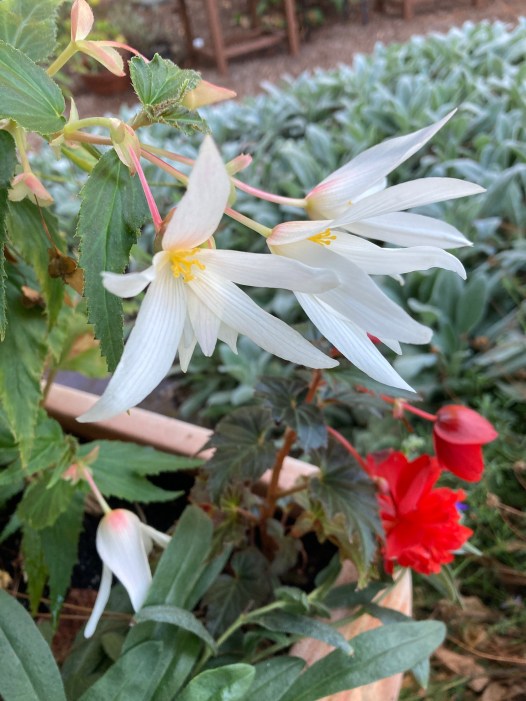
When I get home again next week you can be sure I will let you know the current state of affairs of what is now a group of six Monarch caterpillars. For now, I want to show you something pretty I noticed on the patio — the white begonia is tall and healthy, much bigger than last year. It’s a pristine, comforting bit of newness when the earth is making its yearly descent into death and decay.
When I was planting the new milkweed species that I’d bought, I saw Monarch caterpillars on the established Showy Milkweed plant!
They are still there, three days later. But there is much less of the plant left for them to eat. I notice that this morning two have moved over to the smaller stem. (I wish I could have seen them doing that.) This milkweed is a young start that I moved across the yard from under the fig tree, where the original plant had reproduced dozens more over the years.
I transplanted it last year, close to the Narrow-Leaf Milkweed, out in the open where the Monarchs might find it. The Showy leaves are large and meaty, and they are what I fed my caterpillars four years ago, even though the eggs had been laid on the Narrow-Leaf. Meanwhile, the fig tree has grown so large, in spite of being a dwarf variety, that it is shading the Showy Milkweed out of existence over there.
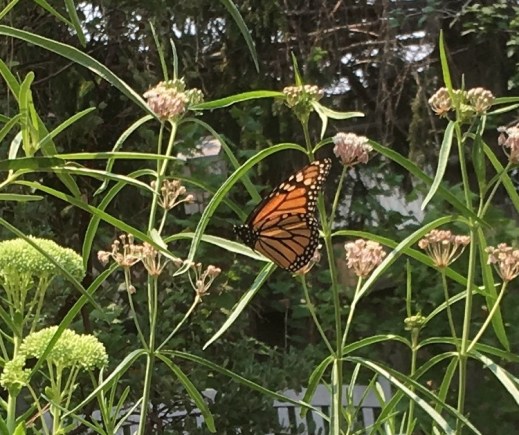
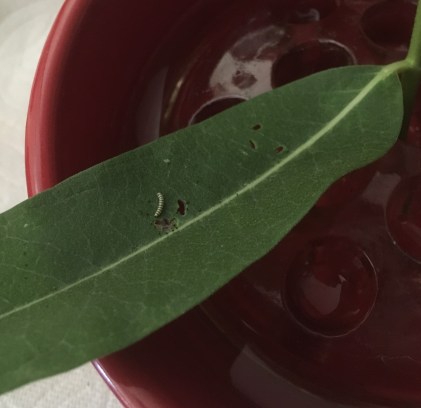
Monarch among the Narrow-Leaf Milkweed plants, 2018.Monarch caterpillar on Showy Milkweed leaf, 2018.2018
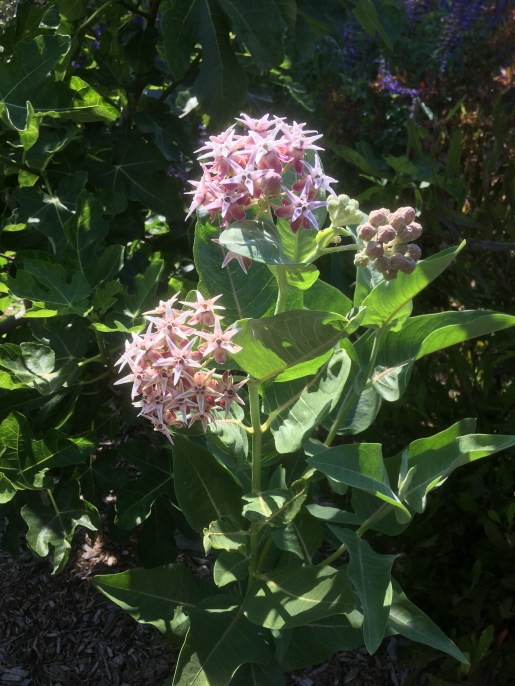
The Narrow-Leaf Milkweed is one of the two species native to my region, which is why I planted it originally. It has the most dramatic blooms, like ladies in crowns and pink dresses dancing in formation:
… but as I have said before, there is not enough leaf matter there to make the newborn caterpillars grow big and strong and become butterflies. It was my hope that if I put the Showy type out there, the Mama Monarch would choose it. And she did! But — it is hardly bigger than the new starts I set out. From the bottom of the picture at left:
I know from the past, when I raised and released three butterflies, that they eat a lot. Back then I picked numerous large leaves off the Showy plant — which was huge — to feed them.
These three have already eaten half of the plant, and they have a lot more growing to do:
When I return from my trip north, I’m afraid that they will have eaten every last leaf, and then starved to death. Should I take them with me, and feed them? But feed them what? I only have two spindly Showy plants growing under the fig tree currently. What if I were to lay them on the ground under the one being eaten right now, making a path to the new starts? Do I really want them to possibly defoliate those, too, when they have barely begun? After that truly thrilling Monarch Project I undertook I decided once was enough. Bearing responsibility for caterpillars was too much work. And physically exhausting for other reasons! So… I think I will have to let nature take its course.
It might be that the smallish Showy Milkweed just wants a tiny bit more water to help Nature along, and then that course might result in this kind of Show next summer:
2021
If so, there will be plenty of food for all caterpillar comers.
“For seasonable weather and the abundance of the fruits of the earth
and for peaceful times let us pray to the Lord.”
-Litany of Peace
Hours of rain. LOTS of raindrops. Glory to God! All the plants and humans around here are happy.
A couple of days before the rain came, I received in the mail three new plants, three species of milkweed that I haven’t had before: Asclepias glaucescens, Asclepias linaria, and Asclepias physocarpa “Family Jewels.” I set them out on the patio to get watered quite naturally. If they bloom next summer I’ll show you pictures.
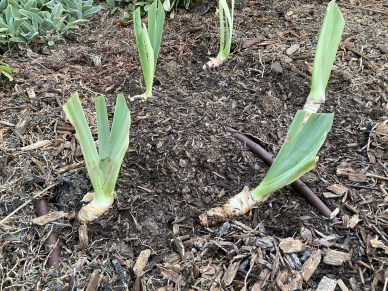
Also not long before the watering, I got around to dividing the irises. The poor things had sat on the driveway during the heat wave, while I was in the mountains. But they were in such thick clumps with lots of dirt surrounding, they didn’t seem to have suffered much. And I ended up with dozens of extra rhizomes that I have been giving away.
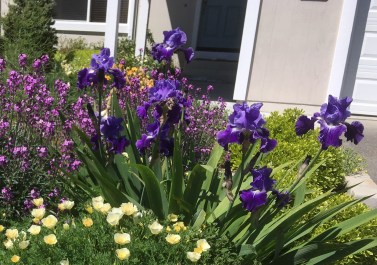
Unfortunately I forgot that I had two colors in those three clumps, and I mixed them all up while I was sorting, but the people who are getting them don’t seem to mind. At least they are both purple; these pictures are from past years. And I am thrilled to think of how all these other friends’ gardens will be further beautified with my “children.”
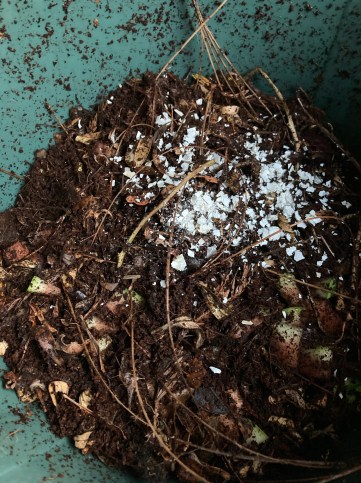
This last picture is of the bedding material I’ve mixed up special for the worms I am getting tomorrow, to start my vermiculture project. I’ve been wanting to do this for years, and step by step I managed all the parts of the preparation, after watching a couple dozen videos on YouTube and reading in the classic book on the topic, Worms Eat my Garbage. A friend who is a long time worm farmer is giving me my starter worms.
What could be better on a rainy Sunday afternoon than taking a nap? Well, on this particular one, for me at least nothing was better, especially because this week is extra busy from the start. Normally I try to reserve Mondays for catching up and re-ordering my mind and living space, but that’s not an option this week. So — I need to work on all that before I go to bed again.
This week Autumn officially arrives!
But in honor of worms, I give you a somewhat Spring-y poem:
THE WORM
When the earth is turned in spring The worms are fat as anything.
And birds come flying all around To eat the worms right off the ground.
They like the worms just as much as I Like bread and milk and apple pie.
And once, when I was very young, I put a worm right on my tongue.
I didn’t like the taste a bit, And so I didn’t swallow it.
But oh, it makes my Mother squirm Because she thinks I ate that worm!
I forgot to show you the summer “bugs” I saw on my trip last week. I know you wouldn’t want to miss them, so I’ll put them at top here. Also so that I can have a flower or something more traditionally pretty at the bottom.
They were all the large size of insects that I only ever see when camping or in the forest, and Pippin does live in the forest. As soon as I would step outside in the early morning my senses took me to mountain camping trips, where the air at the beginning of the day is cool and dry and piney.
Robber Fly
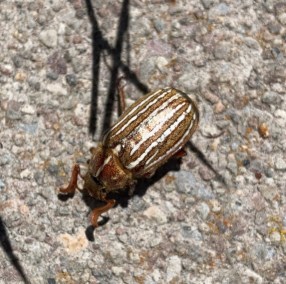
One 95-degree midday Ivy called me over to see a creature resting in the shade on the tree swing. It was a surprisingly still subject, which enabled me to identify it as a Robber Fly. And the morning that I departed, a huge Western Sculpted Pine Borer landed on Pippin’s arm. She brushed it off and then collected it on a paper, where it sat, possibly stunned, and posed.
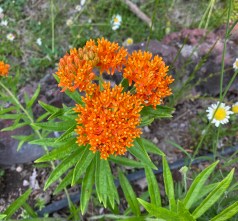
Western Sculpted Pine BorerButterfly Milkweed
My first morning we found a chipmunk on the front doorstep, which a cat had brought as an offering. The second day the sliding door would not shut, and the children and I finally figured out that a dead mouse was jammed between the two doors. I could not access it to get it out, but when she got home Pippin managed after laboring with a yardstick. The next morning another mouse was left at that back doorstep, which I disposed of. Four cats live with the family and at least two are hunters.
We watched “My Octopus Teacher” one night. Have I already mentioned that movie? I also saw it with my Colorado children last summer, and like it very much. I’ve heard a couple of people say that they wish there were less of the narrator and more of the octopus, but if it weren’t for the narrator-photographer, who visited the octopus nearly every day for a year, there would be no story. He had to tell it in his way.
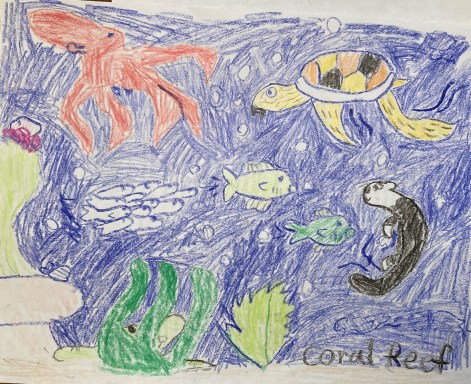
As it is about how the whole experience of interacting with the octopus helped him move into a healthier life and frame of mind, I have to take it as it is, take the human subject as he is. Without agreeing with all of his presuppositions about nature, I very much appreciate that his relationship with the creature was thrilling and healing. Ivy declared that it is her favorite nature movie. Over the next several days she drew one picture after another of ocean landscapes.
Often the children would draw while I read to them, and I read for at least an hour every evening before bed. Mostly this time I read from The Little Bookroom by Eleanor Farjeon. I gave this book to my grandchildren a few years ago, thinking it was an anthology she had compiled of others’ works. But no, all the stories are by Farjeon herself.
They are the most unusual children’s stories I’ve ever read, a combination of fairy tale style with more realistic everyday happenings, and silly stories that make us laugh and laugh. But all happy hearted, and many brimming with pure Goodness. If Scout had not been away at Boy Scout Camp, he would have insisted that we read “The Princess Who Cried for the Moon,” a very long story about a whole kingdom of people who don’t have their thinking caps on.
Eleanor Farjeon
I still haven’t read the whole lot, but I did notice that the last entry in this edition is not a story by Eleanor but a piece titled, “Tea with Eleanor Farjeon,” by my beloved Rumer Godden. I read that one aloud, too, and Ivy was interested but Jamie drifted away. Eleanor sounds like the sort of old lady I would like to be. I wanted to quote from Godden’s article, but I can’t find my own copy of the storybook at the moment.
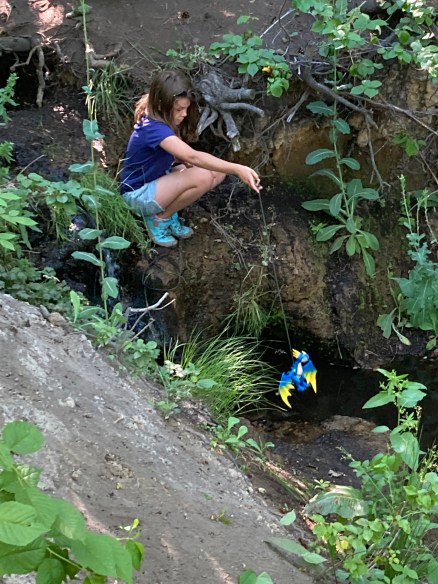
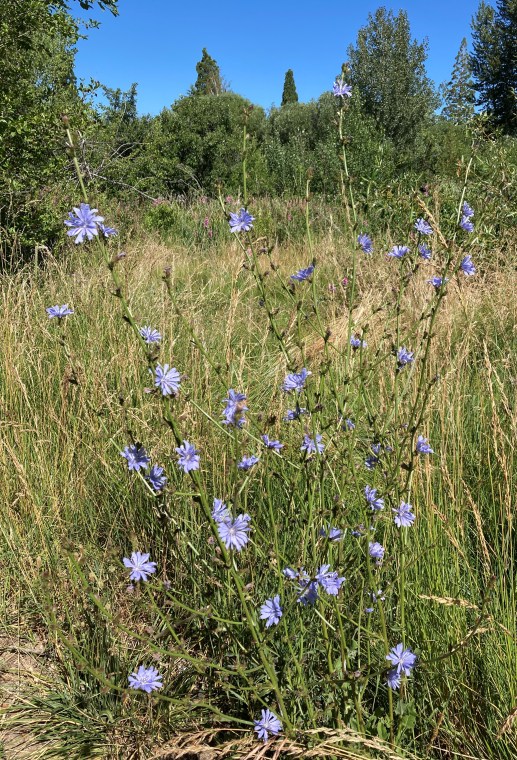
I spent six nights last week at Pippin’s Mountain Homestead, longer than any other visit. That gave me time to go with the children to the library and to have a breakfast picnic in their favorite park that features a tiny waterfall and “jungle.” Ivy made her dragon to fly over the creek, and I discovered chicory and more.
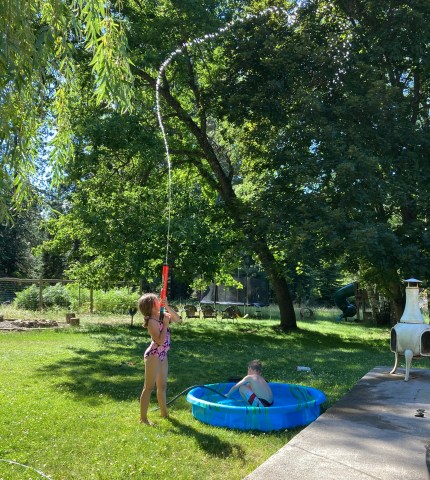
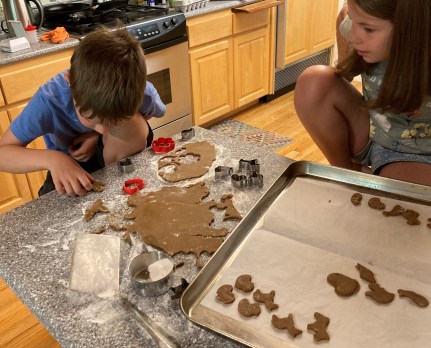
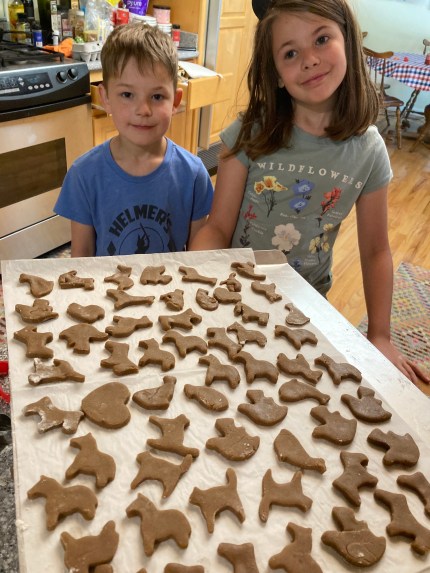
There was lots of water play in the back yard, resulting in burned shoulders. And a big batch of gingerbread for cutting out with my new tiny animal cutters.
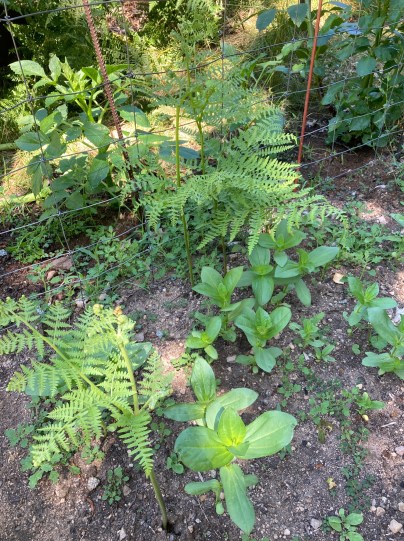
I suppose it’s because Pippin’s garden in the middle of the forest gets extra water, that the ferns constantly encroach. I was watering the new zinnia and dahlia sprouts and wondering at the robust ferns still popping up everywhere. They push against the deer fence that surrounds the vegetable and dahlia enclosure, and try to colonize the whole inside space, too.
Where I pulled out a few fronds to let sunlight on to a strawberry bed, we saw that frogs had been living among them. And while I aimed the hose at small flower plants, Duncan cat lay nearby in his cool and ferny hideaway and begged me to leave that colony as is. And for now it remains, another corner of the estate hospitable to critters.
 Yesterday I wrote about the dwindling supply of milkweed leaves for my hungry caterpillars, and Linda responded in a comment that they have been known to eat butternut squash in a pinch. I was so grateful for her help, and was ready to go shopping for it and to put cubes of vegetable on sticks for them before I would head out of town.




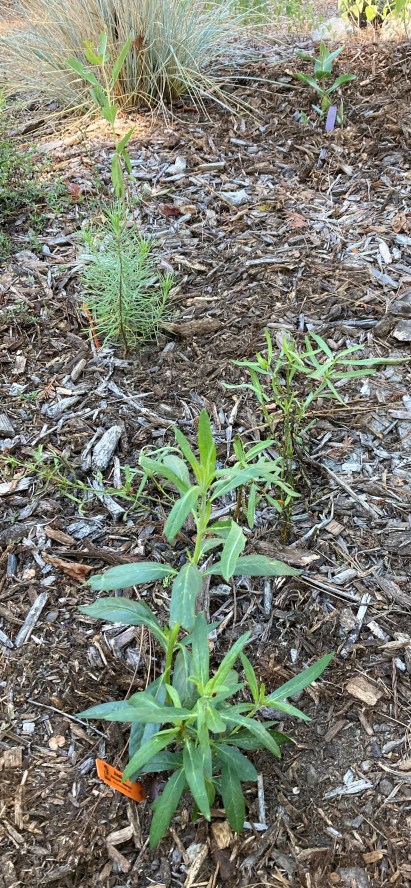 … but as I have said before, there is not enough leaf matter there to make the newborn caterpillars grow big and strong and become butterflies. It was my hope that if I put the Showy type out there, the Mama Monarch would choose it. And she did! But — it is hardly bigger than the new starts I set out. From the bottom of the picture at left:
 Hours of rain. LOTS of raindrops. Glory to God! All the plants and humans around here are happy.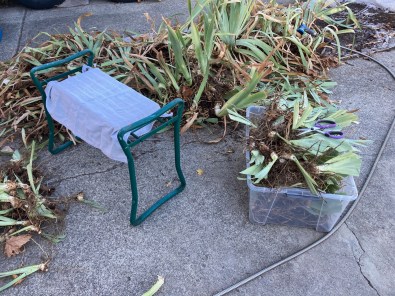



 Often the children would draw while I read to them, and I read for at least an hour every evening before bed. Mostly this time I read from The Little Bookroom by Eleanor Farjeon. I gave this book to my grandchildren a few years ago, thinking it was an anthology she had compiled of others’ works. But no, all the stories are by Farjeon herself.




 Gladsome Lights