 When I recently encountered the W.S. Merwin poem that I posted yesterday, “Losing a Language,” it reminded me of a passage from The Folding Cliffs, which was the first thing I ever read by the author, many years ago. It tells the story of a 19th century native Hawaiian family who did not want to be separated by leprosy, so they escaped into the mountains, where they were pursued by government soldiers.
Back then the book had been lent to me by K., so I had to borrow a copy from the library to find again the passage that had stuck in my mind. It is only one page in this epic narrative of Hawaii that is told in poetic lines. If you have any interest in the history and culture of Hawaii, you might want to look into it. I never would have thought to read it myself, and when I first opened its pages and saw the form Merwin uses, I was dismayed. But I knew I must try at least a few pages, to honor K’s suggestion, and no more that that were needed to hook me into the compelling story.
The particular scene that came to mind recently takes place not long after missionaries arrive on the island of Kauai. They have started a school for the children, and the pastor’s wife had planned to teach them, but she can’t handle the “rough children,” so the pastor himself takes on the job. Here is most of the section “20”:
Whatever the pastor pronounced to them in that voice
……..that was not the one he talked in and not the one
he spoke in when he stood up during the church service
……..and not the one he used for English with other foreigners
whatever words the pastor uttered from the moment
……..they walked through the door onto the dead wood each syllable
of their own language articulated so carefully
……..that it did not sound like their own language at all
not only because every sound that he uttered
……..with that round deliberation was always wrong in his
particular way but because it was coming from those
……..particular clothes that face mouth regard that way of turning
and staring at them and because those words although they
……..were like the words of their own were really arriving
out of some distance that existed for him but not
……..for them and they could hear it echoed in his children…
………………………………………………….…but they repeated
the names of the solitary letters that they
……..said every day the threads of a seamless garment
and he showed them what each letter looked like it was
……..white whether large or small straight or flowing and it was
in itself silent in a black sky where his hand drew it
……..and it stayed there meaning a sound that it did not have
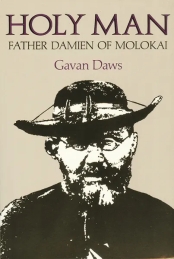 As I say, this scene was memorable for me, capturing my imagination on the subject of indigenous children trying to learn the language of strangers, from someone who makes even their native language strange to them. I was affected by the whole story such that it changed my overall perspective on Hawaii; whereas it had been in the back of my mind as a tourist-y place I didn’t care about, it became full of people and stories. I went on to read the story of Father Damien, the Catholic saint “of lepers and outcasts” — and about other related topics I don’t remember at this remove.
After reading yesterday’s poem and having my interest in The Folding Cliffs renewed, I saw an article criticizing Merwin for cultural appropriation and for changing important parts of the story, a story that is well documented in its historical facts, in publications that Merwin doesn’t give credit to. I wrote a comment about that article, responding in particular to one section of it:
“I still think that The Folding Cliffs overall is wonderful. Poetic license is one thing, but this seems to be going too far: ‘Merwin implies that Pi‘ilani is only superficially Christian and that desperation causes her to reveal a more deeply held set of native beliefs. This is nonsense…. There is no mention in any of Kaluaikoolau! of Pi‘ilani’s faith in anything other than the Christian God.’
“I wonder if Merwin was trying to rectify the harms of colonialism by suggesting that there was no reality to the faith the indigenous people acquired. I doubt he was trying to ‘cash in on’ the story, and the term ‘cultural appropriation’ I think meaningless, but it’s unfortunate that the telling of the whole story of the protagonist was beyond the scope of his sensibilities.”
The offended critic included this information I want to pass on, about factual historical sources, books in which one can read the story of Pi‘ilani:
1) Pi‘ilani Ko‘olau’s Kaluaikoolau!, published in Honolulu in 1906 by John G. M. Sheldon and available in the Archives of Hawaiʻi
2) Helen N. Frazier’s translation of Pi‘ilani’s memoir, The True Story of Kaluaikoolau, or Ko‘olau the Leper, published in the Hawaiian Journal of History, vol. 21 (1987) and available in libraries everywhere.
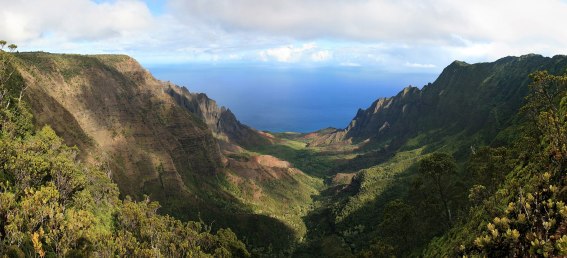
My readings back then created a desire to visit the island of Kauai. But when my late husband and I did vacation in Hawaii for our 40th wedding anniversary, we stayed on Maui instead. Those rugged mountains where lepers hid from soldiers are still waiting for me.
 I’m using this audio book now the way I have two or three others in the last years since I sleep alone, for the times when I don’t sleep. I put a well-known story to play on my phone, set the timer for 30 minutes, and let David or another nice person read me to sleep. This only works with voices that do not draw attention to themselves in various ways, usually by being overly dramatic.

 Gladsome Lights