Tag Archives: narrators

A good narrator lets me get lost.

Earlier this year I was prompted to think about who were my favorite audiobook narrators. It was soon revealed how very many I have! I was glad the request was for the narrators who I find truly add to the reading experience, and not the ones to avoid, because that would not be as pleasant an activity as I was engaged in, perusing through the titles I have listened to.

I’m thankful that the “bad” narrators are much fewer than the good. A good narrator lets me get lost in the story, and the bad ones are distracting in the various ways they draw one’s attention to their reading instead. I will list the narrators along with one or more books that made me love them:

Ralph Cosham (Geoffrey Howard) in How Green Was My Valley and many C.S. Lewis books, e.g. the Ransom Trilogy.

Peter Bishop in The Witness of Poetry.
Mike Fraser in The Timeless Way of Building.

Ellie Heydon in Mary Stewart novels.

 Arthur Morey in The Technological Society.

Andrew Sachs in Silas Marner.

Tom Stechschulte in Up and Down California.

Julie Harris in Out of Africa (unfortunately abridged).

Derek Perkins in G.K. Chesterton books.

Flo Gibson

Flo Gibson, in books about adventurous women, such as A Lady’s Life in the Rocky Mountains, and Letters of a Woman Homesteader.

Eleanor Bron in Elizabeth von Arnim books.

Neil Hunt and David Rintoul in Nevil Shute novels.

Stefan Rudnicki I first heard reading The Aviator, and I thought he was perfect for that story told in the first person. I began searching on Audible to see what other books he had narrated, and that is how I came to read Blitzed: Drugs in the Third Reich.

I started listening to a Joseph Conrad novel done by him, and was amazed at how differently, but also smoothly, he narrated that character’s voice — and not just the accent.  Seeing that he was the narrator of the Ursula LeGuin novel City of Illusions made me willing to try it, and his narration of The Captive Mind was just right for conveying Czeslaw Milosz’s writing voice.

Stefan Rudnicki

The protagonist of The Aviator is Russian, and I wondered if the narrator was Russian — how did he get that accent so well, but not overdo it? That’s why I researched Stefan Rudnicki more than any other narrator, and I learned that he was born in Poland. I also found this video in which he, along with other skilled veteran readers, leads a Round Table Discussion with several relatively new narrators, on the topic of improving their narration.

The whole narration “industry” is fascinating. It seems that participating in it is a satisfying way for older actors to keep working, at a pace that fits their slower stage of life. From reading reviews, I can tell that we listeners don’t all appreciate the same narration style. Are any of these your favorite narrators, too?


Bishop Latour meets the elegant goats.

I’ve read Death Comes for the Archbishop by Willa Cather three times, including an audio recording narrated by David Ackroyd which I only recently completed. These three readings were so far apart that each time seemed a fresh introduction to the characters and the setting. And yet, I do think that the first two readings helped to form a love in my soul for the Southwest territories of the United States, so that this third time I found it there waiting for me, like the warm sand beneath a red rock butte, a place where I might bed down for the night under the stars and feel whole.

Ackroyd’s voice and narrative style seem perfect for the story. There is a steadiness and a lack of hurry that aligns with the faithful dailiness of the lives of the two missionary priests as they try to meet the spiritual needs of a vast diocese that had just enlarged by nearly 30,000 square miles with the Gadsden Purchase.

They are based in Santa Fe, New Mexico, but make frequent trips by horse or mule of hundreds and thousands of miles, even into Old Mexico, to take care of ecclesiastical affairs, to baptize babies and perform marriages, and to serve Mass. Their characters are sympathetic and rich; the story of their friendship over the decades is a thread woven through the novel, made up of small stories scattered through the years.

I’m using this audio book now the way I have two or three others in the last years since I sleep alone, for the times when I don’t sleep. I put a well-known story to play on my phone, set the timer for 30 minutes, and let David or another nice person read me to sleep. This only works with voices that do not draw attention to themselves in various ways, usually by being overly dramatic.
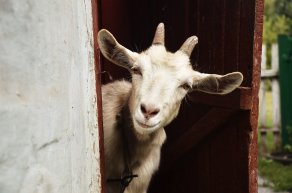
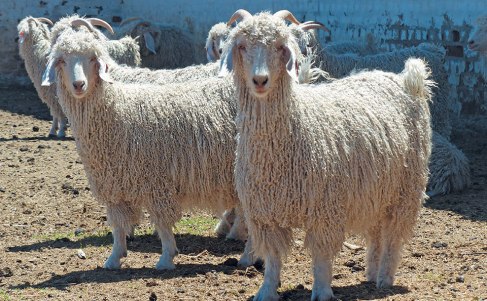
That means I am reading/listening to the book, based on a true story by the way, a fourth time. Because every anecdote and scene seems more luminous and meaningful than ever when it is told or described by a warm human voice, I may post here some passages that appear plain and dry to you poor people who may never have breathed the air of New Mexico or seen the Arizona desert in bloom. But today, it’s only goats we will consider, and I imagine that they are goat-ish the world over.

“After the feast the sleepy children were taken home, the men gathered in the plaza to smoke under the great cottonwood trees. The Bishop, feeling a need of solitude, had gone forth to walk, firmly refusing an escort. On his way he passed the earthen threshing-floor, where these people beat out their grain and winnowed it in the wind, like the Children of Israel.

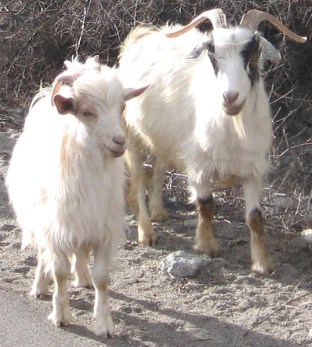
“He heard a frantic bleating behind him, and was overtaken by Pedro with the great flock of goats, indignant at their day’s confinement, and wild to be in the fringe of pasture along the hills. They leaped the stream like arrows speeding from the bow, and regarded the Bishop as they passed him with their mocking, humanly intelligent smile. The young bucks were light and elegant in figure, with their pointed chins and polished tilted horns. There was great variety in their faces, but in nearly all something supercilious and sardonic. The angoras had long silky hair of a dazzling whiteness.

“As they leaped through the sunlight they brought to mind the chapter in the Apocalypse, about the whiteness of them that were washed in the blood of the Lamb. The young Bishop smiled at his mixed theology. But though the goat had always been the symbol of pagan lewdness, he told himself that their fleece had warmed many a good Christian, and their rich milk nourished sickly children.”

-Willa Cather in Death Comes for the Archbishop

She could not be negative or perfunctory.

I’m reading My Antonia again — actually listening for the second time, to the recording narrated by Jeff Cummings. Next time I’d like to hear a different narrator, because I think Cummings makes the adult narrator of the story, Jim Burden, sound like young Anne of Green Gables. And he reads too fast, which doesn’t suit the pace of life depicted in the novel, and does an injustice to Willa Cather’s evocative prose.

This may be the fifth time I’ve read the book, and every time is a fresh experience. A paragraph or a personality will jump out at me as though I’m encountering it for the first time. For example, the introduction to the Burdens’ Norwegian neighbors after they moved into town:

“Mrs. Harling was short and square and sturdy-looking, like her house. Every inch of her was charged with an energy that made itself felt the moment she entered a room. Her face was rosy and solid, with bright, twinkling eyes and a stubborn little chin. She was quick to anger, quick to laughter, and jolly from the depths of her soul. How well I remember her laugh; it had in it the same sudden recognition that flashed into her eyes, was a burst of humour, short and intelligent.

“Her rapid footsteps shook her own floors, and she routed lassitude and indifference wherever she came. She could not be negative or perfunctory about anything. Her enthusiasm, and her violent likes and dislikes, asserted themselves in all the everyday occupations of life. Wash-day was interesting, never dreary, at the Harlings’. Preserving-time was a prolonged festival, and house-cleaning was like a revolution. When Mrs. Harling made garden that spring, we could feel the stir of her undertaking through the willow hedge that separated our place from hers.”

The-Harling-House_Red-Cloud_1013763 (2)
The “Harling House” in Red Cloud, Nebraska